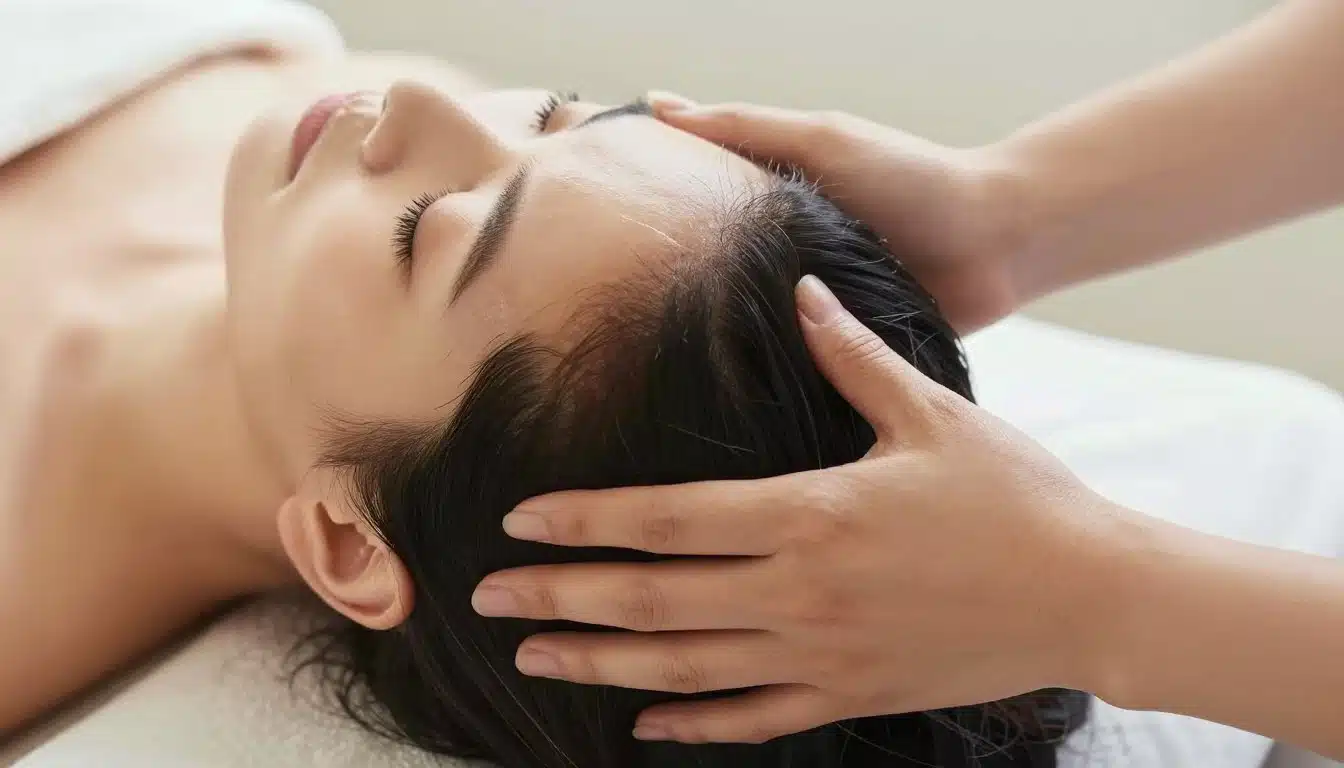
Massage for hair growth is cheap, pleasant and low-risk, which makes it worth doing. Whether it grows hair is a separate question, and the honest answer is that the evidence is thinner than the internet suggests.
It’s worth knowing what the one study everyone cites actually found before you build expectations on it — and worth knowing which patterns of hair loss need a dermatologist rather than a technique.
- The widely-cited study was 9 men with no hair loss using a massage device — hair count and growth rate stayed unchanged, only strand thickness rose 8%.
- Rosemary oil matched 2% minoxidil for hair count in one trial; peppermint’s evidence is mouse-only.
- Never pull or tug hair during massage — sustained traction causes permanent hair loss.
- Scalp itching, burning, redness, scaling, or a receding hairline band needs a dermatologist promptly, not a technique.
Massage For Hair Growth: What the Research Actually Shows
Nearly every article on this topic points to the same paper: Koyama and colleagues, published in Eplasty in 2016. Here’s what it involved.
Nine men. Japanese, aged 25 to 46, and — this matters — with no obvious hair loss. So the study did not test whether massage helps people who are losing hair.
A machine, not hands. Participants used a Panasonic scalp massage device running at 170 rpm for four minutes daily, on one side of the temporal scalp, with the opposite side left untreated as a within-person control. That control design is a genuine strength.
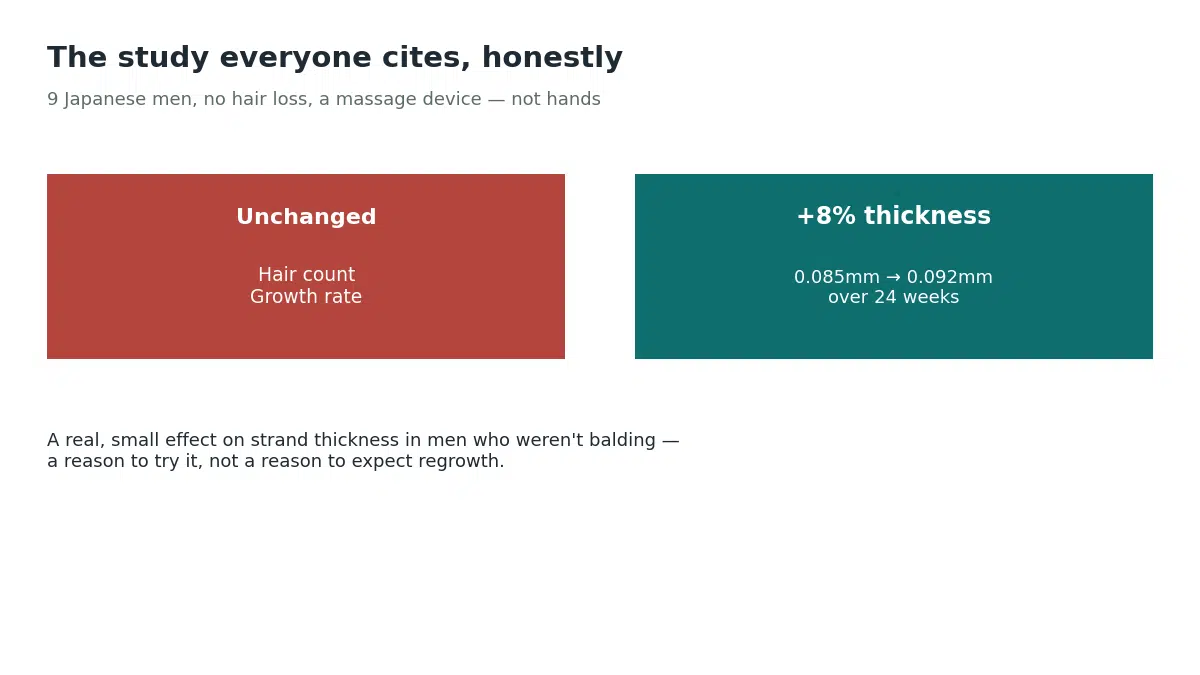
The result was an 8% thickness change. Hair thickness went from about 0.085 mm to 0.092 mm over 24 weeks on the massaged side. Hair count did not increase. Growth rate did not increase. Individual strands got marginally thicker on one patch of scalp.
One of the authors was affiliated with a hair-care company, which is worth knowing though it doesn’t invalidate the finding.
A later survey of people self-treating androgenetic alopecia with massage reported that a majority felt their hair had stabilized or improved — but self-reported outcomes from people who chose the treatment are the weakest form of evidence, and that’s what it is.
So: a real, measurable, small effect on thickness in men who weren’t balding, produced by a device. That’s the honest summary. It’s a reason to try it, not a reason to expect regrowth.
Hair Loss That Needs a Dermatologist, Not a Technique
Some hair loss destroys follicles permanently, and the window for treatment is early. Scarring (cicatricial) alopecias — including lichen planopilaris, frontal fibrosing alopecia and central centrifugal cicatricial alopecia — replace follicles with scar tissue. Once a follicle is gone it does not come back, so months spent massaging instead of getting diagnosed are months lost.
See a dermatologist promptly if you have:
- Scalp itching, burning, tenderness or pain along with the hair loss
- Redness, scaling, or pustules on the scalp
- Smooth, shiny patches where you can no longer see individual pore openings
- A hairline that’s receding at the front and sides in a band, especially in women
- Distinct round bald patches appearing quickly
- Sudden heavy shedding, or hair loss with other symptoms like fatigue or weight change
Diagnosis is usually quick — dermoscopy takes minutes — and treatment for the scarring types is aimed at stopping progression, which only works while there are follicles left to save.
Worth ruling out with blood tests: iron deficiency (ferritin, not just hemoglobin), thyroid disease, and vitamin D. These are common, treatable, and no amount of massage compensates for them.
How to Do It Without Causing Damage
Use the pads of your fingers, never your nails. Small circular motions, keeping the fingers in contact with the scalp and moving the scalp itself rather than sliding over it. Work systematically — hairline, crown, sides above the ears, down to where the skull meets the neck.
Pressure should feel firm but pleasant, roughly like a good shampoo at a salon. If your scalp is sore afterwards, you used too much.
Four to five minutes daily matches what was studied. Consistency matters more than duration, and more is not better.
Don’t pull your hair. Some guides recommend grasping sections of hair near the roots and tugging upward as a “lifting technique.” Skip it. Sustained traction on hair is the mechanism behind traction alopecia, which is itself a cause of permanent hair loss when it goes on long enough — and anyone reading an article about hair thinning is precisely the wrong person to be adding tension to their follicles.
Wet hair is more fragile than dry, so be gentler in the shower. And wash your hands first — you’re working on skin.
Oils: One With Real Evidence, One Without
Oils make massage more comfortable by letting fingers glide. Two are worth discussing specifically.
Rosemary oil has the strongest evidence of anything in this category. A randomized trial in men with androgenetic alopecia compared it against 2% minoxidil over six months and found a similar increase in hair count in both groups, with less scalp itching in the rosemary group. Single trial, modest size — but it’s a real comparison in people who were actually losing hair, which is more than the massage study offers.
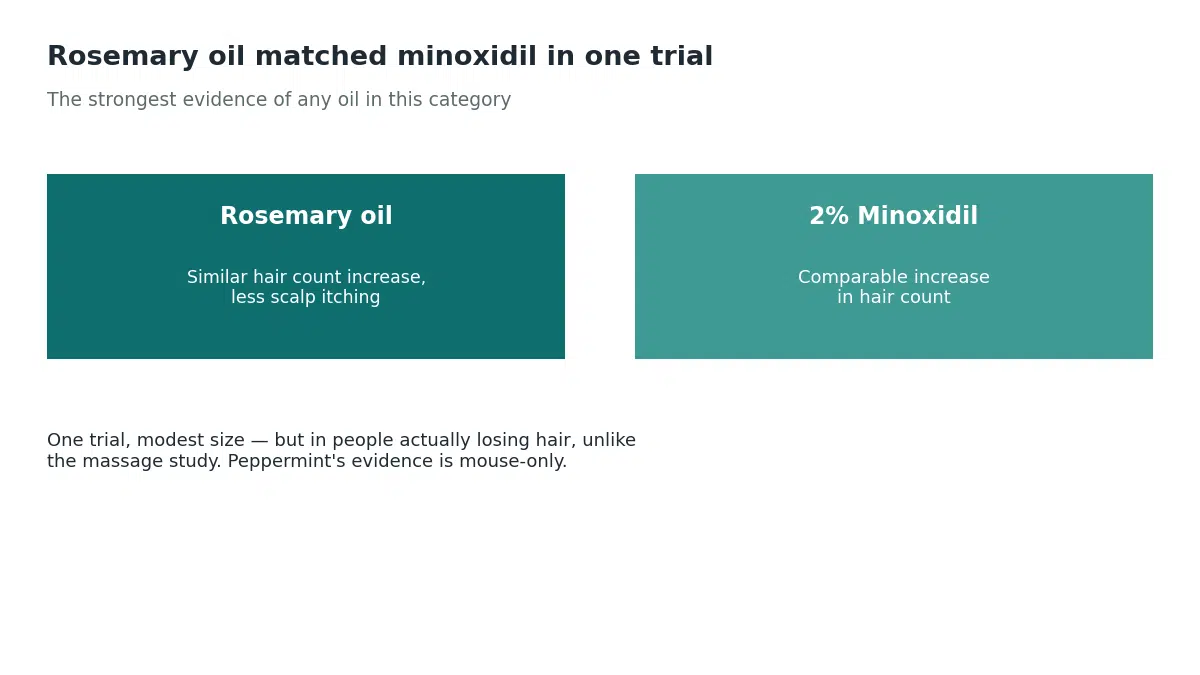
Peppermint oil is frequently promoted on the strength of a study in mice. Mouse hair biology differs substantially from human, and no human trial has confirmed it. The tingling feels like something is happening; that sensation is menthol on nerve receptors, not evidence.
For carrier oils — coconut, jojoba, argan, almond — pick by preference and hair type. They condition and lubricate. Claims that any of them regrow hair are not supported.
Essential oil safety. Never apply undiluted — typically 2–3% in a carrier oil, roughly 3 to 5 drops per tablespoon. Patch test on your inner arm 24 hours before scalp use. Rosemary and peppermint oils are generally advised against during pregnancy and for young children, and rosemary should be avoided if you have a seizure disorder. Keep all essential oils out of reach of children and away from the eyes.
The Stress Angle, Which Is Probably the Real Benefit
Telogen effluvium is the commonest stress-related hair loss: a physical or emotional shock pushes many follicles into the resting phase at once, and the shedding shows up two to three months later. That delay is why people rarely connect the two.
It’s usually self-limiting, and hair regrows once the trigger resolves.
Scalp massage does reliably produce relaxation — a small study in healthy women found reductions in stress hormone, blood pressure and heart rate after scalp massage sessions. Whether that translates into hair outcomes is unproven, but the relaxation itself is real and worth having.
Which is a reasonable way to think about the whole practice: a pleasant few minutes of self-care with a plausible mechanism and a small measured effect. If it also helps your hair, good.
What to Combine It With
Minoxidil is the FDA-approved topical for pattern hair loss and has far stronger evidence than anything else on this page. Let it dry fully before massaging so you don’t redistribute it. Finasteride is the other proven option for men, prescription-only, with side effects worth discussing with a doctor.
Nutrition matters mainly when something is missing. Adequate dietary protein, iron, vitamin D and zinc support normal hair production — but supplementing beyond sufficiency doesn’t add benefit, and excess zinc and excess vitamin A both cause hair loss. Test before supplementing rather than guessing.
Microneedling has reasonable evidence combined with minoxidil. If you use it, skip massage for a day or two afterwards and follow sterilization instructions carefully — unsterile devices cause infection and scarring.
Red light therapy devices have FDA clearance for some types of hair loss, with modest evidence.
Massage is the least powerful item on this list. It’s also free, which is why it belongs alongside rather than instead.
Realistic Timeline
Hair grows roughly half an inch a month, so nothing about hair responds quickly. The one relevant study ran 24 weeks.
Early on you’ll notice the scalp feels less tight and the massage is pleasant. That’s the honest short-term return.
Some people shed slightly more when starting — hairs already in the resting phase releasing a little sooner. It settles.
Monthly photos in consistent lighting are more reliable than daily mirror checks, which detect nothing. And if you have pattern hair loss, massage alone is not going to reverse it. That’s not pessimism, it’s what the evidence says — the study was done on men who weren’t balding.
Frequently Asked Questions
Does massage for hair growth actually work?
The evidence is one small study: nine Japanese men with no hair loss, using a massage device four minutes daily for 24 weeks. Hair thickness rose about 8% on the treated side. Hair count and growth rate did not change.
So there’s a real but small effect on strand thickness, measured in people who weren’t balding. It’s worth doing; it isn’t a regrowth treatment.
How often and how long should I massage?
Four to five minutes daily matches what was studied. Consistency matters more than session length, and longer or harder isn’t better.
Use fingertip pads in small circular motions, moving the scalp rather than sliding across it. Firm but comfortable pressure — no soreness afterwards.
Should I pull my hair as part of the massage?
No. Some guides suggest grasping hair near the roots and tugging upward — skip it. Sustained traction is the mechanism behind traction alopecia, which causes permanent loss when prolonged.
Anyone concerned about thinning is the last person who should be adding tension to their follicles.
Which oil has the best evidence?
Rosemary. A randomized trial in men with androgenetic alopecia found it comparable to 2% minoxidil over six months, with less scalp itching. Single trial, but conducted in people actually losing hair.
Peppermint’s reputation rests on a mouse study with no human confirmation. The tingling is menthol on nerve receptors, not evidence.
When should I see a dermatologist instead?
Promptly, if hair loss comes with scalp itching, burning, pain, redness, scaling or pustules; if you see smooth shiny patches with no visible pore openings; if a band of hairline recedes at the front and sides; or if distinct round patches appear.
Those suggest scarring alopecias, which destroy follicles permanently. Early treatment stops progression; delay costs hair that can’t come back.
Can it help with pattern baldness?
Not on its own. Androgenetic alopecia is driven by hormones and genetics, and the massage study specifically involved men without hair loss.
Minoxidil and finasteride have far stronger evidence. Massage is reasonable alongside them, not instead.
Can massage cause hair loss?
Done gently with fingertips, no. Using nails, excessive force, or pulling can damage hair and irritate the scalp.
Mild extra shedding in the first weeks is usually resting-phase hairs releasing slightly early, and it settles. Stop and see a dermatologist if massage causes pain.
Do supplements help?
Only if you’re deficient. Iron (check ferritin, not just hemoglobin), vitamin D and thyroid function are worth testing when hair is thinning.
Supplementing beyond sufficiency doesn’t help, and excess zinc and excess vitamin A both cause hair loss. Test rather than guess.
SOURCESOur Editorial Standards
HealthMagHub is built on primary sources: peer-reviewed research, clinical practice guidelines, and health agencies such as the NIH, CDC, and FDA. Read our editorial standards to see how we research, cite, and update our articles.
- Koyama T, et al. Standardized Scalp Massage Results in Increased Hair Thickness by Inducing Stretching Forces to Dermal Papilla Cells in the Subcutaneous Tissue. Eplasty, 2016. ncbi.nlm.nih.gov
- Panahi Y, et al. Rosemary oil vs minoxidil 2% for the treatment of androgenetic alopecia: a randomized comparative trial. pubmed.ncbi.nlm.nih.gov
- Kim IH, et al. The effect of a scalp massage on stress hormone, blood pressure, and heart rate of healthy female. J Phys Ther Sci, 2016. pmc.ncbi.nlm.nih.gov
Disclaimer: This article is general information, not medical advice. See a dermatologist promptly for hair loss with scalp itching, burning, redness, scaling or pustules, or for a receding hairline band — scarring alopecias destroy follicles permanently. Avoid rosemary and peppermint oils in pregnancy, young children, and seizure disorders.