
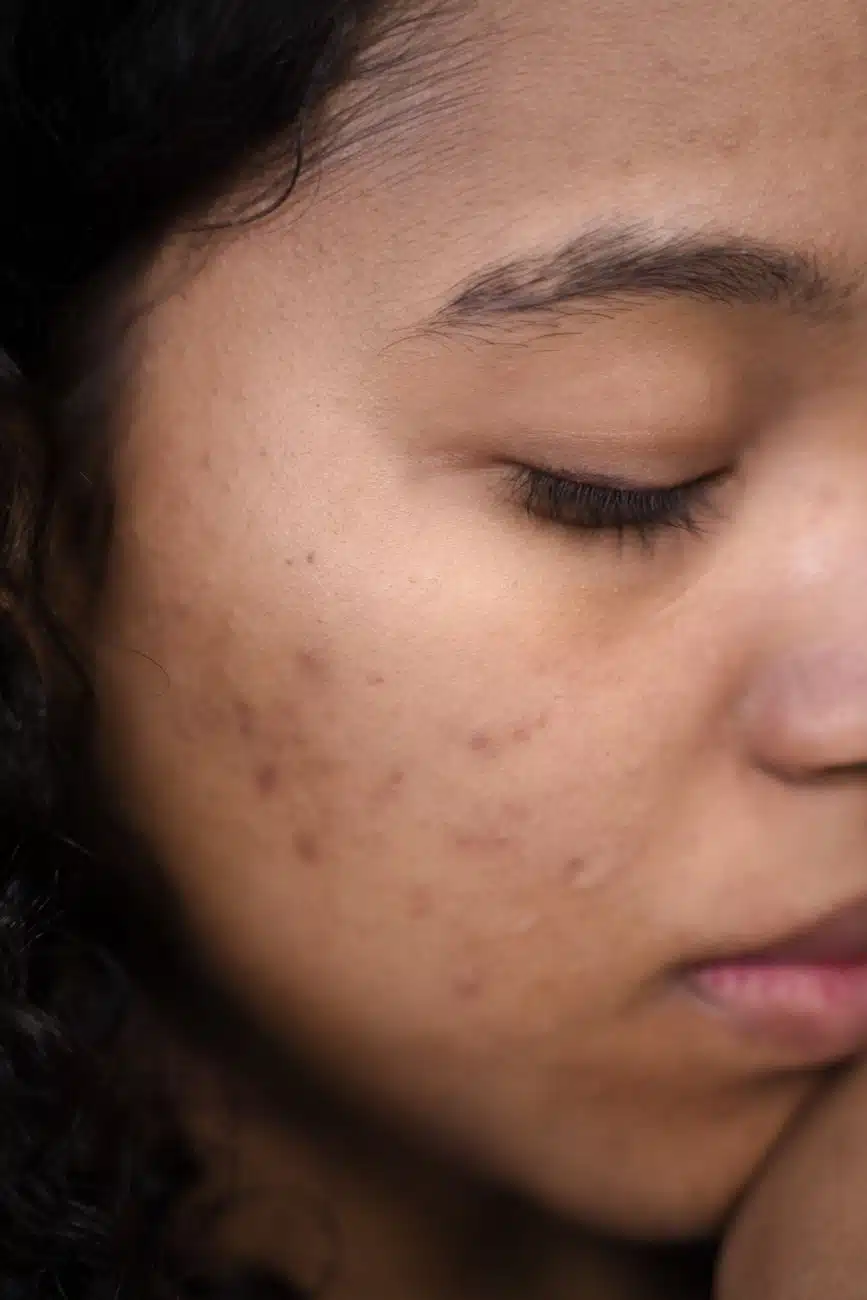
If your acne has not responded to months of treatment, there is a question worth asking before you escalate to something stronger. Is it acne at all?
“Fungal acne” is a common but unofficial term for Malassezia folliculitis, a condition in which yeast in the hair follicles produces bumps that closely resemble acne. Although it is not a form of acne, it is regularly treated as one for months before anyone questions the diagnosis. The reason that matters is uncomfortable: treatments aimed at acne do not clear it, and some may make it harder to control.
Three clues can make Malassezia folliculitis more likely than ordinary acne. None of them confirms it, but together they change the question worth asking a doctor.
- Fungal acne is caused by yeast overgrowth in the follicle, not by bacteria or hormones, so acne treatments aimed at either will not clear it.
- Three clues point toward it rather than acne: no blackheads or whiteheads, bumps that are all the same size, and itching. None confirms the diagnosis on its own.
- Antibiotic exposure has been identified as a risk factor, which is why a breakout can appear or worsen during acne treatment.
- The two conditions can occur together, so a partial response to acne treatment does not rule fungal folliculitis out.
Why your acne treatment stopped working
The fungal acne version of this story tends to follow one shape. Someone develops persistent bumps on the forehead, chest or upper back. They are prescribed a topical antibiotic, then an oral one. Nothing improves. The dose goes up, or a second agent is added.
A case published in Cureus describes a 24-year-old woman treated for three months with topical clindamycin, nicotinamide, oral antibiotics and isotretinoin for presumed acne vulgaris. Her lesions resolved on antifungal treatment.[3]
The pattern is common enough that a 2023 consensus statement from the European Academy of Dermatology and Venereology advises considering Malassezia folliculitis in anyone with persistent or recurrent follicular bumps in oily areas that have not responded to antibiotics.[1]
The condition is not obscure. It is simply not the first thing most people, or always the first thing a busy clinic, thinks of when a breakout will not clear.
Three clues that fungal acne may be the problem
These clues can be noticed without a medical test, but none is diagnostic on its own. Several other conditions produce follicular bumps, including bacterial folliculitis, rosacea and keratosis pilaris. Treat what follows as clues that shift the odds rather than as an answer.
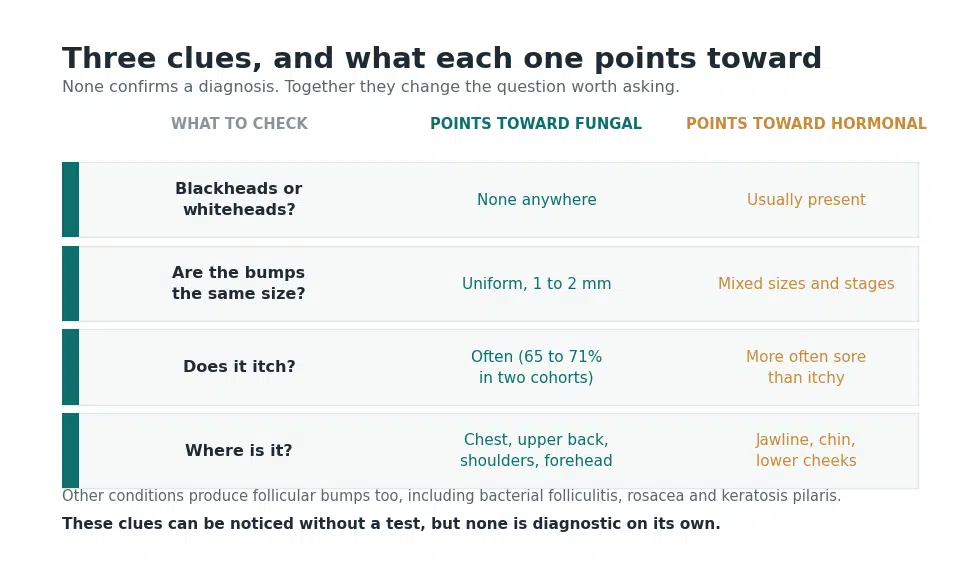
One: no blackheads or whiteheads. The absence of comedones, nodules and cysts is described in the literature as a hallmark feature separating Malassezia folliculitis from acne vulgaris, which usually produces comedones somewhere even when inflamed spots dominate.[1] Blackheads suggest at least some ordinary acne is present, though acne can occasionally present with few visible comedones.
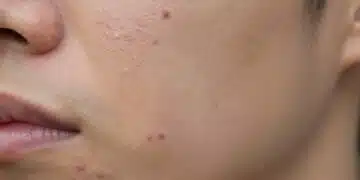
Two: the bumps are all the same size. Dermatologists call this monomorphic. Malassezia folliculitis characteristically produces small uniform papules and pustules, often one to two millimeters, on the chest, back, posterior arms and face.[2] In contrast, acne tends toward a mixed picture, with comedones, papules, larger inflamed lesions and sometimes cysts at different stages at once.
Three: it itches. Acne is more often sore than itchy. Itching is the symptom most commonly reported in Malassezia folliculitis: in a retrospective cohort of 110 patients, 65% reported it, and in a prospective cohort of 55 patients, 71% did.[1] Importantly, itch is common rather than universal, and its absence does not rule the condition out.
Location adds a fourth clue rather than a rule. For example, fungal folliculitis favors the chest, upper back, shoulders, the backs of the arms and the forehead. Adult hormonal acne concentrates lower on the face, along the jawline and chin.
Why antibiotics can make fungal acne worse
This is the part that catches people, and it explains the specific experience of a breakout that got worse on treatment.
Malassezia is a yeast that lives on normal skin and becomes a problem only when it overgrows. Antibiotic exposure has been identified as a risk factor for that overgrowth, alongside immunosuppression.[2] Changes to the skin’s microbial environment may contribute, though the relationship between antibiotics, the skin microbiome and yeast overgrowth is more complex than a simple bacteria-versus-yeast explanation.
Topical corticosteroids complicate the picture differently. Kept up for long enough, both they and oral antibiotics can damp the redness down far enough that the skin genuinely looks better, which is exactly what makes the wrong diagnosis stick. The flare returns once the treatment stops.[1]
Consequently, a breakout that began during or shortly after a course of antibiotics, or one that rebounds every time a steroid cream is stopped, is worth mentioning explicitly to whoever is treating it.
What hormonal acne looks like instead
Adult acne driven by hormones has a different signature. Lesions cluster along the jawline, chin and lower cheeks rather than across the forehead and upper back. The picture is mixed rather than uniform, with comedones present alongside deeper, tender lesions. It often tracks the menstrual cycle, flaring in the week before a period.
Nor does it stop at a particular age. Falling estrogen in perimenopause shifts the balance of hormones acting on the skin, which is why acne can appear or return in the forties and fifties, sometimes for the first time. Our guide to what is really happening to skin during menopause covers that change in more detail.
The third possibility worth ruling out
Persistent adult acne in women, particularly along the jawline, sits on a short list of features that can point to polycystic ovary syndrome. It is more suggestive when it appears alongside irregular or absent periods, unwanted hair growth on the face or body, or difficulty conceiving.
Acne alone is not a diagnosis of anything. That combination, however, is worth raising with a doctor rather than treating as a skin problem in isolation, since the treatment differs and the condition has implications beyond the skin. We make the same point in our guide to choosing a hair removal method, where unwanted hair growth is often the symptom that finally prompts the question.
What actually treats each one
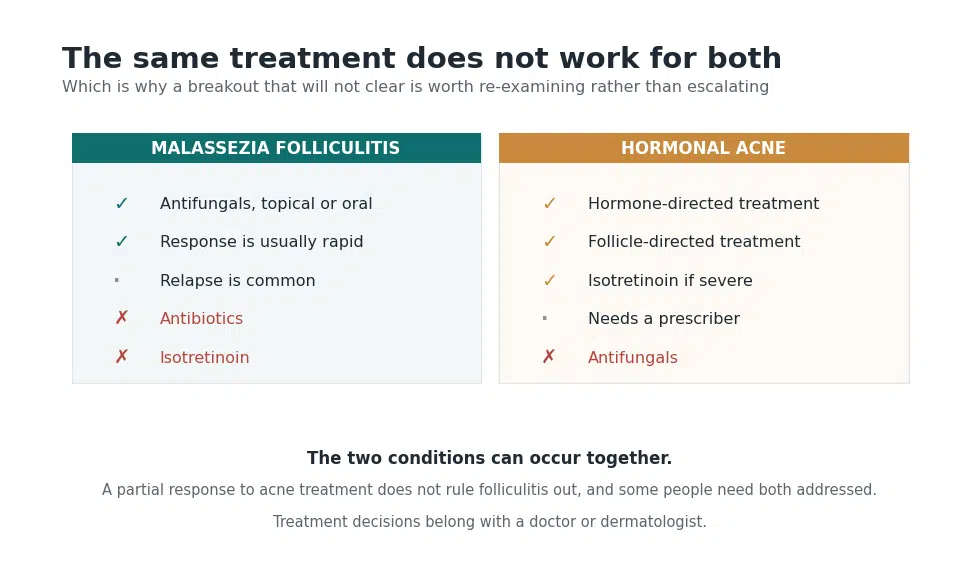
Fungal acne responds to antifungal treatment, topical or oral, and the response is usually rapid. Oral antifungals are described in the literature as the most effective option.[2] Relapse is common, which makes the improvement holding part of the picture rather than the end of it.
Hormonal acne responds to treatments aimed at the hormonal driver or at the follicle itself, which is a conversation for a doctor rather than a shelf.
On the question people search for most: isotretinoin, commonly known by the brand name Accutane, treats severe acne vulgaris, not Malassezia folliculitis. The Cureus case above involved a patient given it without benefit before the folliculitis was identified.[3] If folliculitis is the main driver of the bumps, increasing acne-directed treatment without addressing it is unlikely to solve the underlying problem. That is a judgment for a dermatologist, not a reason to refuse a prescription.
One complication is worth knowing. The two conditions can occur together, which means a partial response to acne treatment does not rule fungal folliculitis out, and some people need both addressed.
When to see a doctor
Self-assessment gets you a better question to ask, not an answer. Whether it turns out to be fungal acne or something else, bring these to a doctor or dermatologist.
- Acne that has not improved after two to three months of appropriate treatment
- A breakout that appeared or worsened during a course of antibiotics
- Bumps that itch rather than hurt, with no blackheads or whiteheads anywhere
- Skin that clears on a steroid cream and flares every time it stops
- Jawline acne alongside irregular periods, unwanted hair growth or difficulty conceiving
- Deep, painful lumps under the skin, which can scar and need earlier treatment
- Any breakout causing enough distress to affect daily life, which is a sufficient reason on its own
A clinician can demonstrate the yeast directly with a skin scraping examined under a microscope, a potassium hydroxide preparation. A clear response to a trial of antifungal treatment supports the diagnosis rather than confirming it. Neither step is elaborate.
Frequently asked questions
How do I know if my acne is fungal or hormonal?
You cannot know for certain without an assessment, but three things narrow it. Are there blackheads or whiteheads anywhere? Are the bumps all the same size? Does it itch? Uniform itchy bumps with no comedones point toward Malassezia folliculitis. A mixed picture with comedones along the jawline, sore rather than itchy, points toward hormonal acne. Both patterns have exceptions, however.
Does Accutane work for hormonal acne?
Isotretinoin is used for severe or scarring acne vulgaris, including cases with a hormonal component. It is not a treatment for fungal folliculitis, and documented cases exist of patients receiving it for months while the actual problem was yeast. That distinction is worth settling before escalating.
Can you have fungal acne and hormonal acne at once?
Yes, and the literature specifically notes that the two can coexist.[2] That is why a partial improvement on acne treatment does not settle the question, and why some people need both addressed.
Why did my acne get worse on antibiotics?
Antibiotic exposure has been identified as a risk factor for Malassezia overgrowth, and a breakout driven by yeast can therefore persist or worsen on antibiotics aimed at bacteria. The underlying microbiology is not fully settled, but the timing itself is a specific and useful thing to report.
Where does fungal acne usually appear?
Fungal acne appears most often on the chest, upper back, shoulders, the backs of the arms and the forehead. Hormonal acne tends to sit lower on the face, around the jawline and chin. Location is a clue rather than a rule, and it is worth weighing alongside the other three.
The one thing to take away
If your acne has not shifted after months of treatment, the useful question is not which stronger product to try next. It is whether the diagnosis was right in the first place.
Look for comedones. Look at whether the bumps match each other. Notice whether it itches. Those three answers will not tell you what you have. They are, however, exactly the things a doctor needs to hear, and exactly what changes whether the next prescription is an antibiotic or an antifungal.
Sources
SOURCESOur Editorial Standards
HealthMagHub is built on primary sources: peer-reviewed research, clinical practice guidelines, and health agencies such as the NIH, CDC, and FDA. Read our editorial standards to see how we research, cite, and update our articles.
- Malassezia folliculitis: an underdiagnosed mimicker of acneiform eruptions. Journal of Fungi 2025;11(9):662. mdpi.com
- Rubenstein RM, Malerich SA. Malassezia (Pityrosporum) folliculitis. Journal of Clinical and Aesthetic Dermatology. PubMed 24688625
- Malassezia (Pityrosporum) folliculitis masquerading as recalcitrant acne. Cureus 2021. PubMed 33786241