
Most summer skin care mistakes aren’t dramatic errors. They’re small habits that seem sensible and quietly work against you across three months of sun exposure — more breakouts, new dark spots, and skin that manages to feel oily and dehydrated at the same time.
The fixes are mostly free.
- Most people apply only 1/4 to 1/2 of the sunscreen amount it was tested at — the fix is a shot glass for the body, nickel-sized for the face.
- Up to 80% of UV still gets through light cloud cover, so cloudy-day exposure accumulates unnoticed.
- Over-cleansing strips the skin barrier and can trigger more oil production, not less.
- Common medicines — doxycycline, isotretinoin, some diuretics, St John’s wort — cause photosensitivity and faster burning.
What Summer Actually Does to Skin
Heat increases oil production. Humidity traps sweat and debris against the skin. And UV does damage well short of burning — generating free radicals that break down collagen, trigger inflammation, and prompt melanin to cluster into the dark spots you notice in September.
The damage accumulates rather than announcing itself. One afternoon outdoors shows nothing. A summer of them shows plenty.
Which is why a routine that worked in winter often fails now: the rich cream that saved your face in February sits on your skin in July, and the exfoliation schedule that suited cool dry air irritates sun-exposed skin.
The Summer Skin Care Mistakes Worth Fixing
Skipping sunscreen when it’s cloudy
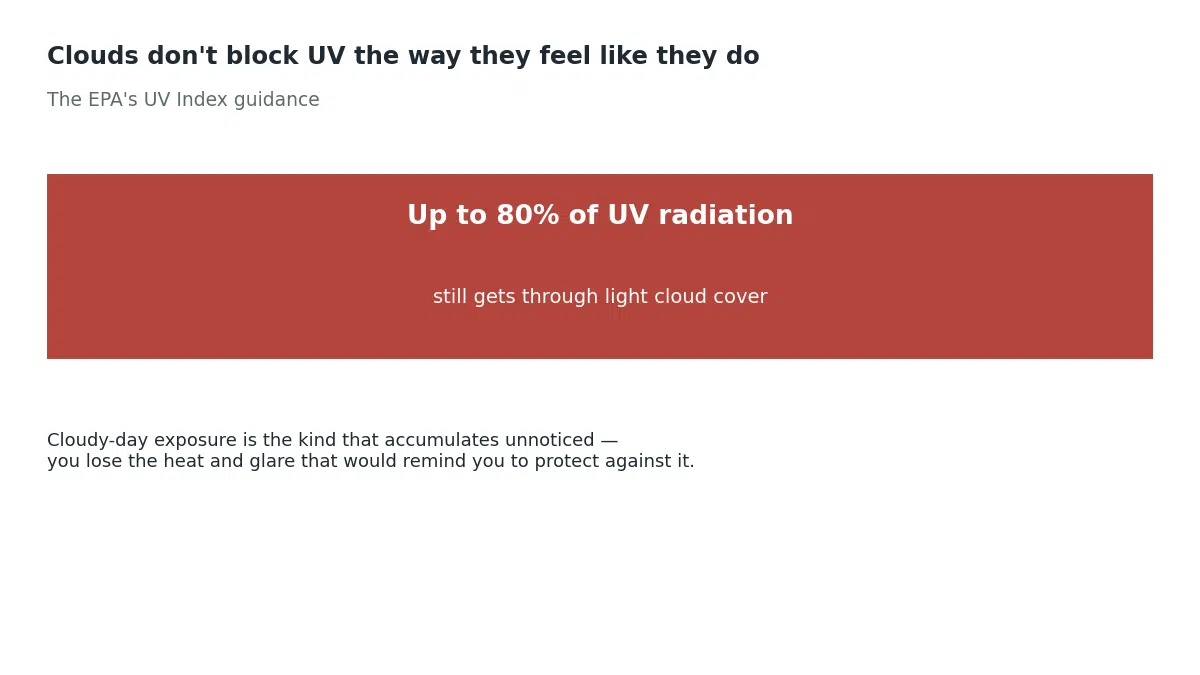
Up to 80% of UV radiation still gets through light cloud cover.[1] You’re getting the exposure without the heat and glare that would remind you to protect against it.
That’s why cloudy-day exposure quietly accumulates — walks, errands, sitting outside for lunch.
Using far too little
Most people apply only a quarter to a half of the amount the SPF on the bottle was tested at.[2] Apply SPF 50 thinly and you are not getting SPF 50.
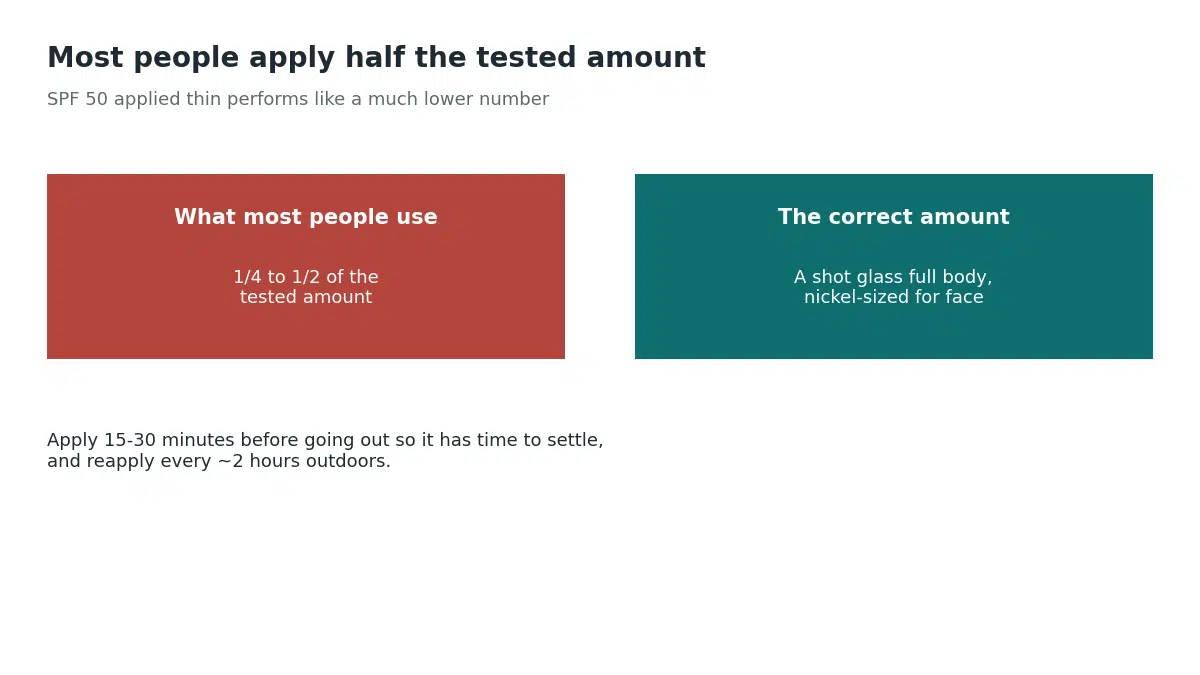
The working measures: roughly a shot glass for the whole body, and about a nickel-sized amount for face and neck. Enough to look visible before you rub it in.
Apply it 15 to 30 minutes before you go out, so it has time to settle rather than being wiped straight off.[3]
Never reapplying
Sunscreen degrades in UV, breaks down in sweat and oil, and rubs off on clothing. After about two hours outdoors, your morning application is doing very little.
This is where almost everyone fails, because it’s tedious. Keep something in your bag or car. Powder or stick formats work over makeup, which removes the main excuse.
Washing your face more because it feels oily
Over-cleansing strips the barrier, and a stripped barrier prompts more oil production plus easier entry for irritants. You end up washing more because you’re washing more.
Twice daily is enough, even in summer. For a midday refresh, plain water or micellar water rather than a full cleanse.
Skipping moisturizer because you’re oily
Oily skin still dehydrates, and dehydrated skin inflames and can produce more oil again. The answer isn’t skipping it — it’s a gel or water-based formula instead of a winter cream.
Exfoliating on the same schedule year-round
Sun-exposed skin is more reactive, and aggressive exfoliation on it causes irritation and can deepen post-inflammatory pigmentation — which then takes months to fade.
Dial it back to once or twice weekly through summer and save the stronger peels for autumn.
Neglecting the eye area
The thinnest skin on your face, and where sun damage shows first. People sunscreen their cheeks carefully and stop at the orbital bone.
A mineral formula suits this area, and UV-blocking sunglasses do more than the sunscreen does — they also stop the constant squinting that creases the skin repeatedly. Our guide to dark circles covers why this area shows everything first.
Missing the bits you can’t see
Ears, the back of the neck, the tops of the feet, the backs of the hands, the parting in your hair. These are where sun damage and skin cancers turn up disproportionately, precisely because nobody applies anything to them.
Check Whether Your Medication Makes You Burn Faster
This one catches people out every summer, and it isn’t obvious from the packet.
A number of common medicines cause photosensitivity — meaning you burn considerably faster than usual, sometimes after minimal exposure:
- Doxycycline and other tetracycline antibiotics, frequently prescribed for acne and often taken through summer
- Some other antibiotics, including sulfonamides and fluoroquinolones
- Isotretinoin and topical retinoids
- Certain diuretics, and some blood pressure medicines
- Some anti-inflammatories
- St John’s wort
If you’ve started something new and burnt unusually easily, that’s worth connecting rather than assuming your sunscreen failed. Ask a pharmacist — it takes a minute and they’ll know.
What Isn’t Just Sun Damage
See a dermatologist for:
- A new mole, or one changing in size, shape, color or texture
- A spot or sore that bleeds, itches, or doesn’t heal within a few weeks — including pearly bumps and rough scaly patches
- A spot that looks unlike all your others
- Sudden severe breakouts not responding to routine changes
- Dark patches that appeared or worsened over summer and aren’t fading
A dermatologist can also document your moles, which gives you a reference point for tracking change — the single most useful thing for catching skin cancer while it’s easy to treat.
And prescription tretinoin substantially outperforms over-the-counter retinol for reversing accumulated sun damage, which is worth knowing before spending on another serum.
A Summer Routine That Takes Five Minutes
Morning — protection. Gentle cleanse. Antioxidant serum, vitamin C being the obvious one. Light moisturizer if you need it. Broad-spectrum SPF 30 or higher last, including neck, ears, chest and hands.
Evening — repair. Remove sunscreen properly, which usually means an oil-based first cleanse followed by your usual one. Hydrating serum. Light moisturizer. Gentle exfoliant once or twice a week, not on the same night as a retinoid.
Midday. Reapply if you’re outdoors. Blotting papers for oil rather than washing, since washing takes the sunscreen with it.
Save the strong stuff for autumn. Deep peels and high-strength retinoids raise sun sensitivity at exactly the wrong time of year. If you’re on prescription treatment, ask whether to adjust rather than stopping on your own.
Choosing Products for Summer
Sunscreen: broad-spectrum, SPF 30 minimum and higher for extended time outdoors. Mineral formulas with zinc oxide suit oily and acne-prone skin and irritate less around the eyes; chemical formulas tend to feel lighter and blend more easily on darker skin without leaving a cast.
The best sunscreen is genuinely the one you’ll use daily without resenting it. A perfect formula you avoid protects nothing.
Check the expiry date. Sunscreen loses effectiveness, and last summer’s half-empty bottle that spent August in a hot car is not reliable protection.
Moisturizer: gel or water-based. Hyaluronic acid, glycerin, niacinamide.
Use carefully in summer: retinoids and exfoliating acids, both of which raise sun sensitivity, and some essential oils, several of which are directly photosensitizing — citrus oils especially.
And bodies get sun too. Shoulders, chest, the tops of the feet, and the backs of the hands need the same attention the face gets, and rarely receive it.
The Habits Underneath
Hydration, honestly. A systematic review found that extra water intake produces a measurable but small improvement in skin hydration, showing up mainly in people who were drinking too little to begin with.[4]
So drink enough, particularly when you’re sweating more — but if you’re already well hydrated, more water isn’t going to transform your skin, whatever the marketing implies.
Shade and timing beat everything. Avoiding the strongest few hours of midday sun does more than any product decision on this page.
Antioxidant-rich food supports repair modestly. Not a substitute for sunscreen; not nothing either.
Sleep, because repair happens overnight, and summer schedules are where it gets lost.
Common Questions About Summer Skin Care Mistakes
Do I really need sunscreen on cloudy days?
Cloudy-day exposure is the kind that accumulates unnoticed.
How much sunscreen is enough?
Most people use a quarter to a half of what the SPF was tested at.
Can I skip moisturizer if my skin is oily in summer?
Switch to a gel or water-based formula rather than dropping the step.
Should I stop using retinol in summer?
If it’s prescribed, ask before changing anything.
Can medication make me burn more easily?
If you’ve burnt unusually easily since starting something new, ask a pharmacist.
Does last year’s sunscreen still work?
Degraded sunscreen gives you less protection than the label claims.
The Bottom Line
Three things prevent most summer skin damage: enough sunscreen, reapplied; gentle cleansing rather than more of it; and a lighter moisturizer instead of no moisturizer.
Then the ones people forget — sunglasses, ears, hands, feet, and checking whether anything you’re taking makes you burn faster.
And a mole that’s changing doesn’t wait for autumn.
SOURCESOur Editorial Standards
HealthMagHub is built on primary sources: peer-reviewed research, clinical practice guidelines, and health agencies such as the NIH, CDC, and FDA. Read our editorial standards to see how we research, cite, and update our articles.
- U.S. Environmental Protection Agency. Learn About the UV Index. epa.gov
- American Academy of Dermatology. Sunscreen FAQs. aad.org
- The Skin Cancer Foundation. Ask The Expert: How to Apply Sunscreen. skincancer.org
- Akdeniz M, Tomova-Simitchieva T, Dobos G, Blume-Peytavi U, Kottner J. Does Dietary Fluid Intake Affect Skin Hydration in Healthy Humans? A Systematic Literature Review. Skin Research and Technology, 2018. onlinelibrary.wiley.com
Disclaimer: This article is general information, not medical advice. See a dermatologist for a new or changing mole, or a spot that bleeds or won't heal. Check with a pharmacist about photosensitivity if you take antibiotics, retinoids, diuretics or St John's wort.