- Laser and IPL are FDA-cleared for permanent hair reduction, not removal — only electrolysis meets the removal standard.
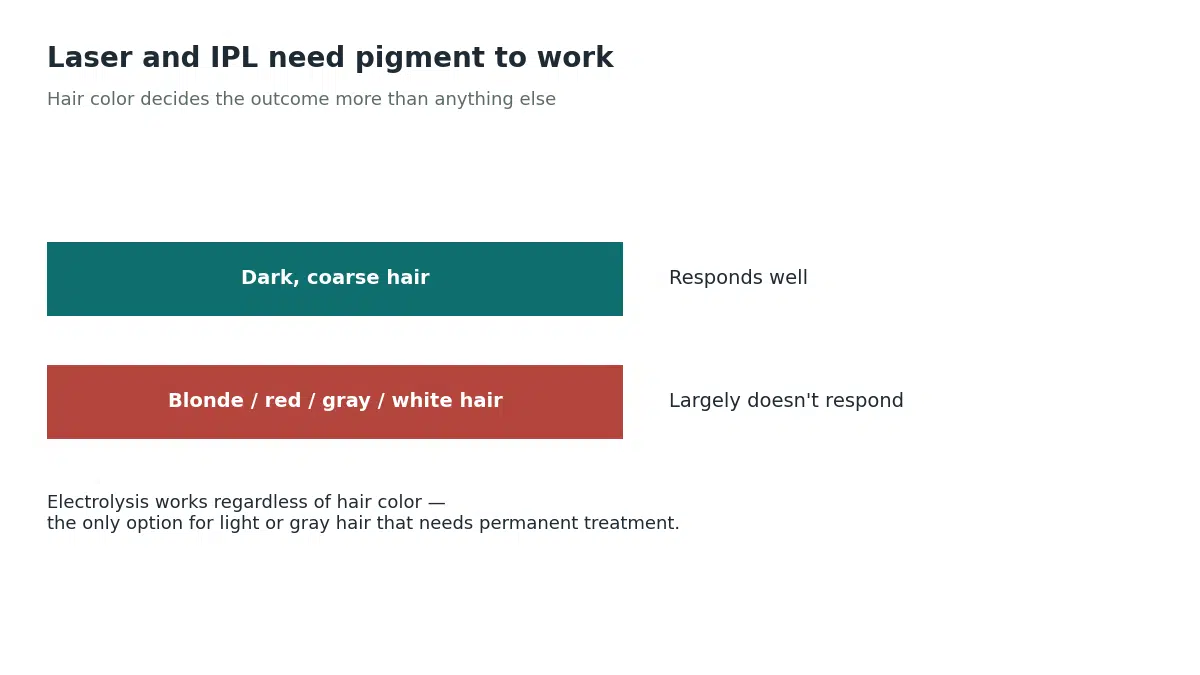
- Dark, coarse hair responds well to laser and IPL; blonde, red, gray and white hair largely don’t respond at all.
- Skin tone affects safety, not effectiveness — the right laser (Nd:YAG) treats darker skin safely.
- New or rapidly increasing hair growth, especially with irregular periods or acne, is worth investigating before treating it cosmetically.
First, One Thing Worth Ruling Out
If unwanted hair has appeared or increased noticeably — particularly coarse dark hair on the face, chest, abdomen or back in a woman — that’s worth investigating before you treat it cosmetically.
That pattern is called hirsutism, and it can point to polycystic ovary syndrome, a thyroid problem, or another hormonal cause. PCOS is the commonest.
Treating the hair alone leaves the cause unaddressed, and in some cases medical treatment reduces the growth itself — which makes any cosmetic removal work far better and cost less.
Rapid onset over months, or hair growth alongside irregular periods, acne, hair thinning on the scalp or unexplained weight change, is worth a doctor’s appointment.
Hair Removal Options: What Actually Decides Which Method Suits You
Hair grows in cycles — a growth phase, a transition, and a resting phase — and only hairs in the active growth phase respond to light-based treatment. That’s the single fact behind why nothing works in one session.
Hair color matters more than anything else for laser and IPL. Both work by pigment absorbing light energy, which heats and damages the follicle. Dark coarse hair responds well. Blonde, red, gray and white hair largely don’t respond, because there’s little pigment to absorb the light. No device gets around this, whatever the marketing says.
Skin tone matters for safety rather than effectiveness. Darker skin can be treated safely with the right equipment — Nd:YAG lasers in particular have evidence for treating darker phototypes where older devices risked burns and pigment changes.[2]
The variable isn’t whether it’s possible; it’s whether your provider has the right laser and the experience to set it correctly.
Everything else — shaving, waxing, sugaring, threading, epilation, electrolysis — works regardless of hair or skin color.
Temporary Methods
Shaving cuts hair at the surface. Regrowth in one to three days, feeling stubbly because the cut end is blunt. Painless, cheap, works for everyone. Shave with the grain, use a sharp blade, and moisturize after.
Depilatory creams dissolve hair just below the surface, buying a few extra days. Patch-test first, follow the timing exactly — leaving them on too long causes chemical burns — and only use facial or intimate formulations where the product is labeled for it.
Waxing removes hair from the root, so results last three to six weeks. Hair needs to be around a quarter of an inch for the wax to grip. Painful, especially initially, and the main cause of ingrown hairs.
Sugaring uses a sugar, water and lemon paste, removed in the direction of growth rather than against it. Many people with sensitive skin find it gentler than wax for similar longevity.
Threading is the precision option — twisted cotton thread lifting hair at the follicle. Best for brows and facial hair, no chemicals or heat, results for two to four weeks.
Epilation uses rotating tweezers to pull multiple hairs at once. Similar longevity to waxing, one-off device cost, and genuinely uncomfortable at first.
Long-Term Methods
Laser
Concentrated light is absorbed by pigment in the follicle and converts to heat, damaging it without harming the surrounding skin — selective photothermolysis.[1]
Because only follicles in the growth phase are affected, and only a fraction are at any moment, you need repeated sessions to catch hairs as they cycle through.
Most people need six to eight sessions weeks apart, then occasional maintenance. Expect a snapping sensation and a few hours of redness like mild sunburn.
IPL
Broad-spectrum light rather than a single wavelength, covering more area per pulse at lower power. Professional IPL sits below laser in intensity; at-home devices sit below that again.
At-home devices work, with patience — typically weekly or every two weeks for months, then maintenance. Shave before treating, don’t wax or pluck, because the root needs to be present for the light to reach.
Electrolysis
A fine probe into each follicle delivers a current that destroys it. One hair at a time, which makes it slow and best suited to small areas or finishing after laser.
Electrolysis is the only method the FDA recognizes as permanent hair removal. Laser and IPL are cleared for permanent hair reduction — a meaningfully lower bar.[3]
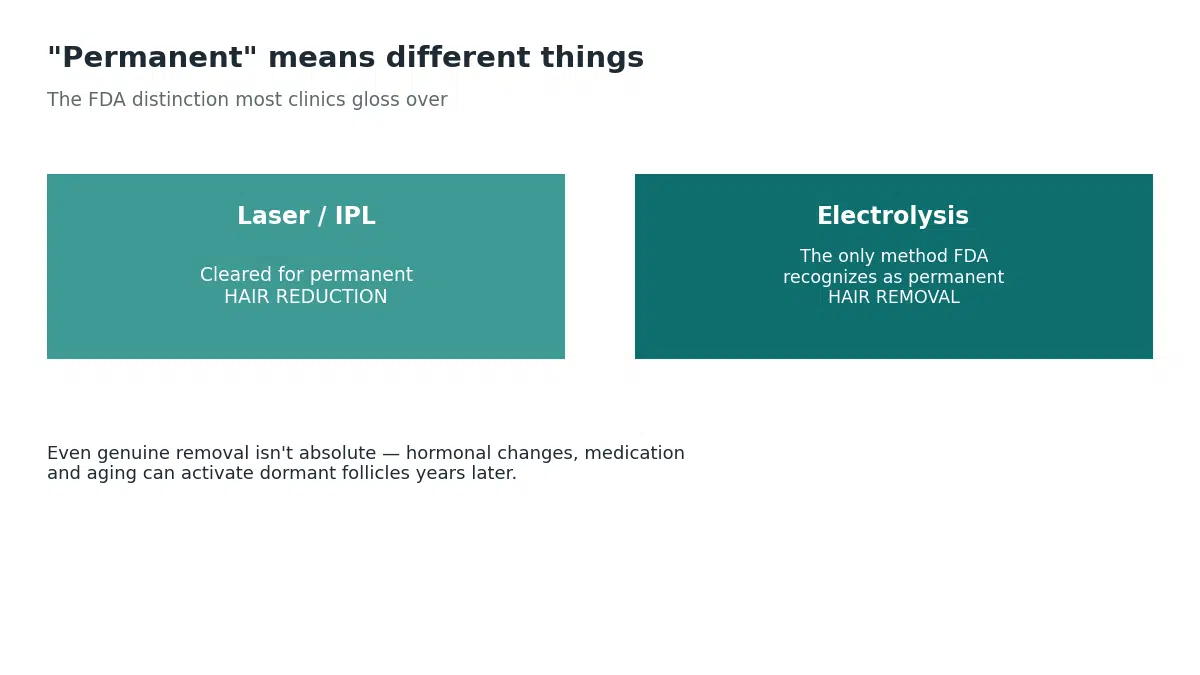
Clinics use “permanent” loosely, and that one word difference is where most disappointed expectations come from.
Electrolysis also works on blonde, red, gray and white hair, which laser and IPL essentially can’t touch.
And even genuine permanence isn’t absolute — hormonal changes, medication and aging can activate dormant follicles years later.
Safety: Who Should Avoid What
Don’t wax on isotretinoin. Isotretinoin (Accutane and similar acne treatments) makes skin fragile, and waxing can tear it, leaving raw patches or scarring.
Dermatologists generally advise avoiding waxing, epilation and other root-removal methods during treatment and for months afterwards. Shaving is fine throughout. Tell any practitioner if you’re on it or have recently finished.
Photosensitizing medication — some antibiotics, acne treatments and anti-inflammatories — means avoiding laser and IPL until cleared.
Pregnancy — laser and electrolysis are generally postponed, since safety data is limited rather than because harm is established. Skin is also more sensitive, so wax burns more easily.
Tanned, sunburned or recently treated skin — no light-based treatment. This is the commonest cause of at-home IPL burns.
Tattoos and moles — never treat over either with laser or IPL.
Keloid tendency, eczema, psoriasis — get a dermatologist’s view before waxing or starting laser.
Pacemakers and implanted devices — discuss electrolysis with your doctor first.
Stop and seek medical advice for blistering, spreading redness, oozing or fever after any method.
Ingrown Hairs — The Common Complaint
Hair curls back into the skin instead of growing out, causing red inflamed bumps. Commonest with shaving, waxing and epilation, and worst in the bikini area.
Exfoliate gently two or three days before and after removal, not immediately before. Moisturize daily. Avoid tight clothing straight afterwards.
If one develops, don’t pick or dig at it — that’s how you get infection and pigmentation, and on darker skin those marks last months. Warm compress and a salicylic acid product instead.
Our guide to treating acne scars covers the same distinction that matters here — which marks are discoloration that fades, and which are structural damage that doesn’t.
Laser reduces ingrown hairs substantially over time, which is a genuine reason people choose it beyond convenience.
By Body Area
Legs and arms — large, low sensitivity, suits anything. Laser is efficient here if hair is dark. Arm hair is often too fine and light for laser to grip.
Underarms — small and quick, which makes it one of the most cost-effective laser areas.
Bikini and Brazilian — sensitive and ingrown-prone. Waxing lasts; laser reduces ingrowns over time. Don’t use depilatory creams here unless the product explicitly says intimate areas.
Face — threading for brows and precision. Laser for persistent upper lip and chin hair. Electrolysis for gray, blonde or fine hairs laser can’t target, and it’s the practical answer for the scattered chin hairs that arrive around menopause.
Back and chest — awkward to reach, so professional waxing or laser rather than home methods.
There’s also a prescription cream, eflornithine, that slows facial hair growth rather than removing it. It’s worth asking about if facial hair is the main concern.
What It Costs
We’ve removed the specific price ranges this article used to carry. They vary enormously by country and city, they date quickly, and a stale number is worse than none when you’re planning a course of six or more sessions.
The shape of it is what’s useful: shaving and creams are cheap per use and never stop costing. Waxing is moderate and recurring.
Epilators and at-home IPL are one-off purchases that pay back over years. Laser and electrolysis are substantial upfront and then mostly stop.
Ask any clinic for a written quote for the full course, not per session — including how many sessions they anticipate, and what happens if you need more. A per-session price for a treatment that’s never done once tells you very little.
Getting Better Results
Before: exfoliate a day or two ahead, not immediately before. Arrive with clean skin, no lotion, oil, makeup or deodorant.
For waxing, let hair reach about a quarter inch. For laser or IPL, shave the day before — root present, surface hair gone.
After: no hot showers, saunas or steam for 24 hours. Loose clothing. Fragrance-free moisturizer only.
Sunscreen and no sunbathing for at least 48 hours — our guide to summer skincare mistakes covers the application errors that catch people out here.
Between laser sessions: shave only. Waxing or plucking removes the root the laser needs and wastes the session you’ve paid for.
Shedding over one to two weeks after laser is normal and means it worked.
Common Questions About Hair Removal Options
Does laser work on blonde or gray hair?
Electrolysis is the option that works regardless of hair color.
Is laser safe for darker skin?
Wrong settings risk burns and pigment changes, so ask directly what laser they use and who they’ve treated.
Is laser actually permanent?
Expect substantial long-term thinning with occasional maintenance, not total elimination.
Do at-home IPL devices work?
Same limits apply — dark hair, lighter skin, never on tanned or sunburned skin.
Can I wax while taking acne medication?
Shaving is fine. Tell your practitioner either way.
Does shaving make hair grow back thicker?
Nothing about shaving alters the follicle.
The Bottom Line
Dark hair and any skin tone, large area, want it gone long-term: laser, from someone with the right device for your skin.
Light, gray or fine hair: electrolysis, or accept a temporary method.
Small budget or low commitment: shaving, waxing or an epilator, and the technique details matter more than the method.
And if the hair growth itself is new or increasing, get the cause looked at before you spend on removing it.
SOURCESOur Editorial Standards
HealthMagHub is built on primary sources: peer-reviewed research, clinical practice guidelines, and health agencies such as the NIH, CDC, and FDA. Read our editorial standards to see how we research, cite, and update our articles.
- Cleveland Clinic. Laser Hair Removal: How It Works & What to Expect. my.clevelandclinic.org
- Sharma VK, Sethuraman G, Garg T, Verma KK, Ramam M. Evaluation of Long-Pulsed 1064-nm Nd:YAG Laser-Assisted Hair Removal in Indian Patients. Indian Journal of Dermatology, Venereology and Leprology. ncbi.nlm.nih.gov
- Cleveland Clinic. Electrolysis: Definition & Treatment. my.clevelandclinic.org
- American Academy of Dermatology. Laser Hair Removal: FAQs. aad.org
Disclaimer: This article is general information, not medical advice. See a doctor if unwanted hair growth is new, rapid, or accompanied by irregular periods, acne or scalp hair thinning. Avoid waxing and other root-removal methods while taking isotretinoin and for months afterwards.