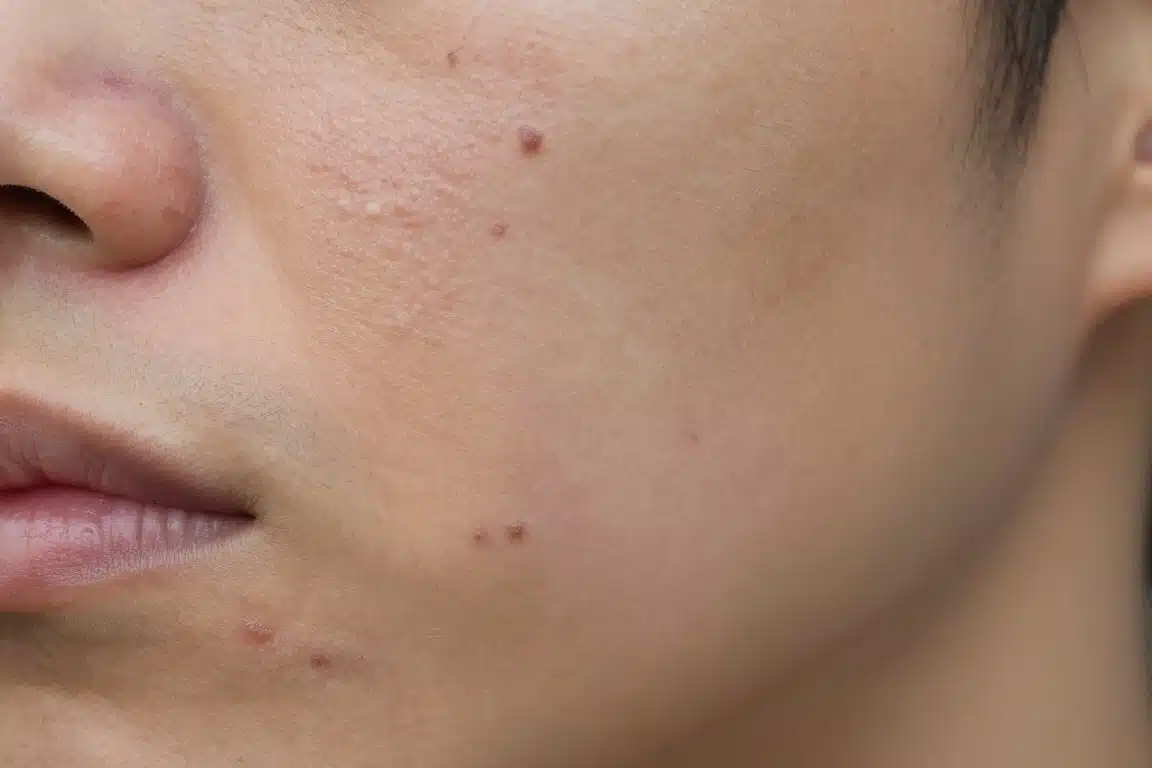
A product that fades discoloration won’t touch an ice pick scar. A procedure that transforms rolling scars does nothing for boxcar scars. That mismatch is why most people feel they’ve wasted money.
So the useful order is: work out what you have, then choose.
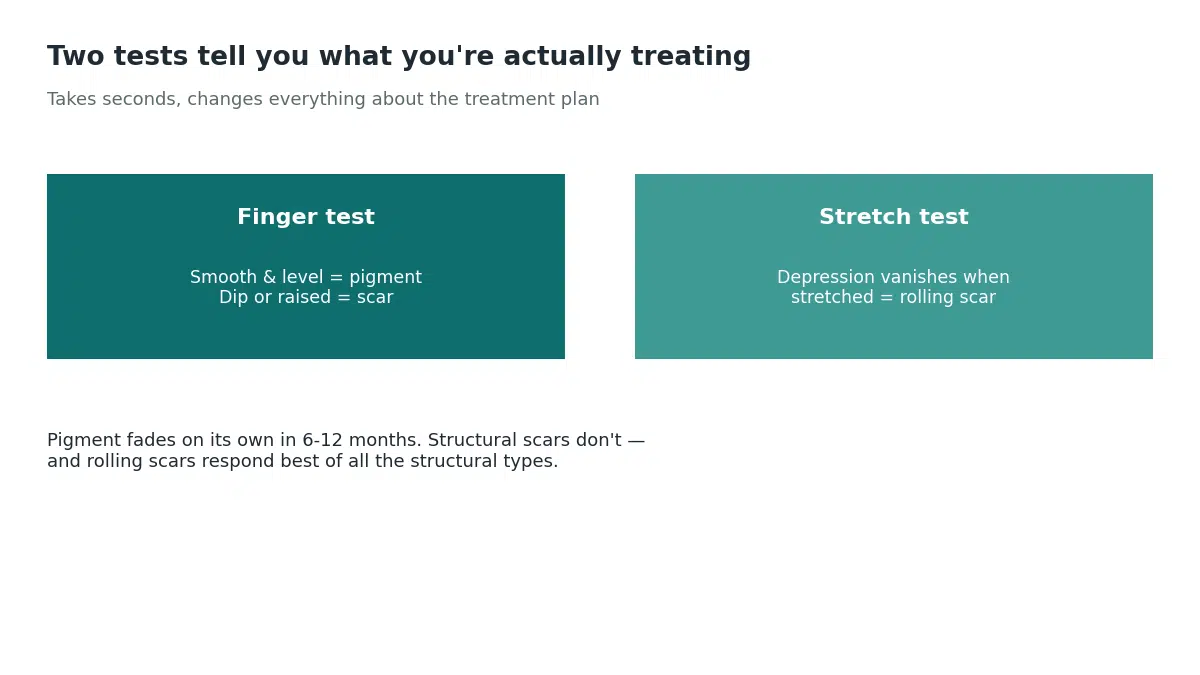
- Two self-tests identify what you’re treating: finger test for pigment vs. scar, stretch test for rolling scars specifically.
- Topicals fade pigment and improve texture but cannot fill a depression or flatten a raised scar.
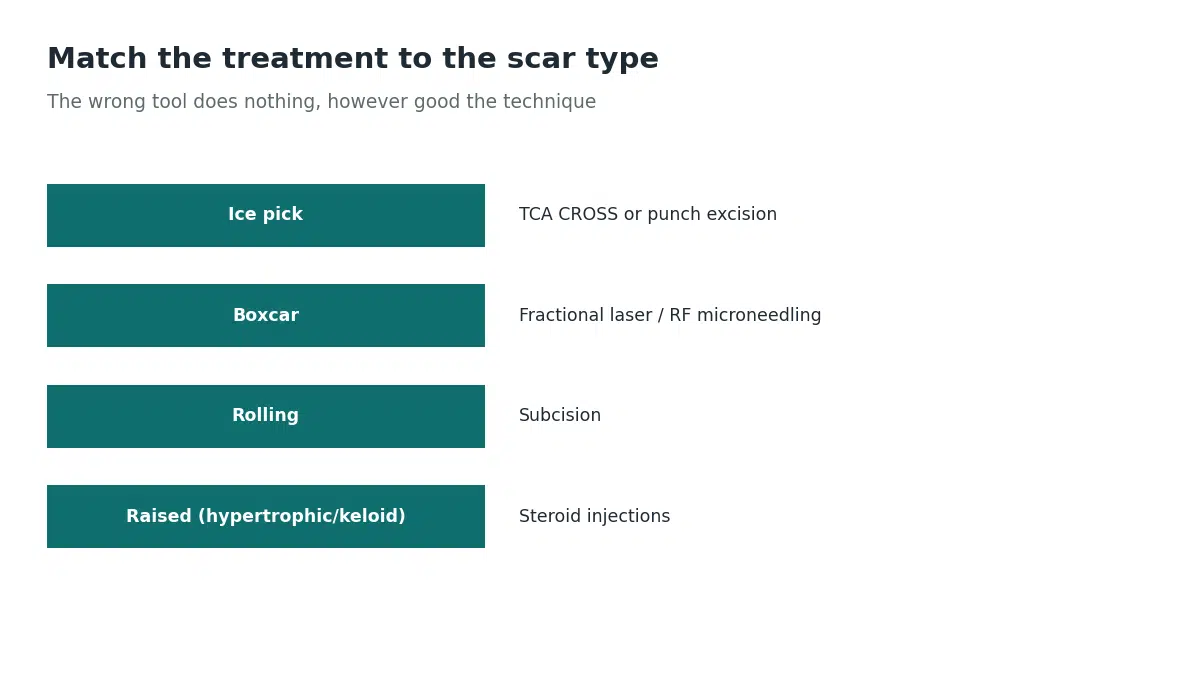
- Each scar type needs a different procedure — subcision for rolling, TCA CROSS for ice pick, lasers for boxcar, steroid injections for raised scars.
- Almost nothing works in one session, and full results take 6 to 12 months after finishing a treatment series.
First: Is It Actually a Scar?
Most people arrive here with a mixture of true scarring and something that isn’t scarring at all.
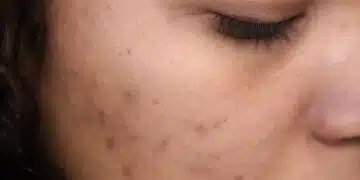
Post-inflammatory hyperpigmentation (dark marks) and post-inflammatory erythema (red marks) are flat discolorations. They fade — typically over 6 to 12 months, faster with treatment. They are not permanent.
The test takes two seconds: run a finger over the mark. Smooth and level with the surrounding skin means pigment. A dip or a raised area means a structural scar.
That distinction changes everything, because pigmentation responds extremely well to topicals and sun protection, while true scarring generally doesn’t.
Why Acne Scars Form?
When a deep lesion ruptures the follicle wall, inflammatory material spills into surrounding tissue. Your immune response contains the damage — and that same inflammation is what scars you.
During repair, collagen gets laid down either too sparingly (leaving a depression) or too enthusiastically (leaving a raised scar), in a disorganized arrangement rather than the normal basket-weave.
Deeper inflammation means more damage, which is why cystic acne scars so reliably. Genetics decide much of the rest — some people scar badly from mild acne, others barely at all.
One nuance worth stating carefully: darker skin doesn’t scar more readily, but it’s considerably more prone to post-inflammatory hyperpigmentation, which can last months and makes the overall appearance worse. Lighter skin tends to hold redness longer instead.
Identifying Your Scar Type
Depressed (atrophic) — the commonest
Ice pick: narrow, under about 2mm, and deep — like a puncture. They don’t flatten when you stretch the skin. Hardest to treat, because surface techniques can’t reach the base.
Boxcar: wider round or oval depressions, roughly 1.5–4mm, with steep vertical walls. The broader opening makes them far more responsive to resurfacing.
Rolling: broad, wave-like undulations with sloped edges, caused by fibrous bands tethering skin to deeper tissue. The giveaway: stretch the skin and they largely disappear. That single observation identifies the type most likely to improve dramatically.
Raised
Hypertrophic scars are firm and raised but stay within the original lesion’s footprint, commonest on chest, back and shoulders.
Keloids grow beyond the original wound and can keep growing for months or years. They’re more common in people of African, Asian and Hispanic descent, and they recur readily — which changes the treatment approach entirely.
Most people have more than one type, which is why combination treatment is usual rather than exceptional.
What At-Home Treatment Can and Can’t Do
Be clear about the ceiling: topicals cannot fill a deep depressed scar or flatten a raised one. They improve texture, thicken surrounding skin slightly, and fade pigmentation — which is genuinely worth having, particularly if pigment is most of what’s bothering you.
Retinoids are the best-evidenced option. Prescription tretinoin works faster than over-the-counter retinol and irritates more. Start low, two or three nights a week, and build. Expect redness and peeling for the first month or two — that’s adjustment, not damage.
Daily broad-spectrum SPF is non-negotiable with retinoids, or you’ll create more pigmentation than you treat.
Vitamin C at 10–20% L-ascorbic acid fades pigment and supports collagen synthesis. It degrades in light and air, so opaque airless packaging matters more than the marketing does.
Alpha hydroxy acids exfoliate the surface and improve tone. Start with lactic acid before glycolic. Don’t stack them with retinoids on the same night until your skin is well adapted.
Niacinamide at 4–5% calms inflammation and regulates pigment, and plays well with everything else.
Silicone gel or sheets are the one at-home option with real evidence for raised scars, worn consistently over at least eight weeks. They do nothing for depressed scars.
If you’ve used the right products correctly for six months with no meaningful change, that’s your answer — not a reason to try a seventh product.
Professional Treatments, Matched to Scar Type
A 2025 review found that combination therapy consistently outperforms any single approach.[3] That’s the underlying principle here — different scars in the same face need different tools.
For ice pick scars
TCA CROSS applies high-concentration trichloroacetic acid into individual scars with a fine applicator, triggering collagen formation that gradually raises the scar floor. Clinical work reports excellent improvement in the majority of patients after a series of sessions.[1] It’s done one scar at a time, so it suits a limited number rather than widespread scarring.
Punch excision cuts the scar out entirely and closes it with a fine suture, trading a pit for a line that can then be resurfaced.
Microneedling and peels don’t reach these. Neither do topicals.
For boxcar scars
Fractional laser and radiofrequency microneedling are the mainstays, over several sessions. Punch elevation — cutting around the base and lifting it to skin level — suits deep isolated ones.
For rolling scars
Subcision is the specific answer, because the problem is tethering rather than lost tissue. A needle is passed under the scar to break the fibrous bands, letting the skin float back up. A classic series found roughly 50% improvement on average, with 90% of patients reporting their appearance had improved.[2] Expect bruising for one to two weeks.
It does nothing for ice pick or boxcar scars. Precision of diagnosis is the whole game.
For raised scars
Intralesional steroid injections flatten hypertrophic scars and keloids over a series of sessions, sometimes with 5-FU or pulsed dye laser alongside.
Ablative resurfacing can make raised scars worse, and surgery alone on a keloid recurs at very high rates. Keloids need combination treatment and long-term follow-up, not a one-off procedure.
For pigmentation
Sunscreen, topicals, and chemical peels — this is the category that responds best and costs least. Hydroquinone works but isn’t for indefinite use; prolonged use can cause ochronosis, a blue-black discoloration that’s difficult to reverse, so it needs supervision.
What to ask for instead: a written quote for the whole course, not per session — including how many sessions are anticipated, what happens if you need more, and whether follow-up and touch-ups are included.
Be wary of anyone quoting a single session price for a treatment that is never done once.
What Can Go Wrong
Temporary redness, swelling, peeling and bruising are expected healing rather than complications. Beyond that:
Post-inflammatory hyperpigmentation is the commonest complication, particularly in medium and darker skin, and particularly with aggressive settings or poor sun protection afterwards. It can last months. This is the single biggest reason to choose a practitioner experienced with your skin type rather than the nearest available one.
Infection is uncommon but needs recognising: increasing pain, warmth, pus, spreading redness, fever.
Scarring from the treatment itself is rare and devastating, and it’s technique-dependent — TCA CROSS especially.
Steroid injections can thin the skin, lighten it, or leave visible vessels if given too often or too strong. Those changes may be permanent.
Filler injected for depressed scars can enter a blood vessel and block it, causing tissue death — and if it travels toward the eye, vision loss. Sudden severe pain, skin blanching white or turning dusky purple, or any vision change during or after injection is an emergency. The practitioner should have hyaluronidase to hand and know what to do with it.
Who should wait
Active acne — control it first, or you risk more inflammation and new scars. Active cold sores or skin infection — treat first; antivirals are given prophylactically before laser if you get them. Recent isotretinoin — most dermatologists wait months before ablative procedures. Keloid tendency — tell them before anything, because controlled injury can trigger new keloids. Pregnancy and breastfeeding — most of this postpones safely.
Realistic Results and Timing
Almost nothing works in one session. Lasers typically need three to five, microneedling four to six, TCA CROSS three or four per scar, steroid injections six or more monthly.
Collagen remodelling takes months. The procedure is only the trigger; improvement accumulates over three to six months afterwards. Final results often aren’t visible until six to twelve months after finishing a series — and early post-procedure swelling gives a flattering preview that settles.
“50% improvement” means the scars are half as noticeable, not gone. Complete clearance is uncommon for moderate to severe scarring, and any provider promising it is overselling.
Rolling scars usually improve most. Deep ice pick and severe boxcar scars improve least, even with combination therapy.
Take photographs in consistent lighting before you start and after each stage. Memory is unreliable and daily scrutiny makes gradual change invisible to the person experiencing it.
And old scars respond much like new ones — the idea that scarring becomes fixed and untreatable with age isn’t true.
Protecting Your Results
Sun protection matters more than any product you can buy. UV darkens pigmentation, slows collagen remodelling and can undo treatment gains. Daily SPF 30 or higher, reapplied outdoors — our guide to summer skincare mistakes covers where people go wrong with it.
Treat active acne properly. Preventing severe acne is easier and cheaper than treating its scars. If over-the-counter treatment hasn’t worked in 8 to 12 weeks, get prescription help rather than continuing.
Don’t pick. Squeezing drives material deeper and ruptures the follicle wall — precisely the mechanism that scars.
Gentle cleansing and moisturizing, even with oily skin. A damaged barrier heals worse and responds worse to treatment.
Don’t smoke. It constricts vessels, reduces oxygen delivery and impairs collagen production directly.
On supplements: collagen, vitamin C and zinc are frequently suggested. Correcting a genuine deficiency helps healing; taking more than you need doesn’t. Our look at what collagen supplements actually do covers how thin that evidence is.
If hormonal shifts are driving breakouts, our guide to menopause and skin goes further into that.
Common Questions About Acne Scars
How do I know if it’s a scar or just a mark?
A dip or raised area means structural scarring, which won’t resolve on its own.
Can creams fix deep acne scars?
Six months of correct use without change means you need procedures, not another product.
Which scars respond best?
Deep ice pick scars respond least, and usually need TCA CROSS or punch excision.
Are these treatments safe for darker skin?
Ask specifically about their experience with your skin type before booking.
Should I treat scars while still breaking out?
It’s also the cheaper order to do things in.
Are old scars too late to treat?
Collagen remodelling can be triggered at any point.
The Bottom Line
Identify the type before spending anything. Stretch the skin — if the depression vanishes, it’s tethering, and subcision is your answer. Run a finger over it — if it’s smooth, it’s pigment, and that’s the cheapest problem to solve.
Mild scarring and pigmentation: retinoid, vitamin C, daily sunscreen, six months before judging.
Moderate to severe structural scarring: see a board-certified dermatologist, expect a combination approach over several sessions, and get the whole course quoted.
Meaningful improvement is achievable for almost everyone. Complete clearance usually isn’t, and anyone promising it should make you cautious rather than hopeful.
SOURCESOur Editorial Standards
HealthMagHub is built on primary sources: peer-reviewed research, clinical practice guidelines, and health agencies such as the NIH, CDC, and FDA. Read our editorial standards to see how we research, cite, and update our articles.
- Khunger N, Sarkar R, Jain RK. Evaluation of CROSS Technique with 100% TCA in the Management of Ice Pick Acne Scars in Darker Skin Types. Journal of Cosmetic Dermatology, 2011. onlinelibrary.wiley.com
- Alam M, Omura N, Kaminer MS. Subcision for Acne Scarring: Technique and Outcomes in 40 Patients. Dermatologic Surgery, 2005. pubmed.ncbi.nlm.nih.gov
- Advances in the Treatment of Acne Scars. Frontiers in Medicine, 2025. frontiersin.org
Disclaimer: This article is general information, not medical advice. Acne scar procedures should be performed by a qualified practitioner. Seek urgent care for severe or worsening pain, fever, spreading redness or pus after a procedure, or for sudden severe pain, skin blanching or vision change during or after any injectable treatment.