
The creatine hair loss worry is one of the most repeated claims in the supplement world, and it rests on a single study from 2009 that never looked at anyone’s hair.
That is not a technicality. It is the whole story. Twenty rugby players took creatine, a hormone called DHT went up, and because DHT drives male pattern baldness, the internet finished the sentence itself.
So does creatine cause hair loss? In April 2025, researchers finally ran the study that answers it directly — twelve weeks, hair measured rather than inferred. Here is what they found, and the honest limits of what it settles.
- The entire concern traces to one 2009 study of 20 rugby players that measured hormones, not hair.
- A 2021 pooled analysis of 12 studies found no significant effect of creatine on testosterone or DHT.
- A 2025 randomized trial measured hair follicle health directly for the first time and found no difference against placebo.
- That trial excluded men already being treated for hair loss, so it does not fully answer the question for someone already thinning.
Where the creatine hair loss myth started
Picture a university sports lab in South Africa. Twenty young rugby players. A three-week protocol.
The research question had nothing to do with scalps. The team wanted to know whether creatine shifted androgen levels in athletes.
So they front-loaded the dose for a week, dropped to a maintenance amount, and drew blood along the way.
Testosterone barely moved. Its more potent cousin did.
Dihydrotestosterone climbed by more than half during that heavy first week. It was still well above baseline once the dose came down.
The write-up landed in the Clinical Journal of Sport Medicine in 2009. It has been quoted ever since as proof of creatine hair loss.
Nobody argues with the blood work. What went wrong came afterwards, in the retelling — because those researchers never once looked at a participant’s hair.
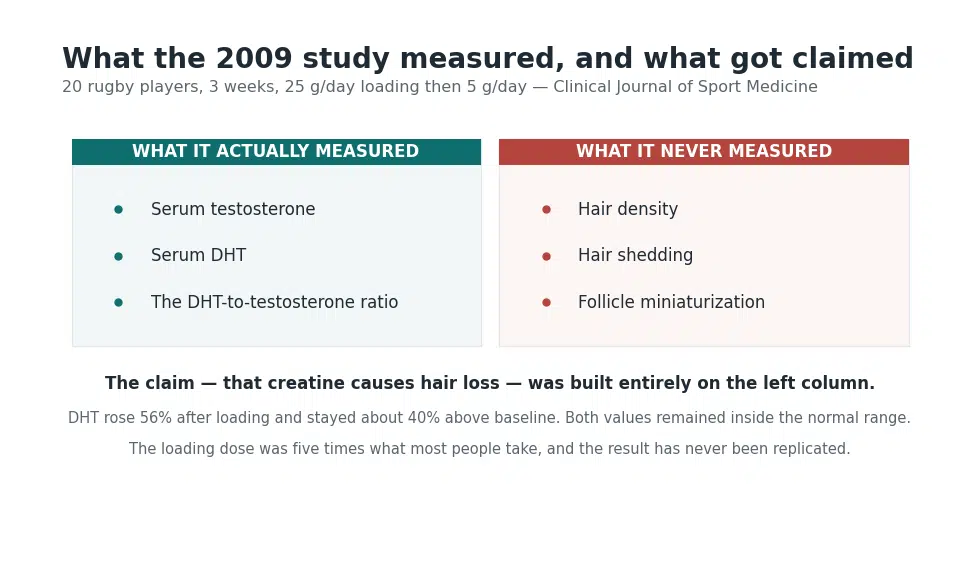
No one counted hairs, photographed a hairline, or checked whether follicles were shrinking. That creatine hair loss study produced one kind of data — numbers from a blood sample — and everything else has been supplied by other people since.
Two details rarely survive the retelling. Despite the dramatic percentage, the DHT values stayed inside the normal range — and the loading dose was five times what most people take.
Why creatine and DHT got connected in the first place
The reasoning behind the creatine hair loss DHT theory is not stupid, which is why it spread.
DHT genuinely is the androgen behind androgenetic alopecia.
In people carrying the genetic sensitivity, it binds to receptors in scalp follicles and shrinks them. Each growth cycle gets shorter, until the hair produced is too fine to matter.
That mechanism is well established. It is why drugs that block DHT work.
So the syllogism looks tidy. Creatine raises DHT, DHT drives hair loss, therefore creatine drives hair loss.
It falls down at the first step.
A 2021 review gathered every trial that had measured these hormones — a dozen of them, 276 people between them. Creatine moved neither testosterone nor DHT to any degree worth reporting.
Fifteen years on, that South African result is still the only one of its kind.
It is a familiar shape: one striking result amplified far beyond what it can carry. The same happens with ashwagandha safety claims, repeated until they sound like consensus.
The 2025 trial that actually measured hair
Sixteen years is a long time for a question to sit unanswered. In April 2025 a team finally stopped arguing about the hormone and went looking at the hair itself, publishing in the Journal of the International Society of Sports Nutrition.
The setup was deliberately ordinary. Men who already lifted, aged eighteen to forty, took either a standard daily scoop of creatine monohydrate or a placebo indistinguishable from it.
No loading week. No megadose. Five grams a day for three months.
Forty-five signed on and thirty-eight finished. Bloods at the start and end — and this time the scalp was examined too.
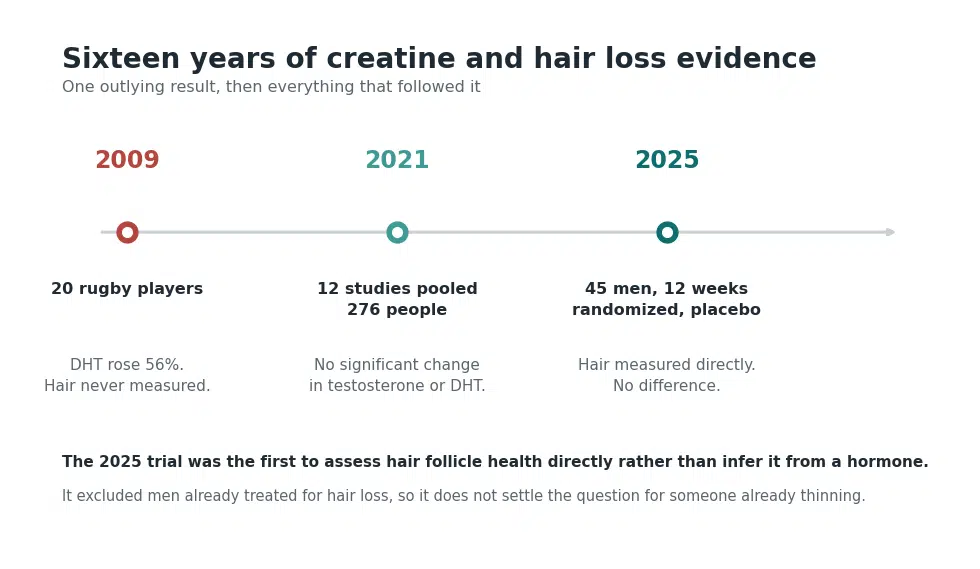
Nothing separated the groups. Not the DHT readings. Not the balance between DHT and testosterone. Not one of the measurements taken from the men’s hair.
Testosterone did drift up over the three months. But it drifted up in the placebo group too, which tells you the training did that, not the tub.
Their own summary is blunt about what it adds: this was the first time anyone had checked hair directly instead of reasoning from a hormone, and the checking found nothing.
What that trial does not settle
The limits matter more than declaring victory here, because the people asking this question are often the ones the study excluded.
The men most worried about hair loss were not in it. Anyone who had already had work done on their hairline, or reached for the usual prescriptions, was turned away at the door.
What you are left with is healthy young men whose hair was fine to begin with. Not the person typing this at midnight.
Nobody was tested for how sensitive their follicles are to androgens either. A small group who react differently could hide inside a flat average.
And the design has limits. Thirty-eight completers detects a large effect, not a subtle one. Twelve weeks is short against a process that unfolds over years. Blood DHT is also not the same as DHT activity at the scalp, which is where androgenetic alopecia actually happens.
None of that resurrects the original claim. It means the honest position is “no evidence of harm in healthy young men over three months,” not “proven safe for everyone.”
Does creatine cause hair loss in women?
There is no trial evidence that it does, and the research base in women is thinner still — the 2009 study and the 2025 trial were both conducted in men.
What can be said is that the proposed mechanism needs a meaningful rise in DHT, and the pooled evidence does not show creatine producing one in anybody. Female pattern hair loss also involves androgens differently, thinning diffusely across the crown rather than receding at the hairline.
If you are a woman noticing shedding, there are more productive questions to ask. Iron and ferritin. Thyroid function. Recent pregnancy, or a sudden weight change.
There is also the delayed shedding that follows physical stress by a few months. All of those explain vastly more cases than any supplement, and all of them are testable. Our guide to what scalp massage can and cannot do covers the realistic levers.
The side effects that are actually documented
The hair loss argument has crowded out what is actually worth knowing. Few supplements have been picked over as thoroughly as creatine monohydrate, and what that scrutiny turned up is boring.
- The scale jumps early. Creatine draws water into muscle. A couple of pounds can appear inside the first two weeks, and it is fluid sitting inside the muscle rather than anything you have gained.
- An unhappy gut. Almost always a loading-dose problem. Break the dose across the day, or skip loading altogether, and it usually settles.
- A blood test that looks alarming. Creatinine is what creatine becomes once your body is finished with it, so taking more of one raises the other. Kidneys entirely fine, number entirely misleading. Mention the supplement to whoever ordered the test, or you may get investigated for nothing.
Existing kidney disease is the one situation warranting real caution, and a conversation with a doctor first.
On the evidence side, creatine is unusually well supported. Our review of pre-workout supplements for beginners rates it the strongest ingredient in the category.
If DHT and androgens are on your mind more generally, our guide to the early signs of low testosterone covers what those hormones do and when testing is worth it.
When to see a doctor
Hair loss has causes worth finding, and blaming a supplement can delay that. These are the patterns where the hair loss is likely to be treatable.
- Hair coming out in clumps, or a sudden dramatic increase in shedding
- Patchy, coin-shaped bald spots rather than diffuse thinning
- Scalp redness, scaling, pain or itching alongside the loss
- Thinning with fatigue, weight change, cold intolerance or irregular periods — that combination points at thyroid or iron
- Hair loss in a woman with new acne or unusual hair growth on the face or body can sometimes point to an underlying hormonal issue
- Any hair loss that is distressing you enough to be researching it at length
That last one is not a throwaway. Androgenetic alopecia responds far better to treatment started early, and a dermatologist can confirm what type you have in a single appointment.
Frequently asked questions
How fast does creatine cause hair loss?
There is no timeline, because there is no established effect to time.
If you started supplementing and found hair in the shower a month later, look at what else changed. Shedding triggered by illness, a hard training block or a stressful stretch runs on a two to three month delay. That is exactly the window that makes people blame whatever they started most recently.
Why does creatine cause hair loss, according to the theory?
The argument goes: creatine pushes DHT up, DHT thins hair in susceptible men, so creatine causes hair loss. Half is solid — DHT really does shrink follicles. The other half is one study nobody has repeated, against a dozen that found no hormonal effect at all.
Are there creatine hair loss before and after cases?
The forums are full of them, and none answers the obvious objection.
Someone starting creatine is usually training harder, eating differently, and a year older than last time they looked properly — in a decade when hairlines move anyway. Separating real hair loss from that mess is what a placebo group is for. The trial that had one showed no gap.
Would stopping creatine reverse any shedding?
There is nothing to undo, since nothing has been shown to happen. Stopping is still worth something as an experiment though: if the shedding carries on without it, you have your answer, and it was never the creatine. Inherited thinning keeps going whatever you take off the shelf.
Does skipping the loading phase reduce the risk?
The hormonal blip everyone cites showed up during a heavy front-loaded week; the trial that measured hair used a modest steady dose. If skipping loading buys peace of mind, skip it — you lose only speed. Muscles fill over three or four weeks instead of seven days and end up in the same place.
The one thing to take away
A hormone measurement in twenty rugby players became sixteen years of received wisdom. When someone finally examined hair itself, there was nothing there.
If your hairline is receding in your twenties or thirties, the likely reason is the one your father and grandfather had. See a dermatologist early, because treatment works far better before the follicles are gone — and that conversation has nothing to do with what is in your shaker.
SOURCESOur Editorial Standards
HealthMagHub is built on primary sources: peer-reviewed research, clinical practice guidelines, and health agencies such as the NIH, CDC, and FDA. Read our editorial standards to see how we research, cite, and update our articles.
- Lak M, Forbes SC, Ashtary-Larky D, et al. Does creatine cause hair loss? A 12-week randomized controlled trial. Journal of the International Society of Sports Nutrition 2025;22(sup1):2495229. PubMed 40265319
- van der Merwe J, Brooks NE, Myburgh KH. Three weeks of creatine monohydrate supplementation affects dihydrotestosterone to testosterone ratio in college-aged rugby players. Clinical Journal of Sport Medicine 2009;19(5):399–404. PubMed 19741313
- Antonio J, Candow DG, Forbes SC, et al. Common questions and misconceptions about creatine supplementation: what does the scientific evidence really show? Journal of the International Society of Sports Nutrition 2021;18(1):13. PubMed 33557850