


If you’re looking for the best pre workout supplements for beginners without jitters, here’s the honest starting point: as a beginner you probably don’t need one, and the two ingredients with the strongest evidence behind them are also the cheapest and least exciting things on the shelf.
What follows is what each common ingredient actually does, the stimulants worth checking your label for before you buy anything, and how to work out your own caffeine ceiling.
- Creatine monohydrate has the strongest evidence of anything in this category, and it isn’t a pre-workout.
- One scoop can contain most of a day’s safe caffeine limit before you’ve had any coffee.
- The beta-alanine tingle is a side effect, not a sign it’s working.
- Some pre-workouts contain stimulants the FDA has ruled illegal, occasionally undeclared on the label.
Best Pre Workout Supplements For Beginners Without Jitters
In your first few months of training, almost everything works. Your progress comes from showing up, learning the movements and sleeping enough. A supplement can’t add much on top of adaptations that are already happening quickly.
That’s worth saying because the jitters problem has a free solution: a cup of coffee and a piece of fruit 30 minutes before you train gets you most of what a pre-workout offers, at a dose you already know you tolerate. If you want to buy something, the sections below are how to do it sensibly.
The Ingredients That Actually Do Something
Creatine Monohydrate
The International Society of Sports Nutrition calls creatine monohydrate the most effective ergogenic nutritional supplement available for increasing high-intensity exercise capacity and lean body mass, with an unusually strong safety record across decades of trials.[1]
Two things beginners get wrong about it. First, it isn’t a pre-workout. It works by saturating your muscles over time, so you take 3 to 5 grams every day and the timing barely matters. Second, plain monohydrate is the studied form. The expensive variants haven’t outperformed it.
It’s also the cheapest thing in this article by a wide margin, which is probably why it’s rarely the headline ingredient in a branded tub.
If the hair loss rumor is what has kept you away from it, that traces back to one small 2009 study that never actually looked at anyone’s hair. Our guide to creatine and hair loss covers what a 2025 trial found when it finally measured hair directly.
Caffeine
The ingredient that produces the effect people actually feel, and the one responsible for the jitters. It genuinely improves perceived effort and endurance. The dose is the whole question, which is the next section.
Beta-Alanine, and What the Tingling Really Is
Beta-alanine works, but not the way most articles describe it. The ISSN position stand is specific: it takes 4 to 6 grams daily for at least two to four weeks to raise muscle carnosine, and the benefit shows up mainly in all-out efforts lasting roughly one to four minutes.[2]
So the scoop you take today is doing nothing for today’s session. It’s a loading ingredient, and if your training is mostly sets of five to twelve reps, it’s aimed at a different problem than the one you have.
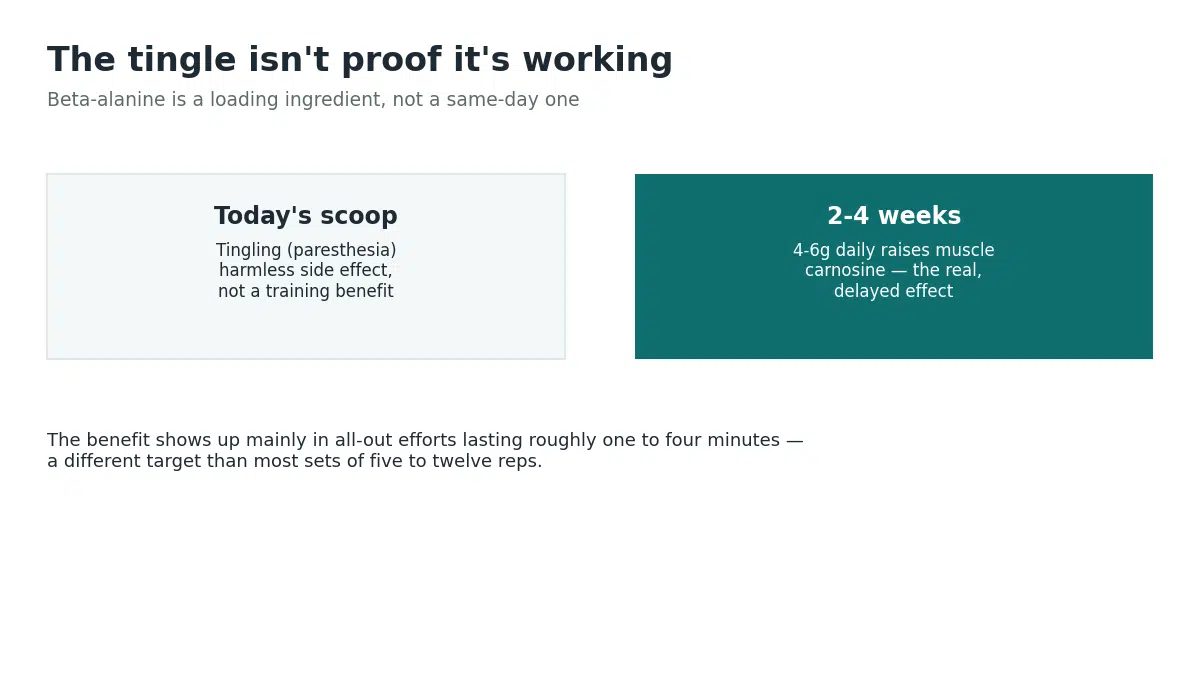
Now the tingling. Paresthesia is the only commonly reported side effect, and it is harmless, but it is a side effect rather than feedback. Treating it as proof the product is working is how people end up chasing a bigger scoop. If you dislike it, the fix is smaller split doses of around 1.6 g or a sustained-release form, not drinking more water.
L-Citrulline and the “Pump”
Citrulline raises nitric oxide and increases blood flow, and the effect on how full your muscles feel mid-set is real. Whether that translates into more strength or faster progress is a much weaker claim. A pump is a sensation, not a measure of a productive session, and much of the pump-focused marketing is selling the sensation because it’s the part you notice.
Before paying extra for a citrulline-heavy formula, weigh a real strength or performance benefit against a sensation you could get from any product that dilates blood vessels. They aren’t the same thing, whatever the marketing implies.
Best Pre Workout Supplements for Beginners Without Jitters: What to Look For
Rather than naming brands that reformulate every year, here are the criteria that hold:
- Third-party certification, specifically. Look for NSF Certified for Sport or Informed Sport on the tub. This matters more than a clean-looking label, for reasons in the next section.
- Caffeine stated in milligrams per scoop. If it isn’t, you can’t dose yourself.
- No proprietary blends. A blend total tells you nothing about how much of anything you’re getting.
- A short ingredient list. Twenty ingredients usually means trace amounts of most of them.
- Stimulant-free, if jitters are your concern. These exist and are a reasonable choice for evening training, just know you’re buying citrulline and beta-alanine, and set expectations accordingly.
The Stimulants to Check For Before You Buy
This is the part most beginner guides leave out, and it’s the reason certification matters more than label-reading.
DMAA (1,3-dimethylamylamine) has been illegal in US dietary supplements since 2013. It raises blood pressure and constricts blood vessels, and the FDA links it to heart attack, chest tightness and shortness of breath, with adverse event reports including liver injury, cardiac arrest, stroke, brain hemorrhage and death following physical exertion. It’s often listed as “geranium extract.”
DMHA and DMBA are chemical cousins introduced as replacements. The FDA considers supplements containing DMHA adulterated and has issued warning letters, along with separate action on phenibut.[3] Products with these ingredients are still sold.
And the label isn’t a guarantee. In 2026 the FDA published a notification that laboratory analysis found DMAA in a pre-workout product where it wasn’t declared at all.[4] That’s the case for third-party certification in one sentence: it’s the only thing checking what’s actually in the tub rather than what’s printed on it.
Practical rule for a beginner: if a product is marketed on how hard it hits, treat that as a warning rather than a selling point.
Caffeine Math, and Why Jitters Happen
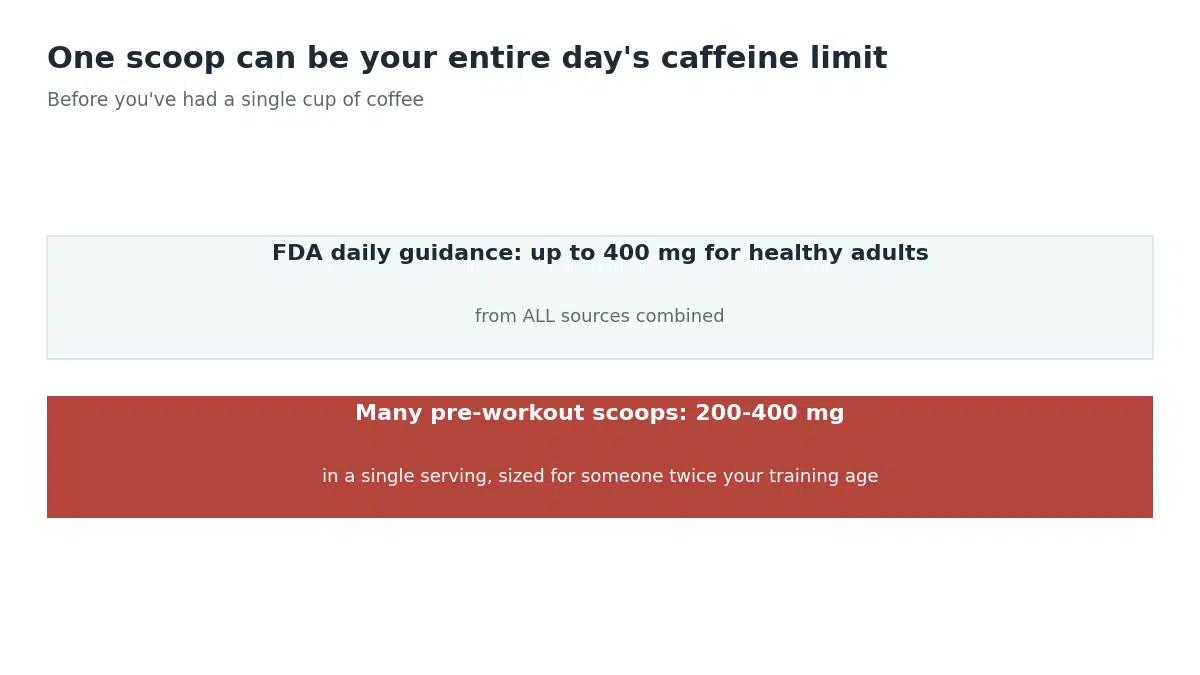
The FDA’s general guidance for healthy adults is up to about 400 mg of caffeine a day. Many pre-workouts contain 200 to 400 mg in a single scoop, so one serving can be your entire daily allowance before you’ve had a coffee, and the scoop is often sized for someone twice your training age.
How to avoid the shaky version:
- Start with a half scoop, or less. You can always add.
- Count everything: coffee, tea, energy drinks and the pre-workout all go in the same total.
- Take it 20 to 30 minutes before training, with a little food rather than on an empty stomach.
- Caffeine has a long half-life. An evening scoop will cost you sleep, and sleep is doing more for your training than the scoop is.
- Don’t use it every session. Tolerance builds, and needing more to feel the same thing is the wrong direction.
When Not to Take a Pre-Workout
Skip these products entirely, or speak to a doctor first, if any of the following apply:
- You have a heart condition, an arrhythmia, or a family history of sudden cardiac problems
- You have high blood pressure, since stimulants raise it further, and it’s worth knowing what your numbers actually mean before adding one
- You’re pregnant or breastfeeding
- You’re under 18
- You take stimulant medication for ADHD, an antidepressant, a blood pressure medication, or a thyroid medication
- You have an anxiety disorder or panic attacks, since high-dose caffeine reliably makes these worse
Stop training and seek medical help if you get chest pain or pressure, a racing or irregular heartbeat that doesn’t settle, severe shortness of breath, fainting or near-fainting, or a sudden severe headache. Don’t try to finish the session. Mention that you took a pre-workout and, if you can, take the tub with you, since the ingredient list matters to whoever treats you.
The Bottom Line
If you want a jitter-free start: take creatine monohydrate daily, have a coffee before you train if you like the lift, and put the rest of the money toward food and sleep. Our high protein eating guide covers the part that actually drives results, and natural ways to boost metabolism after 50 is worth a look if you’re training later in life.
If you do buy a tub, buy a certified one, read the caffeine number, and start on half a scoop. That’s most of the safety of this category in three steps.
Frequently Asked Questions
What is the best pre workout for beginners without jitters?
The lowest-risk approach is a stimulant-free formula or simply a coffee, plus daily creatine monohydrate. Creatine has the strongest evidence of anything in this category, is inexpensive, and causes no jitters because it isn’t a stimulant. If you buy a caffeinated pre-workout, choose one that’s third-party certified, states caffeine in milligrams per scoop, and start on half a serving.
Why does pre-workout make me tingle?
That’s beta-alanine causing paresthesia. It’s harmless and usually fades within about half an hour, but it’s a side effect rather than a sign the product is working. If it bothers you, smaller split doses of around 1.6 g or a sustained-release form reduce it. Note that beta-alanine needs 4 to 6 g daily for two to four weeks to do anything, so a single scoop before training won’t help that session.
How much caffeine is in a pre-workout?
Commonly 200 to 400 mg per scoop. The FDA’s general guidance for healthy adults is around 400 mg a day from all sources, so one serving can be your whole daily allowance before any coffee. Check the milligrams on the tub rather than assuming, and count every caffeinated drink in the same total.
Does creatine cause hair loss?
There is no good evidence that it does. The concern comes from a single 2009 study of 20 rugby players that measured a rise in DHT, a hormone linked to pattern baldness, but never measured hair itself. A 2021 pooled analysis of 12 studies found no significant hormonal effect, and a 2025 randomized trial that assessed hair follicle health directly found no difference against placebo.
Are pre-workout supplements safe?
Most mainstream ones are, at sensible doses, for healthy adults. The real risk is prohibited stimulants: DMAA has been illegal in US supplements since 2013 and is linked to serious cardiovascular events, and the FDA considers products containing DMHA adulterated. These sometimes appear undeclared. In 2026 the FDA reported finding DMAA in a pre-workout that didn’t list it. Third-party certification such as NSF Certified for Sport is the practical protection.
Who should avoid pre-workout supplements?
Anyone with a heart condition, arrhythmia or high blood pressure, anyone pregnant or breastfeeding, anyone under 18, and anyone taking ADHD stimulant medication, antidepressants, blood pressure or thyroid medication should check with a doctor first. People prone to anxiety often find high-dose caffeine makes it markedly worse. Chest pain, palpitations or faintness during a session mean stop and get medical help.
SOURCESOur Editorial Standards
HealthMagHub is built on primary sources: peer-reviewed research, clinical practice guidelines, and health agencies such as the NIH, CDC, and FDA. Read our editorial standards to see how we research, cite, and update our articles.
- Kreider RB, et al. International Society of Sports Nutrition position stand: safety and efficacy of creatine supplementation in exercise, sport, and medicine. ncbi.nlm.nih.gov
- Trexler ET, et al. International society of sports nutrition position stand: Beta-Alanine. ncbi.nlm.nih.gov
- U.S. Food and Drug Administration. FDA Acts on Dietary Supplements Containing DMHA and Phenibut. fda.gov
- U.S. Food and Drug Administration. Medication Health Fraud Notification: Undeclared DMAA in Pre-Workout Product. fda.gov