Here’s what the trials actually found for each ingredient, why we don’t rank products, and the step that matters more than any of it.
- Testosterone-raising supplements work mainly by fixing a deficiency, so if you’re not deficient, there’s little for them to correct.
- Tongkat ali and zinc have the strongest evidence, but mainly in men who are genuinely low; vitamin D and D-aspartic acid have less than their reputations suggest.
- One week of five-hour sleep produced a meaningful testosterone drop in a sleep-lab study. Sleep and body fat move levels more than any supplement.
- Independent analyses have repeatedly found undeclared anabolic steroids or prescription drugs in this supplement category.
Get Tested Before You Buy Anything
The symptoms people attribute to low testosterone (fatigue, weight gain, low libido, poor concentration) are also the symptoms of thyroid disease, depression, diabetes, sleep apnea and several common medications. You cannot tell them apart by how you feel.
Ask for a morning total testosterone drawn between roughly 7 and 10 AM, ideally twice on separate days, since levels fluctuate. Free testosterone and SHBG give a fuller picture.
Many guidelines treat total testosterone below about 300 ng/dL as low, with 300-400 as borderline and interpreted alongside symptoms. Our guide to the early signs of low testosterone covers that differential in detail.
This matters commercially as well as clinically: the ingredients below work mainly by fixing deficiencies. If you aren’t deficient, there’s nothing for them to fix.
What the Evidence Says, Ingredient by Ingredient
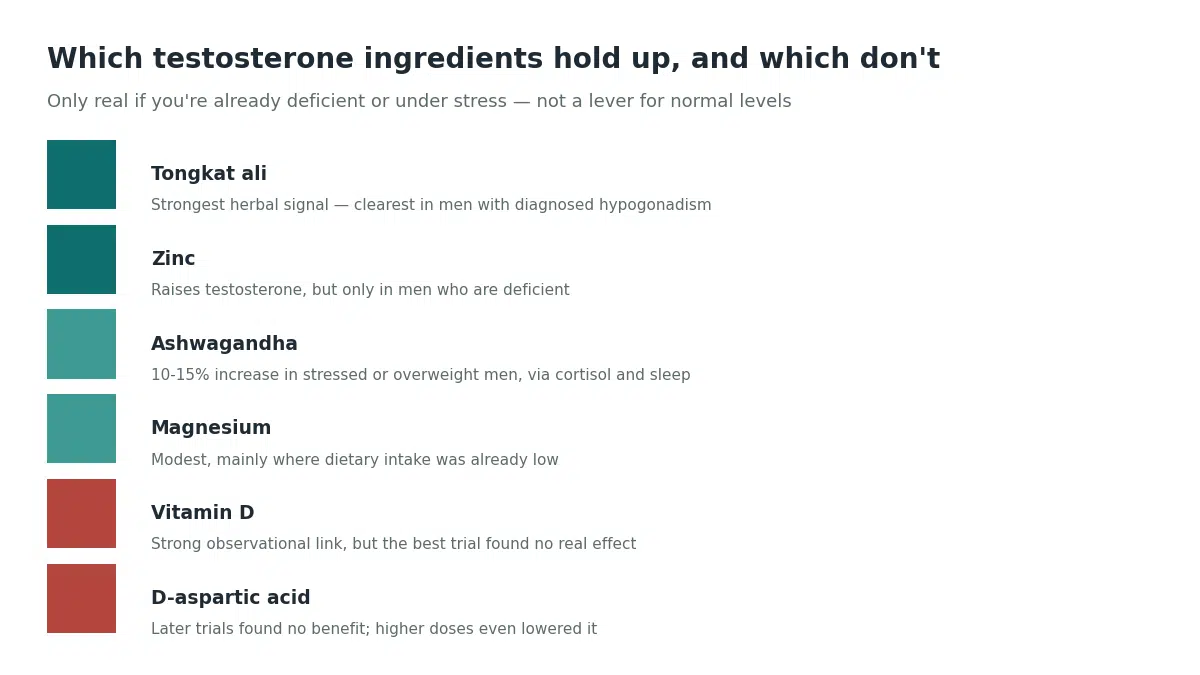
Vitamin D: weaker than you’ve been told. Observational studies consistently link higher vitamin D to higher testosterone, which is where the reputation comes from.
But the most rigorous placebo-controlled trial to date, measuring testosterone by mass spectrometry in 100 men including a specifically low-testosterone group, found no significant increase in total testosterone from high-dose vitamin D3.[2]
Correcting a deficiency still matters for bone and immune health. Just don’t expect it to move your testosterone.
Zinc: works if you’re low. Zinc is directly involved in testosterone synthesis, and supplementation raises testosterone in men who are deficient.[3]
Trials used 15 to 30 mg daily. Above about 40 mg daily long term, zinc causes copper deficiency, so more is actively worse.
Magnesium: modest, mainly in the depleted. Trials in active men and those with low dietary intake show small increases in total and free testosterone, clearest where baseline intake was inadequate.[4] 200 to 400 mg daily.
Ashwagandha: real but modest, via stress. Trials in stressed or overweight men show testosterone increases in the range of 10 to 15%, alongside lower cortisol and better sleep.[6]
300 to 500 mg twice daily of a standardized extract, over 8 to 12 weeks. It also carries genuine cautions. See our guide to who should avoid ashwagandha.
Tongkat ali: the strongest herbal signal. A systematic review and meta-analysis of clinical trials found a significant overall improvement in total testosterone, most pronounced in men with documented hypogonadism.[7] 200 to 300 mg daily of a standardized extract. Extract quality varies widely.
Fenugreek: helps libido more than testosterone. Randomized trials show improvements in libido and some strength measures, but the measured testosterone changes are smaller and inconsistent, which suggests the benefit runs through something other than raw hormone levels.
500 to 600 mg daily of a standardized extract. It lowers blood sugar, so it needs care alongside diabetes medication.
D-aspartic acid: mostly doesn’t work. One early study in men with low testosterone reported large increases. The trials that followed in resistance-trained and healthy men found no meaningful change, and one using a higher daily dose found testosterone fell over two weeks.[5] Any benefit appears confined to men who start out genuinely low.
DHEA: a hormone, not a nutrient. It can raise downstream androgens, but responses vary widely and it affects the whole hormonal picture: acne, hair loss, mood changes, lipid and prostate marker effects are all documented. This one belongs with a clinician, not in a shopping basket.
Realistic ceiling: for men who are actually deficient, the better ingredients plus lifestyle change tend to produce increases in the 10-30% range over a few months. Nothing here approaches what prescription testosterone does, and no supplement should be sold as if it does.
Why We Don’t Rank Products
You’ll find articles, including the earlier version of this one, scoring named testosterone boosters out of five on ingredient quality, dosing accuracy, value and third-party testing.
We don’t do that, for a straightforward reason: we don’t test supplements, we have no laboratory, and we have no way to verify what’s in any bottle.
A rating like “third-party testing: 4.6/5” is a claim about verification that a website cannot honestly make. Formulations also change without notice, so any ranking is out of date the moment a manufacturer reformulates.
What’s worth checking on a label instead:
- Independent certification: USP, NSF International or ConsumerLab, or a published certificate of analysis
- Doses that match the research above, not just an impressive-looking ingredient list
- No proprietary blends for the active ingredients. If the amounts are hidden, assume they’re low
- No stimulants padding the formula to create a felt effect that has nothing to do with hormones
Contamination is the real hazard here rather than ineffectiveness. Independent analyses have repeatedly found products in this category containing undeclared anabolic steroids or prescription drugs, and athletes have failed drug tests because of them.
What Moves Testosterone More Than Supplements
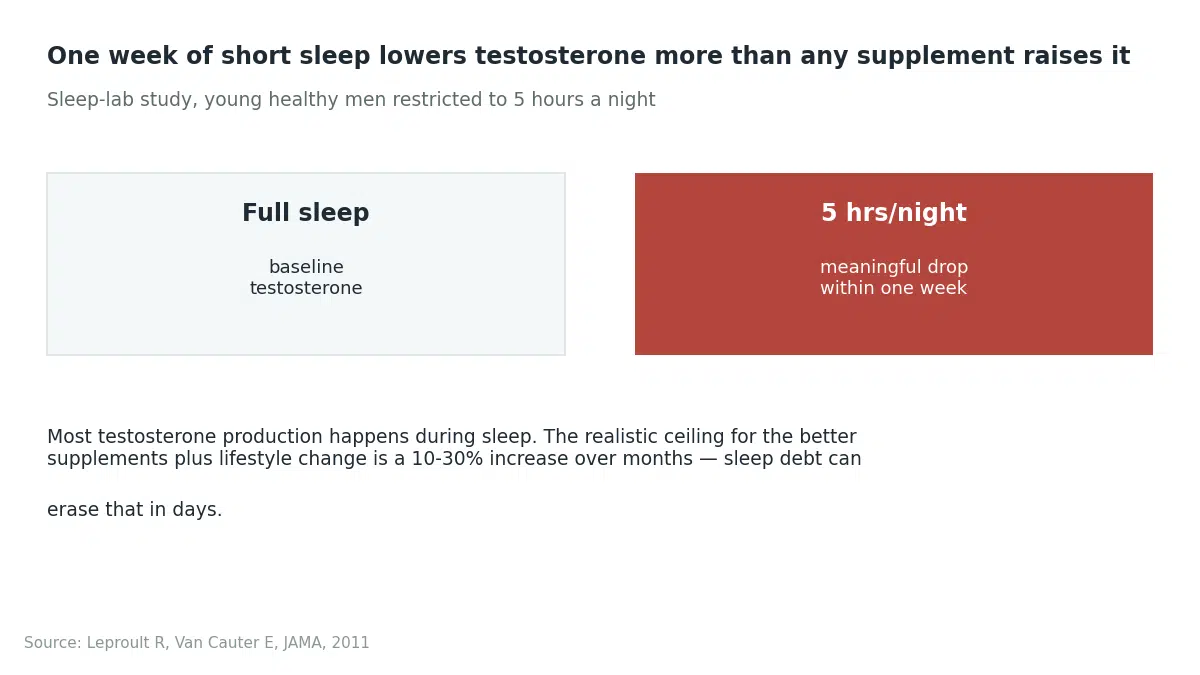
Sleep. Most testosterone production happens during sleep. In a sleep-lab study, young men restricted to five hours a night for one week showed meaningful drops compared with full nights.[8]
If you snore heavily or wake unrefreshed despite enough hours, get assessed for sleep apnea, since treating it often improves testosterone directly.
Strength training. Resistance work produces the strongest hormonal response, particularly compound lifts. Very long endurance sessions can blunt testosterone if they dominate your training.
Body fat. Excess abdominal fat increases aromatase activity, converting testosterone into estrogen.
Losing a modest amount of weight often produces meaningful increases in overweight men. This is one of the larger levers available, and it doesn’t require getting lean.
Stress. Sustained cortisol suppresses testosterone. The method matters less than doing something consistently.
Alcohol. Heavy and binge drinking measurably lowers testosterone, through sleep disruption and direct testicular effects. Moderate drinking is unlikely to be the problem.
Our guide to metabolism after 50 covers some of the same ground and corrects a few common assumptions.
Natural Testosterone Boosters for Men Over 40: Safety
Do not start any testosterone-raising supplement without medical review if you have a history of prostate or breast cancer, liver or kidney disease, or take anticoagulants. Men actively trying to conceive should also check first, because some of these affect sperm production.
Interactions worth knowing: ashwagandha compounds sedatives and can affect thyroid medication; fenugreek amplifies glucose-lowering drugs; zinc reduces absorption of quinolone and tetracycline antibiotics taken at the same time. DHEA has the widest effect on hormone balance of anything here.
Tell every clinician and pharmacist what you’re taking, since supplements alter lab results as well as interacting with medication.
If you have a prostate concern alongside this, our guide to supplements for prostate symptoms covers the overlap.
Common Questions About Natural Testosterone Boosters
Does a natural testosterone booster actually work?
For men whose levels are already normal, there’s little evidence of meaningful benefit.
Is vitamin D a testosterone booster?
Correct a deficiency for other reasons, just not expecting a hormonal result.
How long before I’d see anything?
Testosterone varies 10 to 15% day to day, so an increase of roughly 50 to 100 ng/dL or more is what counts as a real change rather than noise.
Should I take one instead of TRT?
If repeat testing shows clinically low levels with real symptoms, that’s a conversation with a doctor, not a supplement aisle decision.
Which brand is best?
Check for independent certification, doses matching the research, and no proprietary blends hiding the actives.
Can they cause harm?
Contaminated products are the wider risk, since undeclared steroids have repeatedly been found in this category.
The Bottom Line
Test before you buy. If your levels are fine, no natural testosterone booster is going to change how you feel, and the money is better spent elsewhere.
If you’re deficient in zinc or magnesium, or chronically stressed and sleeping badly, correcting those is worth doing, and ashwagandha and tongkat ali have the most credible evidence among the herbal options.
Vitamin D and D-aspartic acid have less than their reputations suggest.
And if repeat morning tests come back genuinely low with symptoms to match, that’s a medical conversation. No capsule substitutes for it.
SOURCESOur Editorial Standards
HealthMagHub is built on primary sources: peer-reviewed research, clinical practice guidelines, and health agencies such as the NIH, CDC, and FDA. Read our editorial standards to see how we research, cite, and update our articles.
- Harman SM, Metter EJ, Tobin JD, Pearson J, Blackman MR. Longitudinal Effects of Aging on Serum Total and Free Testosterone Levels in Healthy Men. Baltimore Longitudinal Study of Aging, JCEM, 2001. pubmed.ncbi.nlm.nih.gov
- Lerchbaum E, et al. Effects of Vitamin D Supplementation on Androgens in Men with Low Testosterone Levels: A Randomized Controlled Trial. European Journal of Nutrition, 2019. ncbi.nlm.nih.gov
- Prasad AS, et al. Zinc Status and Serum Testosterone Levels of Healthy Adults. Nutrition, 1996. pubmed.ncbi.nlm.nih.gov
- Cinar V, et al. Effects of Magnesium Supplementation on Testosterone Levels of Athletes and Sedentary Subjects. Biological Trace Element Research, 2011. pubmed.ncbi.nlm.nih.gov
- Melville GW, Siegler JC, Marshall PW. The Effects of D-Aspartic Acid Supplementation in Resistance-Trained Men over a Three Month Training Period. ncbi.nlm.nih.gov
- Lopresti AL, Drummond PD, Smith SJ. A Randomized, Double-Blind, Placebo-Controlled, Crossover Study Examining the Hormonal and Vitality Effects of Ashwagandha in Aging, Overweight Males. American Journal of Men’s Health, 2019. journals.sagepub.com
- Leisegang K, Finelli R, Sikka SC, Panner Selvam MK. Eurycoma longifolia (Jack) Improves Serum Total Testosterone in Men: A Systematic Review and Meta-Analysis of Clinical Trials. Medicina, 2022. ncbi.nlm.nih.gov
- Leproult R, Van Cauter E. Effect of 1 Week of Sleep Restriction on Testosterone Levels in Young Healthy Men. JAMA, 2011. pmc.ncbi.nlm.nih.gov
Disclaimer: This article is general information, not medical advice, and we do not test or endorse specific supplement products. Do not start testosterone-raising supplements without medical review if you have a history of prostate or breast cancer, liver or kidney disease, take anticoagulants or diabetes medication, or are trying to conceive. Persistent fatigue, low mood and loss of libido have several possible causes and deserve proper investigation rather than self-treatment.