

Here’s what those studies found, what dose they used, and the situations where ashwagandha is a poor idea regardless of the benefits.
What it is: Ashwagandha (Withania somnifera) is a shrub whose root contains withanolides, the compounds thought to drive its effects. It’s classed as an adaptogen, a plant said to help the body handle stress, and has been used in Ayurvedic medicine for centuries, including for women’s reproductive health.
- The strongest evidence is for stress and cortisol reduction, plus improved sleep, though the main trial didn’t report results by sex.
- An 8-week trial in 91 perimenopausal women found significant reductions in hot flashes at 300mg twice daily.
- Ashwagandha raises thyroid hormone, which helps in subclinical hypothyroidism but is dangerous with hyperthyroidism or on levothyroxine.
- Do not take it if pregnant, trying to conceive, or breastfeeding, since evidence suggests it may increase miscarriage risk.
The Benefits of Ashwagandha for Women, Claim by Claim
Stress and Cortisol
This is the claim with the most evidence behind it, and it underpins most of the others.
In a well-known trial, adults with chronic stress taking 600 mg daily of root extract for 60 days reported a 44% reduction in stress scores against 5.5% on placebo, alongside a roughly 28% drop in serum cortisol.[2] The study included both men and women but didn’t report results separately by sex, which is worth knowing when it’s quoted as a finding about ashwagandha for women.
Why it matters here specifically: chronic stress can disrupt menstrual cycles, worsen PMS, interfere with ovulation and make menopausal symptoms harder to tolerate. Lowering the stress response plausibly eases several of those at once.
The effects are gradual rather than immediate, and milder than prescription anxiolytics. Think of it as shifting your baseline response over weeks, not blocking stress.
Perimenopause: The Strongest Female-Only Trial
This is the study most worth citing, because it enrolled women exclusively.
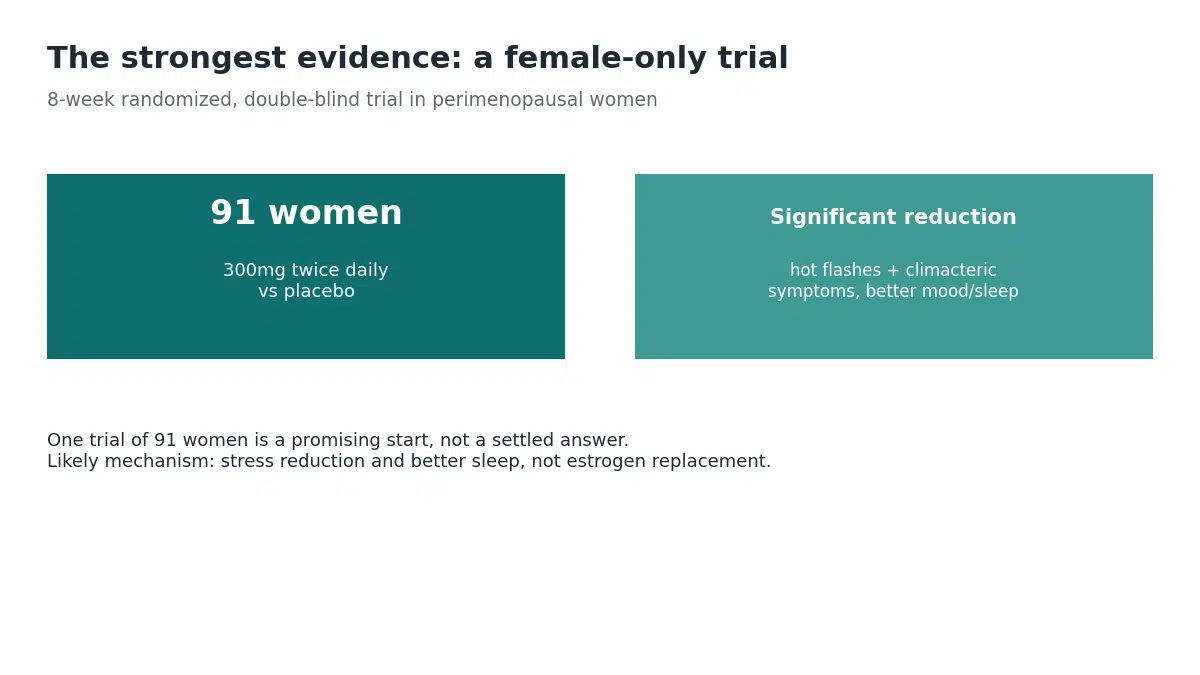
An 8-week randomized, double-blind, placebo-controlled trial in 91 perimenopausal women found that 300 mg of root extract twice daily significantly reduced hot flashes and other climacteric symptoms compared with placebo, with measurable shifts in estradiol, FSH and LH.[3] Participants also reported better mood and sleep.
One trial of 91 women is a promising start, not a settled answer. And ashwagandha almost certainly isn’t acting as an estrogen replacement. The more likely route is through stress reduction and improved sleep, both of which make menopausal symptoms more bearable.
If skin changes are part of your picture too, our guide to menopause and your skin covers what’s hormonal, what’s from aging, and what actually helps.
Thyroid: Why Ashwagandha for Women Cuts Both Ways
A randomized trial found that 600 mg of root extract daily for 8 weeks significantly raised T3 and T4 and lowered TSH in people with subclinical hypothyroidism.[6]
That sounds like good news, and for some it may be. But it’s the same mechanism that makes ashwagandha risky elsewhere: if you have hyperthyroidism or take levothyroxine, that push can take your levels too high. Thyroid disease is substantially more common in women, so this caution applies more often here than the general safety literature implies.
Either way, this is a conversation with whoever manages your thyroid, with monitoring, not a self-directed experiment.
PCOS: Some women with polycystic ovary syndrome try ashwagandha hoping it will help with hormone balance. There isn’t direct research supporting that use. Its stress effects might help indirectly, but PCOS has established treatments and this isn’t one of them.
Sexual Function: Two Small Trials
A pilot study in 50 women with sexual dysfunction found that 300 mg twice daily for eight weeks produced significant improvements in arousal, lubrication, orgasm and overall satisfaction compared with placebo.[4]
A later trial in 80 healthy women without hormonal disturbance reported similar improvements in sexual function scores at the same dose and duration.[5]
Both are small, and neither has been replicated at scale. But they’re female-only trials with consistent results, which is more than most supplement claims can show. The likely mechanism is a mix of reduced stress, better sleep and possible hormonal effects rather than anything acting directly on sexual response.
Sleep: Where Ashwagandha for Women Helps Most Reliably
Women report insomnia and poor sleep quality more often than men, particularly around the menstrual cycle and through menopause, and poor sleep then worsens mood, energy and appetite regulation.
Several trials have tested ashwagandha for sleep, with people falling asleep faster and sleeping more soundly than on placebo, including on objective measures rather than self-report alone.
Most people taking it for sleep take it in the evening, roughly an hour before bed. It’s mildly sedating, so a morning dose can leave some people groggy.
Energy, Mood and Anxiety
Women experience anxiety and depression at roughly twice the rate of men, and exhaustion is one of the most common complaints brought to doctors.
A systematic review concluded ashwagandha outperformed placebo for anxiety reduction, with effects appearing after several weeks of daily use at around 600 mg. The effects were smaller than prescription anxiolytics, but real.
Evidence for depression is thinner. A few small studies suggest it might help mild to moderate symptoms, probably via stress and sleep. It is not a treatment for depression and shouldn’t replace therapy or medication. Some people report mood worsening on it, so pay attention to how you actually feel.
On physical performance, worth a caveat: the well-known strength and muscle trials were conducted in men. Newer mixed-sex studies suggest benefits to recovery and stress markers during training for both sexes, but strength-specific data on ashwagandha for women alone remains scarce.
Weight: The Claim That Doesn’t Hold Up
Ashwagandha is marketed for weight loss, and the evidence doesn’t support it. One small trial found about three pounds over eight weeks as a secondary outcome; pooled across trials, the effect on body fat percentage disappears.
Our full look at whether ashwagandha causes weight loss covers why that study keeps getting overstated, and why it won’t help at all if a hormonal condition like PCOS or hypothyroidism is driving the weight change.
Dose and Timing of Ashwagandha for Women
Most trials showing benefit used 300 to 600 mg daily of standardized root extract, typically standardized to 5-10% withanolides, either once daily or split between morning and evening.
| Goal | Dose used in trials | Timing | Time to effect |
| Stress and anxiety | 300-600 mg daily | Morning or split | 4-8 weeks |
| Sleep quality | 300-600 mg daily | Evening, 1 hour before bed | 2-4 weeks |
| Perimenopausal symptoms | 300 mg twice daily | Split | 8 weeks |
| Sexual function | 300 mg twice daily | Split | 8 weeks |
Take it with food to reduce stomach upset. If nothing has changed after 8 to 12 weeks at an appropriate dose, it probably isn’t going to.
On products: choose root extract rather than leaf powder, check the withanolide percentage is stated, and look for third-party certification from USP, NSF International or ConsumerLab. That last point isn’t optional here, because a 2025 analysis found most tested ashwagandha products exceeded safe limits for lead and nickel.[7]
When Ashwagandha for Women Is a Bad Idea
Do not take ashwagandha if you are pregnant or trying to conceive. There’s evidence it may increase miscarriage risk. Animal studies show pregnancy loss, and traditional Ayurvedic texts describe using the plant to induce abortion.[1] Avoid it while breastfeeding too, since there’s no safety data.
This also means ashwagandha should be stopped once you start trying to conceive, not once a test is positive.
Also avoid, or use only under medical supervision, if you have hyperthyroidism or take thyroid medication, an autoimmune condition, liver disease, surgery scheduled within two weeks, or take immunosuppressants.[1]
It also interacts with sedatives, blood pressure medication and diabetes medication. Case reports of liver injury are documented in the NIH’s LiverTox database.[8] Stop immediately and see a doctor for yellowing of the skin or eyes, dark urine, or severe unexplained fatigue.
Our full guide to who should avoid ashwagandha and why covers every interaction in detail. And if you’re pregnant or planning to be, the constipation that comes with a prenatal’s iron is a far more useful thing to read about, and our guide to high-fiber foods in pregnancy covers what actually helps.
Common Questions About Ashwagandha for Women
What are the main benefits of ashwagandha for women?
Most effects appear after six to eight weeks of consistent use, not immediately.
Can ashwagandha for women help with menopause symptoms?
It’s a single trial, and the likely mechanism is stress and sleep rather than replacing estrogen.
Does it balance hormones?
“Balancing hormones” is marketing language. The real effects are specific, measurable and cut both ways.
Can it improve fertility?
More importantly, ashwagandha should be stopped when you begin trying to conceive because of the miscarriage concern.
What dose of ashwagandha for women do trials use?
Choose a product with third-party certification, given how many tested products exceeded safe heavy-metal limits.
Is ashwagandha for women safe in every case?
Most healthy women tolerate it at normal doses, but it isn’t a supplement to start without checking your own situation.
Ashwagandha for Women: The Bottom Line
The claims with real trial evidence are stress and cortisol, sleep, perimenopausal symptoms and sexual function. Those trials are small, but several were run in women specifically, which is more than most supplements can offer.
The weight-loss claim doesn’t hold up, and “hormone balancing” oversells a thyroid effect that’s a hazard as often as a help.
If you’re pregnant, trying to conceive, breastfeeding, or have thyroid or autoimmune disease, this one isn’t for you, and that covers a lot of the women it’s marketed to. If you’re weighing a different mineral-based option, our look at shilajit’s evidence for women covers similar ground: real trial support for specific uses, and the same buyer-beware pattern around product quality.
SOURCESOur Editorial Standards
HealthMagHub is built on primary sources: peer-reviewed research, clinical practice guidelines, and health agencies such as the NIH, CDC, and FDA. Read our editorial standards to see how we research, cite, and update our articles.
- National Center for Complementary and Integrative Health. Ashwagandha: Usefulness and Safety. nccih.nih.gov
- Chandrasekhar K, Kapoor J, Anishetty S. A Prospective, Randomized Double-Blind, Placebo-Controlled Study of Safety and Efficacy of a High-Concentration Full-Spectrum Extract of Ashwagandha Root in Reducing Stress and Anxiety in Adults. Indian Journal of Psychological Medicine, 2012. ncbi.nlm.nih.gov
- Gopal S, et al. Effect of an Ashwagandha (Withania Somnifera) Root Extract on Climacteric Symptoms in Women During Perimenopause: A Randomized, Double-Blind, Placebo-Controlled Study. Journal of Obstetrics and Gynaecology Research, 2021. obgyn.onlinelibrary.wiley.com
- Dongre S, Langade D, Bhattacharyya S. Efficacy and Safety of Ashwagandha (Withania Somnifera) Root Extract in Improving Sexual Function in Women: A Pilot Study. BioMed Research International, 2015. onlinelibrary.wiley.com
- Efficacy and Safety of Ashwagandha Root Extract for Improvement of Sexual Health in Healthy Women: A Prospective, Randomized, Placebo-Controlled Study. ncbi.nlm.nih.gov
- Sharma AK, Basu I, Singh S. Efficacy and Safety of Ashwagandha Root Extract in Subclinical Hypothyroid Patients: A Double-Blind, Randomized Placebo-Controlled Trial. Journal of Alternative and Complementary Medicine, 2018. journals.sagepub.com
- Heavy Metal Contamination in Adaptogenic Herbal Dietary Supplements. PMC. pmc.ncbi.nlm.nih.gov
- LiverTox: Clinical and Research Information on Drug-Induced Liver Injury. National Institute of Diabetes and Digestive and Kidney Diseases. ncbi.nlm.nih.gov
Disclaimer: This article is general information, not medical advice. Do not take ashwagandha if you are pregnant, trying to conceive, or breastfeeding. Speak to a doctor first if you have any thyroid condition, an autoimmune disease, liver problems, or take regular medication.