That distinction is the whole article. Nearly a third of US adults take a daily multivitamin, mostly hoping to prevent disease, and that is the use the evidence does not support.
Here’s what the big trials found, where multivitamin benefits are genuinely real, and the two ingredients worth avoiding.
- A 2024 analysis of 390,124 adults over 20 years found no mortality benefit from daily multivitamin use, with no difference in cancer, heart disease, or stroke.
- The USPSTF recommends against beta-carotene and high-dose vitamin E, and beta-carotene raises lung cancer risk in current and former smokers.
- Pregnancy, plant-based diets, adults over 50, and absorption problems are the cases where multivitamin benefits are genuinely established.
- Iron is the leading cause of fatal poisoning in young children, so keep adult vitamins, especially gummies, stored out of reach.
Multivitamin Benefits: What the Large Studies Found
Three pieces of evidence matter more than anything else on this topic, and none of them appears in most articles about multivitamins.
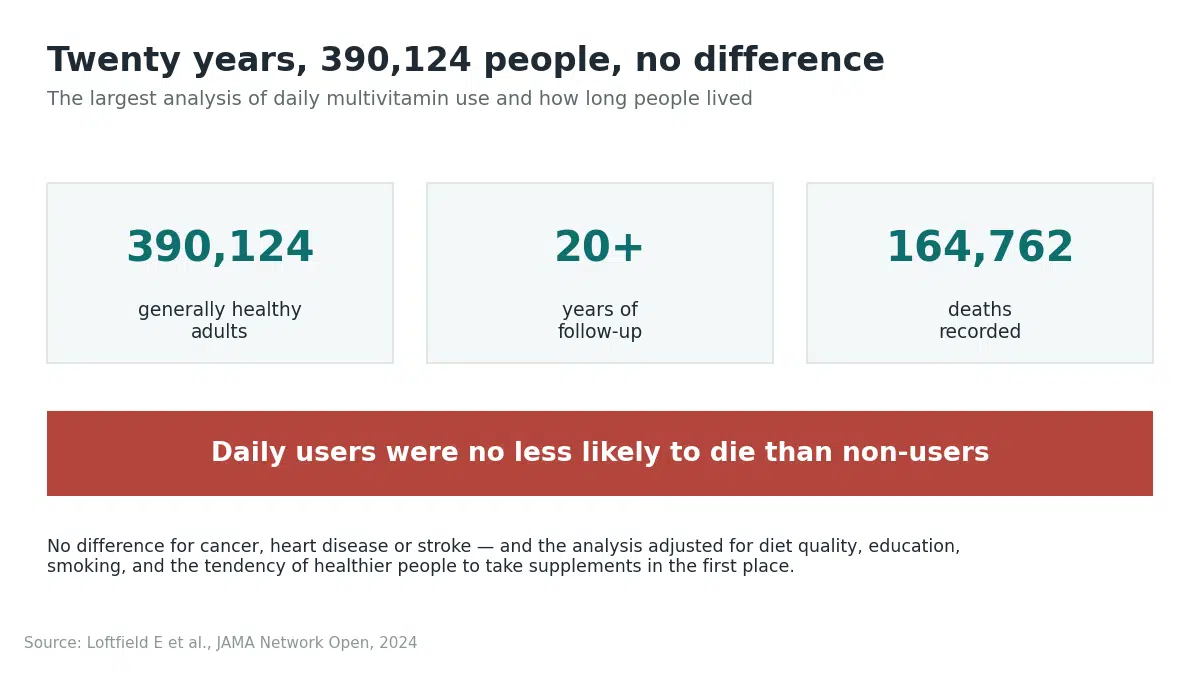
The biggest mortality analysis found nothing. In 2024, National Cancer Institute researchers pooled three large US cohorts covering 390,124 generally healthy adults followed for more than 20 years, with 164,762 deaths recorded. Daily multivitamin users were no less likely to die than non-users. No difference for cancer, heart disease, or stroke. The analysis was adjusted for diet quality, education, smoking and the tendency of healthier people to take supplements in the first place.[1]
The US Preventive Services Task Force says the evidence is insufficient. Reviewing the randomized trials in 2022, the USPSTF issued an “I statement” for multivitamins, meaning the balance of benefit and harm for preventing heart disease or cancer simply can’t be determined from the evidence available.[2] That is not the same as “they don’t work.” It means nobody has shown that they do.
The best single trial was mixed. The Physicians’ Health Study II followed nearly 15,000 male doctors for over a decade. Daily multivitamin use did not reduce heart attacks or strokes. It did produce a modest but statistically significant reduction in total cancer risk.[3] That is a real finding, in one population, that has not been convincingly replicated.
Put together: multivitamin benefits for disease prevention in healthy, well-fed adults are unproven after decades of looking.
Where Multivitamin Benefits Are Genuinely Real
Every study above looked at generally healthy people with no known deficiency. That is exactly the population least likely to gain anything. Change the population and the picture changes completely.
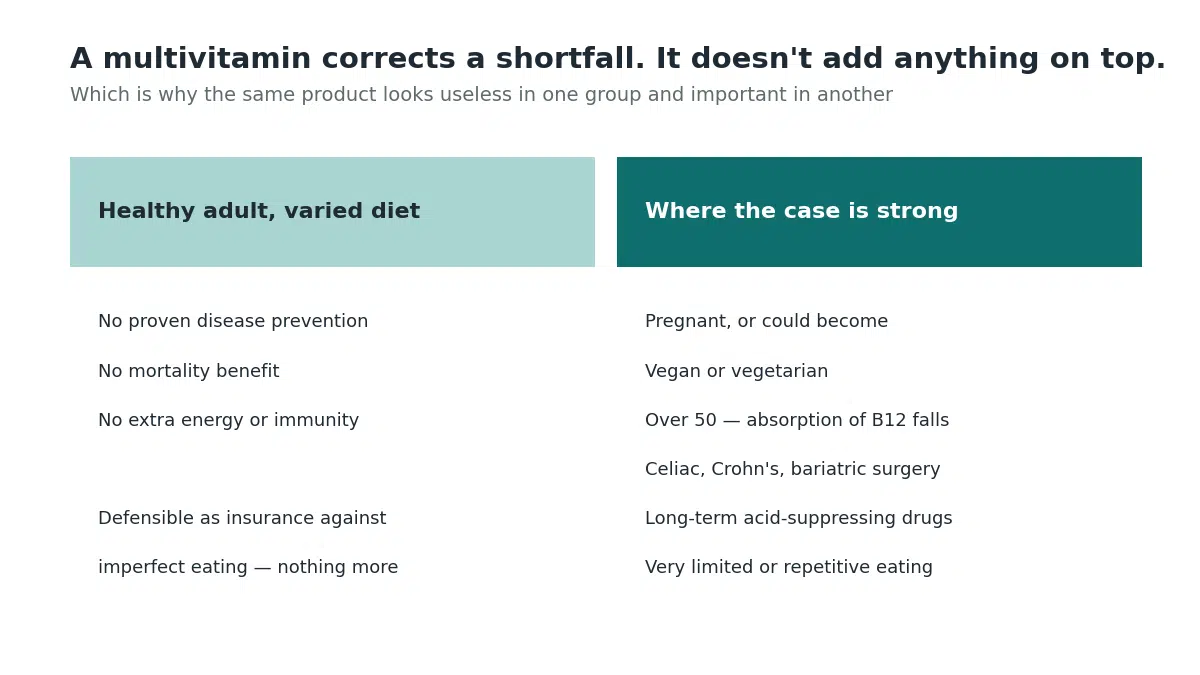
Pregnancy and anyone who could become pregnant. This is the clearest case in all of nutrition. The USPSTF separately recommends 400 to 800 micrograms of folic acid daily for everyone planning or capable of pregnancy, because it prevents neural tube defects, and the neural tube closes before most people know they’re pregnant.[2] Our guides to what folic acid does and choosing a prenatal vitamin go further.
People who don’t eat animal products. Vitamin B12 comes almost entirely from animal foods, and a genuine deficiency causes nerve damage that can become permanent. Supplementation isn’t optional here. Our piece on what B12 does in the body covers why.
Adults over 50. Stomach acid production falls with age, and B12 bound to food needs acid to be released. The supplemental form doesn’t have that problem, which is why B12 is one of the few nutrients where a supplement genuinely outperforms food in older adults.[5]
Restricted diets and absorption problems. Celiac disease, Crohn’s, bariatric surgery, long-term acid-suppressing medication, heavy alcohol use, and very limited or repetitive eating all create real gaps.
The common thread: a multivitamin corrects a shortfall. It does not add anything on top of sufficiency.
Two Ingredients Worth Avoiding
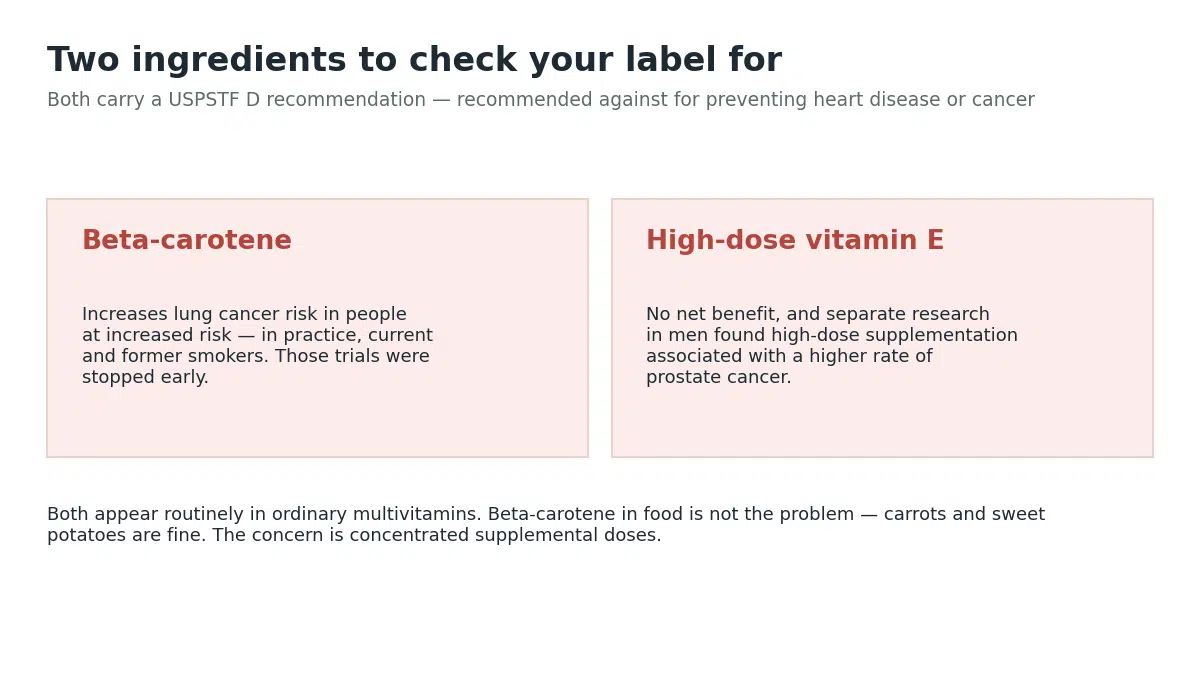
Beta-carotene and vitamin E. The USPSTF gives both a D recommendation, meaning it recommends against them for preventing heart disease or cancer, because the harms outweigh the benefits or there is no net benefit.[2]
Beta-carotene increases lung cancer risk in people at increased risk, which in practice means current and former smokers. That finding came from trials that were stopped early. If you smoke or used to, check your label.
Vitamin E showed no net benefit, and separate research in men found high-dose supplementation associated with a higher rate of prostate cancer.
Both appear routinely in ordinary multivitamins. This is the single most useful thing to check before buying one.
One nuance worth keeping straight: beta-carotene in food is not the problem. Carrots and sweet potatoes are fine. The concern is concentrated supplemental doses.
What a Multivitamin Won’t Do
Several claims attached to multivitamin benefits don’t survive contact with the evidence.
It won’t give you energy. B vitamins are needed to convert food into usable energy, which is not the same as supplying energy. If you’re not deficient, more does nothing. Persistent exhaustion despite adequate sleep needs investigating, not supplementing.
It won’t strengthen your immune system. Deficiency impairs immune function, so correcting one helps. Going above sufficiency doesn’t add protection, and some nutrients impair immune function in excess.
It won’t protect your eyes the way AREDS2 did. That NIH trial reduced progression of age-related macular degeneration by roughly a quarter, but it used a specific high-dose formulation in people who already had the disease.[4] A standard multivitamin is not that product and shouldn’t be bought as one.
It won’t replace food. Whole foods carry fiber and plant compounds no tablet reproduces. An orange is not a vitamin C pill.
Choosing One, If You’re Going to Take One
We don’t name specific products, because we don’t test them and nobody should trust a star rating invented by a website.
What to look for instead:
- A USP Verified or NSF Certified seal. Supplements aren’t reviewed by the FDA for safety or effectiveness before sale, so third-party testing is the only assurance the contents match the label
- Around 100% of the Daily Value for most nutrients. Formulas offering 500% or 1,000% add risk without demonstrated benefit
- No beta-carotene, and no high-dose vitamin E, per the section above
- Iron only if you need it. Menstruating women often do; men and postmenopausal women usually don’t, and excess iron accumulates
- Price is not a quality signal. Certified store brands frequently match premium products
Take it with a meal containing some fat, since vitamins A, D, E and K need it for absorption. Consistency matters more than the time of day.
Safety, Interactions and Who Should Be Careful
Mild nausea or constipation when starting is common and usually settles; taking it with food generally prevents it. The more serious issues are these.
Preformed vitamin A in pregnancy causes birth defects. Prenatal formulas use beta-carotene for this reason. Never take a high-dose vitamin A supplement while pregnant.
Iron is the leading cause of fatal poisoning in young children. Adult vitamins, and especially gummies, must be stored out of reach. If a child swallows any, call Poison Control immediately rather than waiting for symptoms.
Fat-soluble vitamins accumulate. A, D, E and K are stored in body fat, so excess builds up over time in a way water-soluble vitamins don’t.[5]
Interactions worth raising with a pharmacist: vitamin K works against warfarin; calcium and iron block absorption of thyroid medication and several antibiotics, and need spacing by a few hours; iron interferes with a number of drugs.
When to See a Doctor Instead
A supplement is a poor substitute for finding out what’s wrong.
- Exhaustion lasting weeks despite adequate sleep. Thyroid problems, anemia, diabetes, sleep apnea and depression all present this way and all are treatable. Our guide to what an underactive thyroid does and doesn’t explain covers one of them
- Numbness or tingling in hands and feet, or unsteadiness. This can be B12 deficiency, where delay risks permanent nerve damage. Our guide to what causes tingling hands and arms covers the wider list
- Unexplained weight loss, or unusual bruising or bleeding
- Breathlessness or a racing heart on ordinary exertion
- You suspect a deficiency. Ask for a blood test rather than guessing, since treating the wrong thing wastes months
Common Questions About Multivitamin Benefits
Do multivitamin benefits show up in the research?
Where a genuine deficiency exists, correcting it clearly helps. That’s a different question from whether healthy people gain anything.
Are multivitamins a waste of money?
The honest framing is insurance against imperfect eating, not disease prevention.
Which ingredients should I avoid?
Also skip iron unless you need it, and be wary of anything offering many times the Daily Value.
Will a multivitamin give me more energy?
Weeks of unexplained fatigue deserve a blood test, not a supplement.
Are expensive multivitamins better?
Certified store brands routinely meet the same standards as premium ones.
Are gummy vitamins as good as tablets?
They also look and taste like candy, which makes safe storage away from children more important, not less.
The Bottom Line
If you’re pregnant or might be, vegan, over 50, or have a condition affecting absorption, take one, and in those cases the multivitamin benefits are well established.
If you’re a healthy adult eating reasonably and hoping to prevent heart disease or cancer, the evidence doesn’t support it. Nearly 400,000 people over two decades showed no difference in how long they lived.
If you take one anyway as insurance against imperfect eating, that’s a defensible choice. Just buy a certified one at around 100% of the Daily Value, skip the beta-carotene, and don’t expect it to do the work that food, movement and sleep do.
SOURCESOur Editorial Standards
HealthMagHub is built on primary sources: peer-reviewed research, clinical practice guidelines, and health agencies such as the NIH, CDC, and FDA. Read our editorial standards to see how we research, cite, and update our articles.
- Loftfield E, O’Connell CP, Abnet CC, et al. Multivitamin Use and Mortality Risk in 3 Prospective US Cohorts. JAMA Netw Open. 2024;7(6):e2418729. pubmed.ncbi.nlm.nih.gov
- US Preventive Services Task Force. Vitamin, Mineral, and Multivitamin Supplementation to Prevent Cardiovascular Disease and Cancer: Recommendation Statement. JAMA. 2022. uspreventiveservicestaskforce.org
- Division of Preventive Medicine, Brigham and Women’s Hospital. Physicians’ Health Study II. prevmed.bwh.harvard.edu
- National Eye Institute. AREDS/AREDS2 Clinical Trials. nei.nih.gov
- National Institutes of Health, Office of Dietary Supplements. Multivitamin/mineral Supplements. ods.od.nih.gov
Disclaimer: This article is general information, not medical advice. Supplements interact with prescription medication and are not risk-free at high doses. Speak to a doctor or pharmacist before starting one, particularly if you are pregnant or could become pregnant, take regular medication, or have an existing condition. Keep all supplements containing iron out of reach of children.