


Tingling hands and arms almost never mean your nerves are dying. In most people something is pressing on a nerve somewhere along its route, and the pressure is coming from a wrist, an elbow, or a neck rather than from disease.
Which is reassuring, and most tingling hands settle once the pressure comes off. But a handful of causes are worth catching early, one of them sits in your medicine cabinet, and one pattern means calling 911 rather than booking an appointment. Here’s how to tell them apart.
- Which fingers go numb narrows the cause — thumb/index/middle points to carpal tunnel, ring/little finger points to the elbow.
- Both hands plus both feet points to bloodwork — B12, blood sugar, thyroid, kidney function.
- Fluoroquinolone antibiotics carry an FDA warning for nerve damage that can begin within days and sometimes doesn’t reverse.
- Sudden one-sided numbness with facial drooping, slurred speech or weakness is a stroke pattern — call 911, even if it passes.
What Causes Tingling Hands and Arms Most Often? A Squeezed Nerve
Tingling hands rarely arrive without a pattern. Three nerves run down each arm, each serving its own patch of skin, and which fingers go numb tells you which one is in trouble — this is the single most useful thing to notice before you see anyone.
Thumb, index, middle, and half the ring finger means the median nerve, squeezed as it passes through the wrist. That’s carpal tunnel syndrome, the most common trapped-nerve problem there is and the single likeliest explanation for tingling hands, affecting somewhere between 1 and 5 people in every 100. The little finger is spared, and that’s the giveaway.
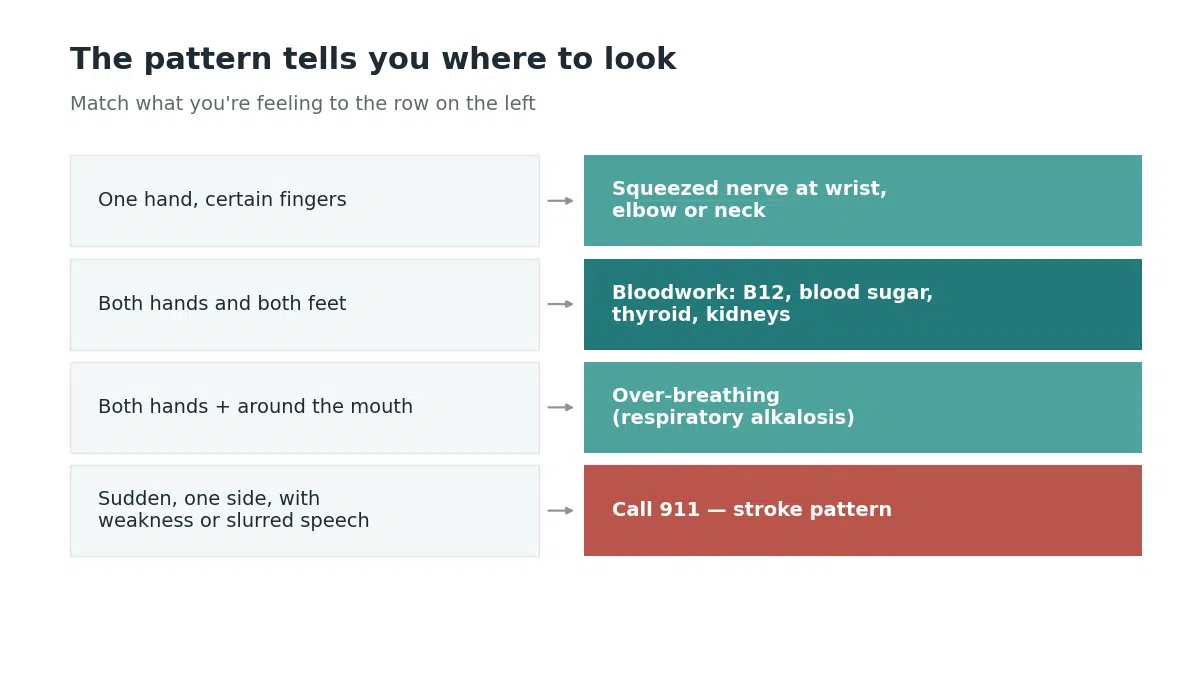
Ring and little finger points to the ulnar nerve, usually pinched at the elbow rather than the wrist. Tingling hands with a dead little finger after a long phone call, a night curled up on one side, or an arm hooked over a chair back all fit this one — it flares when the elbow stays bent.
A stripe running from the neck through the shoulder and down one arm suggests a nerve root being compressed where it exits the spine. Neck movement tends to make it worse, and it’s nearly always one-sided.
Carpal tunnel gets more likely with pregnancy, an underactive thyroid, diabetes, and work involving repetitive gripping or vibrating tools. Women get it more often, most commonly between 40 and 60.
Why It Wakes You at 3 A.M.
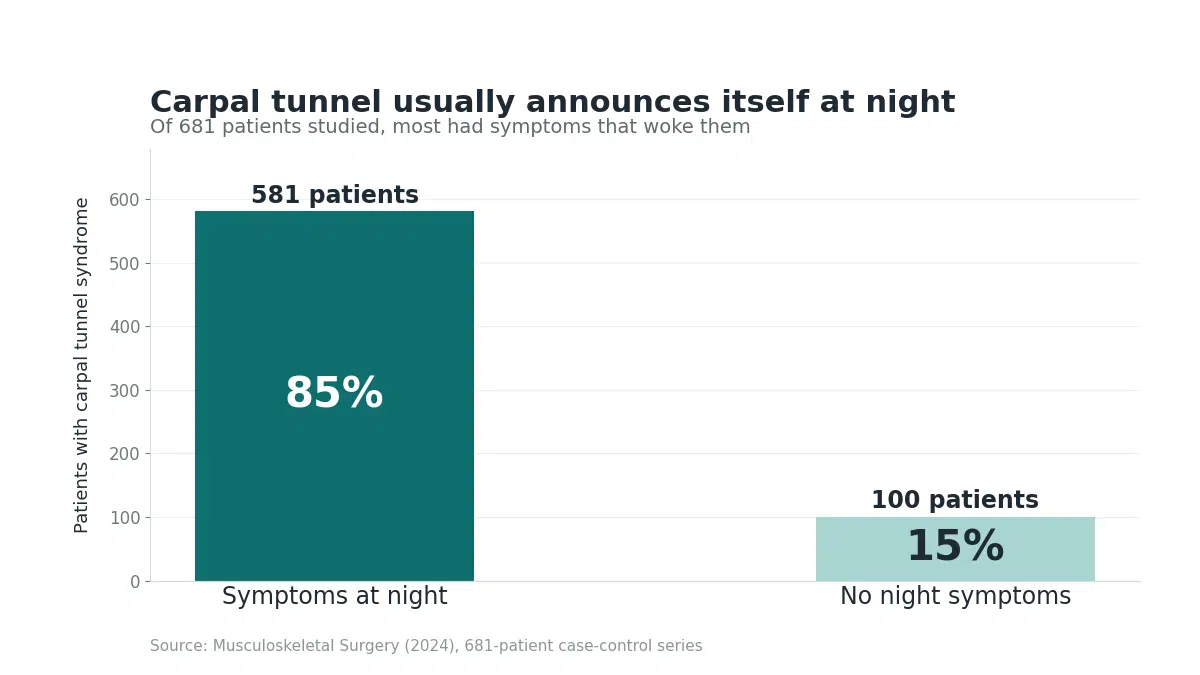
If tingling hands wake you, that’s a strong hint toward the wrist rather than anything more worrying. Night symptoms are the classic opening act of carpal tunnel: in one series of 681 patients, 581 of them had it. Most people describe shaking the hand out over the side of the bed until the feeling comes back.
The reason is dull. Wrists curl while you sleep, and a bent wrist narrows the tunnel the nerve runs through. A neutral wrist splint worn overnight holds it straight, which is why it’s the standard first suggestion and why most tingling hands at night improve with one.
Worth knowing that splints aren’t the strongest option, though. The INSTINCTS trial, published in The Lancet in 2018, compared a single steroid injection against night splints in primary care and found the injection clearly better at six weeks. If you’ve splinted for a couple of months and nothing has shifted, that’s the conversation to have rather than buying a third splint.
When Tingling Hands Point to Something Body-Wide
The pattern that changes the picture is both sides at once, plus the feet. Trapped nerves are local and usually one-sided. When tingling hands arrive together with tingling feet — often feet first, creeping up over months — the nerve endings themselves are the problem, and something systemic is behind it.
Five things account for most of it: diabetes or the prediabetic stage before it, a low B12 level, years of heavy drinking, a sluggish thyroid, and failing kidneys. A blood draw catches every one, and none of them are untreatable.
Numb feet also quietly cost you balance. Your ankles depend on pressure feedback from the soles to make constant small corrections, and when that feedback thins out, unsteadiness follows — which is why balance exercises belong in the plan alongside treating the underlying cause, ideally with supervision rather than alone at home.
Worth separating out one thing that often gets lumped in here: hands that are cold rather than numb point somewhere different again, usually circulation or thyroid rather than nerves — our guide to what’s behind cold hands and feet covers that list, including the medications that cause it.
B12 deserves particular attention, because delay costs you. The damage it does to the insulation around nerves can become permanent if it runs long enough, and folic acid can paper over the blood-count changes while the nerve damage carries on underneath — a trap covered in our guide to what B12 actually does. Vegans, people over 50, anyone on long-term metformin or acid-reducing drugs, and anyone who’s had weight-loss surgery are the ones who run short — and tingling hands are often the first thing they notice.
If diabetes turns out to be the cause, treating the blood sugar is the main lever. Supplements marketed for nerve pain are a secondary question with mixed evidence, which our piece on alpha lipoic acid dosing goes through honestly.
The Medications That Can Cause It
Here’s the one people skip. If tingling hands turned up within a few weeks of starting something new, the bottle may be the answer — and nobody will work that out unless you say so. Write down everything you swallow, prescriptions and supplements both, and put that list in front of whoever sees you before the tests start.
The clearest example is a class of antibiotics. In August 2013 the FDA required stronger labeling on all oral and injectable fluoroquinolones — ciprofloxacin, levofloxacin, moxifloxacin and others — warning that they can cause peripheral nerve damage. Two details matter to anyone taking one: it can begin within a few days of the first dose, and in some people it doesn’t go away. The agency’s instruction is to stop the drug and switch to a different antibiotic if symptoms appear. Eye and ear drops in the same family aren’t implicated.
Others worth knowing: several chemotherapy drugs, long courses of metronidazole, and — the one that surprises people — too much vitamin B6. A vitamin that treats nerve problems at normal doses causes them at high ones, which is why high-dose B6 shows up on the list of things to check in our look at what multivitamins actually contain.
Stopping a drug yourself is the wrong move, though. Call whoever put you on it, describe what your hands are doing, and let them decide what comes out.
When It’s Your Breathing, Not Your Nerves
Here’s a cause that gets missed constantly. Breathe faster than your body needs for long enough and you blow off too much carbon dioxide, which shifts your blood chemistry and changes how calcium behaves. The result is tingling hands.
It has a signature worth memorizing: both hands at once, tingling around the mouth, and lightheadedness. Sometimes the fingers cramp into a claw. It often comes with anxiety or a panic attack, though plenty of people do it without feeling especially anxious — a habit of over-breathing that shows up when they sit still.
Slowing your breathing settles it. Don’t use the paper bag trick you’ve seen in films; it’s no longer advised, because if the real problem is something else, restricting your oxygen makes it worse. And because over-breathing can be triggered by genuinely serious things, a first episode is worth getting checked rather than self-diagnosing.
When This Is an Emergency
Almost everything above develops over weeks or months. Speed and sidedness are what separate a nuisance from an emergency.
Call 911 if numbness or tingling comes on suddenly down one side, especially with any of these: a drooping face, slurred or garbled speech, weakness in the arm or leg, confusion, trouble seeing, or a sudden severe headache. That’s a stroke pattern. Call even if it passes off in minutes — a warning stroke carries a high risk of a full one in the days afterward, and that window is exactly when treatment helps most. The same logic applies to sudden numbness in the face or mouth.
Also get urgent care for:
- Numbness or weakness climbing upward from both feet over hours or days
- New weakness alongside a change in bladder or bowel control
- Numbness following a fall, a blow to the head, or a neck injury
- A hand that becomes genuinely weak — dropping things, losing grip — rather than just numb
- Wasting of the fleshy pad at the base of the thumb, which suggests long-standing nerve compression
Frequently Asked Questions
Can anxiety cause tingling hands?
Yes — anxiety produces tingling hands through over-breathing rather than through the nerves themselves. The pattern is both hands together, often with tingling around the lips and some lightheadedness. If it only happens during stressful moments and settles when your breathing slows, that fits.
What vitamin deficiency causes tingling hands and feet?
B12 is the main one behind tingling hands, and it’s worth testing rather than guessing. B1, B6 and copper deficiencies can do it too, but they’re rarer. Confusingly, an excess of B6 causes the same symptom — so check what’s in any supplement you’re taking before adding another.
Why do I wake up with tingling hands?
Most often a bent wrist compressing the median nerve overnight, which is why tingling hands are worst in the small hours. A neutral splint worn in bed is the usual first step. If both arms go dead in the small hours regularly and a splint does nothing after six to eight weeks, get it looked at properly.
Does tingling in the left arm mean a heart attack?
On its own, almost never — left-sided tingling hands are far more often a trapped nerve or over-breathing. What matters is the company it keeps. Arm discomfort with chest pressure, breathlessness, sweating or nausea is an emergency regardless of which arm it’s in.
Should I be worried about tingling hands that come and go?
Intermittent tingling tied to a position — leaning on an elbow, gripping a steering wheel, sleeping awkwardly — is usually mechanical and low-risk. Book an appointment if it’s becoming more frequent, lasting longer, spreading, or bringing weakness with it.
How long does nerve tingling take to settle?
It depends entirely on the cause. Positional compression eases in minutes. Tingling hands from carpal tunnel treated early often improve over weeks. Damage from a deficiency or a drug can take many months, and if it’s been left too long it may not fully reverse — which is the argument for sorting out the cause sooner rather than later.
The Bottom Line
Start with the pattern. Tingling hands on one side, in specific fingers, worse at night or in a particular position, points at a squeezed nerve and rarely needs anything dramatic. Both hands and both feet points at your bloodwork — B12, blood sugar, thyroid. Both hands with tingling around the mouth points at your breathing.
Check your medication list before you settle on an answer, especially if an antibiotic came just before the symptoms did. And if it arrives suddenly on one side with weakness, drooping or speech trouble, stop reading and call 911.
SOURCESOur Editorial Standards
HealthMagHub is built on primary sources: peer-reviewed research, clinical practice guidelines, and health agencies such as the NIH, CDC, and FDA. Read our editorial standards to see how we research, cite, and update our articles.
- U.S. Food and Drug Administration. FDA Drug Safety Communication: FDA requires label changes to warn of risk for possibly permanent nerve damage from antibacterial fluoroquinolone drugs taken by mouth or by injection. August 15, 2013.
- Lane JCE, Rodrigues JN, Furniss D, et al. INSTINCTS trial: corticosteroid injection versus night splints for carpal tunnel syndrome — an open-label, parallel group, randomised controlled trial. The Lancet, 2018;392(10156):1423-1433.
- Carpal Tunnel Syndrome: A Comprehensive Review. National Library of Medicine, PMC12569720.
- Risk factors, associations, and high-risk patient profiles for nocturnal pain in carpal tunnel syndrome. Musculoskeletal Surgery, 2024. doi:10.1007/s12306-024-00838-w
- The Effect of Hyperventilation Syndrome on Ionized and Serum Calcium: A Case Presentation in the Emergency Department. Cureus. PMC10442464.