
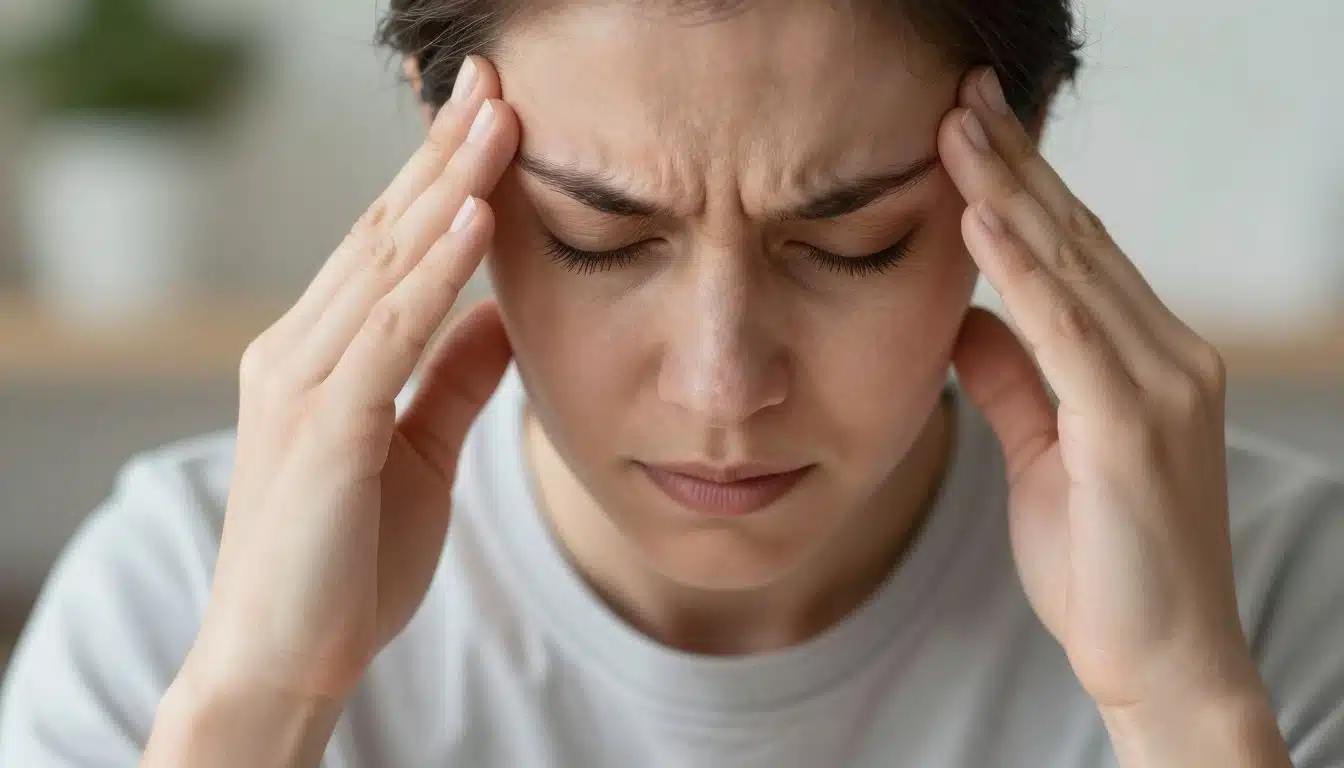
- Water resolves about two-thirds of dehydration headaches within 30 minutes.
- Cold suits throbbing migraine pain, heat suits tension from tight neck and shoulders.
- Using painkillers more than 15 days a month can itself cause rebound headaches.
- A sudden “worst of your life” headache, or a new one after 50 with scalp tenderness, is an emergency.
Get Emergency Care Now If
- Sudden, severe headache — the worst of your life, especially if it peaks within seconds. Can indicate a bleed or aneurysm
- Confusion, difficulty speaking, or trouble understanding speech
- Vision changes or loss of vision
- Weakness or numbness in the face, arm or leg — particularly one-sided
- Difficulty walking or sudden loss of balance
- Fever above 102°F with a stiff neck
- Seizure, or loss of consciousness
- Headache after a head injury, especially with vomiting or drowsiness
Two Causes Almost Never Considered
Carbon monoxide poisoning. If you wake with a headache that eases once you leave the house, and other household members have the same pattern, that’s the signature to take seriously — not coincidence. CO is odorless, and a headache is often the first symptom before nausea and confusion follow. Check your detectors, and if you suspect it, get outside and call for help rather than troubleshooting from inside.
Giant cell arteritis. A new headache in someone over 50, especially with scalp tenderness (combing hair hurts), jaw pain when chewing, or any vision change, needs same-day medical attention. Untreated, it can cause sudden and permanent vision loss — our guide to vision loss in one eye covers this same condition from the eye side.
Why Headaches Happen
Most headaches don’t come from a problem with the brain itself — the brain has no pain receptors. They come from tension in surrounding muscles, changes in blood vessels, or irritated nerves in the head, neck and scalp.
Tension headaches are the most common type — a tight band feeling, usually from stress, poor posture or screen time.
Migraines are different: more intense, often one-sided and throbbing, frequently with nausea or light sensitivity. Regular migraines are worth a dedicated conversation with a doctor about long-term prevention rather than managing each one as it comes.
Dehydration headaches happen as brain tissue temporarily loses fluid. Sinus headaches create pressure specifically around the eyes, nose and forehead, usually alongside nasal congestion or a recent cold — different from a tension headache in location and cause.
Want to identify your pattern? A quick note each time — what you were doing, what you’d eaten, how you’d slept — makes triggers visible within a few weeks that are invisible day to day.
6 Ways to Get Rid of Headaches Fast
These cover most headaches most of the time — in the order worth trying them.
1. Drink Water
Sounds too simple to work, but dehydration is a well-established headache and migraine trigger. A full glass at the first sign, then steady drinking through the day.
A reasonable check: urine should be pale yellow. Darker means you need more, especially after exercise, heat, or caffeine.
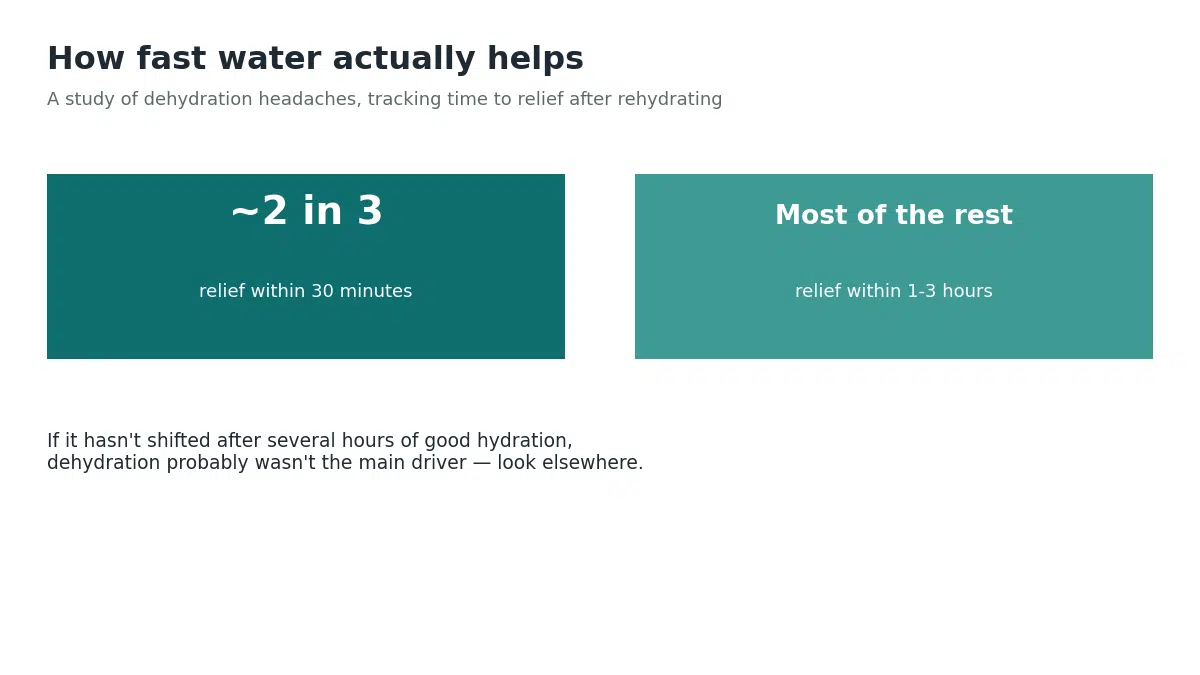
A study on water-deprivation headaches found relief within 30 minutes in about two-thirds of cases, and within one to three hours in most of the rest.[1] If it hasn’t shifted after several hours of good hydration, dehydration probably wasn’t the main driver.
2. Cold or Heat
Cold constricts blood vessels and dulls pain signals — ice wrapped in a thin towel, or a cold pack, on the forehead, temples or back of the neck for 15 to 20 minutes, never directly on skin.
Heat relaxes tense muscles instead and tends to suit tension headaches from tight neck and shoulders better than cold does. Cold usually suits throbbing migraine pain better. Some people use both at once — heat on the neck, cold on the forehead.
3. Remove Physical Pressure
Easy to miss: a tight ponytail, headband, cap, swim goggles or ill-fitting glasses can cause or worsen a headache by restricting blood flow and irritating scalp nerves — usually felt as a band around the head.
Posture matters too. Leaning toward a screen or cradling a phone strains neck muscles, which can trigger a headache starting at the base of the skull and spreading forward. Ears aligned with shoulders, screen at eye level, breaks every 30 minutes.
4. Rest in a Dark, Quiet Room
Bright light, noise and strong smells all worsen head pain, particularly with migraine. Reducing sensory input, even for 15 to 20 minutes, gives an overloaded system a chance to settle — and lowers stress hormones that can worsen pain further.
Keep a nap under 30 minutes if you’re going to rest during the day; longer daytime sleep can trigger headaches of its own. A cooler room, roughly 65–68°F, tends to help.
5. Over-the-Counter Medication
Ibuprofen and aspirin (NSAIDs) reduce inflammation and block pain signals — 200–400mg ibuprofen every 4–6 hours, taken with food, up to 1,200mg daily without medical supervision. Avoid with stomach ulcers.
Acetaminophen blocks pain signals without reducing inflammation, gentler on the stomach — 500–1,000mg every 4–6 hours, up to 3,000mg daily, and avoid alcohol alongside it.
Take at the first sign rather than waiting — it works better early. If nothing has shifted after two hours, taking more isn’t the answer; that’s a sign to see whether something else is going on.
The rebound headache trap
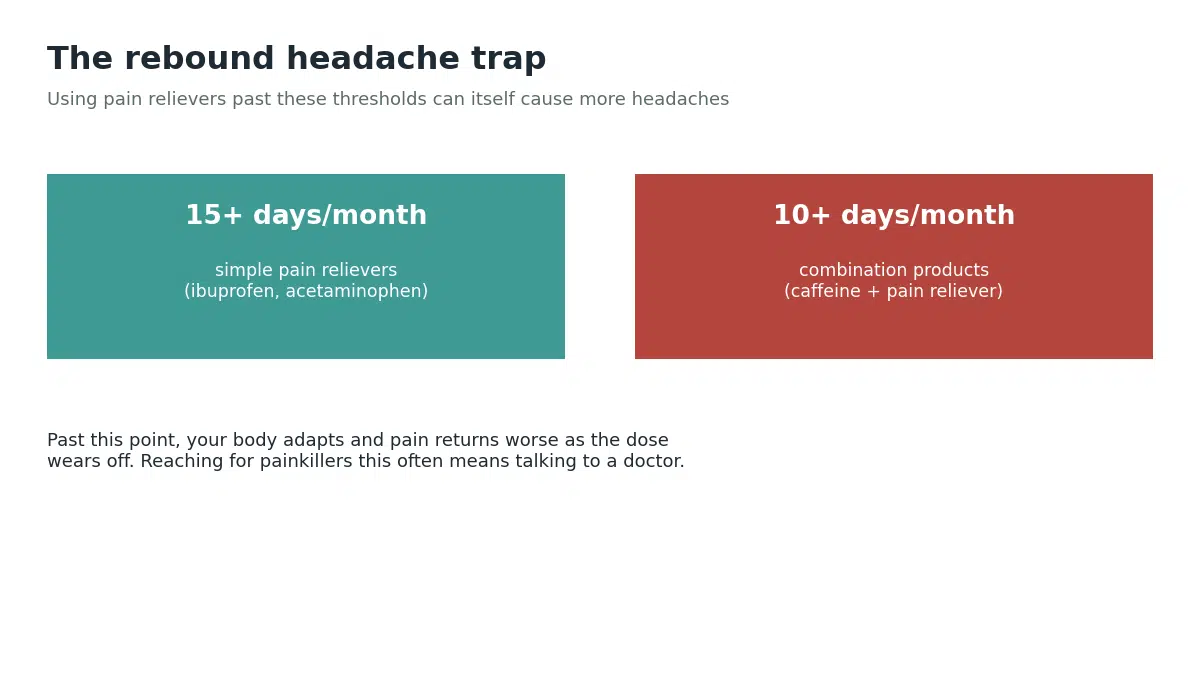
Using simple pain relievers more than about 15 days a month, or combination products more than 10, can itself cause medication overuse headache — your body adapts, and pain returns worse as the dose wears off.[3] If you’re reaching for painkillers that often, that’s a conversation with a doctor about prevention rather than more medication.
If you’re pregnant, on other medications, or have liver, kidney or stomach conditions, check with a doctor before regular use — these aren’t universally safe.
6. Caffeine, Carefully
A small amount — roughly 100mg, about a cup of coffee — constricts blood vessels around the brain and helps pain medication absorb faster. That’s why it’s in many combination headache products.
The catch: if you drink caffeine regularly and skip it, withdrawal headaches follow — typically 12 to 24 hours after the last dose, dull and whole-head rather than one-sided.[2] If you’re a regular coffee drinker, your usual cup might be treating the headache rather than the caffeine itself being remarkable.
Too much can also trigger headaches, particularly in people prone to migraine, and caffeine after early afternoon disrupts sleep — which causes headaches of its own the next day.
Other Options Worth Trying
Massage. Light circular pressure on temples, the base of the skull and sides of the neck, 15 to 20 seconds at a time on tender spots.
Deep breathing. In through the nose for four counts, hold four, out through the mouth for four. A few minutes genuinely lowers stress-driven tension.
Peppermint or lavender oil, diluted with a carrier oil before applying to skin, never ingested. Modest evidence, low risk.
Acupressure — firm pressure between thumb and index finger, or at the base of the skull, for a few minutes.
When to Book an Appointment
Beyond the emergencies above, see a doctor for:
- Headaches more than two or three times weekly
- Over-the-counter medication no longer helping
- A changing pattern, or headaches getting worse over time
- Headaches interfering with work, sleep or daily life
- Reaching for pain medication more than twice a week
- New headaches starting after a head injury
- New or different headaches after age 50 — worth ruling out giant cell arteritis specifically
- New headache in pregnancy, particularly after 20 weeks with vision change or upper abdominal pain — same-day assessment for possible preeclampsia
Bring when they started, how often, how long they last, and what helps or worsens them — plus every medication and supplement you’re taking.
Preventing Them in the First Place
Common triggers: skipped meals, poor hydration, disrupted sleep, stress, bright light, strong smells, weather changes, and for some people specific foods — aged cheese, processed meats, artificial sweeteners — or hormonal shifts through the menstrual cycle.
Consistency helps more than any single habit — regular sleep and wake times, regular meals rather than skipped ones, and 20-20-20 screen breaks (every 20 minutes, look at something 20 feet away for 20 seconds).
Regular exercise reduces frequency for many people, even a 30-minute walk most days.
A headache diary tracking date, activity, food, sleep, stress and weather reveals your own pattern in a way memory alone won’t.
Common Questions About Ways to Get Rid of Headaches
What are the fastest ways to get rid of headaches?
Over-the-counter medication taken early adds another reliable option when those aren’t enough.
How long should a headache take to go?
Dehydration headaches typically ease within 30 minutes to three hours of rehydrating.
Why do I wake up with a headache every morning?
If it happens to everyone in the house and eases once you’re outside, get carbon monoxide checked before anything else.
What’s the difference between a tension headache and a migraine?
Migraines can also last considerably longer and sometimes come with visual disturbance beforehand.
Is it safe to take pain medication every day?
If you’re taking painkillers more than twice a week, see a doctor about prevention rather than continuing to treat each episode.
Can certain foods trigger headaches?
Skipping meals entirely is at least as common a trigger as any specific food.
The Bottom Line on Ways to Get Rid of Headaches
Water, cold or heat, removing pressure, rest, appropriate medication, and careful caffeine cover most headaches most of the time.
Track what precedes yours — patterns become visible within a few weeks that are invisible day to day.
And a sudden, severe headache, or a new one after 50 with jaw pain or scalp tenderness, isn’t one to wait out.
SOURCESOur Editorial Standards
HealthMagHub is built on primary sources: peer-reviewed research, clinical practice guidelines, and health agencies such as the NIH, CDC, and FDA. Read our editorial standards to see how we research, cite, and update our articles.
- Gupta VK. Water-Deprivation Headache: A New Headache With Two Variants. Headache: The Journal of Head and Face Pain. pubmed.ncbi.nlm.nih.gov
- Caffeine Withdrawal. StatPearls, National Library of Medicine, NIH. ncbi.nlm.nih.gov
- Medication Overuse Headache. National Headache Foundation. headaches.org
- Centers for Disease Control and Prevention. Carbon Monoxide Poisoning. cdc.gov
Disclaimer: This article is general information, not medical advice. Seek emergency care for a sudden severe headache, confusion, vision changes, one-sided weakness, difficulty walking, fever with stiff neck, seizure, or headache after a head injury. See a doctor promptly for a new headache after age 50, or new headache in pregnancy with vision change or abdominal pain. Do not use pain medication more than a few days a week without medical advice.