
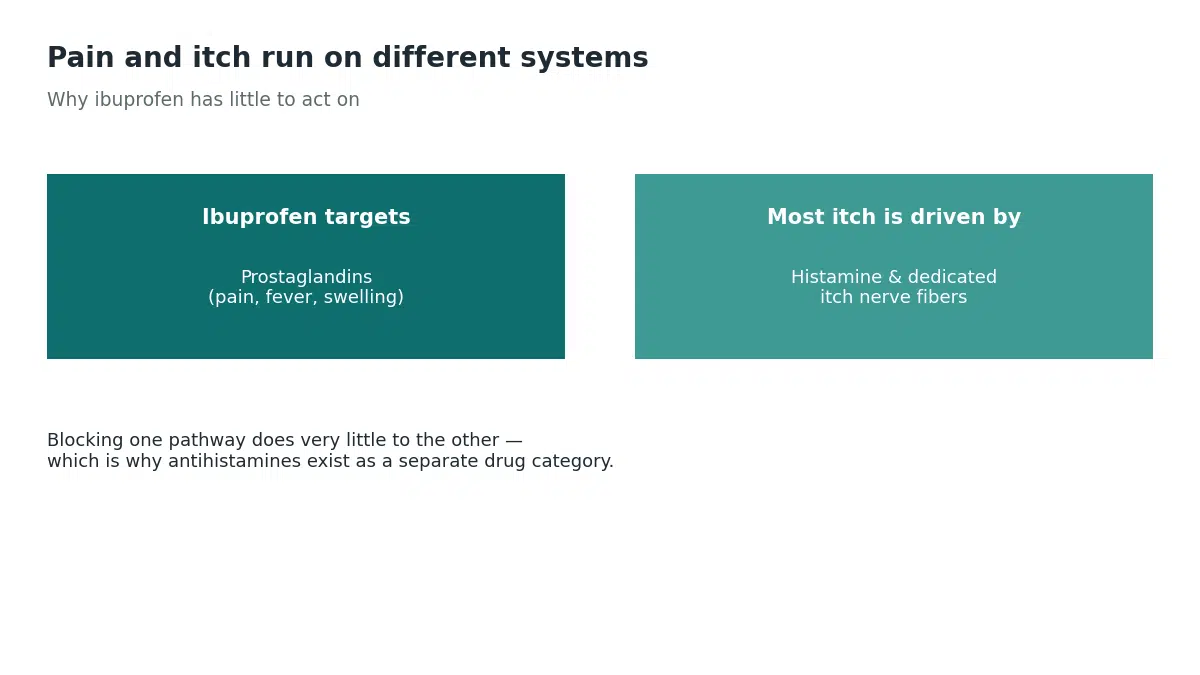
Ibuprofen blocks prostaglandins, which is why it works for pain, fever and inflammation. Most itching runs on a different system entirely: histamine and dedicated itch nerve fibers. Blocking one pathway does very little to the other.
That’s the short answer. The longer one matters more, because there’s a specific reason to be careful rather than simply disappointed.
- Ibuprofen targets prostaglandins, not histamine — the pathway behind most everyday itching, so it does very little for it.
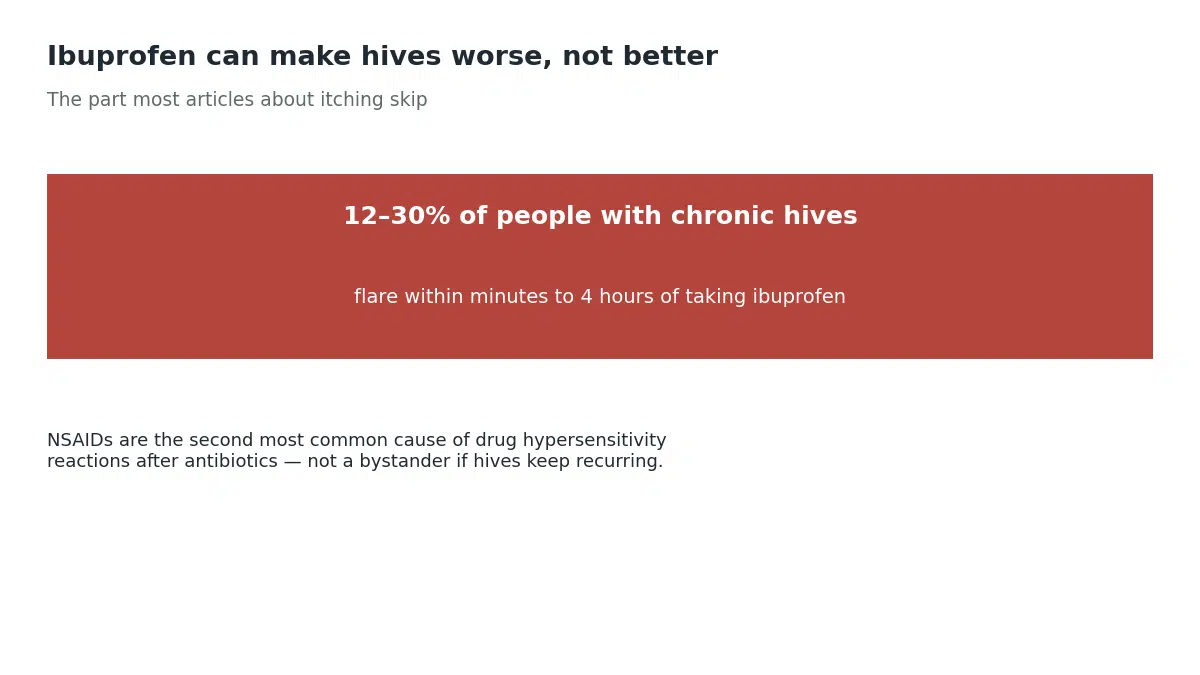
- In people with chronic hives, 12-30% flare within minutes to 4 hours of taking ibuprofen — it can make itching worse, not better.
- Second-generation antihistamines (cetirizine, loratadine, fexofenadine) are the right first choice for histamine-driven itch.
- Widespread itching with no rash can be an early sign of liver, kidney, thyroid or blood conditions and deserves a blood panel.
Before Anything Else
Call 911 or use an adrenaline auto-injector if itching comes with any of these: swelling of the lips, tongue or throat, difficulty breathing, wheezing, tightness in the throat, dizziness or faintness, or hives spreading rapidly over your body. That’s anaphylaxis, and it is time-critical.
Lie the person flat with legs raised unless breathing is difficult, and call for help even if symptoms seem to improve — reactions can rebound.
Do not take ibuprofen for this. It is not a treatment for an allergic reaction, and if the reaction is to an NSAID, it makes things worse.
Does Ibuprofen Reduce Itching? Why It Misses Most Causes
Ibuprofen is an NSAID. It inhibits the COX-1 and COX-2 enzymes, cutting prostaglandin production. Prostaglandins drive pain, fever and swelling, so that’s what ibuprofen treats.
Itch is carried by its own set of nerve fibers, responding mostly to histamine and a handful of other mediators. Pain and itch feel like cousins but they’re separate signaling systems, which is why antihistamines exist as a category distinct from painkillers.
So for the everyday causes — insect bites, hives, allergic reactions, dry skin, eczema — ibuprofen has essentially nothing to act on. If swelling is a large part of the problem, as with a badly inflamed sting or sunburn, reducing that swelling may make things marginally more comfortable. That’s a side effect of treating the inflammation, not itch relief.
The Part Most Articles Miss: Ibuprofen Can Cause Itching
This is the reason the question deserves more than “it doesn’t help.”
NSAIDs are, after antibiotics, the second most common cause of drug hypersensitivity reactions, affecting roughly 1–3% of the general population. They can produce hives and angioedema outright.
More striking is what happens in people who already get hives. Between 12% and 30% of people with chronic spontaneous urticaria flare within minutes to four hours of taking a COX-1–inhibiting NSAID like ibuprofen. The condition has a name — NSAID-exacerbated cutaneous disease — and guidelines advise people with chronic urticaria to avoid the trigger.
The mechanism is the same COX-1 blocking that makes ibuprofen useful for pain. Suppressing that pathway shunts production toward cysteinyl leukotrienes in the skin, which drives the flare.
So if you have hives and reach for ibuprofen, there is a meaningful chance you make them worse rather than better. If you have recurrent unexplained hives and regularly take NSAIDs, that’s worth raising with a doctor — the drug may be part of the pattern rather than a bystander.
What Actually Works for Itchy Skin
Non-drowsy antihistamines first
For histamine-driven itching — bites, hives, allergic reactions — antihistamines are the appropriate class. Modern guidance favours the second-generation, non-sedating options such as cetirizine, loratadine and fexofenadine as first choice.
Older sedating antihistamines like diphenhydramine are still widely recommended online as the default, but they’re no longer considered first line. They cause next-day grogginess, carry anticholinergic effects, and are specifically discouraged in older adults. Sedation is not the same thing as itch control.
Topical treatment where the itch is
Hydrocortisone 1% cream calms localized inflammatory itching. Calamine and menthol or pramoxine preparations interrupt itch signaling by changing the sensation. Prescription-strength steroids and non-steroid options exist for stubborn or delicate areas.
Topical antihistamine creams are best skipped over larger areas — they can sensitize the skin with repeated use.
Moisturizer, if the skin is dry
Dry skin is among the commonest causes of persistent itch, and no medication substitutes for repairing the barrier. Thick, fragrance-free emollient applied within a few minutes of bathing, reapplied through the day, does more than any tablet for this cause.
Simple measures that genuinely help
A cold compress for ten to fifteen minutes. Lukewarm rather than hot water, and short showers. Fragrance-free cleansers. Cotton rather than wool. Nails cut short. A cooler bedroom, since night-time itch is worse partly because skin warms under bedding.
What’s Causing It Matters More Than What You Take
Histamine-driven — insect bites, hives, allergic reactions, contact with an allergen. Responds to antihistamines, often within an hour.
Barrier-related — dry skin, winter itch, over-washing. Responds to moisturizer, not to tablets.
Inflammatory — eczema, psoriasis, contact dermatitis. Needs topical steroids or specialist treatment; antihistamines help sleep more than they help the skin.
Nerve-related — shingles, diabetic nerve damage, trapped nerves. Doesn’t respond to antihistamines at all and needs a different approach entirely.
Internal — liver, kidney, thyroid or blood conditions. This is the category worth knowing about, and it’s covered next.
When Itching Needs Investigating
Itching all over with no rash to explain it is the pattern that deserves attention. Widespread itch without visible skin changes can be the first sign of a problem elsewhere in the body, and it’s easy to dismiss as dry skin for months.
See a doctor promptly if generalized itching comes with:
- Yellowing of the skin or eyes, pale stools or dark urine — itching is a classic early feature of bile flow problems and can precede jaundice
- Night sweats, unexplained weight loss, fevers or swollen lymph nodes — persistent itch is a recognized, occasionally first, symptom of lymphoma
- Known kidney disease, or itching that started around dialysis
- Itching that reliably worsens after a hot shower
- Fatigue, cold intolerance or other thyroid symptoms
A blood panel covering liver function, kidney function, thyroid, iron and a full blood count answers most of these questions in a single appointment.
Also worth an appointment: itch lasting more than two weeks despite sensible treatment, itch that’s wrecking your sleep, itch that started after a new medication, or scratched skin that’s become infected — warm, spreading redness, oozing or crusting.
If the itching is on the soles of your feet specifically, that has its own set of causes — our guide to itching on the bottom of the foot covers them.
If You Take Ibuprofen for Pain, Separately
None of this means ibuprofen is a bad drug. It just isn’t an itch drug. If you’re taking it for something it does treat, the usual cautions apply.
- Stomach and bleeding risk. Higher with a history of ulcers, with corticosteroids, with SSRIs, and considerably higher with anticoagulants like warfarin.
- Blood pressure and kidneys. NSAIDs blunt several blood pressure medicines and can strain kidney function, particularly in older adults or anyone dehydrated.
- Low-dose aspirin. Ibuprofen can interfere with aspirin’s heart-protective effect if the timing overlaps — worth asking a pharmacist about spacing.
- Asthma. A subset of people with asthma react badly to NSAIDs; if you’ve ever wheezed after aspirin or ibuprofen, avoid them and say so.
- Pregnancy. Avoid NSAIDs from around 20 weeks unless a doctor has specifically advised otherwise.
Taking ibuprofen alongside an antihistamine is generally fine for most people — with the obvious exception that if the NSAID is what’s causing the reaction, adding an antihistamine on top of it treats the symptom while the cause continues.
Frequently Asked Questions
Does ibuprofen reduce itching?
Where swelling is a big part of the problem, reducing it may make things slightly more comfortable, but that’s treating inflammation rather than itch. An antihistamine is the right tool for most itching.
Can ibuprofen make hives worse?
NSAIDs are also the second most common cause of drug hypersensitivity reactions after antibiotics. If you get recurrent unexplained hives and take NSAIDs regularly, mention it to your doctor.
What should I take for itching instead?
For dry skin, thick fragrance-free moisturizer does more than any tablet. For localized inflammatory itching, hydrocortisone 1% cream.
Does ibuprofen reduce itching from mosquito bites?
If a bite has swollen substantially, ibuprofen may reduce that swelling — but it won’t stop the itch itself.
Why is itching worse at night?
A cooler bedroom, cotton bedding, and moisturizer applied before bed all help. A non-sedating antihistamine taken in the evening is reasonable if the cause is histamine-driven.
When is itching a sign of something serious?
See a doctor if it comes with yellowing of the eyes or skin, pale stools or dark urine, night sweats, unexplained weight loss or swollen lymph nodes — persistent itch is a recognized symptom of lymphoma. A single blood panel covers most of these.
Is it safe to take ibuprofen and an antihistamine together?
The exception worth naming: if the ibuprofen is what triggered the reaction, adding an antihistamine treats the symptom while the cause keeps going. Stop the NSAID rather than layering on top of it.
How long should I wait before seeing someone?
Don’t wait at all for itching with breathing difficulty, throat or lip swelling, or rapidly spreading hives — that’s anaphylaxis and needs emergency care.
SOURCESOur Editorial Standards
HealthMagHub is built on primary sources: peer-reviewed research, clinical practice guidelines, and health agencies such as the NIH, CDC, and FDA. Read our editorial standards to see how we research, cite, and update our articles.
- Kowalski ML, et al. Approaches to the diagnosis and management of patients with a history of nonsteroidal anti-inflammatory drug–related urticaria and angioedema. Journal of Allergy and Clinical Immunology. jacionline.org
- Chronic Urticaria with NSAID-Exacerbated Cutaneous Disease. The Journal of Allergy and Clinical Immunology: In Practice. jaci-inpractice.org
- Mayo Clinic. Itchy skin — diagnosis and treatment. mayoclinic.org
- American Academy of Dermatology. Itchy skin: everyday care. aad.org
Disclaimer: This article is general information, not medical advice. Speak to a doctor before starting or combining medications, particularly if you take anticoagulants, have asthma, kidney disease, stomach ulcers, or are pregnant. Seek emergency care for itching with breathing difficulty, throat or lip swelling, or rapidly spreading hives.