The whites of your eyes turn yellow before your skin does, so this is often the earliest visible sign. What follows is what causes it, what else to look for, and which combinations shouldn’t wait.
- Yellowing of eyes in an adult always warrants medical evaluation, because it’s never caused by tiredness or diet.
- Causes split into three groups: red cells breaking down too fast, the liver itself, or a blocked bile duct downstream.
- Eating a lot of carrots or squash can turn skin orange-yellow, but it never affects the whites of the eyes. Only bilirubin does that.
- Fever with abdominal pain, confusion, vomiting blood, or yellowing appearing within hours all need the emergency department.
Go to the Emergency Department If Yellowing of Eyes Comes With Any of These
Fever or chills with abdominal pain. Jaundice, fever and right-sided abdominal pain together is a recognized pattern for acute cholangitis, an infection of the bile ducts that can become life-threatening quickly.[3] Confusion, drowsiness, or difficulty staying awake can indicate the liver failing to clear toxins. Also seek emergency care for vomiting blood, or black or bloody stools, severe abdominal pain, or yellowing that appeared over hours rather than days. Any suspected acetaminophen overdose needs treatment early, so don’t wait for symptoms.
Without those, yellow eyes still need an appointment, within days rather than weeks.
Why Eyes Turn Yellow
Red blood cells live about 120 days. When they break down, the hemoglobin inside becomes bilirubin, a yellow pigment. Your liver processes it, packages it into bile, and your gut disposes of it.
Interrupt that chain anywhere and bilirubin accumulates. The sclera shows it first because the tissue there binds bilirubin readily, while skin needs considerably higher levels before it discolors. That’s why a doctor looks at your eyes when jaundice is suspected.
The causes group naturally into three, depending on where the chain breaks.
The Three Places It Goes Wrong
Before the liver: red cells breaking down too fast
If red cells are destroyed faster than the liver can keep up, bilirubin rises even though the liver is healthy. Hemolytic anemia, sickle cell disease, thalassemia and G6PD deficiency all work this way.
People with sickle cell disease often have a persistent mild yellow tinge, which deepens during a crisis. Some medications and infections can trigger hemolysis too.
The liver itself
Hepatitis, which is inflammation of the liver, stops liver cells processing bilirubin properly. It can be viral (hepatitis A, B or C), autoimmune, alcohol-related, or caused by medication.
Cirrhosis is the scarring left by years of damage, from chronic hepatitis, sustained heavy drinking or fatty liver disease. The scarring itself doesn’t reverse, though progression can often be slowed.
Tumors in the liver, whether starting there or spread from elsewhere, interfere in the same way.
After the liver: the drainage is blocked
Bile has to reach the intestine. When something obstructs the ducts, it backs up.
Gallstones are the commonest reason. Most sit harmlessly in the gallbladder for years; the trouble starts when one moves into the bile duct and lodges. That typically causes sudden, intense pain under the right ribs, often spreading to the back or right shoulder, with nausea.
Pancreatitis swells the pancreas, which sits against the bile duct and can compress it. Strictures, meaning narrowing from scarring, previous surgery or conditions such as primary sclerosing cholangitis, do the same more gradually.
Painless jaundice that comes on gradually, particularly with weight loss, needs investigating promptly, since obstruction from a tumor can present that way.
Worth mentioning to your doctor: supplements
Herbal and dietary supplements are a recognized and increasing cause of drug-induced liver injury, and people frequently don’t mention them because they don’t think of them as medication.
Bring the actual bottles to the appointment. Two we’ve covered in detail have documented liver signals. Red yeast rice contains a compound chemically identical to a statin, and ashwagandha has its own entry in the NIH’s drug-induced liver injury database.[4]
Green tea extract at high doses belongs on that list too. None of this means a supplement caused your jaundice. It means your doctor needs the full list to work it out.
What Else to Look For
These details genuinely help a doctor narrow things down, so notice them before your appointment.
Dark urine, tea or cola colored, means bilirubin is being cleared through the kidneys.
Pale, clay-colored stools point strongly toward blocked bile flow, because bile is what gives stool its normal color. Dark urine plus pale stools together is a meaningful combination.
Itching, sometimes intense and worse than any other symptom, from bile salts in the skin.
Pain under the right ribs, fatigue that rest doesn’t touch, appetite loss, unexplained weight loss, or feeling full quickly.
The Harmless Look-Alike
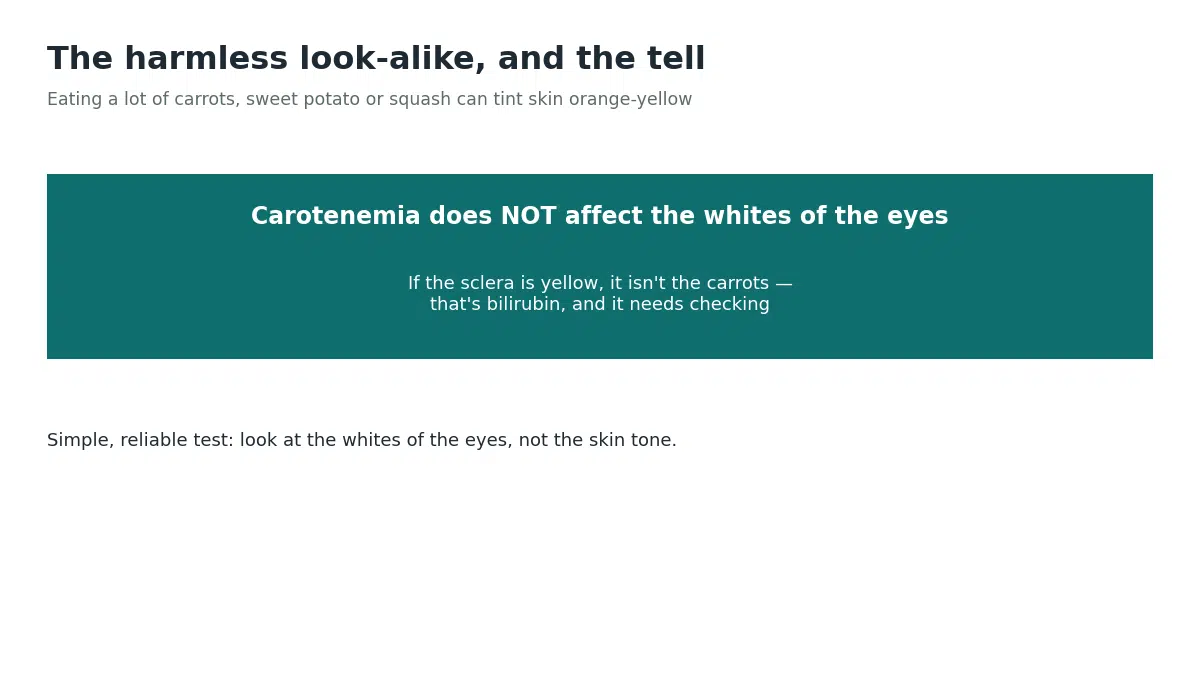
Eating a great deal of carrot, sweet potato, squash or pumpkin can turn skin faintly orange-yellow. That’s carotenemia, and it’s harmless.
The distinguishing feature is simple and reliable: carotenemia does not affect the whites of the eyes. If the sclera is yellow, it isn’t the carrots.
Jaundice in Newborns
Around 60% of full-term babies and 80% of premature babies develop visible jaundice in the first week.[1] Most of it is normal, because babies are born with surplus red cells and an immature liver.
Typical physiological jaundice appears on day two or three, peaks around day three or four, and fades over the following week or two, in a baby who is feeding and behaving normally.
Phototherapy is the usual treatment when levels need bringing down, and it works well. It’s used because very high bilirubin can cause brain injury, which is exactly why newborn jaundice gets monitored rather than assumed to be fine.
Call your pediatrician straight away if your baby has yellowing within the first 24 hours of life, yellowing spreading to the arms or legs, unusual sleepiness or difficulty waking, poor feeding or a weak suck, jaundice deepening after day three or lasting beyond two weeks, or a fever.
What Your Doctor Will Do
Blood tests come first: a complete blood count, liver function tests, and bilirubin. Total bilirubin is normally under about 1.2 mg/dL.[2]
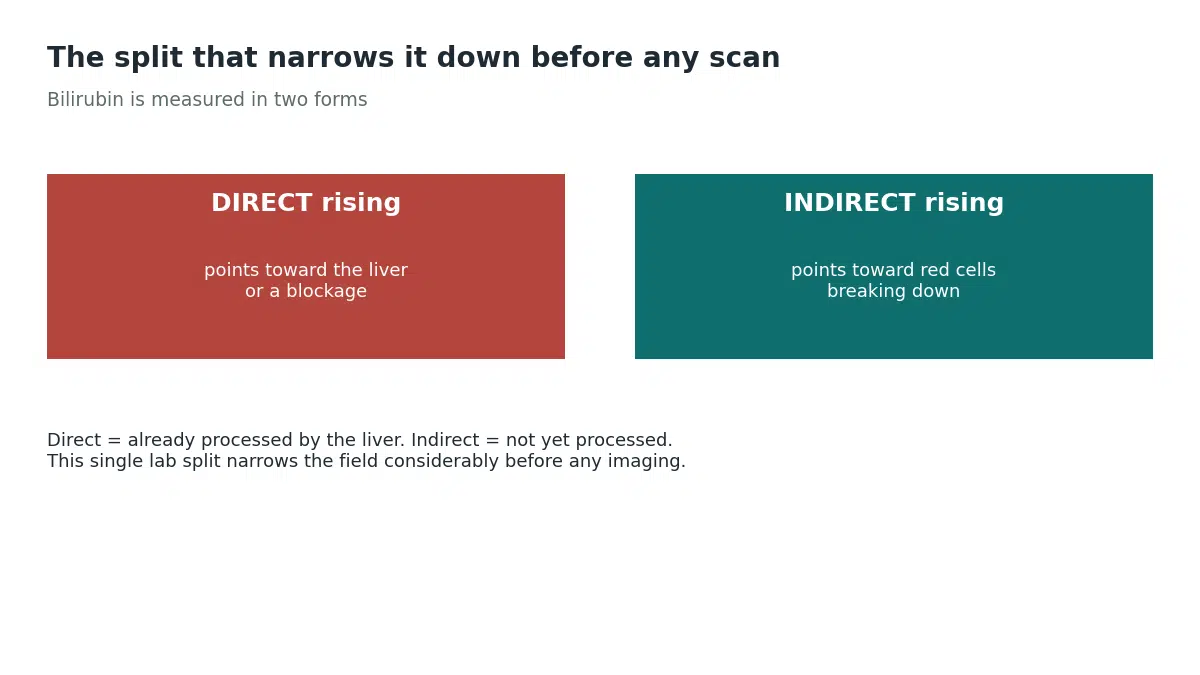
The useful part is that bilirubin is measured in two forms. Direct (processed) bilirubin rising points toward the liver or a blockage; indirect (unprocessed) rising points toward red cells breaking down. That single split narrows the field considerably before any scan.
Imaging usually follows. Ultrasound comes first, since it’s quick and good at spotting gallstones and dilated ducts, then CT, MRI or MRCP if more detail is needed. A liver biopsy is occasionally required to confirm what’s happening in the tissue itself.
Treatment targets the cause rather than the color: antivirals for hepatitis B or C, immunosuppression for autoimmune hepatitis, stopping alcohol, removing gallstones surgically or by ERCP, stenting a narrowed duct, or managing the underlying blood disorder.
Protecting Your Liver
Not every cause is preventable. Genetics and autoimmune disease aren’t lifestyle choices, but several others are.
Keep alcohol moderate; it remains a leading cause of liver disease. Vaccination covers hepatitis A and B and is highly effective. Don’t share needles, razors or toothbrushes, since hepatitis B and C spread through blood.
Watch weight, because fatty liver disease is now a common route to cirrhosis. Follow dosing instructions on medication, particularly acetaminophen-containing products, where it’s easy to double up without realizing because it appears in so many cold and pain remedies.
Common Questions About Yellowing of Eyes
Does yellowing of eyes always mean liver disease?
Blood tests distinguish these quickly, which is why the answer comes from testing rather than guessing.
Can yellow eyes go away on their own?
Fading slightly isn’t a reason to skip the appointment; something raised it in the first place.
Can eating carrots turn my eyes yellow?
Yellow sclera means bilirubin, not diet.
Can stress or lack of sleep cause it?
Don’t attribute yellowing to stress. It always reflects something measurable.
Can medications cause yellow eyes?
Report it rather than stopping a prescription on your own, and bring supplements to the appointment too.
Is it contagious?
The yellowing is the signal, not the infection.
The Bottom Line
Yellowing of eyes is one of the few symptoms that is always worth acting on. It isn’t cosmetic and it isn’t caused by tiredness or diet.
Note the color of your urine and stools before you go, and take a list of everything you take, prescriptions and supplements both.
And if there’s fever, abdominal pain, confusion or blood, that’s an emergency department tonight rather than an appointment next week.
SOURCESOur Editorial Standards
HealthMagHub is built on primary sources: peer-reviewed research, clinical practice guidelines, and health agencies such as the NIH, CDC, and FDA. Read our editorial standards to see how we research, cite, and update our articles.
- Neonatal Jaundice. StatPearls, National Library of Medicine, NIH. ncbi.nlm.nih.gov
- Bilirubin Test. Cleveland Clinic. my.clevelandclinic.org
- Cholangitis. StatPearls, National Library of Medicine, NIH. ncbi.nlm.nih.gov
- LiverTox: Clinical and Research Information on Drug-Induced Liver Injury. National Institute of Diabetes and Digestive and Kidney Diseases. ncbi.nlm.nih.gov
Disclaimer: This article is general information, not medical advice. Seek emergency care for jaundice with fever, severe abdominal pain, confusion or drowsiness, vomiting blood, or yellowing that appears within hours. Tell your doctor about every supplement you take.