The sensation comes from the surface of the eye drying out unevenly. Your cornea is densely supplied with nerve endings, so a tear film that’s breaking down registers as roughness rather than dryness.
Most of the time this is treatable at home. Occasionally it’s a signal worth acting on quickly, and it’s worth knowing which is which before you spend three months on eye drops.
- Gritty eyes usually come from an unstable tear film, most often blocked oil glands in the eyelids.
- Sustained warm compresses (5-10 minutes, twice daily) are the highest-value home fix for gland dysfunction.
- Watering doesn’t rule out dry eye. Reflex tears are mostly water and often signal dryness rather than disprove it.
- Contact lens wearers with a painful eye should remove the lens and get seen the same day, not wait it out.
When Gritty Eyes Need Urgent Care
If you wear contact lenses and the eye is painful, take the lens out and be seen the same day. Corneal infection in lens wearers can scar sight permanently and moves quickly.[4] The same urgency applies if your vision has changed and doesn’t clear when you blink, or if you have severe pain, or light so uncomfortable you can barely open the eye.
If something struck or scratched your eye, or chemicals splashed in, irrigate for 15-20 minutes first, then get seen. Thick discharge with swelling, or an eye you can’t open, also needs the same-day route.
Everything else on this page assumes none of the above applies.
What Causes Dry Eye and That Gritty Feeling
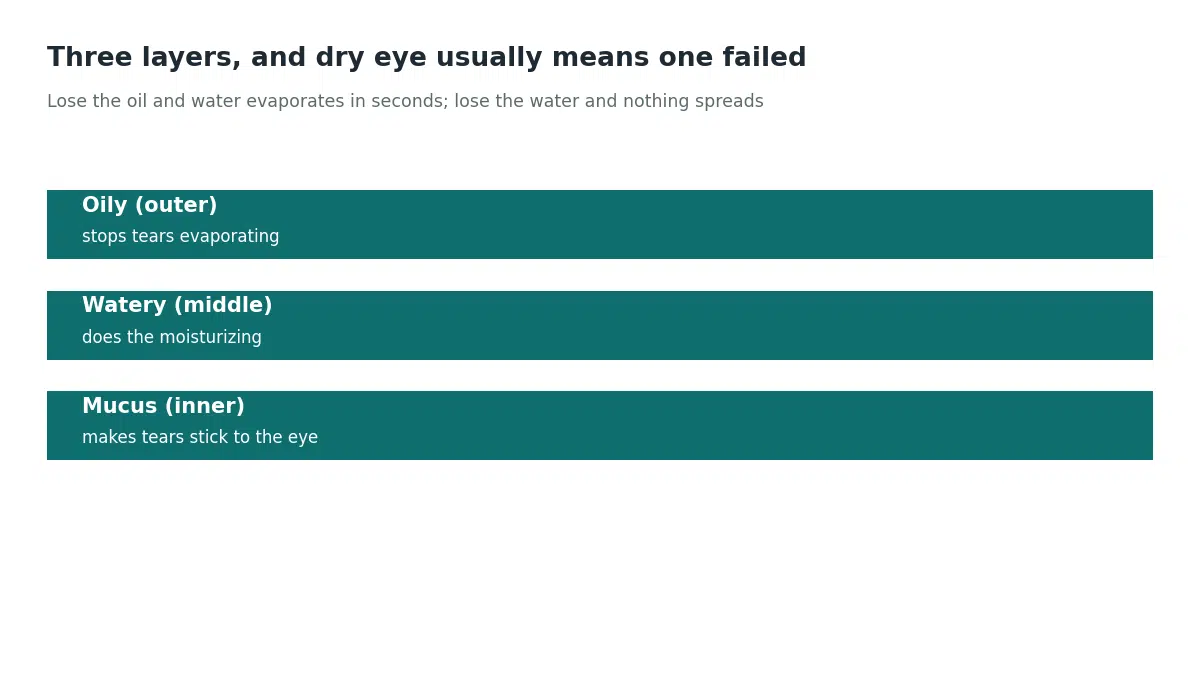
Your tear film has three layers, and dry eye usually means one of them has failed.[1]
An outer oily layer stops tears evaporating. A middle watery layer does the moisturizing. An inner mucus layer makes tears stick to the eye’s surface. Lose the oil and the water evaporates in seconds; lose the water and there’s nothing to spread.
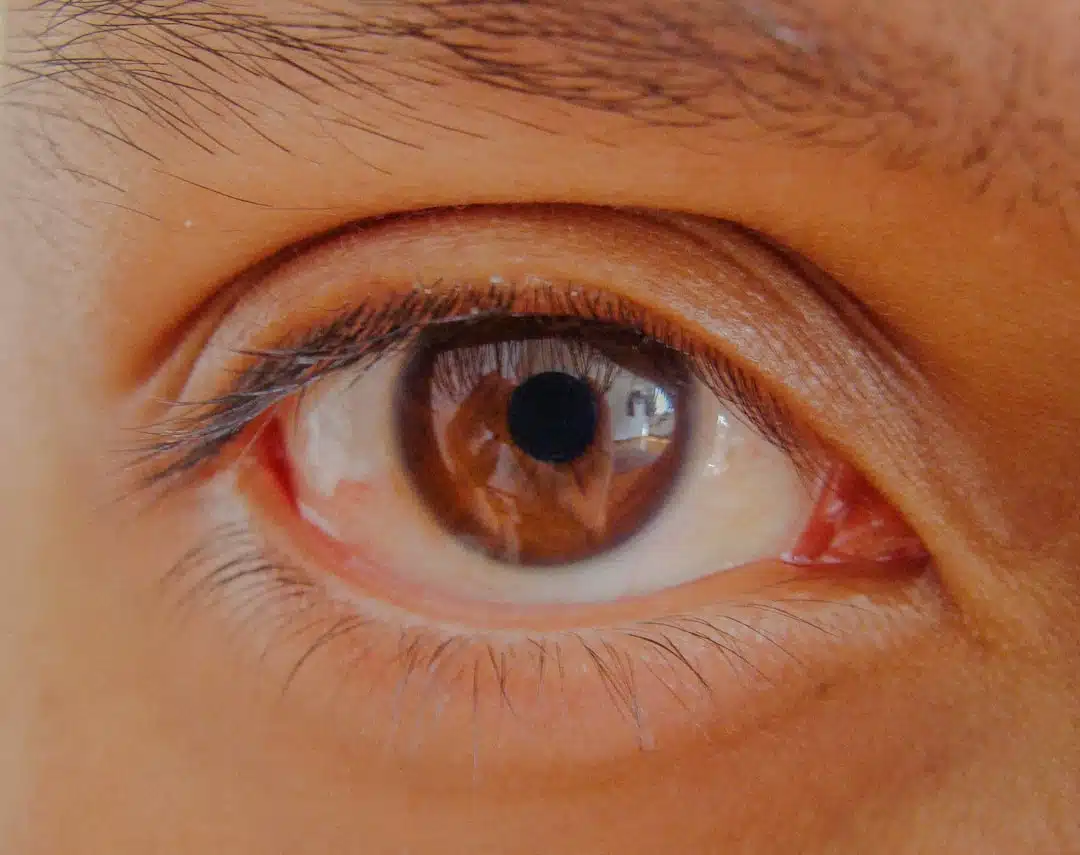
Meibomian gland dysfunction is the commonest culprit and the most underrecognized. Dozens of tiny oil glands line each eyelid margin. When their oil thickens and blocks the openings, the tear film loses its lid and evaporates too fast.[2] This is why warm compresses help. They physically melt the blockage.
Blepharitis is inflammation along the lash line, often alongside gland dysfunction. The giveaway is crusting on the lashes in the morning.[3]
Screens. Blink rate drops sharply during concentrated work, and each blink is what resurfaces the tear film. This is why dry eye symptoms typically build through the day rather than being there on waking.
Medications are frequently the missed cause: antihistamines, decongestants, several blood pressure drugs, antidepressants, and isotretinoin for acne all reduce tear production. The antihistamine one catches people out every summer. A few weeks of tablets for ragweed season settles the itching and leaves the surface of the eye drier than before. If your symptoms started within weeks of a new prescription, raise it with your prescriber rather than stopping the drug yourself.
Age and hormones. Tear production declines from around 40, and drops further after menopause. Hormonal shifts in pregnancy do something similar and are usually temporary.
Contact lenses get their own section below, because the risks there are different.
Why Dry Eyes Water
This confuses people constantly: eyes that feel gritty and dry often stream.
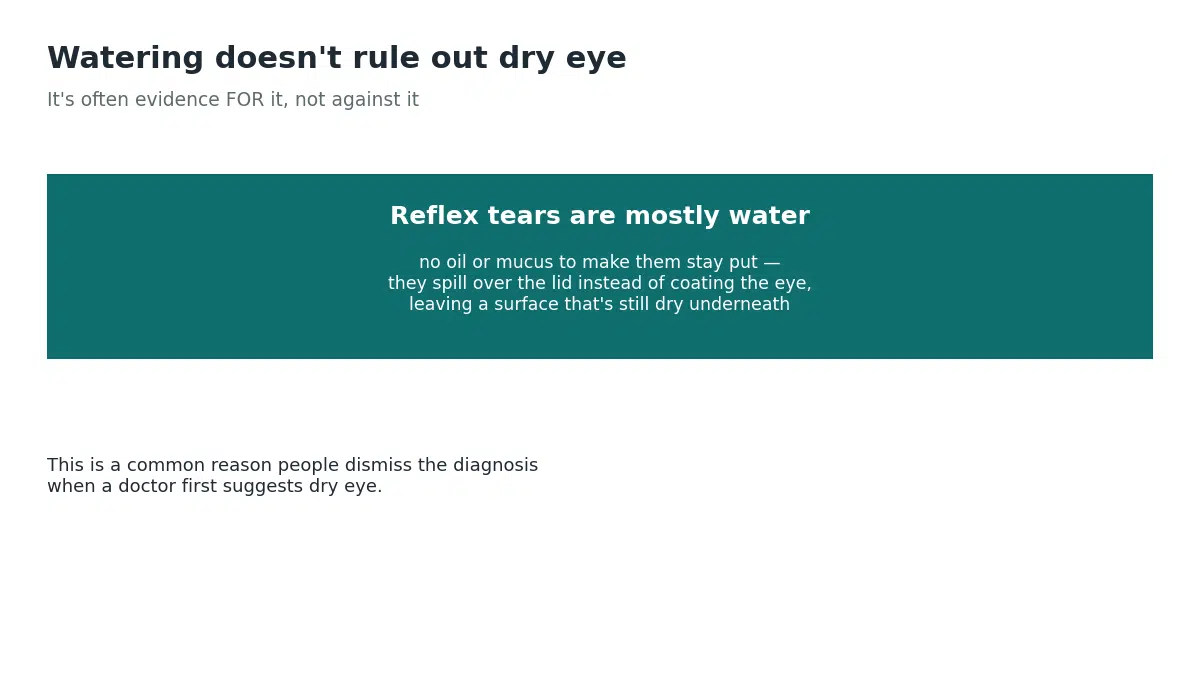
When the surface is irritated, the lacrimal gland floods the eye with reflex tears. These are mostly water, without the oil and mucus that make tears stay put. They spill over the lid rather than coating the eye, so you get wet cheeks and a surface that’s still dry.
Watery eyes are therefore not evidence against dry eye. They’re often evidence for it, and it’s a common reason people dismiss the diagnosis when a doctor suggests it.
The pattern worth mentioning to a doctor
Dry eye plus a persistently dry mouth, particularly with joint pain or unusual fatigue, can point to Sjögren’s syndrome, an autoimmune condition in which the glands producing tears and saliva are attacked.[1]
It’s frequently diagnosed late, because each symptom on its own looks minor and people mention them to different clinicians. If that combination describes you, say all of it in one appointment.
Dry Eye Remedies That Actually Help at Home
Warm compresses, done properly. This is the highest-value thing on the list for gland dysfunction, and most people do it too briefly. You need sustained heat: a warm washcloth reheated as it cools, held over closed eyes for a full 5 to 10 minutes, twice daily. A microwavable eye mask holds temperature better than a cloth. Follow with a gentle sweep along the lid margin to move the softened oil out.
Lid hygiene. A dedicated lid cleanser, or diluted baby shampoo on a cotton pad, wiped along the lash line with eyes closed. Once or twice daily if you have blepharitis.[3]
Artificial tears. Preservative-free if you’re using them more than four times a day, since preservatives themselves irritate with frequent use. Thicker gels last longer but blur briefly, so keep those for bedtime.
The 20-20-20 habit. Every 20 minutes, look at something around 20 feet away for 20 seconds. Its real value is that it restores blinking.
Environment. Humidifier in dry or heated rooms, and redirect car vents and fans away from your face. Wraparound sunglasses outdoors cut wind and evaporation.
Omega-3s have mixed trial evidence. Some studies show benefit for gland function; the largest showed little over placebo. Worth trying from oily fish, and not worth high hopes.
Give any of this two to four weeks before judging it. Gland function doesn’t change in days.
Dry Eye Remedies That Don’t Work
The home-remedy lists circulating online contain several things that are useless, and a few that are actively risky.
Redness-relief drops. The ones that promise to whiten the eye work by constricting blood vessels. They do nothing for dryness, and used regularly they produce rebound redness. The eye becomes redder than it started once the drop wears off. If a bottle advertises getting the red out, it is the wrong bottle.
Homemade saline. Never rinse an eye with anything mixed at home using tap water. Tap water carries Acanthamoeba, an organism that causes a rare but sight-threatening corneal infection, and lens wearers are especially vulnerable.[4] Sterile artificial tears cost very little.
Tea bags on the eyes. A warm tea bag is just an inefficient compress that also introduces tannins and whatever was on the bag. If you want heat, use a clean washcloth or a proper eye mask.
Cucumber, rose water and other kitchen remedies. Pleasant, cooling, and doing nothing whatsoever to an unstable tear film.
Rinsing with more water. Dry eye isn’t a shortage of water on the surface. It’s a tear film that won’t stay put, and flushing the eye washes away what little intact film is left.
The same logic applies to home remedies for pink eye, where the list of things to skip is longer than the list of things that help.
Dry Eye in Contact Lens Wearers
Lenses reduce oxygen reaching the cornea and compete with your eye for the available moisture. Protein deposits build on the surface, and a deposited lens is physically rough against the eye.
Practical fixes: daily disposables eliminate deposits entirely, silicone hydrogel materials pass more oxygen, and a couple of lens-free days each week gives the surface time to recover.
The rule that matters: if the eye hurts, the lens comes out and stays out. Pushing through discomfort is how a manageable irritation becomes a corneal ulcer. Never rinse lenses or cases with tap water, never top up old solution, and replace the case every three months.[4]
If your eyes look red as well as gritty, that combination in a lens wearer is worth a same-day opinion rather than a wait-and-see.
Dry Eye Treatments a Doctor Can Offer
Prescription drops. Ciclosporin and lifitegrast reduce surface inflammation so the eye makes better tears.[2] Both take four to six weeks to show their effect, which is worth knowing before you abandon them at week two.
Punctal plugs. Tiny inserts that block tear drainage, keeping what you produce on the eye longer. Temporary ones are usually tried first.
Gland expression and heat-based treatments. In-office procedures that clear blocked meibomian glands: manual expression, or devices applying heat and pressure together. Intense pulsed light is used where rosacea drives the inflammation.
Worth a note on the last group: these are effective for the right person but are also the most heavily marketed treatments in eye care, often paid for out of pocket. Ask specifically whether your glands are blocked and what the alternative is, before committing to a course.
If vision itself is affected rather than just comfort, particularly in one eye rather than both, that needs investigating separately. Dry eye blurs both eyes and clears momentarily on blinking; anything else doesn’t.
Common Questions About Dry Eye
Why is my dry eye worse in the morning?
A lubricating ointment before bed usually helps. Waking with eyes stuck shut is worth getting checked.
Can gritty eyes damage my vision?
Most people who get it looked at never approach that point.
Can medication cause dry eye?
Don’t stop anything on your own. Tell whoever prescribed it, since there’s often an alternative or a way to compensate.
Why do my eyes water if they’re dry?
Watering doesn’t rule out dry eye. It’s frequently a symptom of it.
How long before dry eye remedies work?
Judging any of them after a few days will tell you nothing useful.
Can allergies cause dry eye?
The bigger trap is the treatment: antihistamines help the allergy but reduce tear production, so they can worsen dryness. If your eyes turned gritty a couple of weeks into ragweed season, the tablets are a likelier explanation than the pollen.
The Bottom Line
Dry eye almost always means an unstable tear film, and blocked oil glands in the eyelids are the most common reason. Sustained warm compresses, lid hygiene, preservative-free drops and fewer uninterrupted screen hours resolve a great many cases.
Check your medication list, and mention a dry mouth or joint pain if you have them.
And if you wear contact lenses and the eye hurts, that’s not a dry eye problem to manage at home. Lens out, seen the same day.
SOURCESOur Editorial Standards
HealthMagHub is built on primary sources: peer-reviewed research, clinical practice guidelines, and health agencies such as the NIH, CDC, and FDA. Read our editorial standards to see how we research, cite, and update our articles.
- National Eye Institute. Dry Eye. nei.nih.gov
- American Academy of Ophthalmology. What Is Dry Eye? Symptoms, Causes and Treatment. aao.org
- American Academy of Ophthalmology. Blepharitis. aao.org
- Centers for Disease Control and Prevention. Contact Lens Health. cdc.gov
Disclaimer: This article is general information, not medical advice, and doesn't replace assessment by an eye care professional. Seek same-day care for a painful eye while wearing contact lenses, any change in vision, severe pain or light sensitivity, eye injury, or chemical exposure (irrigate for 15-20 minutes first). Do not stop prescribed medication because of eye symptoms without speaking to the prescriber.