
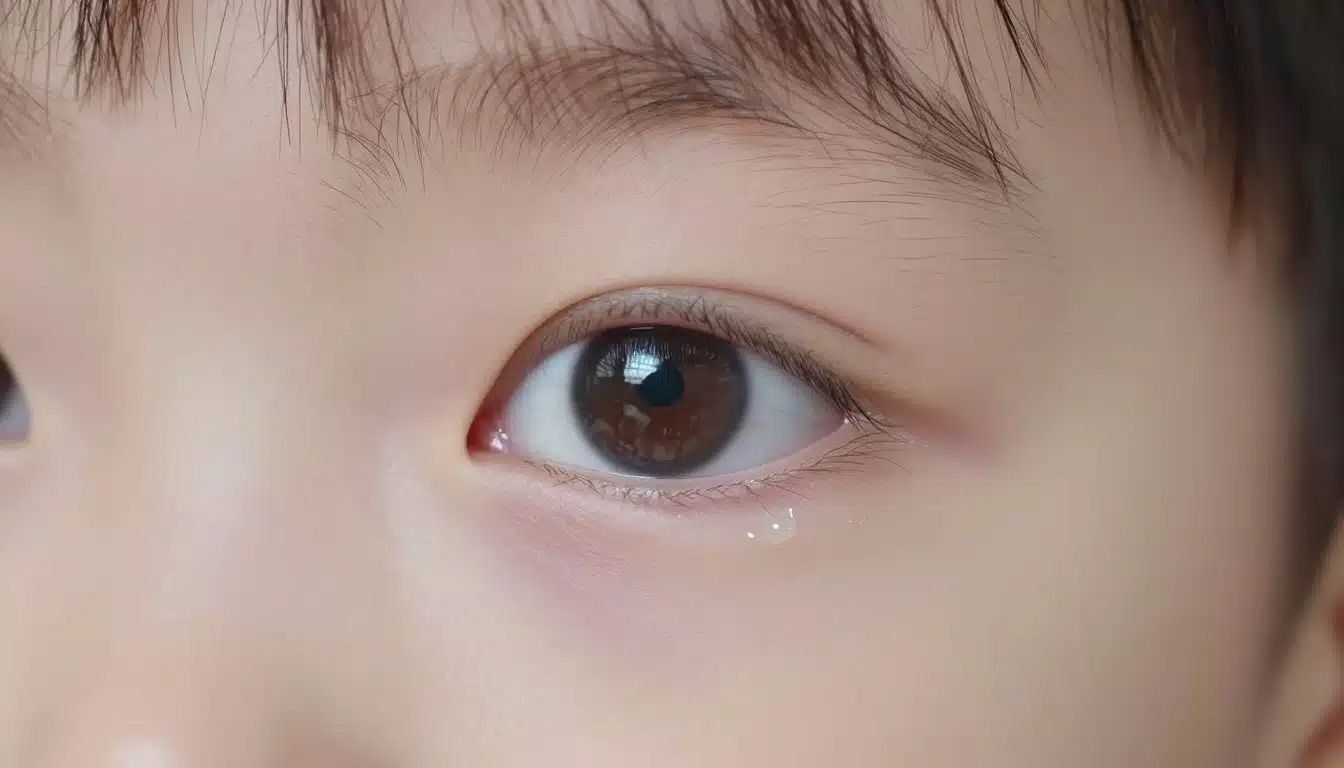
- Most eye discharge in kids is a viral “cold in the eye” that clears on its own, and the color of the discharge is a weak guide to the cause.
- Any eye discharge in a baby under one month old needs a doctor promptly. Rare newborn infections can damage the cornea within days.
- The AAP does not recommend routine school exclusion for pink eye, though many schools have their own stricter policies.
- A swollen, red, tender eyelid with fever is the one picture that needs same-day care, because it can signal an eye socket infection.
Get Medical Care Today If
Get your child seen the same day if the eyelid or the skin around the eye is red, swollen and tender, especially with a fever, or if the eye looks pushed forward, moves oddly, or your child says it hurts to move it. This can be an infection of the eye socket itself, which is an emergency. It threatens sight and can spread further.[4]
The same urgency applies if your baby is under one month old and has any eye discharge at all. Newborn eye infection is treated as urgent rather than as a wait-and-see, and it’s covered in more detail below. Get same-day care too if vision has changed or your child can’t see properly out of the eye, if there’s real pain rather than just irritation, or if they can’t keep the eye open in normal light.
If chemicals splashed in the eye, rinse with clean water for 15-20 minutes before you go anywhere. And if anything struck the eye, or something is stuck in it, that also needs same-day attention.
Otherwise, what follows covers the ordinary cases.
What Eye Discharge in Kids Is Telling You
Tears wash the eye constantly and drain through tiny openings in the inner corner of the lids into the nose. Discharge builds up when the eye is producing extra, or when that drainage is blocked.
Watery and clear, both eyes, with itching, usually allergy, particularly alongside sneezing or a runny nose. Not contagious.
Watery, starting in one eye, with a cold, usually viral. Very contagious, and antibiotics do nothing for it.[2]
Thick, yellow or green, lids stuck shut in the morning, more likely bacterial, though the overlap with viral is bigger than people assume.
Worth being honest about that last point: color is a weak guide. Yellow-green crusting happens with viral infection too, and studies of children with suspected conjunctivitis have found that assumptions about the cause based on appearance are often wrong.[2] Doctors weigh the whole picture, not the color on the pillowcase.
Pink Eye in Children
Conjunctivitis is inflammation of the clear membrane covering the white of the eye, and it’s the commonest reason for eye discharge in kids.
Viral is the most frequent by a distance. It runs one to two weeks and clears on its own. It often follows or accompanies a cold.
Bacterial also frequently clears without treatment. Antibiotic drops shorten it somewhat and are commonly prescribed, but the majority of cases resolve either way.
Allergic affects both eyes, itches intensely, and responds to antihistamine drops and reducing exposure.
Our guide to what actually helps with pink eye goes further into the differences, and red eyes generally covers the causes beyond infection.
School and Nursery: The Guidance Has Changed
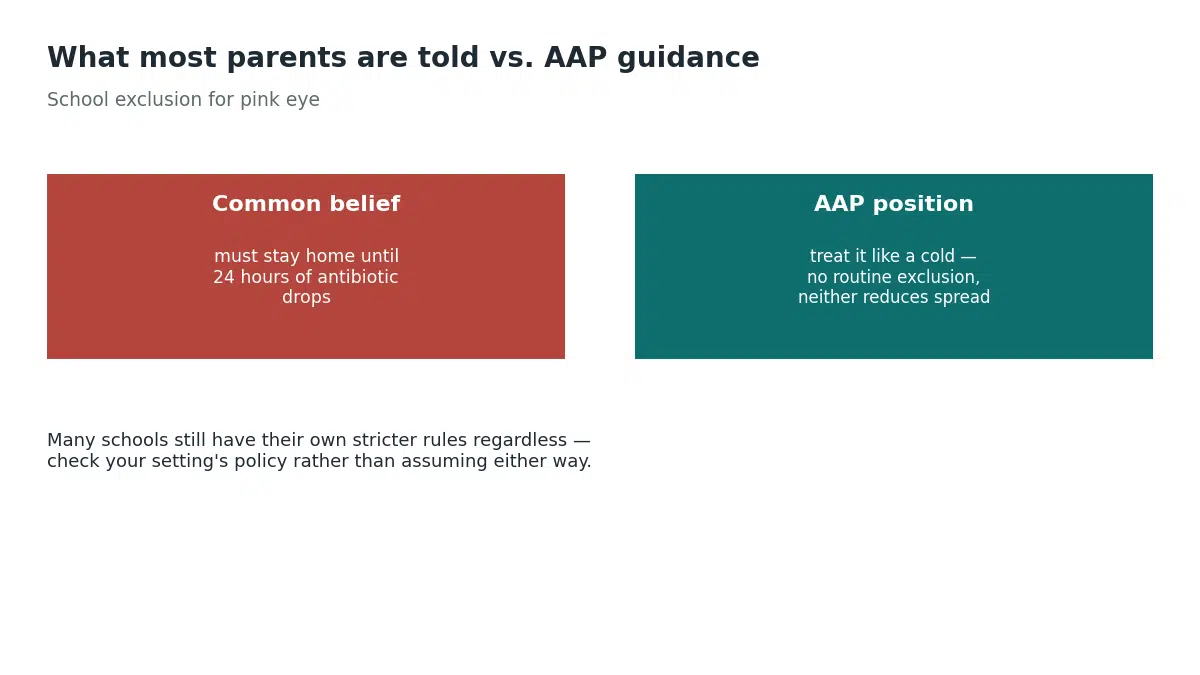
Many parents are told a child with pink eye must stay home until they’ve had 24 hours of antibiotic drops. That is not what the American Academy of Pediatrics recommends.
The AAP’s position is that bacterial and most viral conjunctivitis behave like a common cold. Both can spread, both resolve without treatment, and children aren’t excluded from school for a cold. The reasoning is that neither treating nor excluding children has been shown to reduce spread in group settings.[1]
The practical catch: many schools, nurseries and state health departments still have their own rules requiring treatment or a doctor’s note before return. Those policies exist regardless of the guidance, so check yours rather than assuming either way.
Keep your child home if they’re feverish, in pain, or too unwell to take part in the day, which is the same standard you’d apply to any illness.
Babies and Newborns
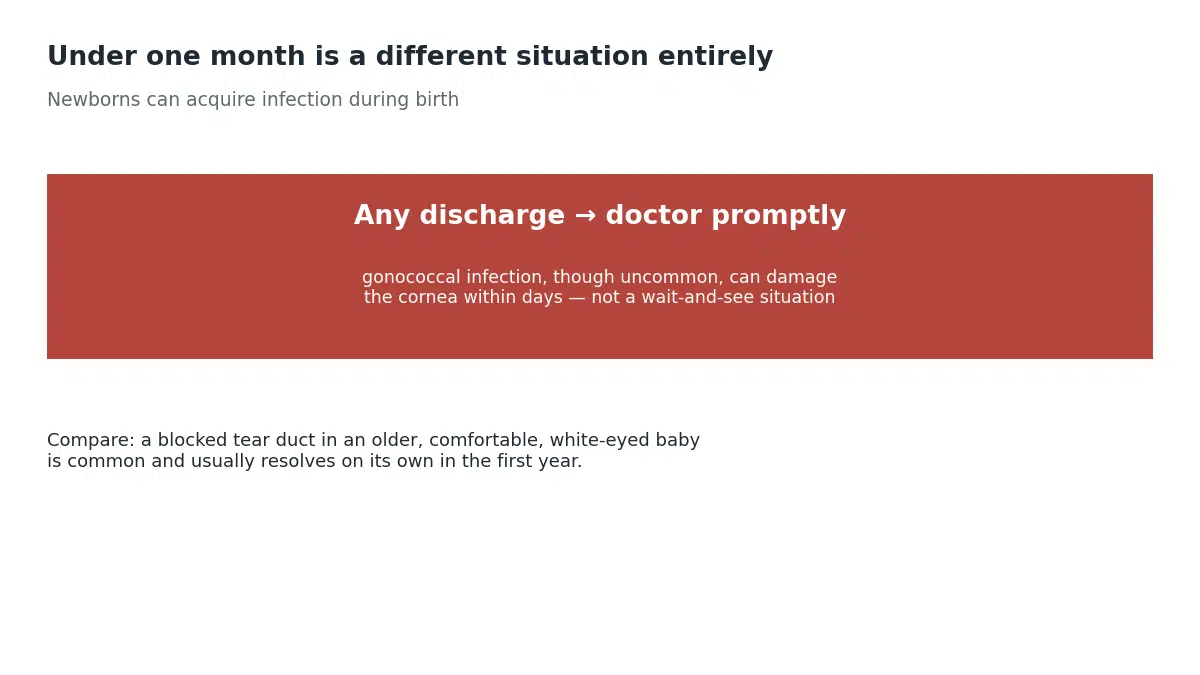
Under one month old, any eye discharge needs a doctor promptly. Newborns can acquire infections during birth, and a small number of these, particularly gonococcal infection, can damage the cornea within days. It’s uncommon, but the damage happens fast enough that it’s worth ruling out rather than waiting.
Blocked tear ducts are the usual explanation in older babies. The drainage channel hasn’t fully opened, so one eye waters constantly with sticky white or clear discharge, and the skin below can get sore.[3]
The eye itself looks white and the baby isn’t bothered. That’s the reassuring picture. Most open on their own during the first year. Your doctor can show you a gentle massage technique along the side of the nose, and if it hasn’t resolved by around a year, a quick probing procedure sorts it.
What changes the picture: a swollen, red, tender lump at the inner corner, a red swollen eyelid, fever, or a baby who seems unwell. That’s an infection on top of the blockage and needs seeing.
Looking After It at Home
Warm compresses. Clean washcloth, warm not hot, wrung out, held on the closed eye for five to ten minutes. Three or four times a day loosens crusting and soothes.
Wiping. Damp cotton wool, wipe from the inner corner outward, fresh piece for every wipe. Never back and forth, and never the same cloth on both eyes if only one is affected.
Hands. Yours and theirs, often. This is what actually limits spread through a household.[2]
Separate towels, washcloths and pillowcases while it lasts.
Don’t use leftover eye drops from a previous illness or another family member, don’t use contact lens solution in the eye, and don’t try to remove anything lodged under the eyelid yourself.
Breast milk is a widely shared remedy, and it isn’t recommended. There’s no good evidence it treats eye infection, and it introduces something unsterile into an already inflamed eye.
When to Call the Doctor
Beyond the emergencies at the top, book an appointment if:
- Discharge is getting worse rather than better after two or three days
- Your child has a fever alongside it
- The eyelid is swelling
- They’re rubbing constantly, saying the eye feels gritty, or avoiding light
- It keeps coming back
- Your child wears contact lenses. Lenses out, and get it looked at rather than waiting
If your child also has ear pain, our guide to middle ear inflammation in children covers the same when-to-worry questions.
Common Questions About Eye Discharge in Kids
Does yellow or green discharge always mean antibiotics?
Most bacterial conjunctivitis in children also clears without treatment, though drops may shorten it.
Does my child have to stay off school?
Check your setting’s policy, and keep them home if they’re feverish or unwell regardless.
My baby’s eye waters constantly. Is that an infection?
The reassuring signs are a white eye and a comfortable baby. Redness, swelling or fever changes that.
Why are my child’s eyes stuck shut in the morning?
Soften it with a warm compress and wipe outward from the inner corner. Don’t pull the lids apart.
Can I use breast milk in my baby’s eye?
Warm water and a clean cloth are safer, and a newborn with discharge should be seen anyway.
How long does it take to clear?
Getting worse after two or three days is the point to call rather than wait.
The Bottom Line
Most eye discharge in kids is a cold in the eye. Warm compresses, careful wiping, separate towels and frequent handwashing cover the great majority of it.
Don’t read too much into the color. Read the eyelid, the fever and the child.
A swollen, red, tender lid with a fever is the one picture that shouldn’t wait, and neither should any discharge in a baby under a month old.
SOURCESOur Editorial Standards
HealthMagHub is built on primary sources: peer-reviewed research, clinical practice guidelines, and health agencies such as the NIH, CDC, and FDA. Read our editorial standards to see how we research, cite, and update our articles.
- American Academy of Pediatrics. Pinkeye (Conjunctivitis): Child Care and Schools. publications.aap.org
- Centers for Disease Control and Prevention. Conjunctivitis (Pink Eye). cdc.gov
- American Academy of Ophthalmology. Blocked Tear Duct in Children. aao.org
- American Academy of Ophthalmology. What Is Cellulitis of the Eye? aao.org
Disclaimer: This article is general information for parents, not medical advice, and doesn't replace assessment by your child's doctor. Seek care the same day for a swollen, red or tender eyelid with fever, any eye discharge in a baby under one month old, changed vision, severe pain, eye injury, or chemical exposure (rinse for 15-20 minutes first). School and nursery exclusion rules vary, so check your own setting's policy.