
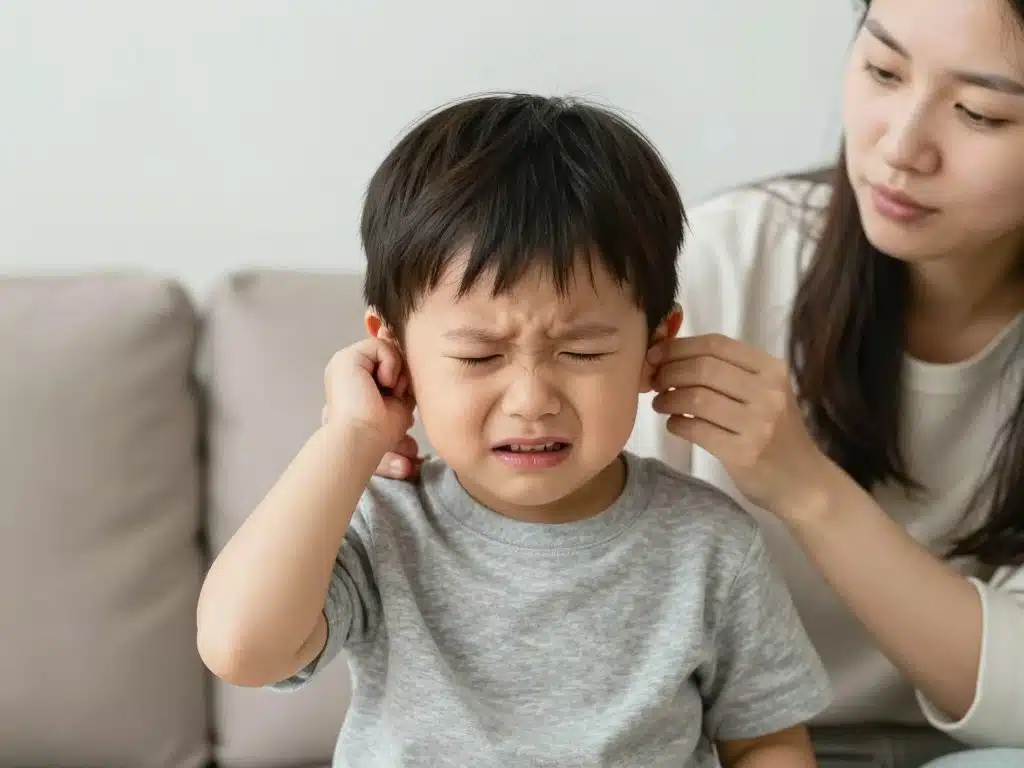
- Most ear infections in healthy children over six months improve within 48-72 hours without antibiotics. Pain relief plus a review point is the standard approach.
- Swelling, redness or tenderness behind the ear can be mastoiditis, an infection of the bone behind the ear, and needs urgent treatment.
- Ear tubes are discussed at specific thresholds: three infections in six months, four in a year, or months of fluid with hearing loss.
- Breastfeeding for six months is linked to about a 43% reduction in ear infections; secondhand smoke roughly doubles or triples the risk.
Get Medical Care Straight Away If
There’s swelling, redness or tenderness behind the ear, or the ear looks pushed outward. This can be mastoiditis, infection of the bone behind the ear, and it needs urgent treatment. Any fever in a baby under 3 months, or a temperature above 102.5°F in a young child, also needs prompt care, as does a stiff neck, severe headache, confusion or unusual drowsiness.
The same goes for severe pain that painkillers don’t touch, sudden hearing loss or severe dizziness, facial weakness on the affected side, or symptoms getting worse rather than better after 48 hours.
What’s Actually Happening
The middle ear is a small air-filled space behind the eardrum holding the three tiny bones that transmit sound. It connects to the back of the throat through the eustachian tube.
A cold or allergy swells the lining of that tube. It stops draining. Fluid collects in a warm enclosed space, and bacteria or viruses already present in the nose and throat multiply in it. Pressure builds against the eardrum, and that’s the pain.
Acute otitis media is the sudden painful infection people picture. Otitis media with effusion is quieter: fluid lingering after an infection or building without one, often with no pain at all. That’s the version where a child turns the television up and says “what?” more often.
The usual bacterial culprits are Streptococcus pneumoniae, Haemophilus influenzae and Moraxella catarrhalis. Viruses including RSV and influenza cause plenty too, which matters for treatment.
Middle Ear Inflammation In Children
Children under three have eustachian tubes that are shorter, narrower and lie almost horizontally, so fluid doesn’t drain the way it does in an adult. Their immune systems are also still meeting these organisms for the first time.
Our guide to stuffy ears covers the same tube from the other direction, the blockage without the infection.
What raises the risk: group childcare, secondhand smoke, bottle-feeding lying flat, pacifier use beyond about six months, and structural differences such as cleft palate or Down syndrome.
Middle Ear Inflammation: What You’ll See
In babies and toddlers, who can’t tell you: tugging or batting at the ear, crying that’s worse lying down because that raises the pressure, waking repeatedly, refusing to lie flat, unsteadiness, reduced appetite. Fever appears in roughly half of cases.
In older children and adults: sharp or aching ear pain, muffled hearing, a sense of fullness, sometimes mild dizziness, and usually a cold in the preceding few days.
Fluid draining from the ear often means the eardrum has torn to release the pressure. The pain typically eases suddenly when that happens. It usually heals within a few weeks, but it should be looked at.
Treatment: Why Waiting Is Often Right
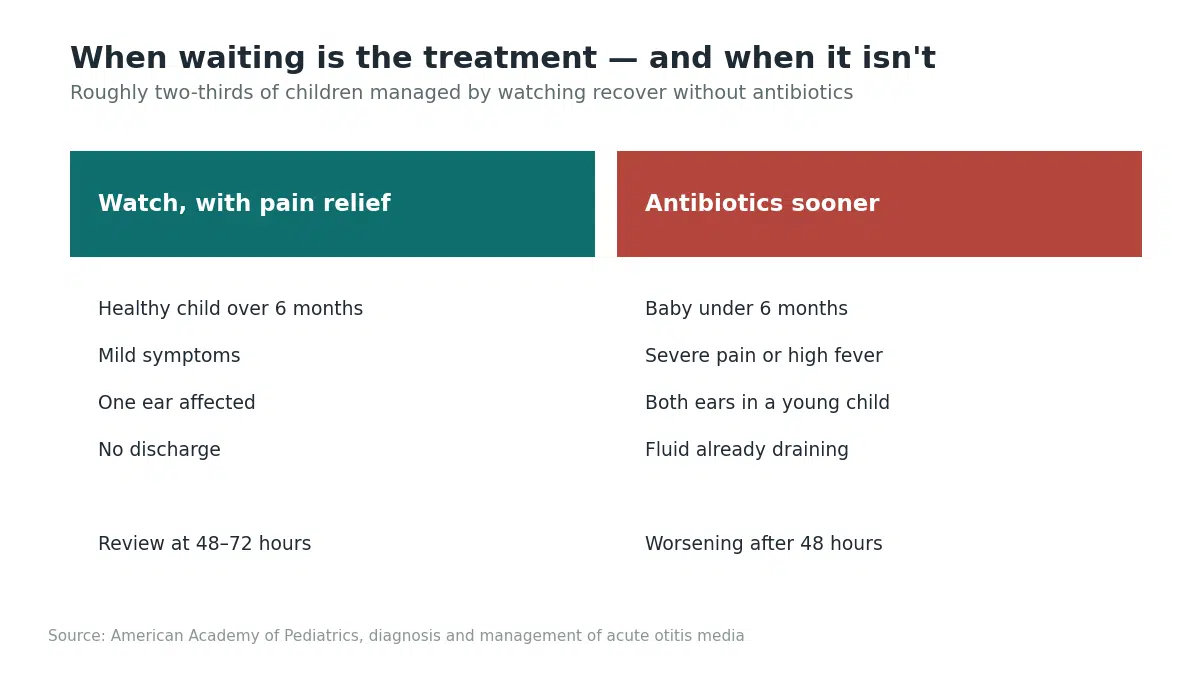
Most ear infections in otherwise healthy children over six months improve within 48 to 72 hours without antibiotics. The American Academy of Pediatrics supports a watch-and-wait approach for mild cases, with pain relief while you watch. Roughly two-thirds of children managed this way recover without ever needing antibiotics.[1]
Pain control is the actual treatment during that window, and it’s often under-done. Acetaminophen or ibuprofen, dosed by weight rather than age. Never aspirin for children, because of Reye’s syndrome.
A warm compress helps. Keeping the head slightly elevated for sleep reduces pressure. For a small child, raise the head of the mattress rather than adding a pillow.
Why not just prescribe antibiotics anyway? Because many of these infections are viral, and antibiotics do nothing for those. Because unnecessary courses drive antibiotic resistance. And because most mild bacterial cases clear on their own.
Watch-and-wait isn’t withholding treatment. It’s pain relief plus a defined review point, usually 48 to 72 hours, with a plan for what happens if things don’t improve.
Antibiotics go in sooner for babies under six months, severe symptoms or high fever, both ears affected in a young child, or fluid already draining. Amoxicillin is usual, for five to ten days depending on age and severity. Finish the course.
Don’t put drops in without a doctor’s say-so, particularly if there’s any discharge, because drops behave very differently if the eardrum is perforated.
Ear Tubes
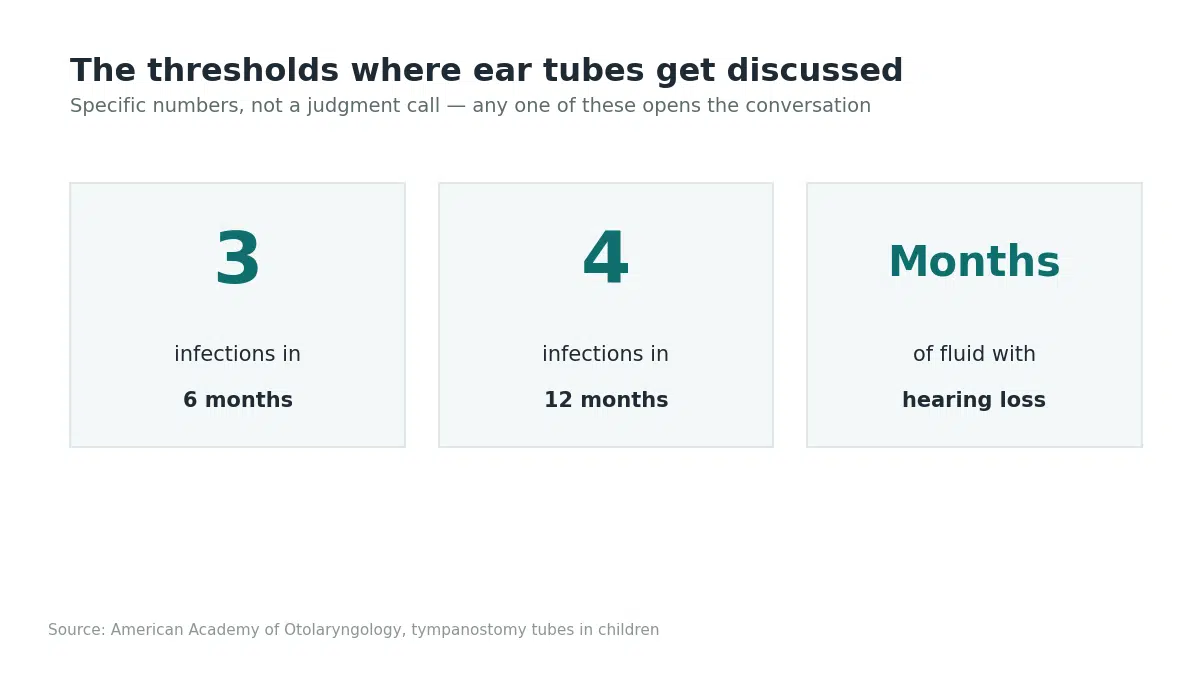
The thresholds where tubes get discussed are specific: three infections in six months, four in a year, or fluid persisting for months with hearing loss, as set out in the American Academy of Otolaryngology’s clinical practice guideline.[2]
It’s a short outpatient procedure. A tiny opening in the eardrum takes a small tube that lets fluid drain and air in. Most fall out by themselves within six to eighteen months as the eardrum heals.
Tubes don’t prevent every future infection. They reduce how often infections happen and restore hearing while they’re in place, which is the point when speech is developing.
Complications Worth Knowing
Temporary hearing loss happens with almost every episode, because fluid damps the eardrum’s movement. It resolves as the fluid clears.
Persistent fluid over weeks or months is different, and in a child still learning to talk, even mild hearing loss during those months can delay speech. That’s the main reason lingering fluid gets treated rather than watched indefinitely.
Mastoiditis is the one to recognize. The mastoid bone sits directly behind the ear, and infection spreading into it causes swelling, redness and tenderness there, sometimes pushing the ear outward. It’s uncommon and it needs urgent hospital treatment.
Rarer still is spread to the membranes around the brain. That possibility is why severe or worsening symptoms get taken seriously rather than waited out.
If hearing doesn’t come back after the infection clears, that’s worth pursuing. Our guide to hearing loss on one side covers when a hearing change needs urgent assessment in its own right.
What Actually Lowers the Risk
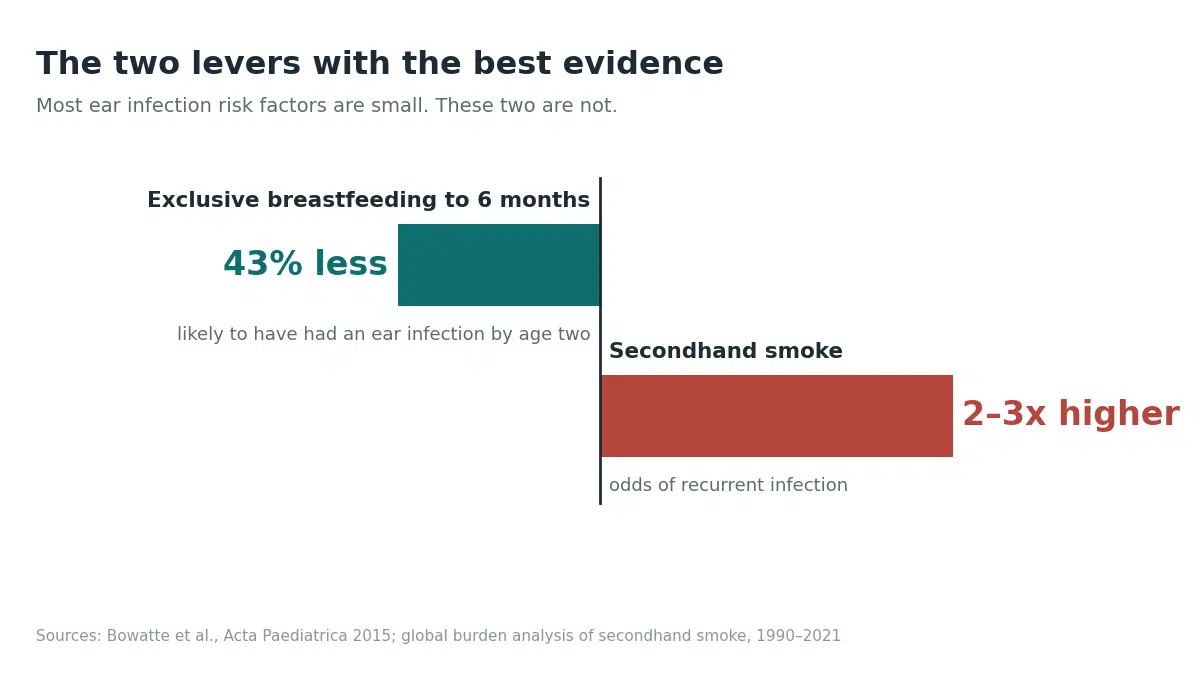
Breastfeeding. A systematic review and meta-analysis found exclusive breastfeeding for six months associated with around a 43% reduction in ever having an ear infection in the first two years.[3] If bottle-feeding, hold the baby upright rather than flat, so milk doesn’t pool near the eustachian tube openings.
Keeping children away from smoke. Secondhand smoke is among the strongest modifiable risk factors, roughly doubling to tripling the odds of recurrent infection.[4] Smoking outside helps; stopping helps more.
Vaccination. The pneumococcal vaccine covers one of the main bacterial causes, and annual flu vaccination reduces the infections that lead to secondary ear infections.
Phasing out the pacifier after six to twelve months, particularly for sleep.
Handwashing through cold season does more than it sounds like it should, since these infections almost always start as an ordinary cold.
Middle Ear Inflammation In Adults
Less often, and usually after a sinus infection, a heavy cold, or allergies. Flying or diving with a cold can cause barotrauma that sets it up. Smoking and chronic allergy are the common background factors.
Adults are more likely to be given antibiotics promptly, since watch-and-wait is mainly a pediatric strategy.
Repeat infections in an adult deserve a proper look for a cause: chronic sinusitis, nasal polyps, allergy, or a structural problem. And persistent one-sided middle ear fluid in an adult is specifically worth investigating rather than treating repeatedly, since it can occasionally signal something obstructing the eustachian tube.
Common Questions
Does my child definitely need antibiotics?
Younger babies, severe symptoms, high fever or discharge change that.
How do I know if it’s an ear infection or just a blocked ear?
Pain, fever and a recent cold point toward infection; pressure and muffling without pain point toward blockage.
Fluid came out of my child’s ear and the pain stopped. Is that good?
Get it checked, keep water out, and don’t use drops without asking.
When are ear tubes considered?
The aim is fewer infections and restored hearing while speech is developing.
Can my child swim?
Our guide to getting water out of the ear covers what’s safe afterwards.
Will repeated infections affect speech?
That’s the reason persistent fluid gets treated rather than left, and why hearing is tested when infections recur.
The Bottom Line
Most middle ear infections in healthy children over six months settle on their own within a few days. Treat the pain properly, and review at 48 to 72 hours rather than escalating immediately.
Get seen sooner for babies under six months, high fever, severe pain, or symptoms that worsen.
And swelling or tenderness behind the ear is the one that goes in today.
SOURCESOur Editorial Standards
HealthMagHub is built on primary sources: peer-reviewed research, clinical practice guidelines, and health agencies such as the NIH, CDC, and FDA. Read our editorial standards to see how we research, cite, and update our articles.
- Lieberthal AS, et al. The Diagnosis and Management of Acute Otitis Media. Pediatrics, American Academy of Pediatrics. publications.aap.org
- Rosenfeld RM, et al. Clinical Practice Guideline: Tympanostomy Tubes in Children (Update). Otolaryngology–Head and Neck Surgery, 2022. entnet.org
- Bowatte G, et al. Breastfeeding and Childhood Acute Otitis Media: A Systematic Review and Meta-Analysis. Acta Paediatrica, 2015. onlinelibrary.wiley.com
- Global Burden of Childhood Otitis Media Attributable to Secondhand Smoke, 1990–2021. ncbi.nlm.nih.gov
Disclaimer: This article is general information for parents, not medical advice, and doesn't replace assessment by your child's doctor. Seek care immediately for swelling or tenderness behind the ear, any fever in a baby under 3 months, stiff neck or severe headache, facial weakness, sudden hearing loss, or symptoms worsening after 48 hours. Do not put drops in the ear without medical advice, particularly if there is discharge.