
Hearing loss on one side only behaves differently from the gradual decline that affects both ears with age. It can happen at any age, it usually has a specific cause, and one version of it is a genuine emergency with a treatment window measured in days.
That timing point matters more than anything else on this page, so it goes first.
- Hearing that disappears in one ear over hours or a couple of days is an emergency. Steroids work best early and the window is measured in days.
- Gradual hearing decline over weeks or months in one ear needs a scan to rule out acoustic neuroma, present in over 90% of those cases.
- A randomized trial found cochlear implants outperformed CROS and bone conduction devices for sound localization and understanding speech in noise.
- Never try to remove impacted earwax yourself, since it risks pushing it deeper or perforating the eardrum.
Sudden Hearing Loss Is an Emergency
Hearing in one ear disappears or drops sharply over hours or a couple of days? Get seen today. Many people notice it on waking. Or when they lift a phone to that ear and there’s nothing there.
This is sudden sensorineural hearing loss. Clinical guidelines define it by onset within a 72-hour window. Outcomes are consistently better the sooner steroid treatment starts.[1] Waiting to see whether it improves is the single most common way people lose hearing permanently that might have been recovered.
Also seek emergency care for hearing loss after a head injury. For hearing loss with severe vertigo, vomiting, or difficulty walking. For hearing loss with facial weakness, severe headache, or vision changes.
It’s often mistaken for earwax or a blocked ear. If you aren’t sure which it is, that uncertainty is itself a reason to be examined the same day rather than a reason to wait.
Why One Ear Matters More Than It Sounds
Your brain compares the tiny differences in timing and volume between your two ears to work out where a sound came from, and to separate one voice from background noise. That’s binaural hearing, and it needs both sides.
Lose one and two specific things break. You can’t locate sounds, whether a car horn or someone calling your name, because there’s nothing to compare. And noisy rooms become exhausting, because everything now arrives at a single ear with no spatial separation to help you pick out the voice you want.
That’s why one-sided loss is more disabling than “half your hearing” suggests, and why it’s treated differently from hearing loss in both ears.
What Causes It
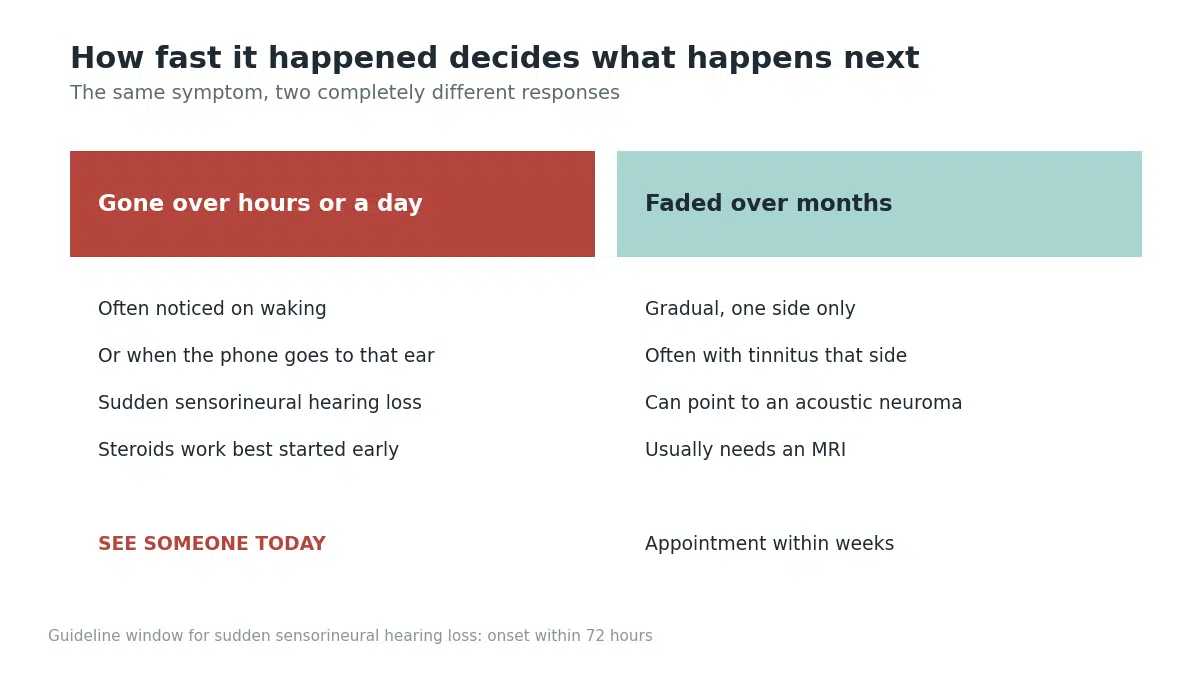
Sudden sensorineural hearing loss. The inner ear loses blood supply, is damaged by a virus, or inflames. The exact cause often isn’t identified, and treatment proceeds anyway because the window is short.
Acoustic neuroma is a non-cancerous growth on the hearing and balance nerve. It develops slowly, so hearing declines over months or years rather than suddenly. Some degree of one-sided hearing loss occurs in more than 90% of people with one.[3] Tinnitus, imbalance or facial numbness on the same side can accompany it.
Ménière’s disease. Episodes of severe spinning vertigo, fluctuating hearing, tinnitus and a sense of fullness in one ear. Hearing often recovers between attacks early on, then becomes permanent over time.
Infection and fluid. Middle ear infection traps fluid behind the eardrum; outer ear infection swells the canal. Both usually resolve with hearing returning. Repeated infections can eventually cause permanent conductive loss. If water that won’t drain started it, our guide to getting water out of your ear safely covers what helps and what makes it worse.
Head trauma can fracture the temporal bone, tear the eardrum, dislocate the middle ear bones or damage the nerve.
Earwax blockage is the simple one, and completely reversible on removal. It’s often made suddenly worse by pushing wax deeper with a cotton swab. Don’t try to dig it out yourself; you risk impacting it further or perforating the eardrum.
Less commonly: autoimmune inner ear disease, stroke affecting the hearing pathway, and certain medications, though drug-related damage usually affects both ears.
What You’ll Notice
Beyond the obvious muffling on one side: constantly turning your “good” ear toward people, switching the phone from one ear to the other, and finding restaurants and meetings disproportionately tiring.
Tinnitus frequently accompanies it: ringing, buzzing or hissing on the affected side. One-sided tinnitus is taken more seriously than ringing in both ears, precisely because it points at a problem on that side.
Fullness or pressure in the ear, common with Ménière’s or middle ear fluid.
Balance problems, because the balance organs sit immediately alongside the hearing structures. Ménière’s and acoustic neuroma both commonly affect the two together.
And the part people underestimate: the effort of following conversation is genuinely draining, and withdrawing from social situations is a common consequence worth mentioning to your doctor alongside the hearing itself.
When It’s Not an Emergency but Still Needs Seeing
Book an appointment within days to weeks for:
- Hearing that has declined gradually in one ear over weeks or months, which is the pattern that warrants ruling out an acoustic neuroma
- Persistent tinnitus in one ear, even with only mild hearing loss
- Hearing that keeps getting worse
- Repeated ear infections on the same side
Start with your primary care doctor, who can examine the canal and eardrum and remove wax. An audiologist performs the hearing tests; an ENT surgeon diagnoses and treats ear disease, and complex cases go to a neurotologist.
How It’s Diagnosed
Examination with an otoscope, looking for wax, fluid, perforation or infection.
Pure-tone audiometry is the core test: tones at different pitches and volumes, each ear separately, plotted on an audiogram. The pattern shows whether the loss is conductive (something blocking sound reaching the inner ear) or sensorineural (inner ear or nerve damage), and how severe.
Speech audiometry tests how well you understand words, which predicts how you’ll do with devices.
Tympanometry measures eardrum movement and identifies middle ear problems.
MRI with contrast is ordered when the pattern suggests a nerve problem or growth. This is what detects an acoustic neuroma. Blood tests may be added for sudden loss to look for autoimmune or infectious causes.
Treatment
Where the cause is fixable: wax removal restores hearing immediately. Infections respond to antibiotics or drainage. Eardrum and middle ear surgery repairs mechanical damage.
Sudden sensorineural loss is treated with high-dose corticosteroids, oral or injected through the eardrum, and the sooner the better.
Acoustic neuromas may be watched with serial scans if small and slow-growing, or treated with surgery or stereotactic radiation.
Devices, if hearing doesn’t come back
A conventional hearing aid works if useful hearing remains in the affected ear.
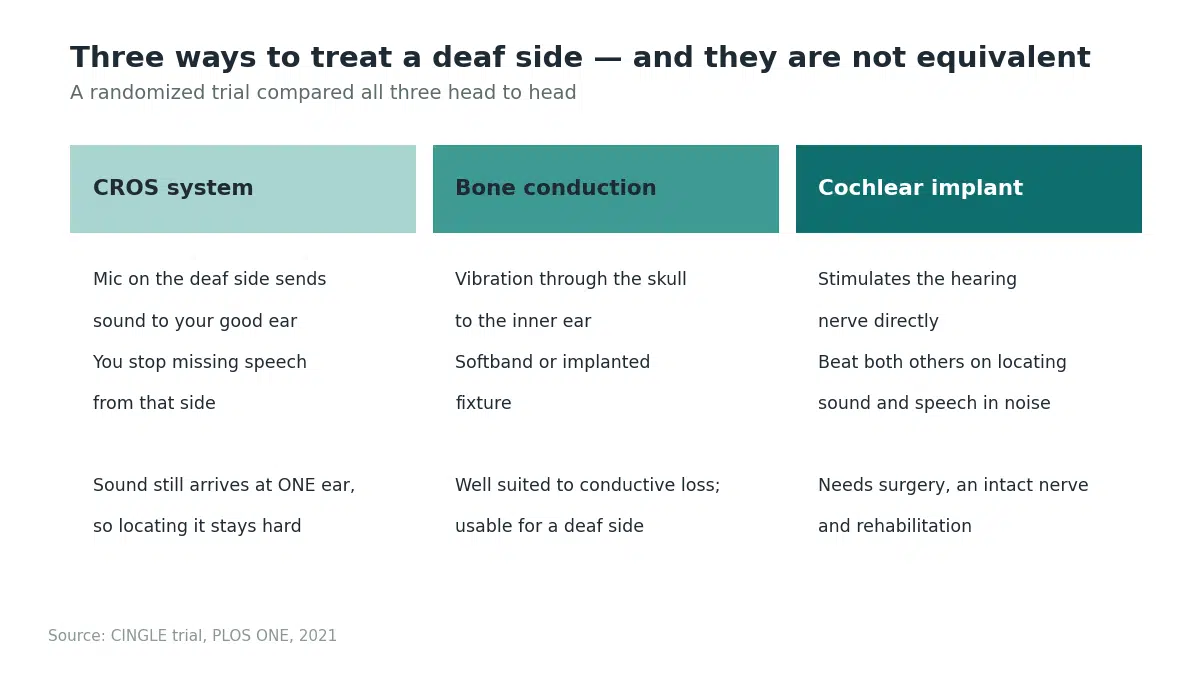
CROS systems put a microphone on the deaf side that transmits wirelessly to a device in the good ear. You stop missing things said on your deaf side, but everything still arrives at one ear, so it doesn’t restore the ability to locate sound.
Bone conduction devices send vibration through the skull to the inner ear, worn on a softband or attached to an implanted fixture. Good for conductive loss, and usable for single-sided deafness.
Cochlear implants stimulate the hearing nerve directly. A randomized trial comparing all three found implants outperformed both CROS aids and bone conduction devices for sound localization and understanding speech in noise.[2] They require surgery, an intact nerve, and rehabilitation afterwards.
That trial result is worth knowing before you’re steered toward the least invasive option by default. The options are not equivalent, and which suits you depends on your cause, your nerve, and what you need to do day to day.
Living With It
Position yourself deliberately. Good ear toward the person speaking; back to a wall in groups so everyone is in front of you; arrive early to pick your seat.
Tell people. Most will happily move to your other side once they know.
Choose quieter rooms. Carpet, curtains and booths absorb sound; hard surfaces reflect it.
Traffic needs more care, because you can’t reliably tell which direction a vehicle is coming from. Look, don’t listen.
At home, visual or vibrating alerts for the doorbell and smoke alarm are worth having.
Phones and video calls: speaker mode, Bluetooth, or live captions. Most hearing aids and implants stream calls directly.
Workplace adjustments are reasonable to ask for: preferential seating, assistive listening devices, captioned presentations, and written follow-ups after verbal instructions.
The Bottom Line
Hearing loss on one side only almost always has a findable cause, and several are treatable.
The distinction that matters is speed. Gradual decline over months needs an appointment and probably a scan. Hearing that vanishes over hours or a day or two needs someone to examine you today, because steroids work best early and the opportunity doesn’t come back.
“Wait and see” is the wrong instinct here.
SOURCESOur Editorial Standards
HealthMagHub is built on primary sources: peer-reviewed research, clinical practice guidelines, and health agencies such as the NIH, CDC, and FDA. Read our editorial standards to see how we research, cite, and update our articles.
- Chandrasekhar SS, et al. Clinical Practice Guideline: Sudden Hearing Loss (Update). Otolaryngology–Head and Neck Surgery, 2019. aao-hnsfjournals.onlinelibrary.wiley.com
- Peters JPM, et al. Short-Term Outcomes of Cochlear Implantation for Single-Sided Deafness Compared to Bone Conduction Devices and Contralateral Routing of Sound Hearing Aids (CINGLE-trial). PLOS ONE, 2021. journals.plos.org
- Acoustic Neuroma (Vestibular Schwannoma). Johns Hopkins Medicine. hopkinsmedicine.org
Disclaimer: This article is general information, not medical advice, diagnosis or treatment. Hearing loss in one ear has many possible causes, and only an examination and hearing test can establish which one applies to you. Seek same-day medical care for hearing that disappears suddenly, over hours or a couple of days. The treatment window for sudden sensorineural hearing loss is measured in days, not weeks, and delay costs recovery. Seek emergency care for hearing loss after a head injury, or hearing loss with severe vertigo, vomiting, facial weakness, severe headache or vision changes. Never attempt to remove impacted earwax yourself.