
Stuffy ears, that muffled underwater feeling when they won’t pop, are more than annoying. They affect your balance, make conversation harder, and can genuinely hurt.
Almost all of it comes down to one narrow tube, and most cases clear with gentle techniques you can do right now. One presentation is an emergency, so that comes first.
- Sudden hearing loss in one ear over hours or a day needs same-day care. It’s easily mistaken for a blocked ear, but the treatment window is measured in days.
- Yawning, swallowing, and a gentle Valsalva maneuver clear most stuffy ears, and force risks the eardrum.
- Decongestant nasal sprays cause rebound congestion after about three days, so don’t exceed that limit.
- Never put drops, oil, or water in the ear if you have or have had a perforated eardrum, ear tubes, or ear surgery.
When Stuffy Ears Aren’t Something to Treat at Home
Sudden hearing loss in one ear, over hours or a day, needs same-day medical care rather than ear-popping techniques. It’s easily mistaken for a blocked ear, and the treatment window for sudden sensorineural hearing loss is measured in days. Our guide to hearing loss on one side only explains why waiting is the commonest way people lose hearing permanently.
Also seek prompt care for severe or worsening ear pain, a fever above 100.4°F (38°C), fluid, pus or blood draining from the ear, dizziness or vertigo, ear symptoms after a head injury, or symptoms lasting more than a week despite home care.
Why You Get Stuffy Ears
The eustachian tube is a narrow passage, about an inch and a half long, running from your middle ear down to the back of your nose and throat. It does three things: equalizes pressure either side of the eardrum, drains fluid the middle ear produces, and stays shut the rest of the time to keep germs out.[4]
It opens briefly when you swallow or yawn. When inflammation or mucus keeps it shut, pressure builds and fluid gets stuck, and your ear feels full, muffled or sore.

The usual triggers: pressure changes from flying, driving through hills or diving; a cold or sinus infection swelling the tube lining; allergies doing the same; and earwax blocking the canal, which is a different mechanism but feels similar.
Often it’s a combination. A cold plus a flight is the classic.
How to Unclog Stuffy Ears at Home
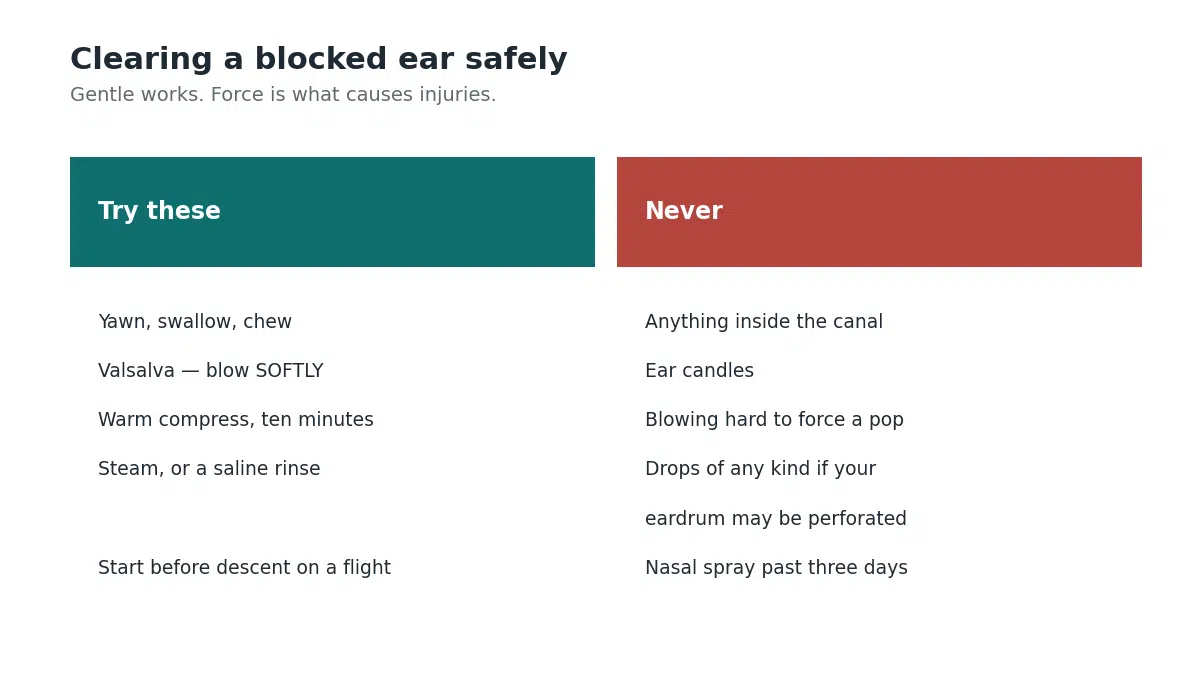
Yawning and swallowing. The simplest and often the most effective, since both activate the muscles that open the tube. Sip water, chew gum, suck a hard candy. On a plane, start before your ears feel full rather than after.
The Valsalva maneuver, gently. Pinch your nose, close your mouth, and blow softly until you feel a small pop. Gently is the whole instruction. Forcing it can damage the eardrum or, rarely, the inner ear. Stop immediately if it hurts. It works for pressure problems, not for infection or fluid.
Warm compress. A warm washcloth held against the ear for ten minutes eases discomfort and encourages drainage. Repeat through the day.
Steam. Loosens mucus and opens swollen passages. Lean over a bowl of hot water with a towel over your head for five to ten minutes. Plain steam is fine. And keep children away from bowls of boiling water entirely, since scalds are a far more common injury than blocked ears.
Saline nasal rinse is underrated here, since the problem usually starts in the nose. Our guide to clearing nasal congestion covers the technique.
When Medication Helps
Decongestants shrink swollen tissue and can relieve the pressure. Oral versions contain pseudoephedrine or phenylephrine, so check with a pharmacist first if you have high blood pressure, heart problems, or take other medication.
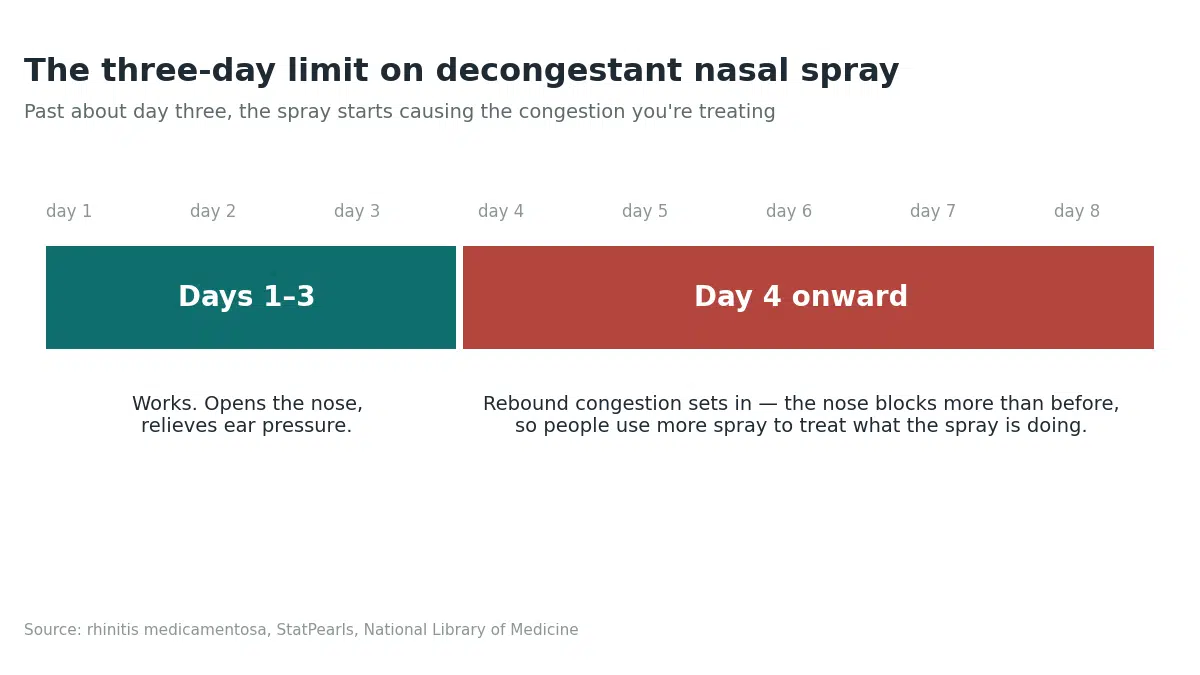
The three-day rule on nasal sprays. Oxymetazoline sprays work quickly, but rebound congestion can set in from around day three of continuous use, leaving your nose more blocked than before you started.[2]
People then use more spray to treat the congestion the spray is causing. It’s a genuinely difficult cycle to break, and the way to avoid it is simply not exceeding three days.
Antihistamines help when allergy is the driver: loratadine or cetirizine in the day, since they don’t sedate much. They’re the wrong tool for a cold, and they can dry things out unhelpfully.
If wax is the problem rather than the tube, softening drops, either olive oil or a carbamide peroxide preparation, used over a few days will often clear it.
Don’t put drops, oil, peroxide or water in your ear if you have or have ever had a perforated eardrum, ear tubes, ear surgery, or a current infection. Fluid entering the middle ear through a hole causes exactly the problem you’re trying to avoid.[3]
If you’re not certain your eardrum is intact, that’s a reason to be looked at rather than to guess.
What Not to Do
Nothing goes in the ear canal: not cotton swabs, bobby pins, keys or fingernails. Cotton swabs push wax deeper and pack it against the eardrum, causing the blockage people use them to prevent, and they’re behind most of the ear injuries doctors see.
Ear candles don’t work. The residue afterwards is burnt candle material, not wax. They cause burns, canal blockage and eardrum injury, and the FDA has warned against them since 2010.
Don’t blow hard to clear your ears. A gentle pop is the target; force risks the eardrum.
Don’t fly with a heavy cold if you can avoid it. If you can’t, use a decongestant spray about half an hour before descent, which is when barotrauma actually happens.
Stuffy Ears on Flights
Descent is the difficult part, not take-off. The tube opens more easily letting air out than letting it back in.
Chew or swallow continuously through descent. Stay awake for it if you can, since you swallow far less asleep. Filtered earplugs designed to slow the pressure change help some people. And for a baby, feeding or a pacifier during descent does the same job as chewing gum.
If your ears block on every flight, that’s worth raising with a doctor rather than accepting, since a prescription steroid nasal spray used beforehand often solves it.
Stuffy Ears in Children
Children block up more often because their eustachian tubes are shorter, narrower and lie flatter, so they drain less efficiently. By age seven, around 70% of children have had eustachian tube dysfunction at least once, against roughly 1% of adults.[1]
What to watch for in a child who can’t explain it: tugging at the ear, not responding to sounds, asking “what?” more than usual, clumsiness, irritability or disturbed sleep, and any fluid from the ear.
Swallowing works for them too: feeding, a bottle, or gum for older children. A lukewarm compress is safe. Acetaminophen or ibuprofen at the right dose for their weight eases discomfort.
Call the pediatrician for fever, discharge, significant pain, symptoms lasting more than two days, or hearing that doesn’t come back after a cold clears. Our guide to middle ear inflammation in children covers what happens next.
What a Doctor Can Do
An otoscope examination shows straight away whether this is wax, fluid behind the eardrum, infection, or a perforation, which is why guessing at home has a short useful life.
From there: professional wax removal by irrigation, suction or instruments; antibiotics if there’s a bacterial infection; prescription steroid nasal sprays for persistent tube dysfunction; and, for recurrent problems, a referral to ENT. Ear tubes are more common in children but adults get them too.
If water is the actual problem rather than pressure, our guide to getting water out of your ear covers what works and what makes it worse.
Common Questions About Stuffy Ears
How long should stuffy ears last?
Pressure-related blockage usually clears within hours. Blockage from a cold can take several days as the swelling settles.
More than a week without improvement is worth getting looked at.
Is it safe to pop my ears by holding my nose and blowing?
Yes, gently. Pinch your nose, close your mouth, blow softly until you feel a small pop.
Don’t force it. Hard blowing can damage the eardrum, and it should never hurt.
Can I use olive oil or hydrogen peroxide?
For softening wax, yes, provided your eardrum is intact and you have no infection, ear tubes or history of ear surgery.
If you’re unsure about any of those, get looked at first rather than guessing.
Why do my ears block after a shower?
Water trapped in the canal, often behind existing wax. Tilt your head and pull gently on the earlobe to open the canal.
Don’t use drying drops if you might have a perforation or ear tubes.
Do I need antibiotics for stuffy ears?
Only for a bacterial infection. Congestion from a cold, allergy or pressure change doesn’t respond to them.
An examination is what distinguishes the two.
My ear is blocked and I can’t hear on that side. Is that normal?
Muffled hearing with a blocked feeling is common and usually settles with the congestion.
But hearing that dropped suddenly in one ear over hours is different, and needs seeing the same day rather than treating as a blockage.
The Bottom Line
Yawning, swallowing, a gentle Valsalva, warmth and steam clear most stuffy ears. Treat the nose if that’s where it started, and keep nasal sprays to three days.
Nothing goes in the ear canal, and nothing goes in at all if your eardrum might be perforated.
And hearing that disappears suddenly on one side isn’t a blocked ear. That one gets seen today.
SOURCESOur Editorial Standards
HealthMagHub is built on primary sources: peer-reviewed research, clinical practice guidelines, and health agencies such as the NIH, CDC, and FDA. Read our editorial standards to see how we research, cite, and update our articles.
- Ear Tubes. Children’s Hospital of Philadelphia. chop.edu
- Rhinitis Medicamentosa. StatPearls, National Library of Medicine. ncbi.nlm.nih.gov
- Schwartz SR, et al. Clinical Practice Guideline (Update): Earwax (Cerumen Impaction). American Academy of Otolaryngology–Head and Neck Surgery Foundation. aafp.org
- Eustachian Tube Dysfunction. StatPearls, National Library of Medicine. ncbi.nlm.nih.gov
Disclaimer: This article is general information, not medical advice. Seek same-day care for sudden hearing loss in one ear, severe ear pain, fever, discharge, dizziness, or ear symptoms after a head injury. Do not put drops, oil, peroxide or water into your ear if you have or have had a perforated eardrum, ear tubes, ear surgery or a current infection. Do not insert anything into the ear canal.