

A few colors are worth acting on. The useful thing is knowing which, and knowing that color on its own almost never tells the story. What it comes with matters far more.
- Yellow through black is almost always normal wax. Color alone rarely signals a problem, but color plus symptoms does.
- Whether your earwax is wet or dry is set by the ABCC11 gene, the same gene that governs how much body odor you produce.
- Recurring foul-smelling discharge with hearing loss can signal cholesteatoma, a growth that erodes bone and needs an ENT opinion, not more drops.
- Severe, disproportionate ear pain with discharge in someone with diabetes needs urgent assessment, because it can signal a rare bone infection.
See a Doctor Promptly If You Have
Foul-smelling discharge that keeps coming back, especially with hearing loss, is worth checking. See the section below, because this one has a specific cause worth ruling out. Severe ear pain with discharge, if you have diabetes or a suppressed immune system, needs urgent assessment rather than a pharmacy visit.
The same goes for bleeding from the ear or blood-stained discharge that recurs, sudden hearing loss in one ear (a same-day problem in its own right), dizziness or vertigo alongside ear symptoms, fever or swelling and redness spreading around the ear, and discharge after a head injury.
What Earwax Is For
Cerumen isn’t dirt and it isn’t a hygiene failure. Glands in the ear canal produce it deliberately: it traps dust and dead skin before it reaches the eardrum, keeps the canal skin from drying out, and maintains a slightly acidic environment that discourages bacteria and fungi.
It’s also self-clearing. Wax migrates slowly outward, carrying debris with it, and jaw movement from chewing and talking moves it along. Most of it falls out without you noticing.
That’s the fact everything else follows from: the ear canal cleans itself, and interfering with it is what causes most of the problems people are trying to prevent.
What Each Color Usually Means
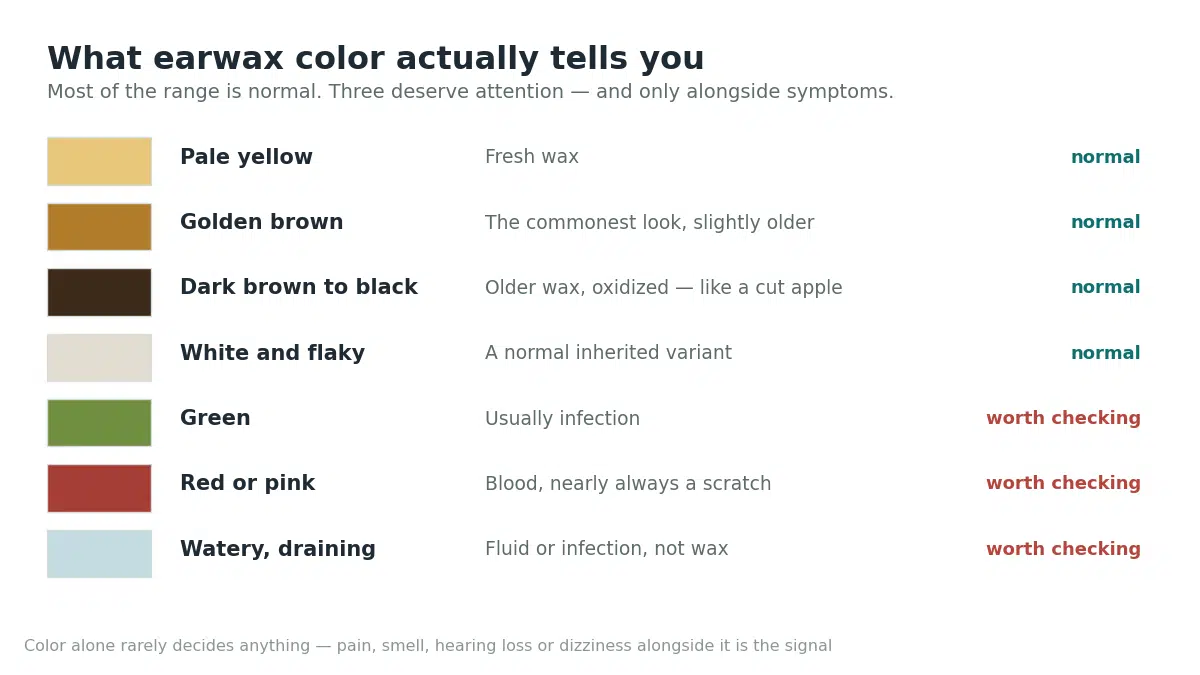
Pale yellow or light orange. Fresh wax, recently produced. Entirely normal.
Golden to medium brown. The commonest appearance. Slightly older wax carrying some dust and dead skin. Normal.
Dark brown or black. Usually just wax that’s been in the canal longer, oxidizing and picking up more debris, like a cut apple browning. On its own it’s not a concern. Combined with hearing loss, fullness or ringing, it may mean impaction.
White, flaky or gray. A normal genetic variant, more common in people of East Asian and Native American ancestry, producing drier wax with less lipid content.
A genuinely odd bit of biology: whether you produce wet or dry earwax is determined by the ABCC11 gene, and the same gene governs how much odor your armpit sweat glands produce. People with dry earwax typically produce noticeably less body odor.[1]
Green. Usually infection, the color coming from white blood cells. Worth checking if it arrives with pain, itching, swelling or smell.
Red, pink or rust. Blood, almost always from a scratch caused by something inserted into the canal. A single streak after over-enthusiastic cleaning isn’t an emergency, but stop putting things in your ear. Repeated bleeding, sudden hearing loss, severe pain or dizziness needs seeing.
Runny, watery or persistently draining. Different from normal wax, and usually infection or fluid escaping through a perforated eardrum.
The pattern worth holding onto: color plus symptoms is the signal color alone rarely is.
Two Situations Most Articles Skip
Persistent foul-smelling discharge
Ear discharge that smells bad, keeps returning despite treatment, and comes with hearing loss on that side deserves an ENT opinion rather than repeated courses of drops.
One cause is cholesteatoma, an abnormal collection of skin cells growing in the middle ear. It isn’t cancer, but it expands and erodes the bone around it, and it can damage hearing, the balance organs and the facial nerve if left. It’s treated surgically, and earlier is considerably better.[4]
Recurring smelly discharge is its most reliable early sign, and it’s frequently managed as ordinary infection for a long time before anyone looks properly.
Severe outer ear infection in diabetes
Outer ear infection is usually a nuisance. In people with diabetes or a weakened immune system it can occasionally become necrotizing otitis externa, where infection spreads from the canal into the surrounding bone.
The warning combination is severe, persistent ear pain that seems out of proportion, often worse at night, with discharge, in someone with diabetes. That needs urgent assessment, not a pharmacy remedy.
This is uncommon. It’s also serious enough, and treatable enough, that it belongs in any honest article about ear discharge.
Earwax Color: What Not to Do
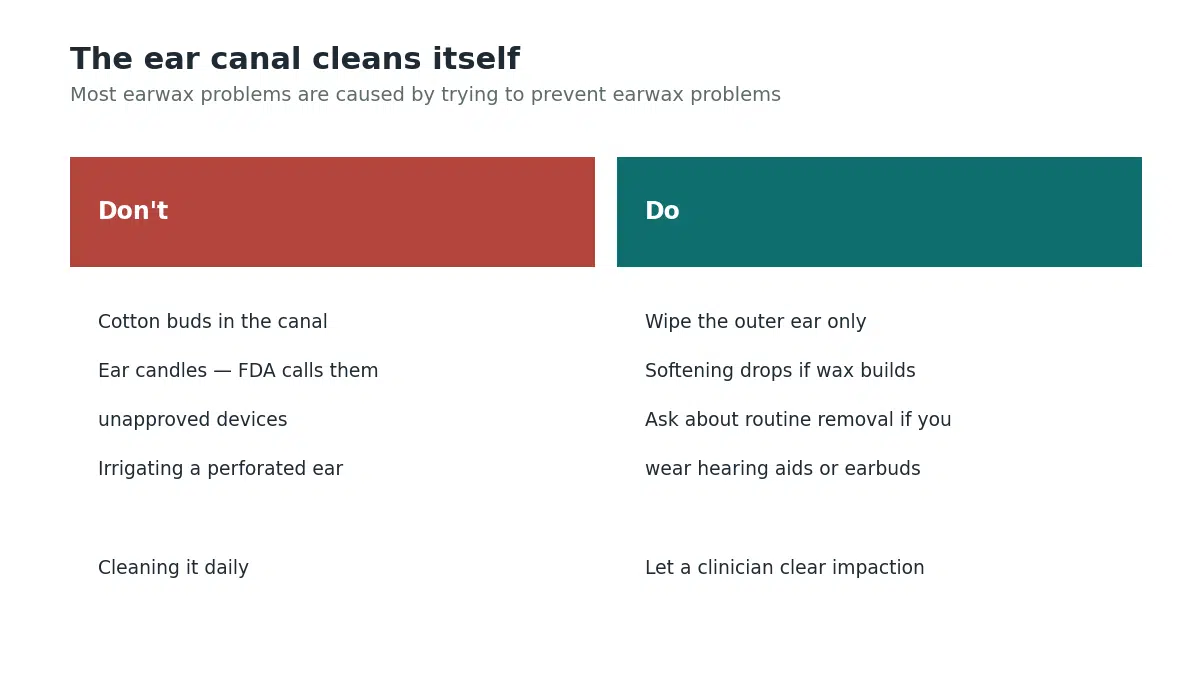
Don’t put anything in your ear canal. Not cotton swabs, not bobby pins, not keys, not a fingernail. Cotton swabs push wax deeper and pack it against the eardrum, creating exactly the blockage people use them to prevent, and they cause most of the ear injuries doctors see. American Academy of Otolaryngology guidelines advise against them specifically.[3]
Don’t use ear candles. They don’t work. The residue people point to afterwards is burnt candle material, not wax. They do cause burns, canal blockage from dripping wax, and eardrum injury. The FDA classifies ear candles as unapproved medical devices and prohibits their sale for earwax removal.[2]
Don’t irrigate if you’ve ever had a perforated eardrum, ear surgery, ear tubes, or a current infection. Forcing water into a damaged ear pushes bacteria where they shouldn’t go.
Don’t clean daily. You can’t remove wax faster than you make it, and stripping the canal leaves the skin dry and more prone to infection.
What’s Actually Safe
Wipe the outer ear with a damp cloth when you notice wax there. That’s it, for most people.
If you genuinely build up wax, softening drops, either olive oil or carbamide peroxide preparations, used for a few days will often let it clear on its own. Gentle warm-water irrigation with a bulb syringe afterwards is reasonable, subject to the exclusions above.
If it’s impacted and symptomatic, a doctor or audiologist can remove it safely by irrigation, suction or instruments. That’s faster and safer than escalating at home.
Some people need this periodically, particularly hearing aid and earbud users, since anything sitting in the canal blocks natural drainage. If that’s you, ask about a routine interval rather than waiting for symptoms. Our guide to unblocking stuffy ears covers the pressure-related causes, and getting water out of your ear deals with the version that follows swimming.
Looking After Your Ears More Generally
Protect them from noise. Damage from loud sound doesn’t reverse, and it takes the high frequencies first. Our guide to high frequency hearing loss covers what that costs you in conversation. If someone next to you can hear your earbuds, they’re too loud.
Keep them dry. Tilt your head after swimming or showering. Trapped moisture is what turns a normal canal into swimmer’s ear.
Clean earbuds and hearing aids as the manufacturer says. They introduce bacteria otherwise.
Know your own baseline. Some people make a lot of wax, some almost none, some naturally darker. Knowing what’s usual for you is what makes a change meaningful.
And if hearing drops on one side, that’s not a wax question until someone has looked. One-sided hearing loss has causes with short treatment windows.
Common Questions About Earwax Color
Is dark brown or black earwax a problem?
It matters if it comes with hearing loss, fullness, ringing or pain, which suggest impaction.
What does green earwax mean?
Worth checking if there’s pain, itching, swelling or a smell alongside it.
Why is my earwax dry and flaky?
It’s a normal variant, not a deficiency.
Is it safe to use cotton swabs carefully?
The outer ear only, which is what the packaging says too.
Does ear candling work?
It causes burns, blockage from dripping wax, and eardrum injury, and the FDA classifies ear candles as unapproved medical devices.
How often should I clean my ears?
Hearing aid and earbud users are the exception and may need periodic professional removal.
The Bottom Line
Yellow through to black is almost always normal, and dry white flakes are genetics rather than a problem.
Green, bloody, or persistently draining wax is what deserves attention, and it deserves more attention when it arrives with pain, hearing loss, smell or dizziness.
Leave the canal alone, protect your ears from noise and water, and get help rather than escalating at home when wax genuinely blocks things up.
SOURCESOur Editorial Standards
HealthMagHub is built on primary sources: peer-reviewed research, clinical practice guidelines, and health agencies such as the NIH, CDC, and FDA. Read our editorial standards to see how we research, cite, and update our articles.
- Nakano M, et al. A Strong Association of Axillary Osmidrosis With the Wet Earwax Type Determined by Genotyping of the ABCC11 Gene. ncbi.nlm.nih.gov
- U.S. Food and Drug Administration. Import Alert 77-01: Detention Without Physical Examination of Ear Candles. accessdata.fda.gov
- Schwartz SR, et al. Clinical Practice Guideline (Update): Earwax (Cerumen Impaction). American Academy of Otolaryngology–Head and Neck Surgery Foundation, 2017. aafp.org
- Cholesteatoma. StatPearls, NCBI Bookshelf. ncbi.nlm.nih.gov
Disclaimer: This article is general information, not medical advice. See a doctor for recurring foul-smelling ear discharge, severe ear pain with discharge if you have diabetes or a weakened immune system, bleeding from the ear, sudden hearing loss, dizziness with ear symptoms, or discharge after a head injury. Do not insert anything into the ear canal, and do not irrigate if you have had a perforated eardrum, ear surgery or ear tubes.