

If you’re looking for the best supplements for tinnitus relief, here is the honest summary before the detail: no supplement has been shown to reliably reduce tinnitus.
That is not a popular thing to write on a page about supplements for tinnitus. But the alternative is repeating claims the research doesn’t support, and if you’re living with constant ringing you deserve better than that.
There is still useful information here. Some supplements help in specific, narrow circumstances. Some carry real risks worth knowing about. And a few things that genuinely do help tinnitus aren’t supplements at all.
- No supplement has been shown to reliably reduce tinnitus. A 2022 Cochrane review of 12 studies found ginkgo no better than placebo.
- B12 and zinc only help if you’re actually deficient. Correcting a deficiency you don’t have does nothing.
- Ginkgo increases bleeding risk and is the supplement most frequently linked to adverse effects in tinnitus surveys.
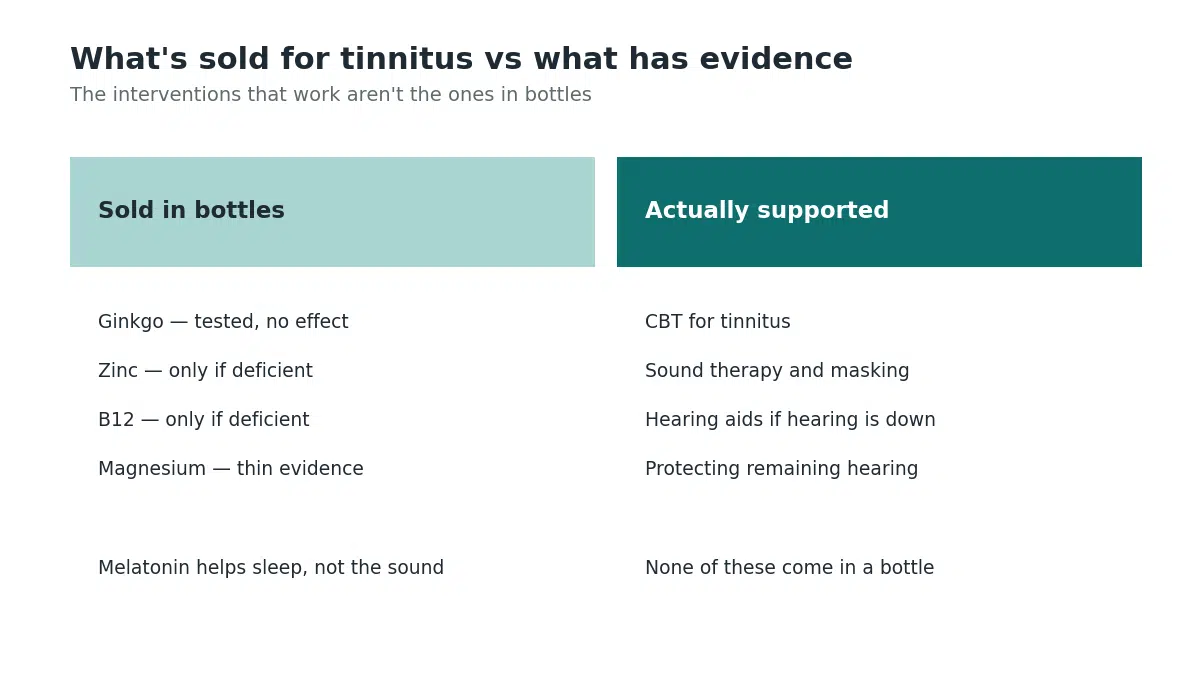
- CBT for tinnitus, sound therapy, and hearing aids all have better evidence than any supplement, but aren’t sold in bottles.
First: some tinnitus needs a doctor, not a supplement
Before anything else, three presentations need medical attention rather than a shopping list. If your hearing drops suddenly alongside tinnitus in one ear, that’s a medical emergency: sudden sensorineural hearing loss is treatable with steroids, but the treatment window is measured in days, and delay can make the loss permanent. Seek same-day care rather than waiting to see whether it improves.
Tinnitus in only one ear also warrants investigation. It can occasionally indicate an acoustic neuroma, a benign tumor on the hearing nerve. It’s uncommon, but it’s found by scanning, not by supplementing.
And pulsatile tinnitus, a rhythmic whooshing in time with your heartbeat, is different from ordinary ringing. It can reflect a blood vessel problem and should be assessed properly. Raised blood pressure is one contributor worth ruling out; our guide to what counts as a normal reading covers the basics, and our look at ringing in ears and blood pressure explains what the evidence does and doesn’t show about that link.
If your tinnitus is in both ears, steady rather than pulsing, and came on gradually, none of the above applies and it’s reasonable to read on.
Ginkgo biloba: the most marketed, and the best disproven
Ginkgo is the supplement most often sold for tinnitus, and it has been studied more thoroughly than any other.
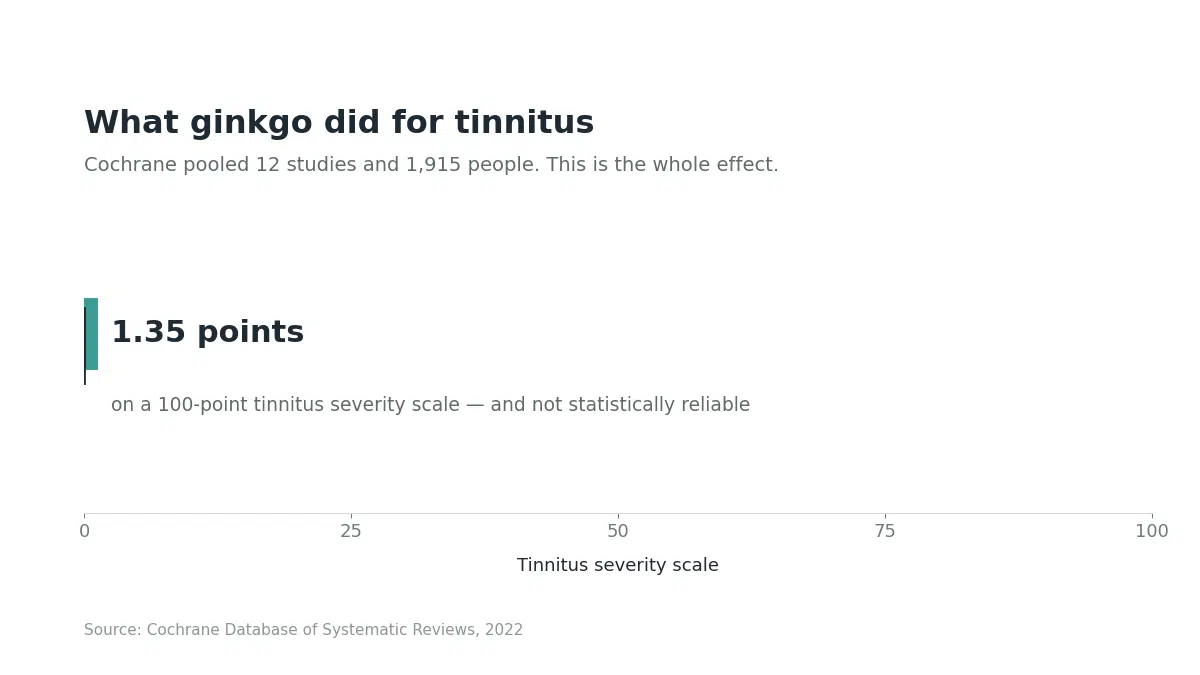
The 2022 Cochrane review pooled 12 studies covering 1,915 participants. It concluded that ginkgo may have little to no effect on tinnitus severity compared with placebo (read the review). The measured difference was 1.35 points on a 100-point scale, too small to notice and not statistically reliable even at that size.[1]
This is about as clear as evidence gets in this field. Ginkgo is popular, widely prescribed in parts of Europe, and it does not appear to work for tinnitus.
It also carries a genuine risk. Ginkgo increases bleeding risk, and that risk is meaningful if you take warfarin or another blood thinner.[3] A large study of veterans found a substantially higher rate of bleeding events when the two were combined. A worldwide survey of tinnitus supplements found ginkgo the most frequently cited cause of adverse effects.
So: unlikely to help, and not risk-free. That combination makes it hard to recommend.
Vitamin B12: only if you’re deficient
B12 maintains the myelin sheath around nerves, including the auditory nerve. Deficiency can cause neurological symptoms.
That mechanism is real, and it leads to a narrow but genuine use: if you are B12 deficient, correcting the deficiency is worth doing, for your nerves generally and possibly for your tinnitus.
What doesn’t follow is that B12 helps tinnitus in people with normal levels. There’s no good evidence for that, and taking more of a vitamin you already have enough of does nothing.
Deficiency is more common than people assume, particularly if you’re over 50, follow a strict vegetarian or vegan diet, take metformin, or use long-term acid reflux medication. It’s a simple blood test, and our guide to what B12 does in the body explains why the deficiency matters beyond your ears.
Get tested rather than guessing. That’s the whole recommendation.
Magnesium: plausible, thinly evidenced
The theory is reasonable. Magnesium blocks NMDA receptors in the auditory pathway, and overactivity there is one proposed mechanism for chronic tinnitus. Military research has also found magnesium can reduce noise-induced hearing damage when taken before exposure.
The clinical evidence for treating existing tinnitus is much thinner than the mechanism suggests: a small trial reporting reduced severity scores after eight weeks, and not much else.
Magnesium is cheap and safe at normal doses, so trying it is low-risk. Just don’t expect much, and know that the evidence is preliminary rather than established.
Zinc: weak, unless deficient
Same shape of story as B12, with less behind it. Zinc is involved in cochlear function, deficiency is relatively common in older adults, and correcting a genuine deficiency is worthwhile.
Trials of zinc for tinnitus in people with normal zinc levels have not shown consistent benefit.
One caution worth naming: high-dose zinc over months interferes with copper absorption and can cause copper deficiency. More is not better here.
Melatonin: helps the sleep, not the ringing
This one is worth taking seriously, but for a different reason than it’s usually sold.
Melatonin does not reduce tinnitus. What it may do is help you sleep. For many people the worst part of tinnitus is lying awake at 2am with nothing to mask it. Poor sleep raises stress, stress makes tinnitus feel louder, and the cycle tightens.
Breaking that cycle at the sleep end is a legitimate strategy. Just be clear about what you’re treating.
Don’t combine it with prescription sedatives without medical advice.
What Works Better Than Supplements for Tinnitus
This is the part most supplement articles leave out.[2]
Cognitive behavioral therapy for tinnitus has better evidence than any supplement. It doesn’t silence the sound. It changes your relationship with it, reducing distress and the attention you pay to it. That sounds like a lesser goal until you consider that distress, not volume, is what makes tinnitus disabling.
Sound therapy and masking, whether background noise, white noise or a fan, makes the ringing less prominent by giving your auditory system something else to process. Simple, free, and effective for many people at night.
Hearing aids, if you have hearing loss alongside tinnitus. Amplifying real sound often reduces how much the phantom sound intrudes. Many people with tinnitus have unaddressed hearing loss, and treating it matters beyond the ringing, since untreated hearing loss is one of the largest modifiable risk factors for dementia.
Habituation is the realistic goal for chronic tinnitus. Over time the brain can learn to file the sound as unimportant background, the way you stop hearing a fridge hum. That process is helped by the approaches above and hindered by anxiety and constant monitoring.
Protecting your remaining hearing matters more than any capsule. Earplugs in loud environments, keeping headphone volume down. Further noise damage makes tinnitus worse.
Best Supplements for Tinnitus Relief: The Honest Bottom Line
If you have a diagnosed deficiency in B12 or zinc, correct it. That’s real and worth doing.
If you don’t, supplements are unlikely to change your tinnitus. Magnesium is cheap and safe enough to try if you want to. Melatonin may help you sleep, which matters. Ginkgo has been tested thoroughly and doesn’t work, and it interacts badly with blood thinners.
The interventions with real evidence aren’t sold in bottles: CBT for tinnitus, sound therapy, hearing aids, and protecting your hearing. That’s part of why they’re less talked about.
And see a doctor if your tinnitus is one-sided, pulsatile, or came with sudden hearing loss. Those need investigating, not supplementing.
Common Questions
Do the best supplements for tinnitus relief actually work?
Not on the current evidence. The most thoroughly tested option, ginkgo biloba, was found by a 2022 Cochrane review of 12 studies and 1,915 people to have little to no effect versus placebo.
The narrow exception is correcting a documented B12 or zinc deficiency, which is worth doing on its own merits. Magnesium is cheap and safe enough to trial, but the evidence is preliminary.
Does anything actually stop tinnitus?
For most chronic tinnitus, no treatment reliably silences it. The realistic goal is reducing how much it bothers you, and that goal is achievable. CBT for tinnitus, sound therapy and hearing aids all have evidence for reducing distress and intrusiveness.
Is it worth taking a supplement at all?
Only if you have a documented deficiency, or if you want to try magnesium knowing the evidence is thin. Buying a multi-ingredient “tinnitus formula” on the strength of its marketing is not a good use of money. Our guide to checking whether a supplement is legitimate covers what to verify before buying.
How long before I’d know if something worked?
If you’re correcting a deficiency, weeks to a few months. If nothing has changed after three months, it isn’t going to.
Can stress make tinnitus worse?
Yes, reliably. Stress and poor sleep both increase how loud and intrusive tinnitus feels, without changing anything about the underlying signal. This is why the psychological approaches work as well as they do.
Should I see an audiologist or my doctor?
Start with your primary care doctor, who can check for treatable causes like earwax, medication effects or infection, and refer you onward. Ask specifically about a hearing test. Unaddressed hearing loss is common alongside tinnitus and treating it often helps.
SOURCESOur Editorial Standards
HealthMagHub is built on primary sources: peer-reviewed research, clinical practice guidelines, and health agencies such as the NIH, CDC, and FDA. Read our editorial standards to see how we research, cite, and update our articles.
- Sereda M, et al. Ginkgo biloba for tinnitus. Cochrane Database of Systematic Reviews, 2022. cochranelibrary.com
- National Institute on Deafness and Other Communication Disorders. Tinnitus. nidcd.nih.gov
- Memorial Sloan Kettering Cancer Center. Ginkgo: herb monograph, interactions and cautions. mskcc.org