
Working out how to tell if a ClickBank supplement is legit comes down to a handful of checks you can run in about ten minutes. Most of them happen on free government databases rather than on the sales page itself.
That distinction matters more than any single warning sign. Everything on a sales page was written by someone who profits from your purchase. The useful information lives elsewhere.
Here’s what to check, in order, and what each check can and can’t tell you.
- The FDA has identified over 1,000 supplements containing hidden drug ingredients, concentrated in six product categories.
- Run the real checks off the sales page: FDA fraud database, independent ingredient lookup, and a pharmacist review if you take medication.
- A “GMP Certified” badge is a legal requirement, not a real verification — USP, NSF and Informed Choice marks are the ones that actually test the product.
- No supplement is “FDA approved” — that claim is false by definition and is itself a red flag.
The Risk That Isn’t Just Wasted Money
The FDA has identified over a thousand products sold as dietary supplements or foods that contained hidden drug ingredients. These include prescription drugs, banned substances, anabolic steroids, and untested compounds not listed anywhere on the label.
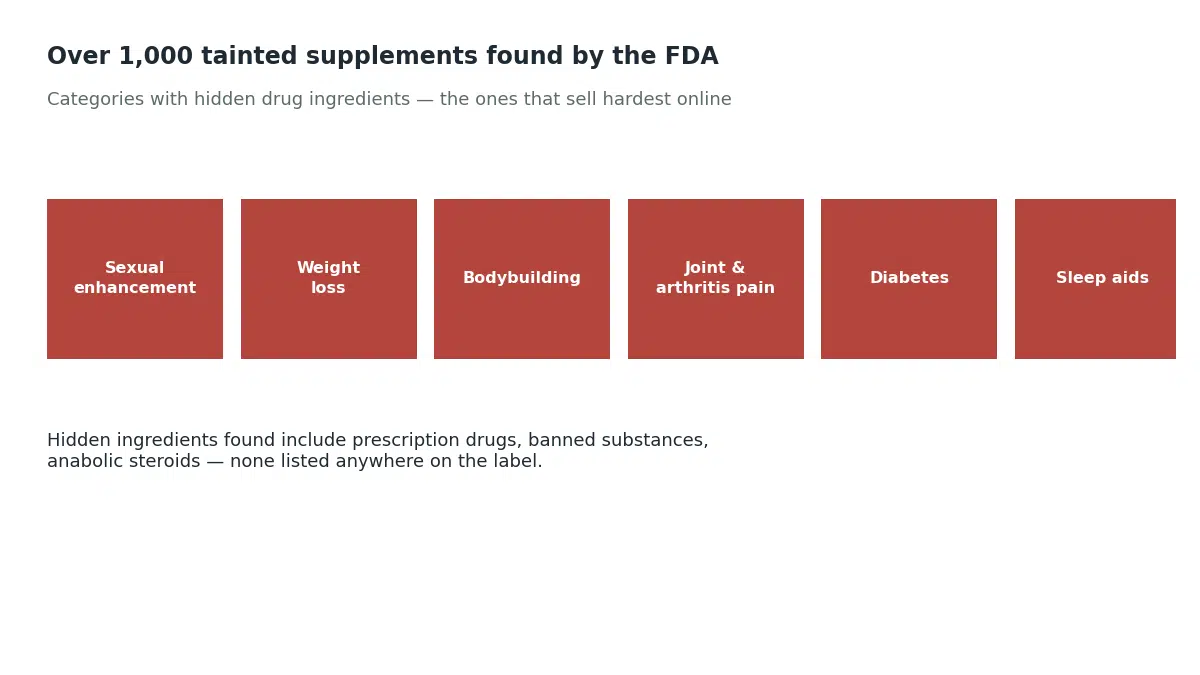
The categories most often affected map almost exactly onto what sells hardest online: sexual enhancement, weight loss, bodybuilding, joint and arthritis pain, diabetes, and sleep aids.
Recent FDA recalls include supplements found to contain undeclared sildenafil, tadalafil, meloxicam, and tianeptine. The agency has received hundreds of reports of harm from tainted products, including serious injuries and deaths. These hidden ingredients can interact dangerously with medication you already take.
So the question isn’t only whether a product works. It’s whether what’s in the capsule matches what’s on the label.
How to Tell If a ClickBank Supplement Is Legit: The Checks That Work
1. Search the FDA’s health fraud database
Start here, because it’s the only check that can tell you a product has actually been found to contain something dangerous. The FDA maintains a searchable database of products identified with hidden ingredients, plus a running list of health-fraud recalls.
One caveat the FDA states plainly: the database covers only a small fraction of the products on the market, so absence from it doesn’t mean a product is safe. It’s a check that can rule something out, not rule it in.
2. Look up the ingredients independently
Take the actual ingredient names to the NIH Office of Dietary Supplements fact sheets, or search PubMed. You’re checking two things: whether the ingredient has evidence for what’s being claimed, and whether the dose on the label matches the dose used in studies.
That second part catches a lot. Many products contain genuinely researched ingredients at a fraction of the studied dose. Enough to list on the label, not enough to do anything.
A proprietary blend defeats this check entirely, which is generally the point. If you can’t see individual amounts, you can’t assess the product, and that alone is grounds to walk away.
3. Take the label to a pharmacist
This is the most underused step and it’s free. Pharmacists check interactions for a living, and plenty of common supplement ingredients interact with prescription medication in ways sales pages never mention.
If you take anticoagulants, diabetes medication, antidepressants, thyroid medication, or heart medication, do this before you buy rather than after.
4. Check for third-party verification — and understand its limits
USP, NSF International, and Informed Choice all test finished products and confirm the contents match the label. A verification mark from one of them is meaningful.
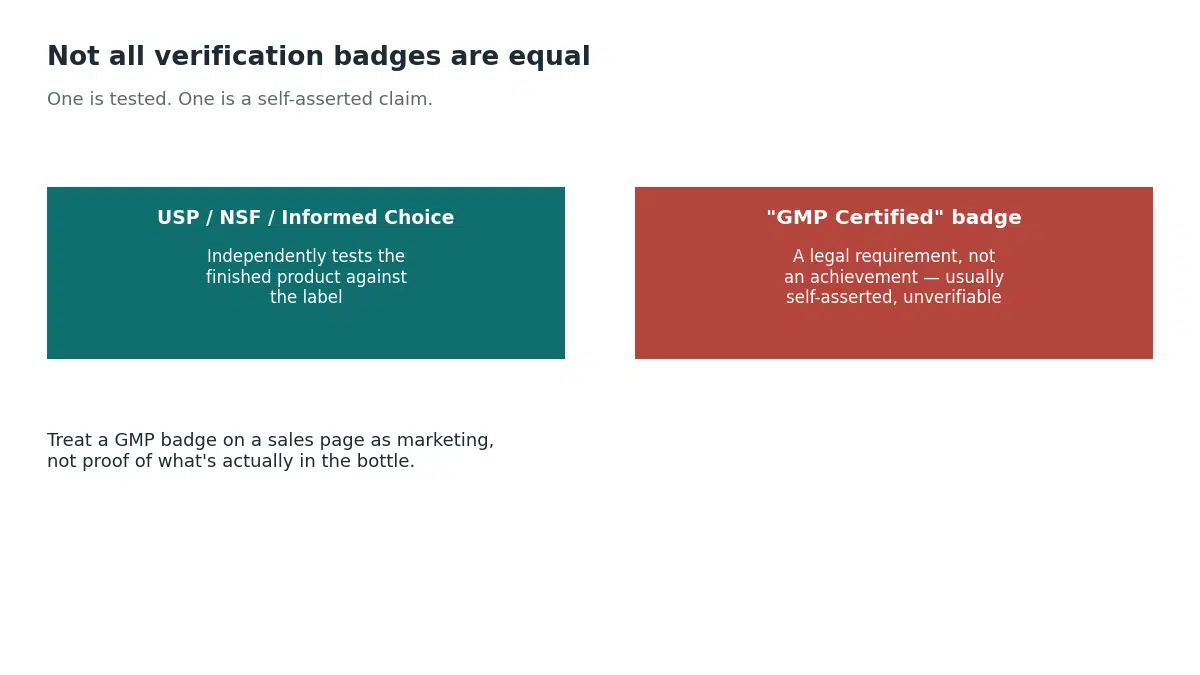
A GMP claim is not the same thing. Good Manufacturing Practices are a legal requirement, not an achievement, and a “GMP certified” badge on a sales page is a self-asserted claim you generally can’t verify. Treat it as marketing.
Same for a Certificate of Analysis: useful if it comes from a named independent lab with a batch number matching your bottle, meaningless as a generic PDF on a landing page.
5. Find out who’s actually behind it
Look for a real company name, a physical address, and a working phone number. Then search that company name separately.
If the product is fronted by a doctor or researcher, search their name independently. Verify they exist, hold the credentials claimed, and are genuinely associated with the product. Invented experts and stock-photo spokespeople are common in this category.
What FDA Regulation Actually Covers
This gets misunderstood constantly, in both directions.
The FDA does not approve dietary supplements before sale. Under the 1994 legislation governing them, supplements are regulated more like food than like drugs: no pre-market review of safety or effectiveness, and no requirement to prove a product does what it says.
Manufacturers are legally required to follow Good Manufacturing Practices and to avoid selling adulterated or misbranded products. But enforcement is largely reactive. The FDA acts after problems surface, which is why the tainted-products list keeps growing.
The practical upshot: any claim that a supplement is “FDA approved” is false by definition, and encountering it is itself a red flag.
Reading the Sales Page for Tells
Certain patterns recur across this category:
- Cure claims. Legally, a supplement cannot claim to treat, cure, or prevent a disease. If a page says it reverses diabetes or cures arthritis, the company is either breaking the law or being careful to imply it without saying it.
- The suppressed-discovery narrative. An ancient remedy, a researcher silenced by the industry, a formula “they” don’t want you to know about. This is a template, not a story.
- Manufactured urgency. Countdown timers that reset when you reload, stock counters that never quite reach zero, prices that expire tonight.
- Video-only sales pages with no way to skim, no written ingredient list, and no obvious close button.
- Long anecdotes, no numbers. Real evidence gets cited specifically. Absence of any study reference, or vague gestures at “clinical research,” tells you what there is.
- Autoship enrolment. Check whether a one-off purchase quietly signs you up for recurring billing, and how you cancel. That should be findable before you buy, not after.
Reviews, and Why Most of Them Don’t Help
Nearly every review of a ClickBank supplement was written by someone earning commission on it. That’s how the platform works. Vendors list products, affiliates promote them, and affiliates are paid per sale.
This isn’t inherently dishonest, but it does mean the incentive runs one way. Affiliate-written reviews rarely conclude that a product isn’t worth buying, because that conclusion pays nothing.
Some practical filters:
- Look for a disclosure. A reviewer who states their commission relationship upfront is more likely to be honest about the rest.
- Check whether the review says who the product isn’t for, or names a downside with any specificity. Reviews that only find upsides aren’t reviews.
- Search the product name alongside “complaint” or “refund” and read what surfaces on independent complaint platforms.
- Be wary of large batches of near-identical reviews posted in a short window, and of testimonials with no verified-purchase indicator.
For a sense of what an ingredient assessment looks like when it isn’t selling anything, our pieces on collagen vs glucosamine for joint pain, supplements for focus and concentration, and whether slimming tea is safe daily all reach conclusions that would make poor sales copy.
Refunds: What the Guarantee Is Worth
ClickBank’s default return window is 60 days from purchase, though vendors can set different periods per product. Check the specific product’s terms rather than assuming.
Refunds are requested through ClickBank’s own order lookup using your order number, or the postcode and last four digits of the card, rather than through the vendor. That’s a genuine advantage over buying direct from an unknown company.
Read the vendor’s conditions before buying. Some require returning bottles, including empty ones. Some apply the guarantee only to the first bottle of a multi-bottle order. Some make you pay return shipping. And a generous guarantee tells you nothing about whether a product works. Companies bank on most people not bothering.
If Something Goes Wrong
Stop taking the product and speak to a doctor or pharmacist if you have any reaction. Particularly chest pain, palpitations, severe headache, yellowing of skin or eyes, dark urine, or a rash with swelling or breathing difficulty. Bring the bottle with you.
Report adverse reactions to the FDA through MedWatch. Suspected tainted products can also be reported to the FDA for testing, and deceptive marketing to the Federal Trade Commission. Those reports are how products end up on the fraud database in the first place.
The Short Version
Search the FDA health-fraud database. Look up each ingredient and its dose on NIH or PubMed. Show the label to a pharmacist if you take any medication. Look for USP or NSF verification, and treat a GMP badge as marketing rather than proof.
Walk away from proprietary blends, cure claims, countdown timers, and any product whose only evidence is a testimonial.
And remember what a 60-day guarantee actually protects: your money, not your health.
FAQ
How can I tell if a ClickBank supplement is legit?
Run the checks off the sales page rather than on it: search the FDA’s health fraud database, look each ingredient and dose up on NIH or PubMed, check for USP or NSF verification, and show the label to a pharmacist if you take any medication.
Walk away from proprietary blends, since hidden amounts make the product impossible to assess.
Are supplements sold on ClickBank FDA approved?
No supplement is. The FDA doesn’t review dietary supplements for safety or effectiveness before they go on sale — they’re regulated more like food than like drugs.
Manufacturers must follow Good Manufacturing Practices, but enforcement is mostly reactive. Any product claiming to be “FDA approved” is misrepresenting itself.
Can a supplement contain ingredients that aren’t on the label?
Yes, and this is the real safety issue. The FDA has identified over a thousand products sold as supplements containing hidden drug ingredients, including prescription drugs, banned substances, and anabolic steroids.
Recent recalls involved undeclared sildenafil, tadalafil, meloxicam, and tianeptine. The categories most affected are sexual enhancement, weight loss, bodybuilding, joint pain, diabetes, and sleep aids.
Does a GMP certified badge mean a product is verified?
No. Good Manufacturing Practices are a legal requirement rather than an achievement, and a GMP badge on a sales page is a self-asserted claim you usually can’t check.
USP, NSF International, and Informed Choice actually test finished products against the label. Those marks mean something; a GMP graphic generally doesn’t.
Why are online supplement reviews so positive?
Because most are written by affiliates earning commission per sale. That’s how the platform works, and a review concluding “don’t buy this” earns nothing.
Look for an upfront disclosure, and check whether the reviewer names any downside or says who the product isn’t for. Reviews that only find upsides aren’t reviews.
What is ClickBank’s refund policy?
The default return window is 60 days from purchase, though vendors can set different periods per product, so check the specific terms.
Refunds go through ClickBank’s own order lookup rather than the vendor. Read the conditions first — some require returning bottles, some cover only the first bottle of a multi-bottle order, and some make you pay return shipping.
How do I report a suspicious supplement?
Report adverse reactions to the FDA through MedWatch, and suspected tainted products to the FDA for testing. Deceptive marketing goes to the Federal Trade Commission.
Those reports are how products end up on the health-fraud database, so reporting genuinely protects other people.
A Note on Incentives
This site publishes supplement content and participates in affiliate programs, which means the same incentive described in this article applies to us. We think that’s worth stating rather than leaving you to work out.
The practical response is to run the checks above on anything you read here as well, including our own articles. Every claim we make should be traceable to a source you can open and read yourself.
SOURCESOur Editorial Standards
HealthMagHub is built on primary sources: peer-reviewed research, clinical practice guidelines, and health agencies such as the NIH, CDC, and FDA. Read our editorial standards to see how we research, cite, and update our articles.
- U.S. Food and Drug Administration. Avoiding Products Contaminated with Hidden Ingredients and the health fraud product database. fda.gov
- U.S. Food and Drug Administration. Recalls — Health Fraud. fda.gov
- U.S. Food and Drug Administration. Fraudulent Products — Medication Health Fraud. fda.gov
- National Institutes of Health, Office of Dietary Supplements. Dietary supplement fact sheets. ods.od.nih.gov