

Before you try any sciatica stretches, one thing is worth knowing: sciatica is not a diagnosis. It is a description — nerve pain running from the lower back down the back of one leg — and several different problems produce it.
That matters because the cause decides whether stretching helps. Pain from a tight piriformis muscle usually eases with the right stretch. Pain from a disc pressing on a nerve root often does not, and aggressive forward-bending can make it worse.
The good news is that most of it settles. The American Academy of Family Physicians describes acute low back pain with or without sciatica as usually self-limiting, with staying active and reassurance being enough for most people. Below are the moves worth doing, organized by the position you are actually in, plus the one symptom that means stopping and getting help today.
- Sciatica is a symptom, not a diagnosis — a disc, spinal narrowing, or a tight piriformis muscle all produce it, and they respond differently to stretching.
- Most cases are self-limiting, and staying gently active beats bed rest. Imaging is usually not needed in the first four to six weeks without red flags.
- Numbness in the groin or saddle area, or new bladder or bowel trouble, is a same-day emergency rather than a stretching problem.
- In pregnancy, true sciatica accounts for roughly 1% of low back pain — most of it is pelvic girdle pain, which needs a different approach.
What is actually causing your sciatica
Three things account for most sciatica, and they behave differently.
A herniated disc is the most common cause, typically in the lower lumbar spine. The pain often runs past the knee, worsens with sitting, coughing or sneezing, and eases when you stand or walk.
Spinal stenosis — narrowing of the canal — is more common past 60. The giveaway is the reverse pattern: worse standing and walking, better sitting or leaning forward over a cart.
Piriformis irritation involves a muscle deep in the buttock that the nerve runs beneath. Pain is more buttock-centered, worse after long sitting, and this is the one that responds best to stretching.
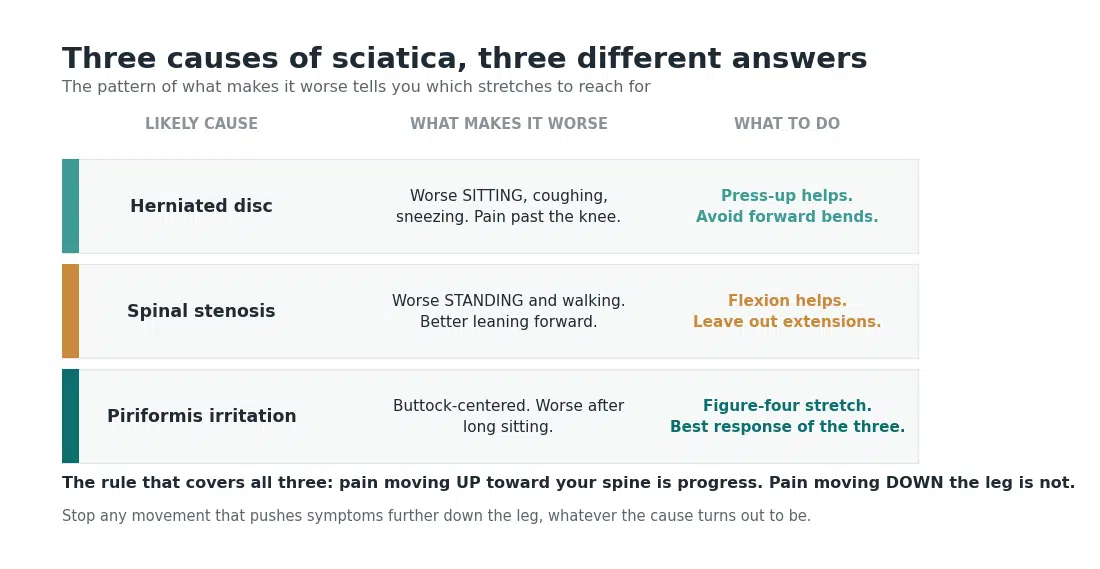
The practical rule for all three: a stretch should ease the leg pain or pull it back toward your spine. If a movement pushes pain further down the leg, that one is not for you today. Pain that stops at the knee and worsens on bending or stairs may not be sciatica at all — our guide to knee pain when bending covers that pattern.
Sciatica stretches and exercises with evidence behind them
These six sciatica stretches and exercises cover most of what physical therapists actually prescribe. Hold each for 20 to 30 seconds unless noted, breathe normally, and stop short of sharp pain.
- Figure-four (piriformis) stretch. On your back, ankle across the opposite knee, pull the supporting thigh toward your chest. The single most useful move if the buttock is the sore spot.
- Single knee to chest. On your back, draw one knee up slowly. Gentle, low-risk, a good starting point.
- Sciatic nerve glide. Sitting, slumped slightly, straighten one knee and pull the toes up, then release. Ten slow repetitions rather than a held stretch — this mobilizes the nerve rather than lengthening a muscle.
- Pelvic tilt. On your back, knees bent, flatten your lower back into the floor and release. Ten repetitions.
- Prone press-up. Lying face down, push your chest up on your forearms or hands, hips staying down. Often the most useful move for disc-related pain, and the one that most reliably pulls pain back toward the spine.
- Glute bridge. On your back, knees bent, lift the hips. This is strengthening rather than stretching, and it matters more for staying better than for feeling better today.
Do them once or twice a day rather than grinding through them. Nerve pain flares with volume, and more is not better here.
If numbness or tingling is also showing up in your hands, that is a separate question — our guide to tingling hands and arms works through those causes.
Stretches for lower back pain
If the ache sits in your lower back as much as your leg, three of the above do most of the work: the pelvic tilt, the prone press-up, and single knee to chest.
These are the sciatica stretches for lower back involvement specifically, rather than buttock or leg pain alone.
Add a cat-cow on hands and knees — arching and rounding slowly through the whole spine, eight to ten times. It is a mobility drill rather than a stretch, and it tends to be well tolerated when everything else feels provocative.
What to skip: toe-touching and other loaded forward bends. Bending forward under load is one of the more reliable ways to aggravate disc-related nerve pain, and it is exactly what people instinctively reach for when their back hurts.
Stretches you can do standing at a counter
Sciatica stretches standing up are useful when getting on the floor is not realistic, or when sitting is the thing that hurts.
- Standing figure-four. Hold a counter, cross one ankle over the opposite knee, and sit back slightly as if lowering into a chair.
- Standing hamstring stretch. Heel on a low step, back straight, hinge forward from the hips. Keep this gentle — hard hamstring stretching pulls directly on an already irritated nerve.
- Standing back extension. Hands on your lower back, lean gently backward. The upright version of the press-up, and it works well as a reset every hour at a standing desk.
- Walking. Not a stretch, but short frequent walks are among the better-supported things you can do, particularly for disc-related pain.
If standing and walking are what bring on the pain and sitting relieves it, that pattern points toward stenosis rather than a disc — and the standing extension is the one to leave out.
Stretches for sitting at a desk
Sitting raises pressure through the lower spine, which is why office workers get the worst of this. These sciatica stretches sitting at your desk take under two minutes.
- Seated figure-four. Ankle on the opposite knee, sit tall, hinge forward from the hips until you feel it in the buttock. The most practical office stretch there is.
- Seated nerve glide. Straighten the knee, lift the toes, lower. Ten slow repetitions, no drama.
- Seated spinal twist. Gentle rotation, holding the chair back. Small range only.
The bigger lever is not a stretch at all: get up every 30 minutes. A two-minute walk beats a five-minute stretch you do once at lunchtime.
Raise the chair so hips sit slightly above knees, keep both feet down, and stop sitting on a wallet.
Stretches for pregnant women — and why it usually isn’t what you think
Sciatica stretches for pregnant women deserve their own reframe, because the popular version is mostly wrong.
True sciatica is uncommon in pregnancy. UT Southwestern puts the diagnosis at around 1% of pregnant patients, and it accounts for only about 1% of pregnancy-related low back pain.
The overwhelming majority of that pain is pelvic girdle pain — irritation of the joints at the front and back of the pelvis, which loosen under pregnancy hormones.
The two feel similar and are treated differently, so telling them apart is the first job:
- Pelvic girdle pain is hard to pin down precisely, sits around the pubic bone, groin, buttock or back of the pelvis, rarely travels past the knee, and flares on single-leg tasks — stairs, rolling over in bed, putting pants on.
- True sciatica follows a distinct line down one leg, often past the knee and sometimes into the foot, and brings numbness or tingling along that path.
If it is pelvic girdle pain, hard stretching is the wrong instinct — those joints are already loose, and stretching them further tends to aggravate things.
Gentle glute and pelvic floor work, a support belt and a referral to a women’s health physical therapist are the standard route.
If it genuinely is sciatica, the seated figure-four and side-lying knee-to-chest are usually comfortable. Avoid lying flat on your back for long after the first trimester, skip deep twists, and clear any new routine with your midwife or obstetrician first.
What makes it worse
Bed rest. Beyond a day or two it slows recovery rather than speeding it. This is one of the clearest reversals in modern back care.
Loaded forward bending. Toe touches, sit-ups, heavy lifting with a rounded back.
Hard hamstring stretching. The sciatic nerve runs down the back of the thigh alongside the hamstring. Pulling hard on a nerve that is already irritated is not a stretch, it is provocation.
Pushing into pain. Muscle stretch tolerates mild discomfort. The nerve pain of sciatica does not.
The emergency that gets buried
Almost every article on sciatica is a list of stretches with no mention of the one thing that genuinely cannot wait.
Cauda equina syndrome is compression of the bundle of nerves at the base of the spinal cord. The American Association of Neurological Surgeons lists its warning signs as numbness across the inner thighs, groin and buttocks — saddle anesthesia — along with bladder or bowel dysfunction, weakness affecting more than one nerve root, and back or leg pain. It is uncommon, and delay causes permanent damage.
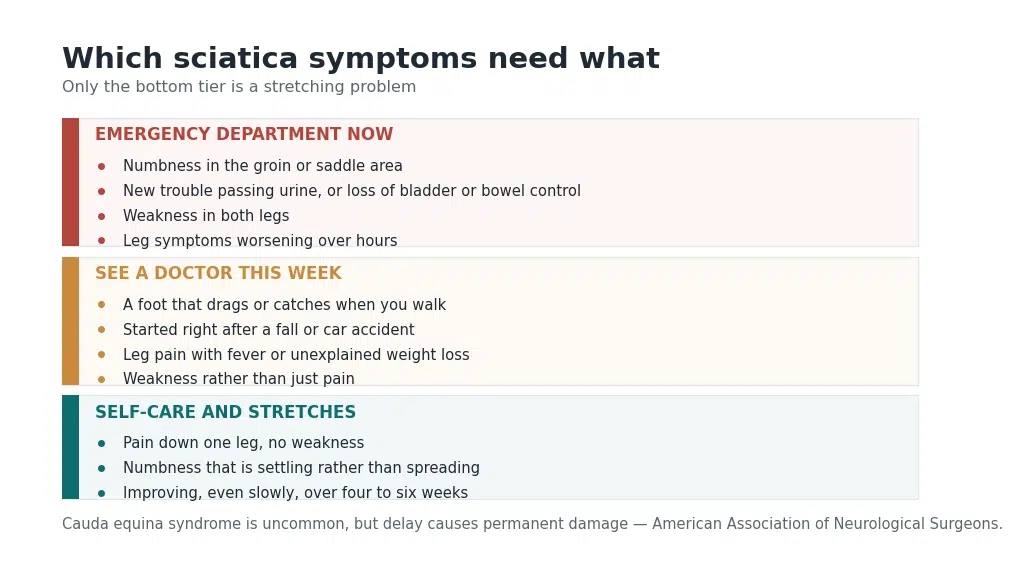
Go to an emergency department now for numbness in the groin or saddle area, new difficulty passing urine or loss of bladder or bowel control, weakness in both legs, or leg symptoms that are worsening over hours.
Also urgent: a foot that drags or catches when you walk, sciatica that began immediately after a fall or a car accident, or leg pain with fever or unexplained weight loss.
One more distinction worth making. Calf pain with swelling, warmth or redness in one leg is a different problem entirely — that pattern points toward a clot rather than a nerve, and we cover it in our guide to swelling in the feet and ankles.
When to see a doctor
- Any of the emergency signs above — same day, not an appointment
- Sciatica that has not started improving after four to six weeks of sensible self-care
- Weakness rather than just pain — trouble rising on your toes or lifting your foot
- Numbness that is spreading rather than settling
- Pain severe enough to stop you sleeping or working
- Sciatica in pregnancy that is not responding, or that you cannot tell apart from pelvic pain
- A history of cancer, steroid use, or a weakened immune system alongside new back pain
Imaging usually is not needed early. The AAFP notes that in the absence of red flags, scans can reasonably wait four to six weeks, because incidental findings are common and lead to treatment nobody needed.
Frequently asked questions
How long before sciatica stretches work?
Some people feel a change within days, particularly with piriformis-driven pain. Disc-related pain follows the natural recovery curve more than the stretching, which means weeks. If nothing has shifted after four to six weeks, that is the point to get assessed rather than to stretch harder.
Should I stretch if it hurts?
Mild discomfort in the muscle is acceptable. Pain shooting further down the leg is not — that means the nerve is being provoked.
The useful signal in sciatica is centralization: a movement that pulls pain back toward your spine is working, even if the back itself feels more sore.
Is walking good for sciatica?
Usually yes, and short frequent walks beat one long one. The exception is spinal stenosis, where walking is often the thing that brings the pain on. If you can walk further leaning on a cart than standing upright, mention that pattern to your doctor — it is a useful clue.
Can I do these stretches in bed?
Knee to chest, the figure-four and pelvic tilts all work on a mattress, though a firm surface gives better feedback.
Doing them before getting up can make the first few minutes of the morning easier, since discs are more hydrated and stiffer overnight.
What is the fastest relief?
There is no instant fix, and anything promising one is selling something. In the first couple of days, gentle movement, changing position often, and heat or ice are what is reasonably supported.
The prone press-up gives the quickest change for many people with disc-related pain.
The one thing to take away
Work out which pattern you have before you pick a stretch. Buttock-centered and worse after sitting points at the piriformis, and the figure-four is your move.
Worse sitting with pain past the knee points at a disc, and the press-up is. Worse standing and better leaning forward points at stenosis, and the extension moves come out.
Then judge every movement by one rule: pain moving up toward the spine is progress, pain moving down the leg is not. And if numbness reaches the groin or your bladder changes, stop reading and go in.
SOURCESOur Editorial Standards
HealthMagHub is built on primary sources: peer-reviewed research, clinical practice guidelines, and health agencies such as the NIH, CDC, and FDA. Read our editorial standards to see how we research, cite, and update our articles.
- Casazza BA. Diagnosis and treatment of acute low back pain. American Academy of Family Physicians. AAFP clinical review
- American Association of Neurological Surgeons. Cauda equina syndrome. aans.org
- UT Southwestern Medical Center. Sciatica in pregnancy: when it’s more than the usual aches and pains. utswmed.org