
Before anything else: get same-day medical help if your knee is hot, swollen and red with a fever, if you can’t put any weight on it after an injury, or if it locks in one position and won’t straighten. Those aren’t ordinary wear-and-tear problems.
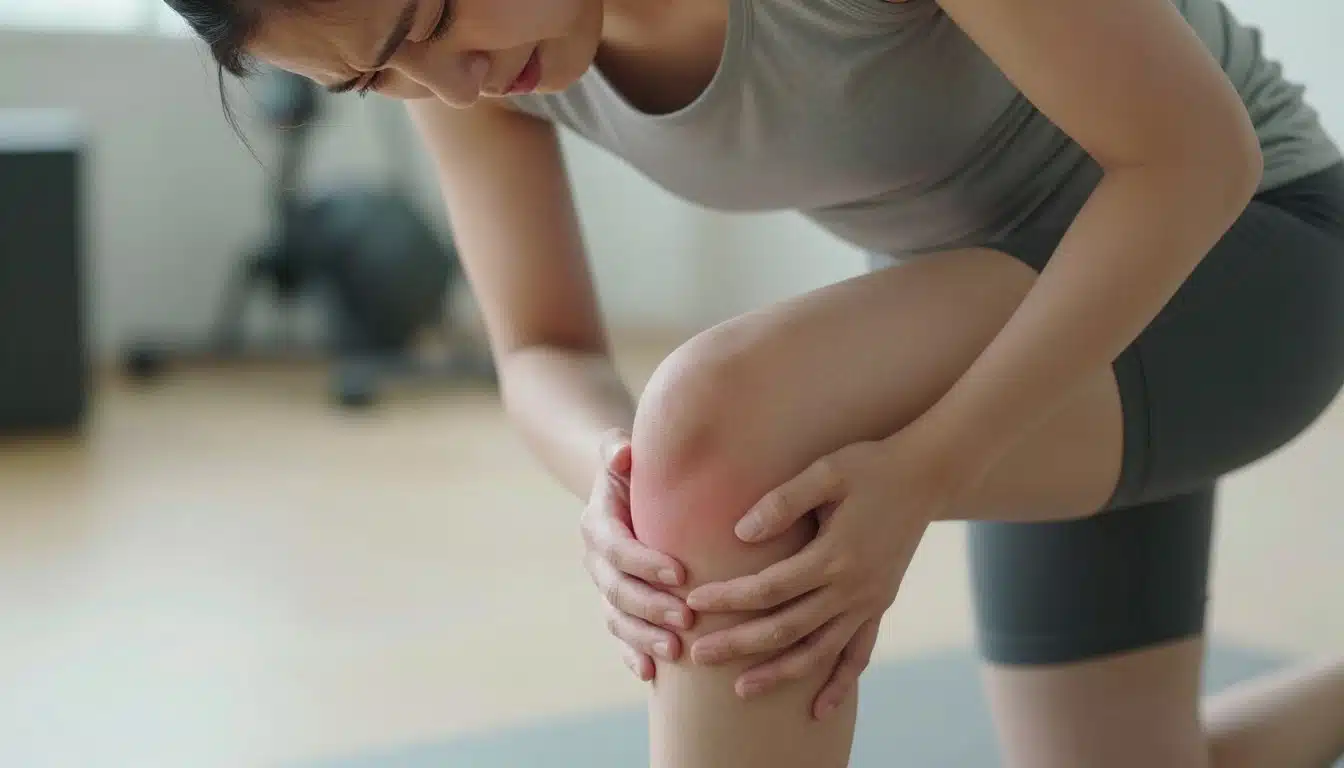
Knee pain when bending has a habit of creeping up on people. It starts as a twinge going down the stairs, then shows up when you stand from a low chair, and eventually you catch yourself planning your day around how many steps you’ll have to take.
Here’s the useful part: bending pain narrows things down. A knee that hurts when you flex it under load is telling you something quite specific, and the shortlist of causes is shorter than you’d think.
- Bending under load can put up to seven times body weight through the kneecap joint, so stairs, squats and kneeling all target the same structures.
- Runner’s knee (patellofemoral pain) is the most common cause and usually reflects undertrained hip and thigh muscles, not damaged cartilage.
- Degenerative meniscus tears in people over 40 respond as well to exercise therapy as to surgery in long-term trials.
- A hot, swollen, feverish knee or one that’s locked and won’t straighten needs same-day care.
Why bending is the movement that hurts
Straightening your leg is cheap. Bending it while holding your body weight is expensive.
Every time you lower yourself down a step, your thigh muscle has to pay out slowly, like a rope through your hands, to stop you dropping. That tension pulls your kneecap hard against the groove in your thigh bone. Researchers have measured the load: stair negotiation puts several times more force through the kneecap joint than walking on flat ground, and it climbs further the deeper the knee bends.[5]
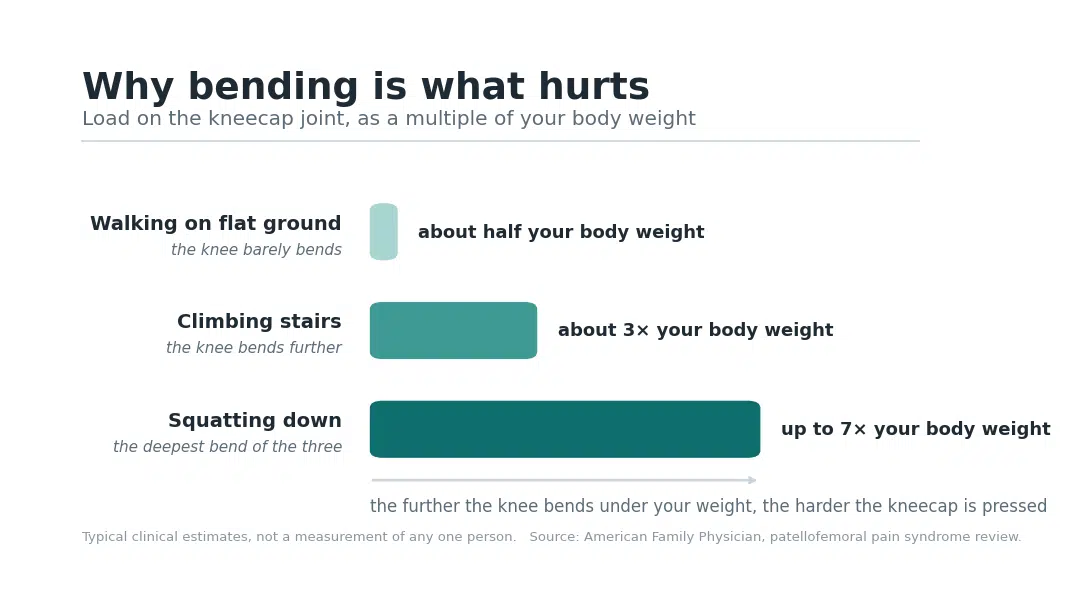
So stairs, squatting, kneeling and getting out of a car all load the same structures in the same way. If those are your problem movements, the front of the knee is usually where to look first.
Runner’s knee: the most common answer
The medical name is patellofemoral pain, which simply means pain coming from where the kneecap meets the thigh bone. You don’t have to be a runner to get it. It’s one of the most common knee complaints there is, with roughly one in five people affected in a given year, and it turns up about twice as often in women.[4]
It has a recognizable pattern. Vague, achy pain around or behind the kneecap rather than one sharp spot you can point to. Worse going down stairs than up. Worse after sitting still for a long stretch, which physical therapists nickname the “theater sign” because it announces itself when you stand up at the interval.
The old explanation blamed soft cartilage under the kneecap. The current thinking is broader: the joint is being loaded more than it’s currently conditioned to handle, often because the hip and thigh muscles that steer the knee aren’t strong enough to control it.
That’s genuinely good news. Weakness responds to training in a way that worn cartilage doesn’t.
When it’s a meniscus tear
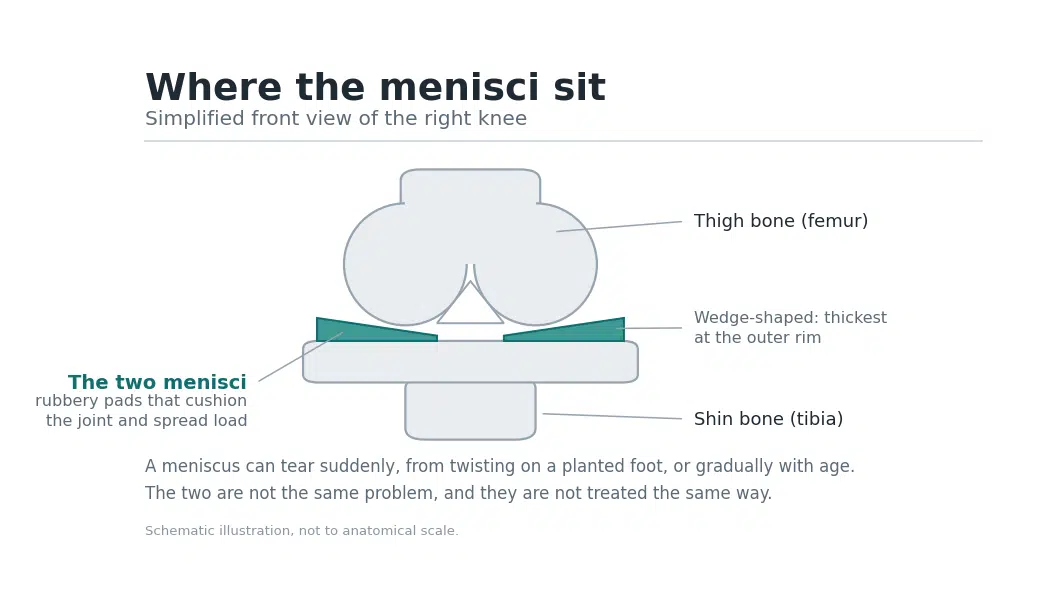
Your knee has two rubbery C-shaped shock absorbers called menisci sitting between the leg bones. They can tear two ways, and the difference matters enormously.
A young athlete tears one by twisting on a planted foot, usually with a memorable moment and rapid swelling. Past about 40, they tear the way a worn tire splits, gradually, sometimes with no injury at all. You just notice pain deep in the joint line when you squat, maybe a click or a catch.
People assume a torn meniscus means surgery. The evidence says otherwise for the gradual, age-related kind. The Dutch ESCAPE trial randomized 321 people aged 45 to 70 with confirmed degenerative tears to either keyhole surgery or a course of exercise therapy. At five years, exercise was no worse than surgery for knee function.[2] A separate Norwegian trial followed patients for a full decade and found the same thing.
That doesn’t make surgery useless. A knee that genuinely locks, where a flap of torn cartilage is jamming the joint, is a different situation and worth an orthopedic opinion. But “the scan shows a tear” is not, by itself, a reason to book an operation.
Osteoarthritis
If you’re over 50 and the pain builds slowly, with stiffness for the first ten or fifteen minutes of the morning and a grinding sensation when you bend, osteoarthritis is high on the list.
The word frightens people more than it should. Osteoarthritis isn’t your knee wearing out on a timer. It’s an active process in the whole joint, and it responds to how you use the joint.
One thing worth clearing up: X-rays and symptoms often disagree. Plenty of people have knees that look rough on film and barely bother them, and plenty have significant pain with mild changes. How your knee feels and functions matters more than what the picture shows.
One distinction worth holding onto, because it applies to every joint: morning stiffness that clears within about fifteen minutes points to wear-related arthritis. Stiffness that lasts an hour or more, or a joint whose range keeps shrinking rather than fluctuating, is a different category. The shoulder version of that is frozen shoulder, where the restriction is mechanical rather than painful.
The other usual suspects
A few less-discussed causes worth knowing:
- Bursitis: a small fluid-filled cushion becomes inflamed, often after a lot of kneeling. Tender in one distinct spot, sometimes visibly puffy.
- Patellar tendinopathy: pain in the cord just below the kneecap, common after jumping sports, worst at the start of activity.
- A Baker’s cyst: a fluid pocket behind the knee that makes it feel tight and blocked when you bend it fully. It’s usually a symptom of irritation inside the joint rather than a problem in itself.
- Referred pain: hip arthritis can send pain down to the knee, which is why a doctor examining your knee will often check your hip too.
- Nerve pain from the back: pain that begins in the lower back or buttock and travels past the knee into the calf or foot is a nerve problem rather than a joint one, and it responds to completely different things. Our guide to sciatica stretches covers how to tell which pattern you have.
What actually helps knee pain when bending
The instinct is to rest. That’s the one thing that reliably backfires. Knees get worse with prolonged unloading, and the muscles that protect them shrink fast.
Load it, don’t stop it. For osteoarthritis, the American College of Rheumatology and the Arthritis Foundation give exercise their strongest possible recommendation.[1] Not a specific magic exercise, either. Walking, cycling, water-based work and resistance training all count. The rule of thumb clinicians use is that pain during exercise is acceptable if it settles within about 24 hours and isn’t climbing week on week.
Strengthen upstream. The quadriceps get all the attention, but hip strength does a lot of the work in controlling how the knee tracks when you bend. Glute and core strengthening work often reduces knee pain in people who never trained a single knee exercise.
Modify the movement while you build. Going down stairs one step at a time, sitting in higher chairs, and shortening how deep you squat all reduce the load without stopping you moving. These are temporary scaffolding, not permanent restrictions.
Be patient with the timeline. Muscle takes six to twelve weeks to change meaningfully. Two weeks of exercises and a shrug isn’t a fair test.
On pain relief: for knee osteoarthritis, the same guideline strongly recommends topical anti-inflammatory gels and suggests trying them before swallowing tablets, because far less of the drug reaches the rest of your body.[1] Oral anti-inflammatories work too, but they carry stomach, kidney, blood pressure and heart risks, so they are worth a conversation with your pharmacist if you’re over 65, on blood pressure medication, or taking a blood thinner.
What about joint supplements?
Glucosamine and chondroitin are the ones everyone reaches for, and the evidence has not been kind to them. The 2019 American College of Rheumatology guideline moved from a soft “probably not” to a strong recommendation against glucosamine for knee osteoarthritis, based on high-quality trials showing it doesn’t work.[1]
There’s a safety point too, one that rarely makes it onto the label. Glucosamine has been linked with dangerous increases in the effect of warfarin. If you take a blood thinner, this isn’t a harmless “might as well try it” supplement. We’ve covered how collagen and glucosamine compare in more detail, along with what a realistic collagen timeline looks like.
Red flags: when knee pain needs a doctor now
Go to an emergency department or call for urgent help if:
- Your knee is hot, swollen and red, especially with a fever or feeling generally unwell. Septic arthritis, an infection inside the joint, is an emergency, and the knee is the joint it most often affects in adults. It can destroy cartilage within days.[3]
- Your knee is locked and you cannot straighten it.
- You can’t bear weight after an injury, or the knee gave way completely.
- Your calf is swollen, warm and painful alongside the knee. That can be a blood clot rather than a joint problem. Our guide to swelling in the feet and ankles covers how to tell the difference.
Book a routine appointment if the pain has lasted more than six weeks despite sensible self-management, if the knee is repeatedly giving way, if it swells every time you use it, or if it’s waking you at night. Unexplained weight loss or night sweats alongside joint pain always deserves a proper look.
The one thing to take away
Most knee pain when bending comes down to a joint being asked to do more than it’s currently conditioned for. It responds to gradual, sustained loading far better than to rest, and better than to anything you can buy in a bottle.
Start with the stairs one step at a time and some hip work. Give it two months. If the pain is worsening rather than plateauing, that’s the point to get it examined properly rather than pushing through.
SOURCESOur Editorial Standards
HealthMagHub is built on primary sources: peer-reviewed research, clinical practice guidelines, and health agencies such as the NIH, CDC, and FDA. Read our editorial standards to see how we research, cite, and update our articles.
- Kolasinski SL et al. 2019 American College of Rheumatology/Arthritis Foundation Guideline for the Management of Osteoarthritis of the Hand, Hip, and Knee. pubmed.ncbi.nlm.nih.gov
- Noorduyn JCA et al. Physical Therapy vs Arthroscopic Partial Meniscectomy: Five-Year Follow-up of the ESCAPE Randomized Clinical Trial. JAMA Network Open
- Momaya AM, Riehl JT. Septic Arthritis. StatPearls. NCBI Bookshelf
- Dixit S et al. Management of Patellofemoral Pain Syndrome. American Family Physician
- Nakagawa TH et al. Lower Extremity Kinematics of Females With Patellofemoral Pain Syndrome While Stair Stepping. JOSPT