

Before anything else: shoulder stiffness that follows a fall or a wrenching injury, or comes with numbness, weakness or an arm that feels heavy and cold, isn’t frozen shoulder and needs assessing. So does shoulder pain with fever, or with chest discomfort and breathlessness.
The first symptom of frozen shoulder is usually pain, not stiffness. That catches people out, because the name suggests the opposite.
It starts as an ache deep in the shoulder that gets worse at night and makes lying on that side impossible. The stiffness arrives later, and by the time you notice you can’t reach behind your back or fasten a seatbelt comfortably, the condition is already well established.
Understanding the sequence matters more than it might seem. The treatment that works best works best early, so knowing which stage you’re in changes what’s worth doing.
- Pain comes first, stiffness later, and the restriction is mechanical rather than pain-limited (someone else lifting your arm still won’t work).
- Three stages (freezing, frozen, thawing) typically span 6 months to 2 years in total.
- People with diabetes face up to 6 times the risk, and it tends to resolve more slowly and less predictably.
- Early steroid injection during the painful phase outperforms exercise alone, and waiting reduces its value.
What frozen shoulder actually is
The medical name is adhesive capsulitis, and it describes the mechanism better than the common name does.
Your shoulder sits inside a capsule of connective tissue. In frozen shoulder that capsule becomes inflamed, then thickens and contracts, and bands of scar tissue form inside it. There’s also less of the fluid that normally lubricates the joint.[3]
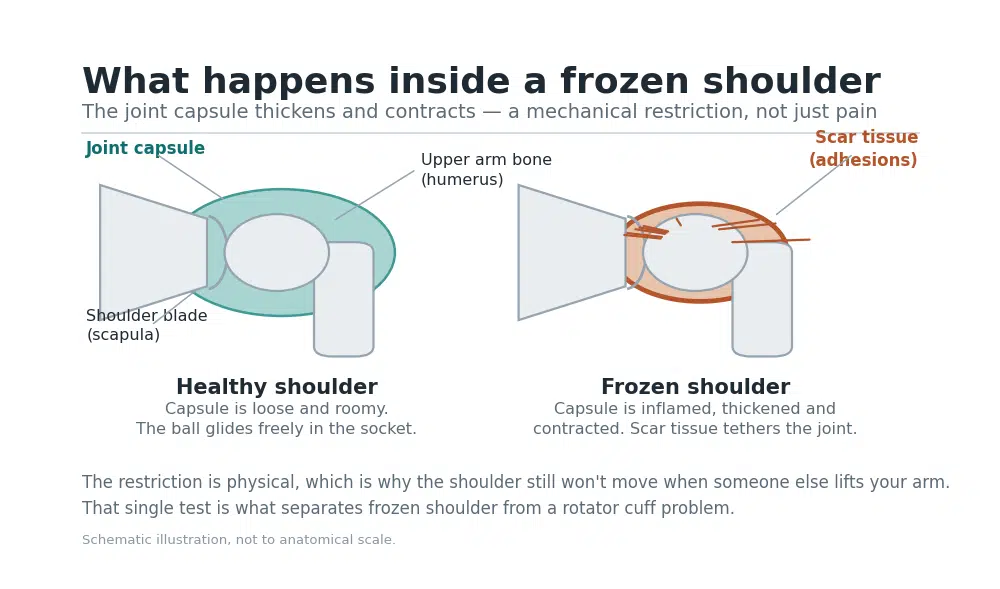
The result is a joint that’s physically tethered. This is the detail that explains everything else about the condition: the restriction is mechanical, not a matter of pain limiting how far you move. If someone else lifts your arm for you, it still won’t go. That’s what separates frozen shoulder from most other shoulder problems, and it’s exactly what a doctor tests for.
It affects roughly 2 to 5% of people, most commonly between 40 and 60, and more women than men.[1]
The three frozen shoulder stages, and how long each takes
The stages overlap rather than switching cleanly, and the timings vary a great deal between people. But the sequence is consistent.
- Stage one, freezing. Pain dominates. It builds gradually over weeks, is worse at night, and movement becomes progressively more restricted as the shoulder guards against it. Typically runs somewhere between 10 and 36 weeks.
- Stage two, frozen. The pain settles, sometimes considerably. The stiffness doesn’t, and this is when daily tasks become genuinely awkward: washing your hair, reaching a back pocket, putting on a coat. Usually 4 to 12 months.
- Stage three, thawing. Range of motion gradually returns. This is the longest and slowest phase, and it can run anywhere from 12 to 42 months.
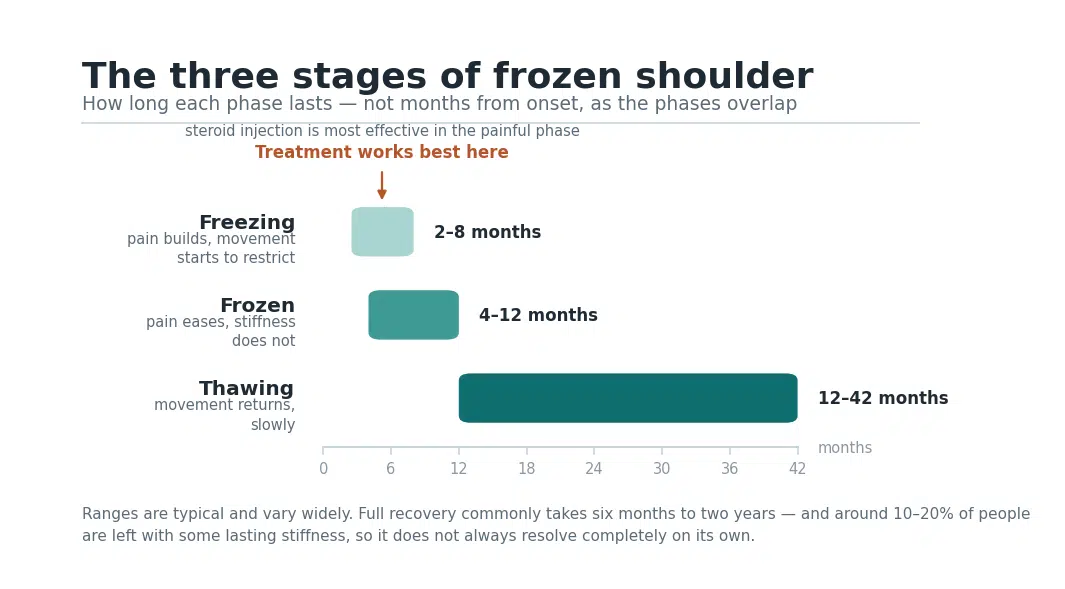
Adding those together explains the reputation. Full recovery commonly takes somewhere between six months and two years, and occasionally longer.[1]
The part most articles get wrong
You’ll read almost everywhere that frozen shoulder is self-limiting and resolves completely on its own.
That’s optimistic. Around 80% of people regain near-normal function with appropriate treatment, which means roughly 10 to 20% are left with lasting stiffness or discomfort.[1] A 2026 review in the American Journal of Medicine put it more bluntly, describing frozen shoulder as frequently not self-limited, with many patients still experiencing pain and functional limitation years after onset.[2]
That matters practically. If you believe it always resolves by itself, waiting is rational. If you know a meaningful minority are left with permanent restriction, and that the most effective treatment works best in the first phase, waiting looks different.
Why diabetes changes the picture entirely
This is the single most under-communicated fact about frozen shoulder.
In the general population, prevalence sits around 2 to 5%. In people with diabetes, reported figures run from about 11% to 30% depending on the study. That’s up to six times the risk.[1]
Frozen shoulder in diabetes also tends to be more stubborn, taking longer to resolve and responding less predictably to treatment. Nobody fully understands why, though it’s thought to involve the way excess glucose affects collagen in connective tissue.
Two practical consequences. If you have diabetes and your shoulder starts aching at night, take it seriously earlier than you otherwise would. And if you’re offered oral steroids, that decision needs weighing carefully, because they raise blood sugar.
Thyroid disease, prolonged immobilization after an injury or surgery, and a previous shoulder problem also raise the risk.
What frozen shoulder is not
Several shoulder conditions get confused with it, and the distinction changes the treatment completely.
- Rotator cuff problems hurt when you move the arm a particular way but usually allow full passive movement. Someone else can still lift your arm. Strengthening work like rear shoulder exercise is appropriate there and not during an acute frozen shoulder.
- Shoulder osteoarthritis produces stiffness too, but tends to come with grinding and shows on an x-ray. Frozen shoulder is diagnosed clinically, with imaging used mainly to rule other things out.
- Referred pain from the neck often comes with tingling or numbness down the arm, which frozen shoulder doesn’t cause.
- Pain that started immediately after a specific injury is more likely a tear than a capsulitis.
The test that separates them is simple enough that a doctor will do it in seconds: whether your shoulder moves when someone else moves it for you.
What actually helps frozen shoulder, and when
Timing is the theme here.
Intra-articular corticosteroid injection is the most effective early intervention, and it works best during the painful freezing phase. A meta-analysis found significant pain relief at four to six weeks alongside improved function and range of motion.[4] It isn’t a cure-all. One study following patients for 12 weeks found just over half met the threshold for meaningful improvement. But combined with structured exercise, early injection still outperforms exercise alone.
Physical therapy matters throughout, but what it involves should change with the stage. During the freezing phase, gentle range-of-motion work within comfort is appropriate. Aggressive stretching into pain at this point tends to make things worse, and it’s the most common self-treatment mistake.
NSAIDs help with symptoms, but the evidence for them as a treatment on their own is limited. They make the nights more bearable; they don’t change the course.
Oral corticosteroids have shown benefit comparable to exercise therapy in the short term, though exercise did better for restoring rotation.[1] Given the systemic effects, they need weighing carefully, particularly with diabetes.
For the minority who don’t improve, hydrodilatation, manipulation under anesthesia and arthroscopic capsular release exist. These are for refractory cases, not first steps.
On supplements: nothing sold for joints has evidence in adhesive capsulitis specifically, and our comparison of collagen vs glucosamine for joint pain is about osteoarthritis, which is a different problem in a different tissue.
Living with the frozen phase
The months when pain has eased but movement hasn’t are the hardest to manage practically.
Rearrange what you can reach, moving everyday items down to waist height. Front-fastening clothes are easier than anything requiring reaching behind. A long-handled sponge is not defeat.
Keep using the arm within its available range. Complete disuse worsens stiffness, and immobilization is itself a risk factor for the condition in the first place.
And keep the other shoulder moving properly, because people compensate heavily and the second shoulder is affected in a proportion of cases, usually not at the same time. If joint pain is showing up elsewhere too, in the knees when bending, for instance, that’s worth mentioning at the same appointment rather than treating separately.
When to see a doctor
Book an appointment for shoulder pain and stiffness lasting more than a couple of weeks, especially if night pain is disturbing sleep or your range of motion is visibly reducing.
Go sooner if you have diabetes or a thyroid condition, because your risk is higher and early treatment is more valuable.
Seek urgent assessment for shoulder pain with fever, stiffness that followed a significant injury, numbness, weakness or coldness in the arm, or shoulder pain accompanied by chest discomfort, breathlessness or sweating, which can be referred cardiac pain rather than a joint problem at all.
The one thing to take away
Frozen shoulder follows a predictable path, but a slow one, and the window where treatment does most good is the early painful phase that people are most likely to wait out.
If your shoulder has been aching at night for a few weeks and you’re finding it harder to reach behind you, that’s the appointment worth making now rather than in three months. Especially if you have diabetes.
SOURCESOur Editorial Standards
HealthMagHub is built on primary sources: peer-reviewed research, clinical practice guidelines, and health agencies such as the NIH, CDC, and FDA. Read our editorial standards to see how we research, cite, and update our articles.
- Adhesive Capsulitis (Frozen Shoulder). StatPearls, NCBI Bookshelf. ncbi.nlm.nih.gov
- Frozen shoulder: Diagnosis and treatment of adhesive capsulitis. The American Journal of Medicine, 2026
- Frozen Shoulder: Adhesive Capsulitis. OrthoInfo, American Academy of Orthopaedic Surgeons
- Corticosteroid Injections for Pain Relief and Range of Motion in Adhesive Capsulitis. PMC