
Before anything else: lateral hip pain after a fall needs an x-ray, not a stretch, especially if you can’t bear weight or the leg looks shortened or turned out. Hip pain with fever, or with unexplained weight loss, also needs assessing rather than treating at home.
Hip bursitis is usually not bursitis.That sounds like a technicality. It isn’t. It changes what helps, what makes it worse, and what to do first, and it explains why so many people get an injection, feel better for six weeks, and end up back where they started.
- Despite the name, most “hip bursitis” is actually gluteal tendinopathy, a tendon problem rather than an inflamed cushion.
- Compression, not overuse, keeps it going: crossing legs, sleeping on that side, and hanging on one hip all press the tendon into bone.
- The LEAP trial found education plus exercise beat both a steroid injection and wait-and-see at 8 weeks and a year.
- Hip pain after a fall, or with fever or unexplained weight loss, needs assessment rather than home treatment.
What hip bursitis actually is
The pain sits on the outside of the hip, over the bony point you can feel through your skin. That point is the greater trochanter, the top of your thigh bone.
For decades, pain there was blamed on inflammation of the bursa, a small fluid-filled cushion sitting over the bone. Hence trochanteric bursitis.
Then imaging and surgical studies looked properly. The most common finding isn’t an inflamed bursa. It’s tendinopathy of the gluteus medius and minimus, the two muscles that run from your pelvis to that bony point and stabilize your hip every time you stand on one leg.
So the problem is usually a tendon, not a cushion. Clinicians now often use greater trochanteric pain syndrome, or gluteal tendinopathy when the tendons are confirmed.
Why the distinction matters: an inflamed bursa is something you calm down. A degenerative tendon is something you load progressively, the way you’d rehabilitate an Achilles or a patellar tendon. Those are close to opposite instructions.
What hip bursitis feels like
Hip bursitis has a pattern recognizable enough that most people identify themselves in it immediately.
- Pain on the outside of the hip, sometimes spreading down the outer thigh, but rarely past the knee.
- Tender to press on that bony point, often exquisitely so.
- Worse lying on that side at night. This is the complaint that drives people to seek help, and it’s close to diagnostic.
- Worse lying on the other side too, if the top leg falls across the body.
- Worse on stairs, standing on one leg, or after sitting with legs crossed.
It affects women far more than men, most commonly between 40 and 60.
One thing it shouldn’t do: cause pain in the groin. Groin pain points to the hip joint itself, osteoarthritis for example, rather than the tendons on the outside. That distinction is worth carrying to your appointment, in the same way that where knee pain shows up narrows its cause.
One more thing it shouldn’t do: turn up in several joints at once. Hip bursitis is a local, one-sided problem. If your hip pain arrives alongside swollen, stiff finger joints on both hands, that points toward inflammatory arthritis rather than a tendon, and it needs a different sort of appointment, and a prompt one.
Why it happens: compression, not overuse
Hip bursitis persists for one reason: tendons dislike being compressed against bone.
When your hip moves inward past the midline, whether that’s crossing your legs, standing with your weight slung onto one hip, or lying on your side, the gluteal tendons get pressed against the greater trochanter underneath them.
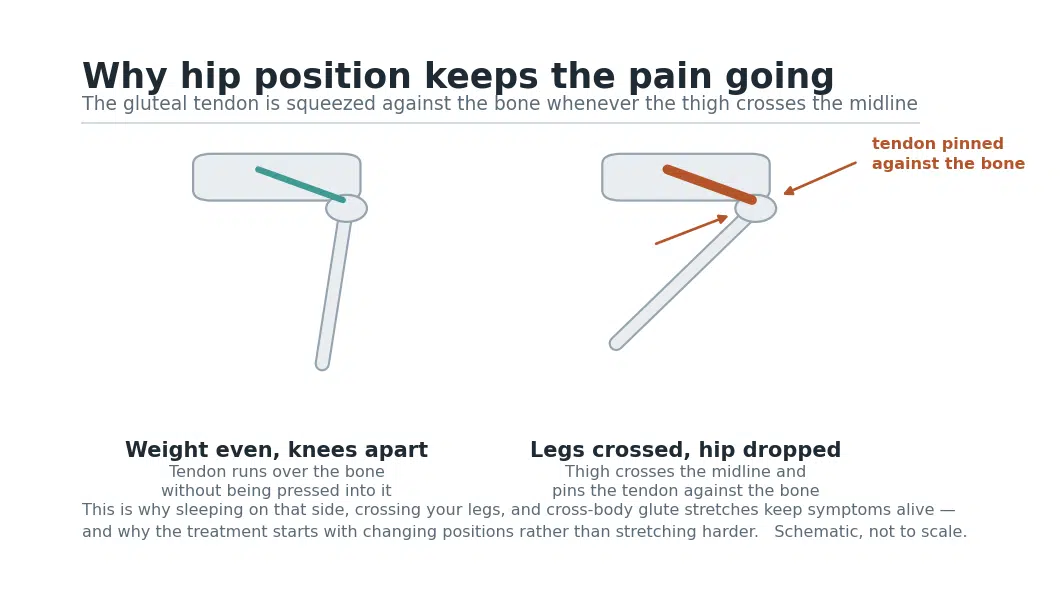
Do that repeatedly and the tendon is being squeezed rather than loaded. Research on tendon pain treats compressive load as a factor in how tendinopathy develops in the first place.[3]
Which is why the usual advice can quietly keep the problem alive: stretch it out, roll the IT band, sleep on the good side. Every one of those increases compression at exactly the wrong spot.
What actually helps hip bursitis: the trial worth knowing about
Most articles list hip bursitis treatments without ranking them. There’s a good trial here, so ranking them is possible.
The LEAP trial, published in the BMJ in 2018, randomized people with gluteal tendinopathy into three groups: education on load management plus exercise, a corticosteroid injection, or a wait-and-see approach.[1]
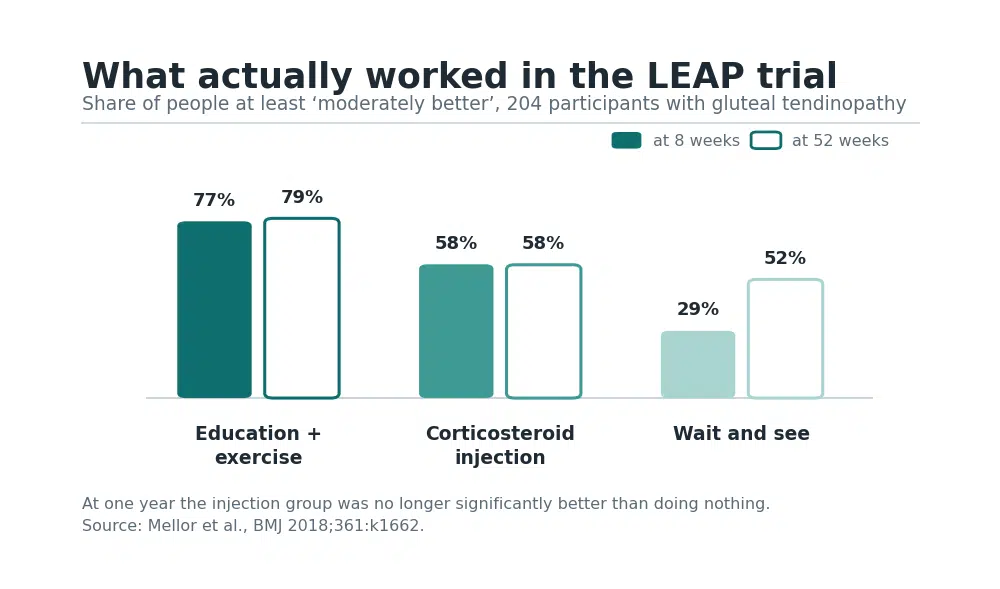
Education plus exercise won, at eight weeks and again at 52 weeks, on both global improvement and pain. It beat the injection on function, quality of life and self-efficacy, and at a year the exercise group had less frequent pain than the injection group.[1]
Wait-and-see performed worst at every time point. Doing nothing is a real option people are offered, and it’s the weakest one.
Three practical conclusions follow.
- The injection isn’t the first move. It works, in the sense that it reduces pain for a while. But it was outperformed at eight weeks by an approach with no needle, and the gap held at a year.
- The education half isn’t filler. In the trial, that component was specifically about avoiding positions that compress the tendon, which is the section below. Participants weren’t just handed exercises.[2]
- Progress takes months, not weeks. The program ran over eight weeks and outcomes were still improving at a year. A couple of weeks of exercises proves nothing.
Positions and exercises to avoid with hip bursitis
This is the half of hip bursitis advice people skip, and it’s the half that stops the problem recurring.
- Don’t sleep on the painful side. If you must, a pillow between the knees keeps the top leg from dropping across the body, which is what compresses the tendon.
- Don’t sit with your legs crossed, or with knees together and feet apart. Both drive the hip inward.
- Don’t stand hanging on one hip. That habitual weight-shifted stance, hip pushed out to one side, is one of the most common maintaining factors.
- Don’t stretch into the pain. The classic figure-four and cross-body glute stretches press the tendon straight into the bone. They feel like they’re helping. They aren’t.
- Don’t foam-roll the outside of your hip. Rolling directly over the greater trochanter compresses the exact tissue that hurts.
- Go easy on deep squats and low chairs early on, and take stairs one at a time while symptoms are settling.
What to do instead: sit with knees apart, sleep with a pillow between the knees, stand with weight evenly through both feet, and build strength in the hip abductors, the muscles that hold your pelvis level when you stand on one leg. Isometric holds are often the starting point, because they load the tendon without moving it through the compressive range. Core and glute strengthening supports the same job. A physical therapist earns their fee here, because the progression matters more than the exercise selection.
Does hip bursitis go away on its own?
Sometimes, slowly, and less reliably than people hope.
The wait-and-see group in that trial is the closest thing to an answer. They did improve, but they improved least, at every measurement point, and were still behind a year later. Hip bursitis isn’t a condition that reliably resolves if you leave it alone.
The reason is mechanical rather than mysterious. If the positions compressing the tendon are part of your ordinary day (how you sleep, how you sit, how you stand at the kitchen counter), then nothing changes just because time passes. The load keeps arriving.
Expect a realistic timeline of three to six months for meaningful change, longer if symptoms have been present for years. Tendons remodel slowly, and hip bursitis is frequently described in the literature as recalcitrant, which is a polite way of saying it outlasts most people’s patience. The same is true of frozen shoulder, where the timeline is measured in months to years.
The encouraging part: the trial’s exercise group was still improving at 52 weeks. Slow isn’t the same as stuck.
What a doctor will do
Diagnosing hip bursitis is mostly clinical. Tenderness over the greater trochanter, plus pain reproduced by standing on one leg for 30 seconds, gets you most of the way.
Imaging isn’t routine. Ultrasound or MRI can confirm tendinopathy or a tear, and both are worth doing if symptoms are severe, atypical, or not settling. But a scan isn’t needed to start treatment.
On medication: anti-inflammatories can make the early weeks tolerable, with the usual cautions: stomach, kidney and blood pressure risks worth checking with a pharmacist if you’re older or on other medication. They don’t fix a tendon.
Shockwave therapy and platelet-rich plasma injections exist, and the evidence for both is weaker than for exercise. Surgery is reserved for confirmed tendon tears that haven’t responded to a proper rehabilitation program. Joint supplements have no evidence here either. Our comparison of collagen vs glucosamine for joint pain concerns cartilage in osteoarthritis, not tendons.
When lateral hip pain is not hip bursitis
Get urgent assessment for hip pain after a fall, particularly if you can’t bear weight, the leg looks shorter or rotated outward, or you’re over 65 or have osteoporosis. Fractures around the hip get missed when pain is assumed to be soft tissue.
Get seen promptly for hip pain with fever or feeling generally unwell, for pain that wakes you every night and is getting steadily worse rather than fluctuating, or for unexplained weight loss alongside it.
Book a routine appointment if the pain hasn’t improved after six to eight weeks of load modification and exercise, if it radiates below the knee, if you feel pins and needles or numbness in the leg, or if the hip gives way.
The one thing to take away
If you’ve been told you have hip bursitis, the most useful thing you can do is stop treating it like an inflamed cushion.
The tendon underneath is what usually hurts, compression is what usually keeps it hurting, and the best-evidenced treatment is load management plus progressive strengthening rather than a needle.
Start with the positions list. Stop sleeping on that side, stop crossing your legs, stop stretching into it. Then get a proper strengthening program and give it three months.
SOURCESOur Editorial Standards
HealthMagHub is built on primary sources: peer-reviewed research, clinical practice guidelines, and health agencies such as the NIH, CDC, and FDA. Read our editorial standards to see how we research, cite, and update our articles.
- Mellor R, Bennell K, Grimaldi A, et al. Education plus exercise versus corticosteroid injection use versus a wait and see approach on global outcome and pain from gluteal tendinopathy. BMJ 2018;361:k1662
- Mellor R, Grimaldi A, Wajswelner H, et al. Exercise and load modification versus corticosteroid injection versus ‘wait and see’ for persistent gluteus medius/minimus tendinopathy (the LEAP trial): protocol. PubMed
- Cook JL, Purdam C. Is compressive load a factor in the development of tendinopathy? British Journal of Sports Medicine