healthmaghub
  • HOME
  • BLOG
  • REVIEWS
  • TOOLS
No Result
View All Result
  • HOME
  • BLOG
  • REVIEWS
  • TOOLS
No Result
View All Result
HealthNews
No Result
View All Result

Back Delt Exercises: Complete Guide to Building Stronger Rear Delts

by Owen Bradley
July 22, 2026
Reading Time: 27 mins read
0
Training your back delt exercises properly transforms not just shoulder appearance but overall upper body function. The posterior deltoids remain among the most undertrained muscles in resistance programs, yet their development proves essential for balanced shoulder strength and injury prevention. Many lifters focus heavily on chest and front shoulder work while neglecting the muscles that provide stability and healthy shoulder mechanics.

The rear deltoids work constantly during pulling movements and stabilization activities. Weakness in these muscles contributes to rounded shoulders, poor posture, and increased injury risk during pressing exercises. Dedicated rear delt exercises correct muscular imbalances and create the three-dimensional shoulder development that distinguishes advanced physiques from beginners.

This comprehensive guide examines proven back delt exercises with detailed form instructions and programming recommendations. You’ll discover the anatomical function of posterior deltoids, exercise selection criteria, and how to integrate rear delt training into your existing routine for maximum results.

Understanding Posterior Deltoid Anatomy and Function

The deltoid muscle consists of three distinct heads that perform different movement functions. The posterior deltoid originates from the spine of the scapula and inserts on the lateral humerus. This positioning allows the rear delt to perform horizontal shoulder extension, external rotation, and shoulder abduction when the arm moves behind the body.

Understanding rear delt function helps you select exercises that effectively target these muscles. The rear delts activate maximally during rowing movements where elbows travel behind the torso and during reverse fly patterns. They also stabilize the shoulder joint during pressing movements, preventing excessive internal rotation that can damage shoulder structures.

Primary Functions of Rear Deltoids

  • Horizontal shoulder extension pulling the arm backward from front position
  • Shoulder external rotation turning the upper arm outward
  • Transverse abduction moving the arm away from midline in horizontal plane
  • Scapular stabilization during pressing and overhead movements
  • Postural support maintaining upright shoulder position
  • Deceleration control during throwing and reaching movements

Why Rear Delts Often Lag Behind

Most training programs emphasize anterior muscle groups visible in the mirror. Chest pressing, front raises, and overhead work all target front delts and pectorals. This creates significant volume disparity between anterior and posterior shoulder muscles, leading to the classic rounded-forward posture common among lifters.

The rear deltoids also receive less stimulation from daily activities compared to front shoulder muscles. Pushing motions dominate most movement patterns, while dedicated pulling with proper rear delt engagement requires conscious effort and technique refinement.

Best Rear Delt Exercises for Complete Development

Effective posterior deltoid exercises share common characteristics that maximize muscle activation. The most productive movements position the shoulder in horizontal extension or abduction while minimizing involvement from larger back muscles. Proper exercise selection ensures rear delts receive adequate stimulus without excessive trapezius or latissimus dorsi dominance.

Face Pulls with Rope Attachment

Face pulls represent one of the most effective exercises for targeting rear delts while improving shoulder health. This movement combines horizontal shoulder extension with external rotation, addressing multiple posterior shoulder functions simultaneously. The constant tension from cables provides consistent muscle activation throughout the entire range of motion.

  • Setup: Attach a rope handle to a cable machine set at upper chest or face height.
  • Grip: Grasp the rope ends with palms facing each other, thumbs pointing toward your body.
  • Starting Position: Step back until arms extend fully with slight tension on the cable, feet shoulder-width apart.
  • Pull Phase: Drive elbows back and outward while pulling the rope toward your face, separating the rope ends.
  • Peak Contraction: Finish with hands beside your ears, elbows behind shoulder line, squeezing rear delts hard.
  • Return Phase: Control the weight back to the starting position without letting shoulders roll forward.
  • Breathing: Exhale during the pull phase, inhale during the return to starting position.

Reverse Pec Deck Machine

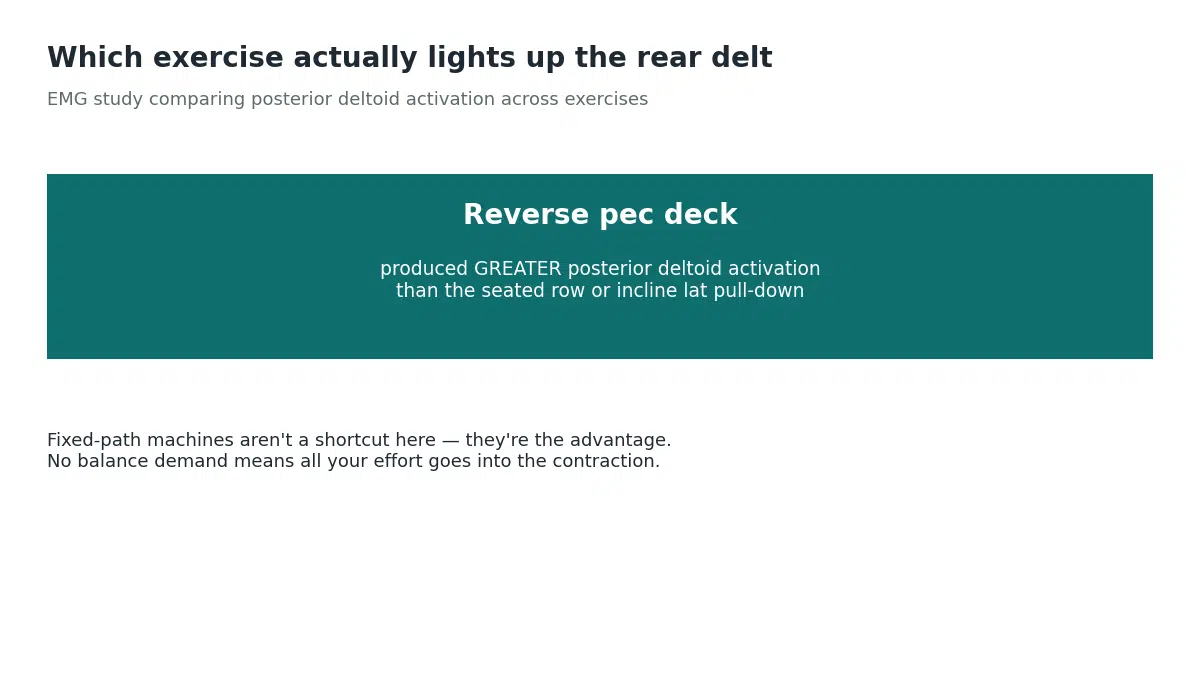
The reverse pec deck isolates rear delts effectively by eliminating stabilization demands. This machine guides the movement path, allowing lifters to focus entirely on muscle contraction. The fixed arc prevents compensation patterns that often occur with free weight exercises.

Adjust the seat height so handles align with shoulder height when arms extend forward. Position chest against the pad with arms nearly straight, maintaining a slight elbow bend. Drive elbows backward in a wide arc, focusing on squeezing shoulder blades together while contracting rear delts. Control the return phase rather than letting weight slam back.

Bent-Over Dumbbell Reverse Fly

This classic free-weight movement develops rear delts while challenging core stability. The bent-over position reduces momentum and forces strict form. Dumbbell reverse flies allow natural arm paths that accommodate individual shoulder mechanics better than fixed machines.

  • Hinge forward at hips until torso reaches near-parallel to floor
  • Hold dumbbells with arms hanging straight down, palms facing each other
  • Maintain neutral spine throughout the movement with engaged core
  • Raise dumbbells out to sides in wide arc with slight elbow bend
  • Lift until arms reach parallel to floor at shoulder height
  • Squeeze rear delts at top position for one second
  • Lower weights under control back to starting position
  • Avoid swinging or using momentum to lift the weight

Seated Cable Rope Face Pull Variation

The seated position for face pulls eliminates leg drive and forces upper body muscles to handle all work. This variation suits lifters who struggle maintaining proper posture during standing versions. The stability allows heavier loading while maintaining perfect form.

Sit on the floor or bench facing the cable machine with feet braced against a solid surface. Set cable height slightly above head level. Pull the rope toward your forehead while driving elbows high and back. This angle emphasizes the upper portion of rear delts and improves shoulder external rotation strength.

Seated cable face pull exercise showing proper elbow and rope position

Single-Arm Dumbbell Row with Rear Delt Focus

While traditional rows emphasize lats and middle back, technique modifications shift emphasis toward posterior delts. The key involves pulling with a wider elbow path and higher hand position. This rowing variation builds functional strength in pulling patterns while isolating rear shoulder muscles.

  • Position: Place one knee and hand on a bench, opposite foot on floor for stability.
  • Grip: Hold dumbbell with free hand, arm hanging straight from shoulder.
  • Body Alignment: Keep torso parallel to floor with neutral spine and engaged core.
  • Pull Pattern: Drive elbow back and slightly outward rather than tight to body.
  • Top Position: Finish with elbow behind torso, hand near hip level, squeezing rear delt.
  • Lowering Phase: Control weight down slowly, maintaining shoulder stability throughout.

Prone Incline Dumbbell Raise

This exercise provides complete support for the torso, eliminating compensation and momentum. The incline bench position places optimal tension on rear delts throughout the movement range. Chest support allows focus on muscle contraction without stabilization concerns.

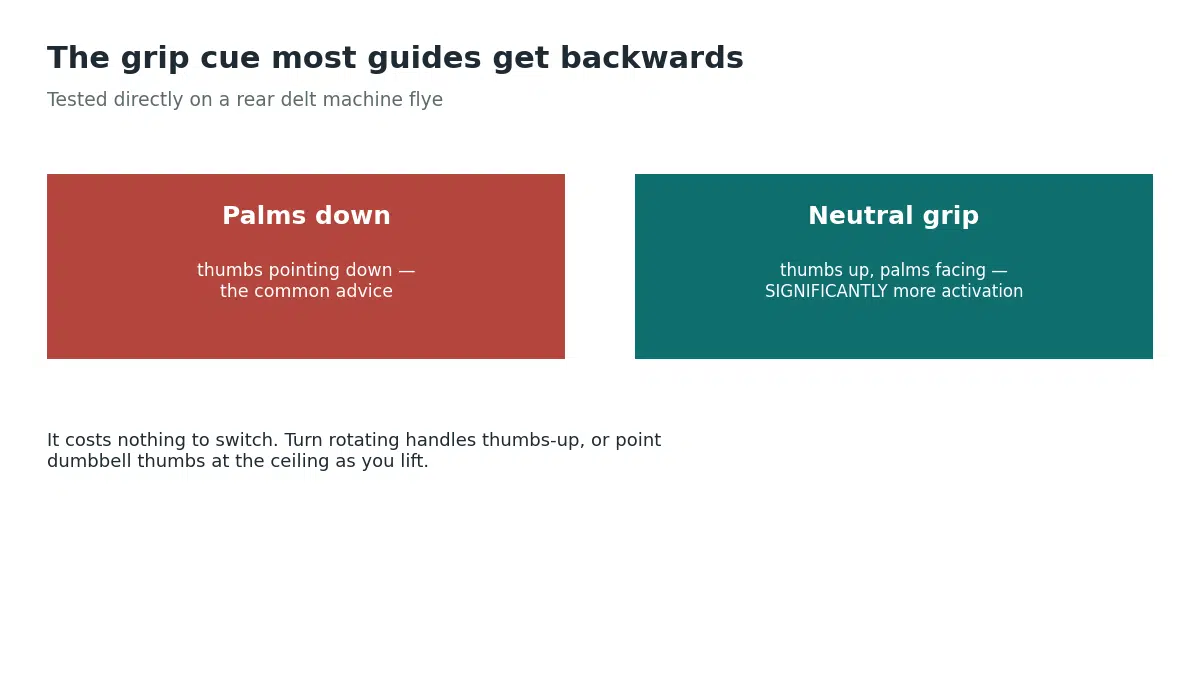
Set an adjustable bench to 30-45 degree incline. Lie face-down with chest against the pad, feet firmly on floor. Hold dumbbells with arms hanging straight down. Raise weights out to sides with thumbs pointing toward ceiling until arms reach parallel to floor. The pronated grip position maximizes rear delt activation while minimizing upper trapezius involvement.

Cable Reverse Fly

Cable reverse flies provide constant tension advantages over free weights. The crossing cable pattern allows natural convergence at the starting position and maximum stretch. This movement suits high-repetition work and serves as an excellent finishing exercise for rear delt workouts.

Stand centered between cable towers with pulleys set at shoulder height. Cross arms in front of body and grasp opposite handles. Step back to create tension with arms extended forward, slight elbow bend maintained. Pull handles outward in wide arc until arms reach full abduction, squeezing shoulder blades together. The movement pattern mimics dumbbell flies but with superior resistance curve.

Wide-Grip Barbell Row to Chest

Barbell rows with wider grip and higher pull position transform this back exercise into effective rear delt work. The modification requires lighter weight than traditional rows but delivers superior posterior shoulder stimulation. This compound movement builds overall upper body pulling strength while emphasizing rear delts.

  • Grip barbell with hands wider than shoulder width, double overhand grip
  • Hinge forward maintaining neutral spine, knees slightly bent for stability
  • Pull barbell toward upper chest or lower neck rather than abdomen
  • Drive elbows up and back, keeping them higher than hands throughout pull
  • Squeeze rear delts and upper back muscles at top position
  • Lower bar with control, maintaining torso angle and core tension

Wide grip barbell row targeting rear deltoids

Resistance Band Pull-Apart

Resistance band pull-aparts offer portable rear delt training requiring minimal equipment. This movement works exceptionally well as warm-up activation before pressing exercises or as high-repetition finisher. The bands provide accommodating resistance that increases as you pull, matching natural strength curves.

Hold band with hands shoulder-width apart, arms extended at shoulder height. Pull band apart by driving elbows backward while keeping arms relatively straight. Focus on squeezing shoulder blades together and contracting rear delts maximally. The band should touch chest at full stretch position. Control return to prevent band from snapping back.

Reverse Cable Crossover

The reverse cable crossover challenges rear delts from a standing position with full body integration. This functional movement pattern develops shoulder stability and posterior chain coordination. The exercise allows natural scapular movement while maintaining constant cable tension.

  • Setup: Set cable pulleys at shoulder height on opposite towers.
  • Grip: Cross arms and grasp opposite handles with palms facing floor.
  • Stance: Stand centered between cables with feet shoulder-width, slight forward lean.
  • Pull: Drive arms back and outward in wide arc, thumbs rotating toward ceiling.
  • Contraction: Finish with arms fully abducted, squeezing rear delts intensely.
  • Return: Control cables back to crossed position without losing shoulder stability.

Comparing Rear Delt Exercise Effectiveness

Different rear delt exercises offer unique advantages based on available equipment, experience level, and training goals. Understanding the strengths and limitations of each movement helps you build effective workout programs. The comparison below evaluates exercises across multiple performance criteria.

Exercise Isolation Quality Equipment Needed Difficulty Level Best For
Face Pulls High Cable machine with rope Beginner-Intermediate Shoulder health and rear delt mass
Reverse Pec Deck Very High Reverse pec deck machine Beginner Pure isolation and learning contraction
Bent-Over Dumbbell Fly High Dumbbells only Intermediate Home training and stabilization
Cable Reverse Fly High Dual cable station Intermediate Constant tension and muscle pumps
Prone Incline Raise Very High Incline bench and dumbbells Beginner-Intermediate Strict form and eliminating momentum
Wide-Grip Barbell Row Moderate Barbell and weights Intermediate-Advanced Overall upper back thickness
Band Pull-Apart Moderate-High Resistance band Beginner Warm-up and activation work
Single-Arm Dumbbell Row Moderate Dumbbell and bench Intermediate Unilateral strength and muscle balance

Exercise selection should match your training environment and experience level. Beginners benefit from machine exercises like reverse pec deck that guide movement patterns. Intermediate lifters achieve excellent results with free weight options including dumbbell flies and cable variations. Advanced trainers often combine multiple exercises within single workouts for comprehensive rear delt development.

Comparison of different rear delt exercise positions and angles

Programming Back Delt Exercises Into Your Routine

Effective rear delt training requires strategic program design balancing volume, frequency, and exercise selection. The posterior deltoids respond well to higher repetition ranges due to their endurance-oriented muscle fiber composition. Most lifters achieve optimal results with 12-20 reps per set rather than heavy low-rep work.

Training frequency depends on overall program structure and recovery capacity. Direct rear delt work 2-3 times weekly provides sufficient stimulus for growth while allowing adequate recovery. The small muscle size and rapid recovery rate permit more frequent training compared to larger muscle groups.

Volume Recommendations for Rear Delt Growth

Research on muscle hypertrophy suggests that 10-20 sets per muscle group per week optimizes growth for most individuals. For rear delts, this translates to 8-15 direct sets weekly depending on training experience and recovery ability. Beginners start toward the lower end while advanced lifters may benefit from higher volumes.

Beginner Volume Guidelines

  • 2 exercises per week targeting rear delts
  • 3-4 sets per exercise performed
  • Total weekly volume of 6-8 sets
  • Focus on learning proper form and mind-muscle connection
  • 12-15 reps per set with moderate weight

Advanced Volume Guidelines

  • 3-4 rear delt exercises weekly
  • 3-5 sets per exercise session
  • Total weekly volume of 12-18 sets
  • Variety in angles and equipment used
  • Mix of rep ranges from 10-20 per set

Sample Rear Delt Training Splits

Integrating rear delt exercises into existing programs requires thoughtful placement. These muscles work during back training days but rarely receive adequate direct stimulus. Dedicated rear delt work ensures balanced development and prevents the anterior-posterior strength imbalances common among lifters.

  • Push-Pull-Legs Split: Include 2-3 rear delt exercises on pull days after back work, 3-4 sets each.
  • Upper-Lower Split: Add rear delt focus to upper body days, alternating exercises between sessions.
  • Body Part Split: Train rear delts with back or on dedicated shoulder day with 4-5 total sets.
  • Full Body Routine: Include one rear delt exercise each workout, rotating through different movements.

Exercise Order and Sequencing

Placing rear delt exercises appropriately within workouts maximizes effectiveness. Performing isolation work when fresh produces better mind-muscle connection and contraction quality. However, the small muscle size allows productive training even after larger muscle work.

Many successful programs begin back workouts with dedicated rear delt isolation like face pulls or reverse flies. This pre-exhaust approach activates posterior shoulders before compound rowing movements. The activation enhances rear delt recruitment during subsequent back exercises. Alternatively, finishing workouts with high-repetition rear delt work creates effective metabolic stress for hypertrophy.

Progressive Overload Strategies

Continuous improvement requires systematic progression in training variables. The rear delts respond to multiple progression methods beyond simply adding weight. Small muscles like posterior deltoids benefit from varied progression approaches that prevent plateaus.

  • Increase weight by smallest available increments when maintaining perfect form
  • Add repetitions within the target range before increasing resistance
  • Decrease rest periods between sets while maintaining performance
  • Increase time under tension by slowing eccentric or concentric phases
  • Add additional sets when recovery allows increased volume
  • Improve mind-muscle connection and contraction intensity
  • Experiment with advanced techniques like drop sets or partial reps

Training Insight: According to Mayo Clinic guidance on strength training, allowing 48 hours between working the same muscle group provides optimal recovery for most people. However, smaller muscles like rear delts may recover faster, potentially allowing more frequent training when volume per session remains moderate.

Common Mistakes That Limit Rear Delt Development

Technique errors during rear delt exercises reduce effectiveness and increase injury risk. The posterior deltoids remain difficult muscles to feel working, leading many lifters to compensate with improper mechanics. Recognizing and correcting these mistakes accelerates progress while protecting shoulder health.

Using Excessive Momentum and Body English

Swinging weights or using torso movement to complete reps shifts tension away from rear delts. The momentum carries weight through the range of motion rather than muscle contraction. This common error occurs most frequently during bent-over flies and standing cable exercises.

Maintaining strict form requires selecting appropriate weight that allows controlled movement. Your torso should remain stable throughout each repetition with movement occurring only at the shoulder joint. If you cannot complete the target rep range without swinging, reduce the load immediately.

Insufficient External Rotation

The rear deltoids assist with shoulder external rotation, yet many lifters perform pulling exercises with internal rotation dominance. Keeping thumbs pointing down or inward during raises and rows reduces rear delt activation significantly. Proper technique involves rotating thumbs toward the ceiling during the concentric phase.

Practice this pattern with light weights until the external rotation becomes natural. The slight outward rotation of the upper arm maximizes rear delt contraction while minimizing front delt involvement. Think about showing your palms toward the ceiling at peak contraction.

Pulling with Back Muscles Instead of Shoulders

Large back muscles like lats and traps easily dominate during rear delt exercises when technique breaks down. Focusing on bringing elbows backward rather than pulling hands creates this compensation. Proper form emphasizes driving elbows out to the sides rather than straight back toward the spine.

Signs of Back Dominance

  • Feeling more lat or mid-back pump than rear delt fatigue
  • Elbows traveling close to body during pulls
  • Excessive scapular retraction during movements
  • Inability to feel rear delt contractions
  • Forward shoulder roll at starting position

Corrections for Better Isolation

  • Focus on wide elbow path away from torso
  • Think about moving elbows rather than hands
  • Use lighter weights allowing perfect form
  • Pause and squeeze at peak contraction
  • Maintain shoulder blade position without excessive pinching

Training Rear Delts Too Heavy

Attempting to lift heavy weight during isolation exercises compromises form and reduces target muscle activation. The small size of rear delts limits absolute strength compared to larger muscle groups. Ego lifting with weights too heavy for strict form represents wasted effort that could be spent on productive training.

Effective rear delt work occurs in moderate to higher rep ranges with controlled tempo. Most lifters achieve better results with 12-20 reps per set using weight that allows perfect technique. The burn and pump sensations indicate productive work more reliably than the amount of weight moved.

Neglecting Full Range of Motion

Cutting movement short at either end reduces time under tension and overall effectiveness. Many lifters fail to fully extend arms at the starting position, maintaining constant tension that prevents full stretch. Others stop short of complete contraction, missing the peak squeeze that drives hypertrophy.

Each repetition should move through the complete available range without compromising form. Begin with arms fully extended to stretch the rear delts, then pull until arms reach full abduction or horizontal extension. The final few degrees of movement provide significant muscle building stimulus despite feeling challenging.

Inconsistent Training Frequency

Sporadic rear delt work produces minimal results compared to consistent weekly stimulation. Training these muscles only occasionally when you remember leaves them perpetually underdeveloped. The posterior deltoids require regular progressive stimulus just like any other muscle group.

Schedule specific rear delt exercises into your program with the same commitment given to chest or arm training. Treating rear delt work as optional accessory movement guarantees continued imbalances. Consistent execution of planned sessions drives steady progress over time.

Essential Form Cues for Better Rear Delt Activation

Mastering key technique points transforms average rear delt exercises into highly effective movements. These coaching cues help establish proper motor patterns that maximize posterior shoulder activation. Implementing even one or two suggestions typically produces immediately noticeable improvements in muscle contraction quality.

Think Elbows, Not Hands

Mental focus on elbow position rather than hand movement improves rear delt activation dramatically. Visualize driving elbows backward and upward during rows or outward during flies. This internal cue shifts emphasis from arm pulling to shoulder muscle contraction.

When performing , ask yourself “where are my elbows?” before each repetition. The answer should involve elbows traveling away from your midline in a wide arc. Hands simply follow the elbow path rather than actively pulling weight.

Maintain Scapular Stability

Excessive shoulder blade movement during rear delt isolation reduces target muscle work. While some scapular retraction occurs naturally, focusing primarily on pinching shoulder blades shifts tension to mid-back rather than delts. Proper technique maintains relatively stable scapulae while the shoulder joint performs the movement.

  • Set shoulder blades in slight retraction before beginning movement
  • Maintain this scapular position throughout the entire set
  • Focus movement at the glenohumeral joint rather than scapulothoracic region
  • Avoid aggressively squeezing shoulder blades together at peak contraction
  • Think about shoulders staying down and back in stable position

Control the Eccentric Phase

Lowering weight slowly under control amplifies hypertrophy stimulus significantly. Most lifters focus only on the lifting phase while allowing gravity to control the lowering. The eccentric phase provides crucial muscle building tension when performed deliberately.

Take 2-3 seconds to return weight to the starting position on every repetition. Resist the temptation to let cables snap back or dumbbells drop rapidly. The controlled negative rep creates metabolic stress and mechanical tension that drives adaptation.

Achieve Peak Contraction Hold

Pausing briefly at maximum contraction intensifies muscle activation beyond continuous motion. Holding the squeezed position for 1-2 seconds at peak contraction creates additional time under tension. This technique works especially well during face pulls, reverse flies, and machine exercises.

As elbows reach full abduction or horizontal extension, consciously squeeze rear delts as hard as possible. Maintain this maximal contraction briefly before beginning the eccentric phase. The extra second of intense squeeze produces significantly more muscle fatigue and stimulus per set.

Use a Lighter Grip

Death-gripping handles or dumbbells increases forearm and grip fatigue while potentially reducing rear delt focus. A relaxed grip allows better concentration on shoulder muscles rather than holding implements. Think about hands as hooks that connect you to weight rather than the prime movers.

Hold handles or dumbbells firmly enough to control them safely but no tighter. Relaxing unnecessary tension in hands and forearms helps maintain mental focus on posterior shoulder contraction. This subtle adjustment often helps lifters finally feel their rear delts working properly.

Rear Delt Training for Shoulder Health and Injury Prevention

Beyond aesthetic benefits, strong rear delts play crucial roles in maintaining healthy shoulder function. The posterior deltoid contributes to dynamic shoulder stabilization during pressing movements and daily activities. Weakness in these stabilizers increases injury risk during bench pressing, overhead work, and sports involving throwing.

The rounded-forward shoulder posture common among desk workers and lifters stems partly from rear delt weakness. Anterior muscles including pectorals and front deltoids overpower weak posterior structures, pulling shoulders into internal rotation. This position compresses structures within the shoulder joint and reduces available range of motion.

Posture comparison showing rounded shoulders versus proper shoulder alignment

Balancing Push and Pull Volume

Healthy shoulders require balanced strength between opposing muscle groups. Many programs include excessive pressing volume without equivalent pulling work. This imbalance gradually weakens posterior structures while overdeveloping anterior muscles.

Assess your current program by counting total sets of pressing versus pulling exercises weekly. A common recommendation suggests 1.5-2 pulls for every pressing movement. This ratio accounts for the fact that pulls typically involve larger muscle groups and may not adequately stimulate smaller rear delts without dedicated isolation work.

Medical Perspective: Research published by the National Institute of Neurological Disorders and Stroke indicates that muscle imbalances contribute significantly to chronic shoulder pain and dysfunction. Strengthening weaker posterior shoulder muscles through targeted exercise may help prevent or alleviate certain shoulder conditions.

Rear Delts in Overhead Athlete Performance

Athletes involved in throwing, swimming, volleyball, or racquet sports depend heavily on posterior shoulder strength. The rear deltoid decelerates the arm during the follow-through phase of throwing motions. Inadequate eccentric strength in this muscle increases strain on passive shoulder structures.

Sport-specific rear delt training should emphasize both concentric strength and eccentric control. Exercises performed with controlled tempo develop the deceleration capacity needed during athletic movements. Higher repetition ranges build the muscular endurance required for repetitive overhead activities.

Prehabilitation Before Heavy Pressing

Activating rear delts before bench pressing or overhead work prepares shoulders for heavy loads. The pre-activation enhances neuromuscular coordination and stabilization capacity. Many lifters experience immediate improvements in pressing strength and comfort after implementing rear delt activation protocols.

  • Warm-up Phase: Perform 5-10 minutes of light cardiovascular activity to increase body temperature.
  • Band Pull-Aparts: Complete 2-3 sets of 15-20 reps with resistance band to activate rear delts.
  • Face Pulls: Perform 2 sets of 12-15 reps with light cable weight focusing on form.
  • External Rotation Work: Add 2 sets of band or cable external rotations per arm.
  • Scapular Wall Slides: Execute 10-15 reps to activate stabilizers and improve shoulder mechanics.
  • Gradual Load Progression: Begin pressing exercises with lighter warm-up sets before working weights.

Advanced Training Techniques for Stubborn Rear Delts

Lifters who struggle developing rear delts despite consistent effort may benefit from advanced training methods. These techniques increase training intensity beyond standard straight sets. Implementation should be strategic rather than constant, as recovery demands increase substantially with advanced methods.

Drop Sets for Extended Time Under Tension

Drop sets extend a set beyond initial failure by immediately reducing weight and continuing repetitions. This technique creates extreme metabolic stress that drives hypertrophy in stubborn muscles. The continuous tension prevents recovery between loads, forcing maximal muscle fiber recruitment.

Perform your working set to failure within the target rep range. Immediately reduce weight by 20-30% and continue to failure again. Optional third drop of another 20-30% extends the set further. Cable and machine exercises work best for drops since weight changes happen quickly without rest.

Pre-Exhaust Supersets

Pre-exhausting rear delts with isolation work before compound pulling movements enhances posterior shoulder activation during rows. The fatigued rear delts require greater recruitment during subsequent back exercises, improving mind-muscle connection. This sequencing helps lifters who struggle feeling rear delts during rowing movements.

  • Begin with rear delt isolation like reverse flies for 12-15 reps to failure
  • Immediately transition to compound row variation without rest
  • Perform rowing exercise focusing on driving elbows high and back
  • Rest 90-120 seconds between supersets
  • Complete 3-4 total rounds of the pairing
  • Notice improved rear delt activation during rows due to pre-fatigue

Slow Eccentric Training

Extending the lowering phase to 4-5 seconds dramatically increases mechanical tension on muscle fibers. The slow eccentric tempo requires lighter loads but produces significant hypertrophy stimulus. This method suits lifters who tend to use momentum or struggle with mind-muscle connection.

Select weight approximately 60-70% of normal working loads. Perform the lifting phase at normal speed, then count slowly to five during the lowering phase. The extended time under tension per repetition reduces total reps per set but increases overall stimulus quality.

Partial Reps in Stretched Position

Performing partial repetitions in the lengthened muscle position creates strong growth stimulus. After completing full-range reps to failure, continue with partial reps through the bottom half of the range. The stretch-mediated tension provides unique adaptation signals beyond standard training.

Execute a full set of reverse fly or similar exercise to momentary failure. Instead of ending the set, perform 5-8 additional partial reps moving only through the bottom half where rear delts achieve maximum stretch. The burning sensation intensifies but drives additional hypertrophy.

High-Frequency Training Blocks

Short periods of increased training frequency can shock stubborn muscles into growth. A 3-4 week block of training rear delts 4-5 times weekly with moderate volume per session provides novel stimulus. This approach works best after extended periods of standard frequency.

Recovery Consideration: Advanced training techniques create significant additional fatigue and recovery demands. Implement these methods sparingly rather than every workout. Monitor for signs of overtraining including persistent soreness, strength decreases, or mood disturbances. Most lifters benefit from using advanced techniques for 1-2 exercises per workout maximum.

Sample Rear Delt Workout Routines

Practical workout examples demonstrate how to integrate rear delt exercises into complete training programs. These templates provide starting points you can modify based on individual needs and equipment availability. Consistency with any well-designed program produces better results than constantly changing approaches.

Workout routine written on training log with rear delt exercises highlighted

Beginner Rear Delt Routine

New lifters benefit from simple programs emphasizing proper technique development. This routine includes fundamental movements with machine and cable options that provide guided movement paths. Frequency of twice weekly allows adequate recovery while building foundational strength.

Exercise Sets Reps Rest Period
Face Pulls (rope attachment) 3 12-15 60 seconds
Reverse Pec Deck Machine 3 12-15 60 seconds
Resistance Band Pull-Aparts 2 15-20 45 seconds

Intermediate Home Workout

Lifters training at home with limited equipment can build impressive rear delts using dumbbells and bands. This program requires only basic gear while providing comprehensive posterior shoulder development. The variety prevents adaptation while working muscles from multiple angles.

  • Bent-Over Dumbbell Reverse Fly: 4 sets × 10-12 reps, 90 seconds rest
  • Single-Arm Dumbbell Row (wide elbow): 3 sets × 12 reps per arm, 75 seconds rest
  • Resistance Band Face Pull: 3 sets × 15-20 reps, 60 seconds rest
  • Band Pull-Apart (slow tempo): 2 sets × 20 reps with 3-second eccentric, 45 seconds rest

Advanced Gym-Based Routine

Experienced lifters with full gym access benefit from comprehensive programs utilizing varied equipment. This routine combines compound and isolation movements with advanced techniques. The higher volume suits those with developed work capacity and recovery ability.

  • Wide-Grip Barbell Row to Chest: 4 sets × 8-10 reps, explosive concentric, 3-second eccentric
  • Cable Face Pull (seated): 4 sets × 12-15 reps, 1-second peak contraction hold
  • Reverse Cable Crossover: 3 sets × 12-15 reps, standard tempo
  • Prone Incline Dumbbell Raise: 3 sets × 15 reps, drop set on final set
  • Machine Reverse Fly: 2 sets × 20 reps, partial reps in stretched position after failure

Shoulder Specialization Program

A focused 6-8 week block prioritizing shoulder development dedicates extra resources to deltoid training. This specialization routine trains rear delts three times weekly with varied rep ranges and intensities. Reduce volume for other muscle groups during specialization periods to manage total fatigue.

Monday – Strength Focus

  • Face Pulls: 5 sets × 8-10 reps with heavy resistance
  • Barbell Row (wide grip): 4 sets × 6-8 reps
  • Dumbbell Reverse Fly: 3 sets × 10-12 reps

Wednesday – Hypertrophy Focus

  • Cable Reverse Fly: 4 sets × 12-15 reps
  • Prone Incline Raise: 4 sets × 12-15 reps
  • Band Pull-Apart: 3 sets × 20 reps

Friday – Endurance/Pump Focus

  • Machine Reverse Fly: 3 sets × 15-20 reps
  • Single-Arm Cable Reverse Fly: 3 sets × 15 reps per arm
  • Face Pull Finisher: 2 sets × 25 reps with light weight

Key Principles

  • Vary intensity across sessions
  • Total weekly volume: 16-20 sets
  • Different rep ranges for complete development
  • Recovery days between rear delt sessions

Supporting Rear Delt Growth Through Nutrition and Recovery

Training provides the stimulus for muscle growth, but adaptation occurs during recovery periods. Proper nutrition and rest allow your body to repair tissue damage and build new muscle protein. Neglecting recovery factors limits results regardless of how well you execute exercises.

Protein intake stands as the most critical nutritional factor for hypertrophy. The amino acids from dietary protein provide building blocks for new muscle tissue. Research consistently shows that consuming 1.6-2.2 grams of protein per kilogram bodyweight daily optimizes muscle protein synthesis for most people engaged in resistance training.

Balanced meal with protein sources supporting muscle recovery

Protein Timing Considerations

Distributing protein intake across multiple meals throughout the day maintains elevated muscle protein synthesis rates. Consuming 20-40 grams of high-quality protein every 3-4 hours provides steady amino acid availability. This pattern supports recovery more effectively than consuming the same total protein in fewer larger meals.

Post-workout nutrition timing, while less critical than once believed, still offers benefits. Consuming protein within a few hours after training capitalizes on elevated muscle sensitivity to nutrients. A meal or shake containing 20-40 grams protein and some carbohydrates supports recovery and replenishes energy stores.

Sleep Quality and Muscle Recovery

Sleep represents the most powerful recovery tool available to athletes and lifters. During deep sleep stages, your body releases growth hormone and testosterone that facilitate muscle repair and growth. Inadequate sleep disrupts these hormonal patterns and impairs recovery significantly.

  • Aim for 7-9 hours of quality sleep nightly for optimal recovery
  • Maintain consistent sleep and wake times even on weekends
  • Create dark, cool sleeping environment between 60-67°F (15-19°C)
  • Limit screen exposure 1-2 hours before bedtime
  • Avoid caffeine within 8 hours of planned sleep time
  • Consider short 20-minute naps if nighttime sleep is insufficient

Managing Training Stress and Fatigue

Accumulated fatigue from excessive training volume or inadequate recovery impairs performance and increases injury risk. Monitor your body’s signals for overtraining including persistent muscle soreness, declining strength, poor sleep quality, or irritability. Addressing early warning signs prevents more serious recovery issues.

Deload weeks every 4-6 weeks allow accumulated fatigue to dissipate. Reduce training volume by 40-50% while maintaining intensity during deload periods. This strategic reduction provides recovery benefits while preserving strength and neural adaptations from regular training.

Measuring and Tracking Rear Delt Development

Objective progress tracking maintains motivation and identifies when program modifications become necessary. Rear delts develop gradually over months rather than weeks, making systematic tracking essential for recognizing improvements. Multiple measurement methods provide comprehensive assessment of your development.

Performance-Based Metrics

Strength increases in rear delt exercises indicate successful adaptation to training. Keep detailed logs recording weight, reps, and sets for each exercise. Progressive improvements in these variables confirm that your program produces results.

Metric Measurement Method Assessment Frequency
Exercise Weight Used Record weight and reps for each working set Every workout session
Total Volume Calculate sets × reps × weight weekly End of each week
Visual Assessment Progress photos from multiple angles Every 4 weeks
Shoulder Circumference Tape measure around widest point Every 4-6 weeks
Posture Improvement Side-view photos noting shoulder position Every 6-8 weeks

Visual Documentation

Progress photographs reveal changes that daily mirror viewing misses. Take standardized photos every 4 weeks under consistent lighting conditions wearing the same clothing. Include front, side, and back views to assess overall shoulder development from multiple angles.

Pay particular attention to rear and side photos when evaluating rear delt growth. From the side, stronger rear delts create more rounded shoulder appearance and improve posture. Rear views show increased muscle definition and size in the posterior shoulder region.

Identifying Plateaus and Making Adjustments

Progress rarely continues linearly indefinitely. Plateaus where strength and size gains stall require program modifications. If measurements show no improvement for 3-4 consecutive weeks despite consistent effort, consider adjusting training variables.

  • Increase Volume: Add 1-2 sets per exercise if recovery capacity allows.
  • Change Exercises: Swap current movements for similar variations providing novel stimulus.
  • Adjust Frequency: Try adding or removing one weekly rear delt session.
  • Modify Intensity: Experiment with different rep ranges or advanced techniques.
  • Improve Recovery: Enhance sleep, nutrition, or stress management before adding training volume.
  • Deload: Take a planned recovery week to dissipate accumulated fatigue.

Frequently Asked Questions About Back Delt Exercises

What are the most effective back delt exercises?

The most effective back delt exercises include face pulls, reverse pec deck machine, bent-over dumbbell reverse flies, and cable reverse flies. Face pulls rank among the best because they combine horizontal extension with external rotation, addressing multiple rear deltoid functions. The reverse pec deck provides excellent isolation by removing stabilization demands.

Exercise effectiveness depends partly on individual mechanics and available equipment. Most people achieve best results combining 2-3 different movements weekly to stimulate rear delts from various angles. Consistency and proper form matter more than specific exercise selection.

How often should I train rear delts?

Training rear delts 2-3 times weekly provides optimal growth stimulus for most lifters. The small muscle size and fast recovery rate allow more frequent training compared to larger muscle groups. Beginners may start with twice weekly sessions while advanced lifters can handle three or more.

Total weekly volume matters more than specific frequency. Aim for 8-15 direct sets targeting rear delts weekly, distributed across your chosen number of sessions. Monitor recovery carefully and reduce frequency if persistent soreness or strength decreases occur.

Why can’t I feel my rear delts working?

Difficulty feeling rear delts typically results from improper form allowing larger back muscles to dominate movements. Common issues include using excessive weight, pulling with elbows too close to the body, or insufficient external rotation. The rear deltoids remain challenging to develop mind-muscle connection with initially.

Improve activation by reducing weight significantly and focusing on perfect technique. Think about driving elbows outward rather than pulling hands backward. Start each set with band pull-aparts to pre-activate rear delts. The sensation improves with practice and consistent attention to proper form cues.

What rep range builds rear delts best?

Rear delts respond well to moderate and higher repetition ranges between 10-20 reps per set. The posterior deltoid contains higher proportions of slow-twitch muscle fibers suited for endurance activities. Most lifters achieve better results with controlled 12-15 rep sets rather than heavy low-rep work.

Some variety benefits overall development. Include sets of 8-10 reps on compound movements like wide-grip rows, then use 15-20 reps for isolation exercises. The higher reps allow focus on form and muscle contraction without ego lifting with excessive weight.

Can I build rear delts without equipment?

Building rear delts without traditional gym equipment proves challenging but possible using bodyweight and household items. Resistance bands provide the most effective home training option for posterior deltoids. Band pull-aparts and band face pulls deliver excellent stimulus with minimal investment.

Creative alternatives include using water bottles or bags filled with books as improvised dumbbells for reverse flies. Inverted rows on a table or bar with wide elbow positioning target rear delts effectively. Progress becomes limited without progressive resistance, but beginners can achieve initial development with these methods.

Should I train rear delts on back day or shoulder day?

Rear delt exercises fit logically into either back or shoulder training sessions. Many programs include rear delts with back training since both involve pulling movements. This pairing allows fresh energy for heavy rowing before finishing with rear delt isolation work.

Alternatively, training all three deltoid heads together on shoulder day creates balanced development. Some lifters split the difference by including lighter rear delt work on both back and shoulder days. Experiment to find which placement allows best performance and recovery for your individual situation.

How long does it take to see rear delt growth?

Noticeable rear delt development typically requires 6-12 weeks of consistent training with proper nutrition and recovery. The small muscle size means absolute growth occurs slowly even when relative strength increases rapidly. Beginners often see faster initial progress compared to advanced lifters.

Early improvements in posture and shoulder width may appear within 4-6 weeks as muscles strengthen and tone develops. Significant hypertrophy becomes visible after 3-4 months of dedicated training. Progress photos help track gradual changes that daily mirror viewing misses.

Do rows work rear delts effectively?

Rowing exercises activate rear delts as secondary movers, but dedicated isolation work targets them more effectively. Standard rows with elbows close to the body emphasize lats and middle back. Modifying technique with wider elbow paths and higher pull positions shifts emphasis toward posterior deltoids.

Wide-grip barbell rows pulled to upper chest provide better rear delt stimulus than traditional rowing variations. However, even modified rows cannot replace direct isolation movements like face pulls or reverse flies for complete posterior shoulder development. Use both compound and isolation exercises for balanced training.

What’s the difference between rear delts and traps?

Rear delts and trapezius muscles occupy different anatomical locations and perform distinct functions. The posterior deltoid sits on the back of the shoulder, performing horizontal extension and external rotation. The trapezius covers the upper back and neck, responsible for scapular elevation, retraction, and rotation.

Proper exercise technique targets rear delts while minimizing trap involvement. Excessive scapular retraction during reverse flies or face pulls shifts work to traps. Maintaining stable shoulder blades while moving primarily at the shoulder joint isolates posterior deltoids effectively. The distinction becomes clearer as you develop better mind-muscle connection.

Can rear delt training fix rounded shoulders?

Strengthening rear delts helps correct rounded shoulder posture caused by muscle imbalances. Forward shoulder positioning often results from tight chest muscles and weak posterior shoulder structures. Dedicated rear deltoid training balances this discrepancy by pulling shoulders back into better alignment.

Complete posture correction requires addressing multiple factors beyond just rear delt strength. Include chest stretching, upper back strengthening, and postural awareness throughout daily activities. Combining rear delt exercises with comprehensive shoulder balancing work produces better results than isolation training alone.

Are face pulls better than reverse flies?

Face pulls and reverse flies both effectively target rear delts but through slightly different movement patterns. Face pulls combine horizontal shoulder extension with external rotation, making them superior for overall shoulder health. Reverse flies provide pure transverse abduction isolating posterior deltoids with minimal involvement from other muscles.

Neither exercise proves definitively superior—both deserve places in well-rounded programs. Face pulls excel for shoulder prehabilitation and general health. Reverse flies allow higher isolation for pure muscle building. Most lifters benefit from including both movements rather than choosing one exclusively.

Should rear delts be sore after training?

Mild muscle soreness 24-48 hours after training indicates effective stimulus, but extreme soreness isn’t necessary for progress. Rear delts may feel tight or slightly tender after good workouts, especially when first beginning dedicated training. The soreness typically decreases as your body adapts to regular posterior shoulder work.

Absence of soreness doesn’t indicate ineffective training. Advanced lifters rarely experience significant soreness despite making continuous progress. Focus on performance improvements and visual development rather than using soreness as your primary progress indicator. Severe pain or soreness lasting beyond 72 hours may indicate excessive volume or injury.

What causes rear delt pain during exercises?

Pain during rear delt exercises may indicate improper form, excessive weight, inadequate warm-up, or underlying injury. Sharp pain differs from normal muscle burning and warrants immediate attention. Common form errors causing pain include excessive internal rotation, momentum usage, or training through existing injuries.

Address pain by reducing weight and reviewing technique carefully. Ensure thorough warm-up including band work and light sets before heavier loads. If pain persists despite form corrections, consult healthcare professionals to rule out rotator cuff issues or other shoulder problems requiring treatment.

Can I train rear delts every day?

Daily rear delt training with appropriate volume management can work for some individuals, though most people achieve better results with 2-3 weekly sessions. If training daily, keep volume per session low—perhaps 2-3 sets of one exercise. This high-frequency approach suits those struggling to feel rear delts working or needing extra emphasis.

Monitor recovery carefully with daily training. Watch for signs of overtraining including decreased strength, persistent soreness, or shoulder discomfort. Most lifters optimize growth with 48 hours between sessions rather than daily work. Daily training should remain a temporary specialization strategy rather than permanent programming.

What’s the best rear delt exercise for beginners?

The reverse pec deck machine provides the best starting point for beginners learning to train rear delts. The fixed movement path eliminates stabilization challenges, allowing complete focus on muscle contraction. Seat and handle adjustments accommodate different body sizes while the machine guides proper motion patterns.

Face pulls with rope attachment represent the best beginner cable exercise. The movement teaches important shoulder external rotation while strengthening posterior deltoids. Start with very light weight focusing entirely on form and feeling the target muscles working. Progress to free weight exercises once you’ve developed solid mind-muscle connection.

Do rear delts help with bench press?

Strong rear delts improve bench press performance through enhanced shoulder stability and injury prevention. The posterior deltoid stabilizes the shoulder joint during pressing movements, preventing excessive internal rotation. This stabilization allows safer technique and potentially heavier loads over time.

Balanced shoulder development from adequate rear delt training reduces injury risk during heavy bench pressing. Many lifters experience immediate improvements in pressing comfort after implementing dedicated posterior shoulder work. The stability benefits translate to all pressing variations including overhead and incline movements.

How do I avoid using traps during rear delt exercises?

Minimize trapezius involvement by maintaining stable scapulae and avoiding excessive shoulder elevation. Set shoulder blades in slight retraction before beginning movements and maintain this position throughout sets. Focus on moving arms at the shoulder joint rather than aggressively squeezing shoulder blades together.

Think about depression and retraction rather than elevation. If you feel significant upper trap engagement, reduce weight and focus on keeping shoulders down and back. The cue “show your armpits” during reverse flies helps maintain proper shoulder position. With practice, the distinction between rear delt and trap activation becomes clearer.

Are dumbbells or cables better for rear delts?

Cables and dumbbells each offer unique advantages for rear delt training. Cables provide constant tension throughout the entire movement range and allow various angles impossible with free weights. The continuous tension creates excellent muscle pumps and metabolic stress.

Dumbbells require greater stabilization and allow natural movement paths accommodating individual biomechanics. The increased stabilization demands build functional strength applicable beyond the gym. Optimal programs include both equipment types rather than exclusively using one. Let exercise variation and equipment availability guide your selections.

Building Complete Shoulders With Dedicated Rear Delt Training

Comprehensive back delt exercises transform not just shoulder appearance but overall upper body function and health. The posterior deltoids play essential roles in shoulder stability, posture maintenance, and balanced strength development. Neglecting these muscles creates the imbalances common among lifters who focus predominantly on pressing movements visible in the mirror.

Successful rear delt development requires strategic exercise selection, proper form execution, and consistent progressive training. The movements detailed throughout this guide provide complete options for all experience levels and equipment situations. Face pulls, reverse flies, and rowing variations with proper technique modifications deliver the stimulus needed for growth.

Programming considerations including volume, frequency, and exercise order determine long-term success. Most lifters optimize results with 8-15 weekly sets distributed across 2-3 training sessions. Higher repetition ranges between 12-20 reps suit the posterior deltoid’s fiber composition better than heavy low-rep work. Patience proves essential as rear delts develop gradually over months of dedicated effort.

Form quality supersedes weight selection importance when targeting rear delts. Common mistakes including excessive momentum, improper elbow paths, and back muscle dominance prevent effective isolation. Implementing the form cues and techniques discussed throughout this article helps establish proper motor patterns that maximize muscle activation.

The benefits of strong rear delts extend beyond aesthetics to include injury prevention and performance enhancement. Balanced shoulder strength reduces strain during pressing exercises and overhead activities. Improved posture and shoulder positioning create immediate visual improvements while supporting long-term joint health.

Medical Disclaimer

Important Health Information

The content provided in this article serves educational and informational purposes only. It should not replace professional medical advice, diagnosis, or treatment from qualified healthcare providers. Always consult with licensed medical professionals, certified personal trainers, or sports medicine specialists regarding questions about exercise programs, shoulder health conditions, or training concerns.

Individual results from rear deltoid training vary significantly based on genetics, training history, current fitness level, and numerous other factors. The information presented here may not apply to your specific situation. Before implementing any new exercise program, especially if you have existing shoulder injuries, rotator cuff issues, or other musculoskeletal concerns, seek personalized guidance from qualified professionals.

While research supports various training approaches discussed, individual responses differ. Some people may experience pain, injury, or unsatisfactory results. The methods and programs described represent general guidelines based on current exercise science, which continues to evolve as new research emerges. No training approach can guarantee specific results or prevent all injuries.

If you experience sharp pain, unusual discomfort, decreased range of motion, or adverse reactions during any exercise, stop immediately and consult healthcare professionals. Pregnant women, individuals with cardiovascular conditions, or those with pre-existing injuries should obtain medical clearance before beginning resistance training programs.

HealthMagHub does not endorse specific products, equipment brands, or commercial interests. Information presented aims to educate readers about exercise principles and shoulder training concepts. Reliance on any information provided remains solely at your own discretion and risk.

This article does not create a trainer-client or doctor-patient relationship. For personalized exercise programming, form coaching, or medical assessment, establish relationships with qualified local professionals who can evaluate your individual circumstances and provide appropriate guidance.

Related Posts

Can Ashwagandha Cause Weight Loss?
BLOG

Can Ashwagandha Cause Weight Loss?

July 23, 2026
Best High Fiber Foods for Pregnancy
BLOG

Best High Fiber Foods for Pregnancy for Healthy Moms

July 23, 2026
Food Sources of Tyrosine
BLOG

Food Sources of Tyrosine: Your Complete Guide to This Essential Amino Acid

July 23, 2026
Which Is the Best Tea for Weight Loss?
BLOG

Which Is the Best Tea for Weight Loss? Science-Backed Guide to 12 Effective Teas

July 22, 2026
Best Breakfast Cereals for Diabetics
BLOG

Best Breakfast Cereals for Diabetics: Smart Choices for Blood Sugar Control

July 22, 2026
Should Diabetics Eat Banana?
BLOG

Should Diabetics Eat Banana? A Complete Guide to Blood Sugar and Fruit

July 22, 2026
Natural Remedies for Nose Congestion
BLOG

Natural Remedies for Nose Congestion: Proven Solutions for Clear Breathing

July 22, 2026
freshly brewed green tea in transparent cup showing golden-green color with pH testing strip
BLOG

Is Green Tea Acidic? Understanding pH Levels and Health Implications

July 22, 2026
ProDentim Reviews: What Real Users Are Saying About This Oral Health Supplement
REVIEWS

ProDentim Reviews: What Real Users Are Saying About This Oral Health Supplement

July 24, 2026
How to Get Rid of Fat Neck
BLOG

How to Get Rid of Fat Neck: Complete Solutions Guide

July 22, 2026
Load More

Leave a Reply Cancel reply

Your email address will not be published. Required fields are marked *

I agree to the Terms & Conditions and Privacy Policy.

Our Mission

At HealthMagHub, our mission is to empower individuals and families to make informed health decisions by providing accurate, evidence-based, and easy-to-understand health information. We are committed to delivering high-quality content across a wide range of topics, including nutrition, fitness, weight management, men’s and women’s health, mental wellness, healthy aging, disease prevention, and in-depth health product reviews. Every article is carefully researched, fact-checked, and written with our readers’ well-being in mind. Our goal is to simplify complex health topics, promote healthier lifestyles, and build a trusted resource where people can confidently find reliable guidance, practical wellness tips, and the latest insights to support a healthier, happier life.

Can Ashwagandha Cause Weight Loss?
BLOG

Can Ashwagandha Cause Weight Loss?

by Jenna Castillo
July 23, 2026
0

Affiliate Disclosure: This article contains affiliate links. We may earn a commission from purchases made through these links at no...

Read moreDetails
Best High Fiber Foods for Pregnancy

Best High Fiber Foods for Pregnancy for Healthy Moms

July 23, 2026
Food Sources of Tyrosine

Food Sources of Tyrosine: Your Complete Guide to This Essential Amino Acid

July 23, 2026
Which Is the Best Tea for Weight Loss?

Which Is the Best Tea for Weight Loss? Science-Backed Guide to 12 Effective Teas

July 22, 2026
Best Breakfast Cereals for Diabetics

Best Breakfast Cereals for Diabetics: Smart Choices for Blood Sugar Control

July 22, 2026

Categories

  • BLOG
  • Brain Health
  • General Fitness
  • Hearing Health
  • Joint Health
  • Men's Health
  • Neuropathy Help
  • Oral Health
  • Prostate Health
  • REVIEWS
  • Skin Health
  • Toenail Fungus Help
  • Weight Loss
  • HOME
  • ABOUT
  • PRIVACY POLICY
  • Terms & Conditions
  • Affiliate Disclosure
  • Medical Disclaimer
  • Contact Us
  • SUBMIT YOUR REVIEW

© 2026 HealthMagHub. Trusted Health. Smarter Living. All Rights Reserved.

No Result
View All Result
  • HOME
  • BLOG
  • REVIEWS
  • TOOLS

© 2026 HealthMagHub. Trusted Health. Smarter Living. All Rights Reserved.

This website uses cookies. By continuing to use this website you are giving consent to cookies being used. Visit our Privacy and Cookie Policy.