

Beetroot juice does lower blood pressure. That part is settled, and unusually well documented for a food.
What is less well known is how small the effect is, how quickly it fades, and how differently it works from one person to the next. Trials measure it in single-digit millimeters of mercury, lasting hours rather than days.
None of that makes it useless. It does mean the honest answer is more specific than yes.
- A 2024 meta-analysis of 11 trials in people with hypertension found systolic pressure fell by about 5 mmHg. Diastolic pressure did not change significantly.
- The effect peaks roughly 2 to 3 hours after drinking it and fades within a day, so it needs repeating rather than being a one-off fix.
- Response varies widely between individuals, by around 7 mmHg either way, which is why some people see nothing at all.
- It works through dietary nitrate, so it is not specific to beetroot. Leafy greens supply the same compound.
Does beetroot juice lower blood pressure?
Yes, modestly, and mainly the top number.
The clearest evidence comes from a 2024 systematic review and meta-analysis that pooled 11 randomized controlled trials covering 349 people with clinically diagnosed hypertension. Systolic pressure fell by a mean of 5.31 mmHg against placebo. Diastolic pressure did not change significantly, and neither did 24-hour ambulatory readings.[1]
Earlier pooled analyses land in the same territory. A review of 12 trials found a systolic reduction of 4.5 mmHg across nitrate doses varying almost tenfold.[2]
The direction is therefore consistent across independent groups. Roughly 4 to 5 mmHg off the systolic reading, in people who already have raised blood pressure.
One important caveat sits alongside that number. The 2024 authors rated their certainty in the evidence as low, and noted moderate to high variation between the trials they pooled. That is not a reason to dismiss the finding, but it is a reason to hold it loosely.
Why nitrate, not beetroot, is doing the work
The active ingredient is inorganic nitrate, and its pathway is well characterized.
Nitrate from food is absorbed, concentrated in saliva, and converted to nitrite by bacteria living on the back of the tongue. Swallowed nitrite is then converted to nitric oxide, which relaxes the smooth muscle in blood vessel walls. Wider vessels mean lower pressure.
Two consequences follow from that, and both are more interesting than the headline.
Beetroot is not special. It is simply a convenient concentrated source. Rocket, spinach, lettuce and celery are also nitrate-rich, and the body cannot tell where the nitrate came from. That overlap is worth remembering if you are already eating for electrolyte reasons, since several of the same vegetables appear on both lists.
Antibacterial mouthwash blunts the effect. The conversion step depends on oral bacteria. Studies using antiseptic mouthwash have found it reduces or abolishes the blood pressure response, a strange yet genuine interaction worth knowing if you are drinking beetroot juice deliberately.
How quickly beetroot juice lowers blood pressure
Faster than most people expect, and for a shorter time.
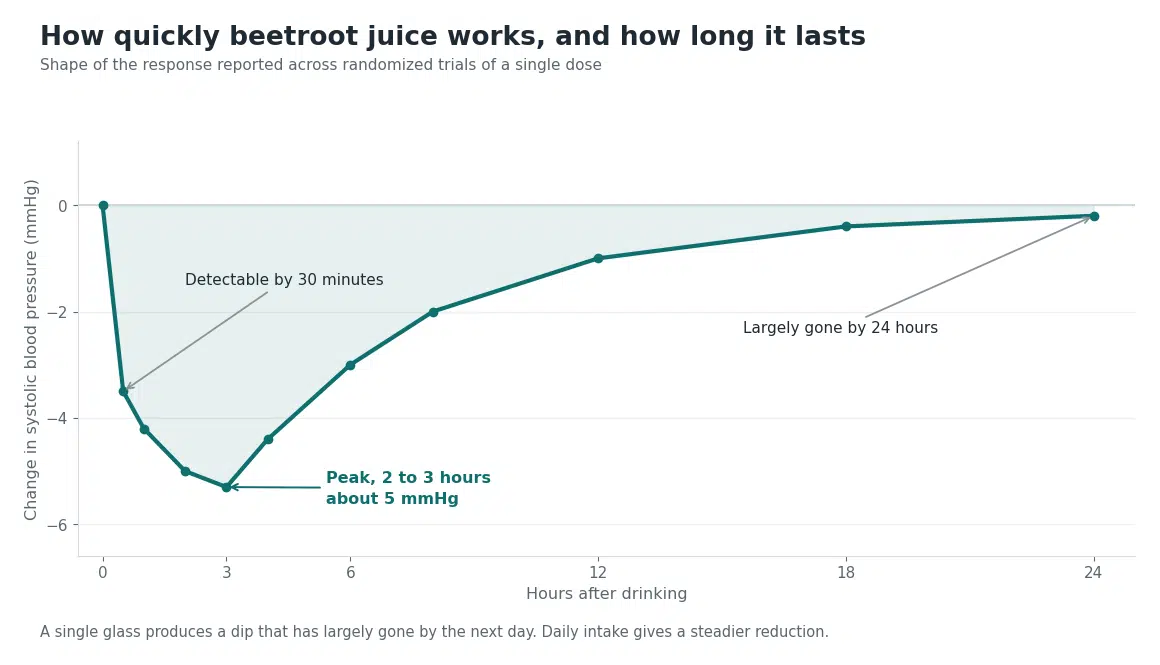
A 2013 meta-analysis of acute nitrate studies found the effect peaking around 2 to 3 hours after ingestion.[2] A double-blind crossover trial measuring central aortic pressure detected a 5.2 mmHg fall as early as 30 minutes, with a smaller effect at an hour.[3]
The same trial makes the limitation clear. Those effects were not sustained across the following 24 hours, and ambulatory monitoring found no meaningful change over the day.[3] The 2024 meta-analysis reached the same conclusion about 24-hour readings.[1]
A single glass therefore produces a real dip that has largely gone by the next day. Daily intake gives a steadier reduction, and the 2024 review found no sign of tolerance developing, meaning it does not stop working with repeated use.[1]
How much it actually moves the number
Five millimeters of mercury sounds trivial written down. Context helps.
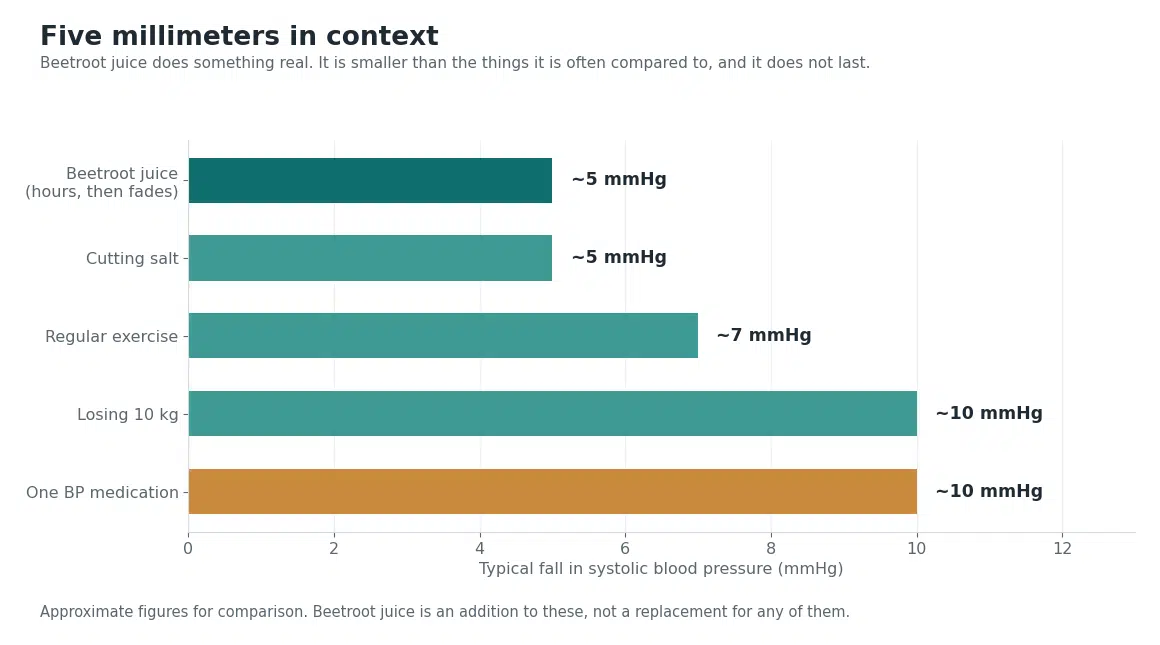
A single blood pressure medication typically lowers systolic pressure by roughly twice as much, and does so continuously rather than for a few hours. Losing weight, cutting salt and regular exercise all produce comparable or larger reductions, and they last.
That is the right frame. Beetroot juice is a small contribution stacked on top of the things that matter more, not a replacement for any of them.
It is also worth noting who the trials studied. The 5 mmHg figure comes from people with diagnosed hypertension. Effects in people with normal blood pressure are generally smaller, and in one crossover trial in healthy young adults the effect on brachial pressure was minimal.[3]
Why it works for some people and not others
This is the part almost no article mentions, and it explains a lot of disappointed experiments.
A 2024 randomized replicate crossover trial was designed specifically to measure individual variation. Average systolic reduction was 7 mmHg. But the variation between participants was roughly plus or minus 7 mmHg on top of that average.[4]
In plain terms, some people get a substantial drop and some get essentially nothing, and both outcomes are normal. The study also found responses were reasonably consistent within the same person when repeated, which suggests genuine biological differences rather than measurement noise.
Oral bacteria are one likely explanation, since the conversion step depends on them. If you try it and see no change after a couple of weeks, that is a real result rather than a failure to do it properly.
What the evidence does not show
Three claims outrun the research.
That it treats hypertension. Lowering a number in a trial is not the same as reducing heart attacks or strokes. No trial has shown beetroot juice changes those outcomes, because none has been large or long enough to try.
That it replaces medication. The 2024 review examined it as a possible adjunct to drug treatment, not a substitute. Stopping prescribed blood pressure medication is dangerous and this is not a reason to consider it.
That the 24-hour average improves. Repeatedly, it does not. Clinic readings fall; ambulatory monitoring across a full day does not show the same benefit.[1] That gap is unexplained and worth being honest about.
Who should be careful
- Anyone on blood pressure medication. The effects add up, and a drop on top of treatment can cause dizziness or circulation symptoms such as cold hands and feet. Mention it to your doctor rather than starting quietly.
- Anyone taking nitrates for angina, or drugs for erectile dysfunction. Both act on the same nitric oxide pathway, and the combination can drop pressure sharply.
- People with a history of kidney stones. Beetroot is high in oxalate, which matters for calcium oxalate stone formers.
- People with chronic kidney disease. Beetroot is also high in potassium, which damaged kidneys clear poorly.
One harmless effect that alarms people: beeturia, red or pink urine and stools after eating beetroot. It affects a substantial minority, means nothing, and passes.
When to see a doctor
- Readings persistently at or above 140/90 at home, whatever you are eating
- A single reading at or above 180/120, which needs same-day assessment
- Chest pain, breathlessness, severe headaches or vision changes with a high reading, which is an emergency
- Dizziness or light-headedness after starting beetroot juice while on blood pressure medication
- Any plan to change or stop prescribed medication, which is never a decision to make alone
Frequently asked questions
How much beetroot juice lowers blood pressure?
Trials used daily nitrate doses of roughly 200 to 800 mg, which corresponds to about 70 to 250 ml of concentrated beetroot juice depending on the product. Nitrate content varies considerably between brands and even between batches, which makes the dose harder to control than it looks.
Does beetroot juice lower blood pressure immediately?
Quickly, though not instantly. One trial detected a fall in central aortic pressure at 30 minutes, and pooled data put the peak at 2 to 3 hours. It is not something to drink in response to a single high reading.
Is whole beetroot as good as the juice?
Whole beetroot contains the same nitrate but far less of it per serving, which is why trials use concentrate. Cooked beetroot loses some nitrate to the water. Nitrate-rich leafy greens are a reasonable alternative if you dislike the taste.
Why does beetroot juice lower blood pressure at all?
Its nitrate is converted by mouth bacteria into nitrite, then into nitric oxide, which relaxes blood vessel walls. That last step is the same pathway several cardiovascular drugs act on, which is why the interactions above matter.
How long before it works?
A single dose acts within hours. For a steadier effect, trials ran from a few days to eight weeks, with no loss of response over time. If two weeks of daily intake changes nothing, you may be one of the non-responders.
The one thing to take away
Beetroot juice does something real, and something small. About 5 mmHg off the top number in people with raised blood pressure, peaking within hours and largely gone within a day.
Treat it as a minor addition to the things that work harder, and expect the possibility that you are one of the people it does nothing for. If your readings are consistently high, the useful step is a conversation with a doctor rather than a bigger glass.
Sources
SOURCESOur Editorial Standards
HealthMagHub is built on primary sources: peer-reviewed research, clinical practice guidelines, and health agencies such as the NIH, CDC, and FDA. Read our editorial standards to see how we research, cite, and update our articles.
- Effects of beetroot juice on blood pressure in hypertension according to European Society of Hypertension Guidelines: a systematic review and meta-analysis. Nutrition, Metabolism and Cardiovascular Diseases 2024. PubMed 39069465
- Siervo M, et al. Inorganic nitrate and beetroot juice supplementation reduces blood pressure in adults: a systematic review and meta-analysis. Journal of Nutrition 2013. PubMed 23596162
- A double-blind placebo-controlled crossover study of the effect of beetroot juice containing dietary nitrate on aortic and brachial blood pressure over 24 h. PMC6369216
- Inter-individual differences in the blood pressure lowering effects of dietary nitrate: a randomized double-blind placebo-controlled replicate crossover trial. PMC11850510