
What follows is what the two numbers mean, what actually shifts them, and how to get a reading worth acting on.
- Normal blood pressure is below 120/80 mm Hg, but no diagnosis is made on one reading — clinicians look for consistent elevation across multiple readings.
- Poor measurement technique can shift a reading by 10 mm Hg or more — enough to move you a whole category.
- Weight loss lowers systolic pressure by roughly 1 mm Hg per kilogram (about 1 mm Hg per 2 pounds) — meaningful, but slower than often quoted.
- A reading of 180/120 mm Hg or higher that stays high after resting and rechecking is a medical emergency, especially with chest pain, confusion, or sudden weakness.
Seek Emergency Care Now If
You have a reading of 180/120 mm Hg or higher that stays high after resting five minutes and rechecking. The same goes for severe chest pain or pressure, a severe headache with confusion, vision changes, or difficulty speaking, sudden numbness or weakness in the face, arm or leg (particularly on one side), sudden shortness of breath, or severe back or chest pain that feels like tearing.
A very high reading with any of these symptoms is a medical emergency, not something to recheck tomorrow.
What the Two Numbers Mean
Blood pressure is the force of blood pushing against your artery walls.
Systolic — the top number — is the peak pressure when your heart contracts. Diastolic — the bottom number — is the pressure between beats, while the heart refills.
Both matter, and either being elevated carries risk. Systolic tends to rise with age as arteries stiffen, which is why it’s often the number that drifts upward first.
Normal Blood Pressure Ranges
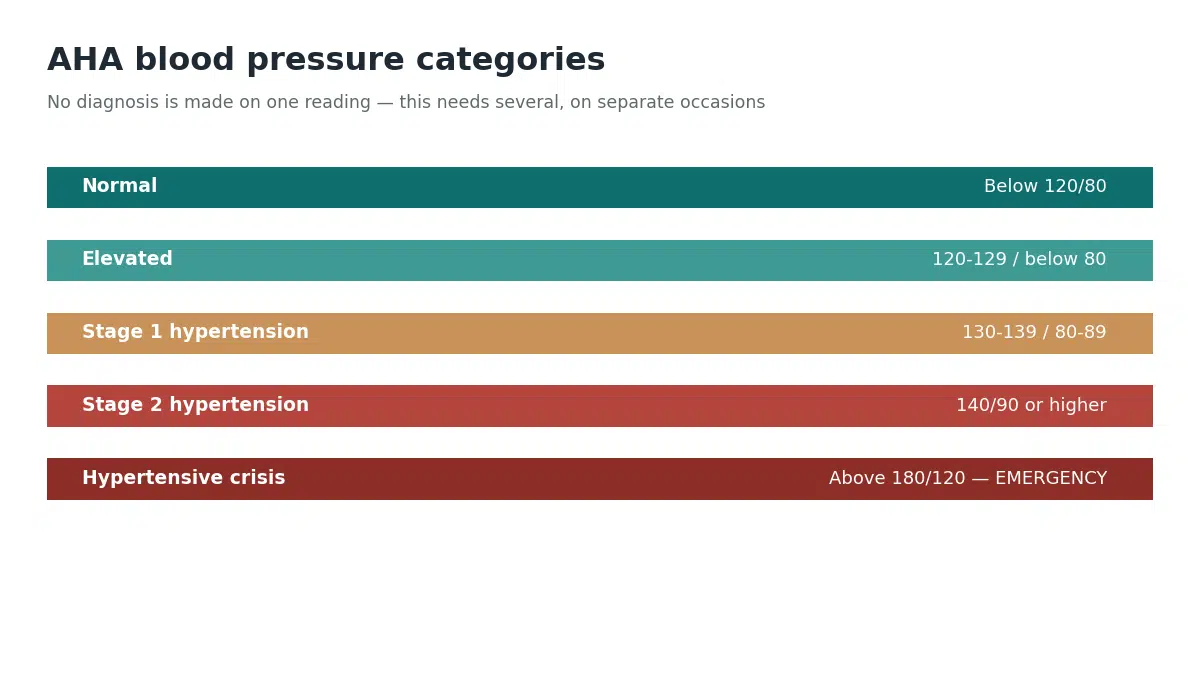
The American Heart Association categories:[1]
- Normal: below 120/80 mm Hg
- Elevated: 120–129 systolic and below 80 diastolic
- Stage 1 hypertension: 130–139 systolic or 80–89 diastolic
- Stage 2 hypertension: 140/90 mm Hg or higher
- Hypertensive crisis: above 180/120 mm Hg — emergency care
No diagnosis is made on one reading. Blood pressure moves constantly — with activity, stress, caffeine, sleep, time of day, even a full bladder. Clinicians look for consistent elevation across multiple readings on separate occasions.
Targets are also individualized. Age, kidney disease, diabetes and frailty all shift what your clinician aims for, and in older adults there’s a genuine balance between lowering cardiovascular risk and avoiding readings low enough to cause falls.
Getting a Reading That’s Actually Accurate
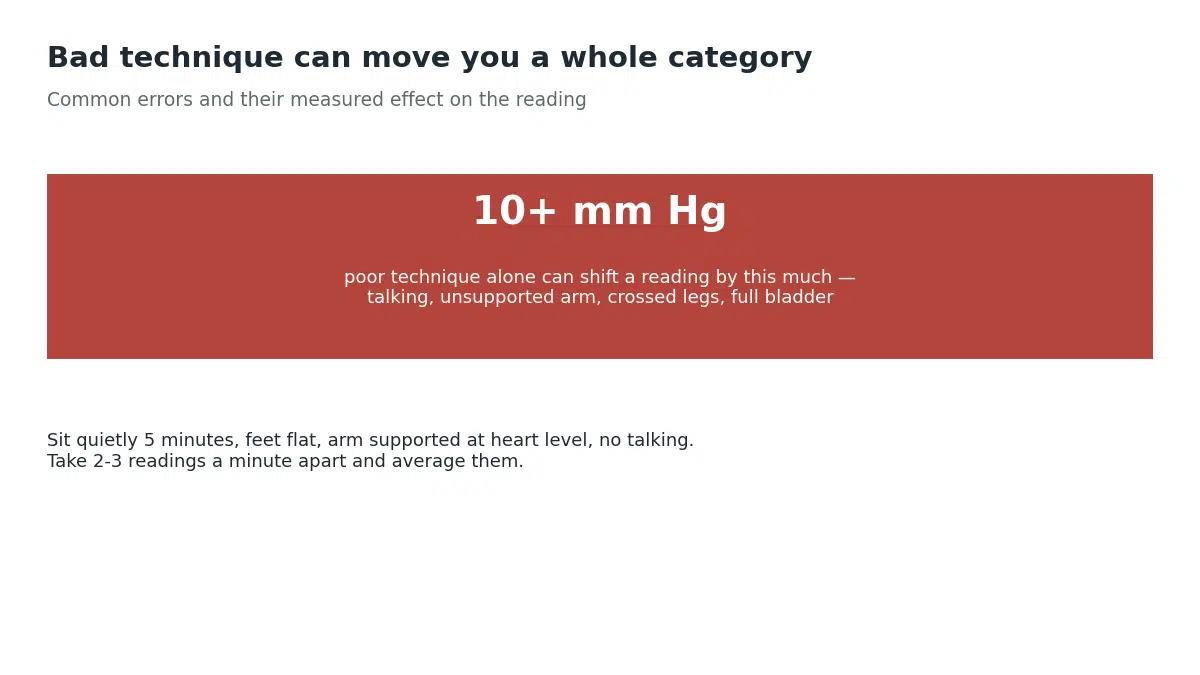
This section matters more than most people expect, because poor technique routinely shifts readings by 10 mm Hg or more — enough to move you a whole category.
Use an upper-arm cuff. Wrist and finger devices are less reliable. Cuff size matters: too small reads falsely high.
Before measuring: sit quietly for five minutes. Empty your bladder. No caffeine, exercise or smoking for 30 minutes beforehand.
During: back supported, feet flat on the floor, legs uncrossed, arm resting at heart level on a table. Don’t talk — talking alone can add several points.
Take two or three readings a minute apart and average them. Record date and time.
Take readings at consistent times — many people do morning before medication and again in the evening — and bring the log to appointments. Patterns are what your clinician can act on.
Worth knowing: a difference between arms of more than 10–15 mm Hg is worth mentioning, as it can indicate arterial narrowing. Small differences are normal.
And have your home monitor checked against your clinic’s once a year.
What Moves Your Numbers
Sodium. It makes your body hold water, raising blood volume. The AHA advises under 2,300 mg daily, ideally 1,500 mg for people with high blood pressure — against a typical intake nearer 3,400 mg.[3] Most of it comes from bread, processed meat, canned soup and restaurant food, not the salt cellar.
Weight. Losing excess weight lowers blood pressure fairly reliably. The evidence points to roughly 1 mm Hg systolic per kilogram lost — around 1 mm Hg for every 2 pounds — which is meaningful but slower than the figures often quoted.
Activity. About 150 minutes of moderate exercise weekly, plus strength work twice a week. Ten-minute blocks count.
Alcohol. Heavy or regular drinking raises blood pressure and interferes with medication.
Smoking raises it acutely and damages arteries long-term.
Sleep. Blood pressure normally dips overnight; poor or fragmented sleep blunts that dip. Obstructive sleep apnea is a particularly common and treatable cause of blood pressure that won’t come down — worth raising if you snore heavily, wake gasping, or feel unrefreshed after adequate time in bed.
Medications can raise it: decongestants, NSAIDs taken regularly, some contraceptives, certain antidepressants, steroids.
Other conditions — kidney disease, thyroid disorders, diabetes and sleep apnea all affect readings.
On risk factors you can’t change
Age, family history and genetics all play a part.
Hypertension rates are notably higher among Black adults in the US, and it tends to develop earlier and more severely. It’s worth being precise about why: the evidence points substantially to social and structural factors — access to care, environment, chronic stress from discrimination, food environment — rather than to race functioning as a biological cause. The practical implication is earlier and more consistent screening, not fatalism.
What Actually Lowers It
The DASH eating pattern has the strongest evidence of any dietary approach — fruit, vegetables, whole grains, lean protein and low-fat dairy, with less saturated fat and added sugar.[2] Many people see change within a few weeks.
Potassium helps counter sodium’s effect. Our guide to potassium-rich foods covers the best sources — and importantly, who needs to avoid loading up on them, because people with kidney disease or on certain blood pressure medications can develop dangerously high potassium. Check before making a deliberate effort to increase it.
Dietary nitrate is the other food-based lever with trial evidence behind it. Beetroot juice lowers systolic pressure by roughly 5 mm Hg in people with hypertension, although the effect peaks within hours and has largely faded within a day. Our guide to whether beetroot juice lowers blood pressure covers what the trials actually measured, and why it does nothing at all for some people.
Practical swaps that work: fresh or frozen vegetables over canned, herbs and citrus instead of salt, cooking at home more often, and reading labels on bread and sauces where sodium hides.
Realistic timeline: sodium reduction can show within days to a week. Exercise and weight loss take several weeks. Track for two weeks before judging whether something worked.
Why Uncontrolled Blood Pressure Matters
High blood pressure is called silent because it damages organs for years without symptoms. That’s the entire argument for screening.
Heart: the muscle thickens and pumps less efficiently, and atherosclerosis accelerates — raising heart attack and heart failure risk.
Brain: weakened vessels can rupture or become blocked, causing stroke. Long-term hypertension also contributes to cognitive decline.
Kidneys: the fine filtering vessels are damaged by sustained pressure, and failing kidneys make blood pressure harder to control — a cycle that accelerates.
Eyes: damage to retinal vessels can cause vision problems and, over time, permanent loss.
Legs: peripheral arterial disease, causing pain on walking and poor healing.
The reassuring half: controlling blood pressure measurably reduces all of these risks, and it’s one of the most treatable cardiovascular risk factors there is.
Medication, Briefly
When lifestyle change isn’t enough, the main classes are diuretics (remove sodium and water), ACE inhibitors and ARBs (relax vessels), calcium channel blockers (relax vessels), and beta-blockers (slow the heart).
Combinations are common, and finding the right regimen often takes adjustment.
Side effects worth recognizing: a persistent dry cough with ACE inhibitors, ankle swelling with calcium channel blockers, fatigue with beta-blockers, and increased urination with diuretics.
If something is bothering you, there are almost always alternatives — but speak to your prescriber rather than stopping. Stopping suddenly can cause a sharp rebound.
Particular Situations
Pregnancy. Blood pressure normally dips in early pregnancy and returns toward baseline later. New high blood pressure after 20 weeks — particularly with headache, vision changes, upper abdominal pain or sudden swelling of face and hands — needs contacting your maternity team the same day. That’s the preeclampsia pattern.
Older adults. Stiffer arteries mean higher systolic readings. Control still matters, but targets are individualized, and orthostatic hypotension — dizziness on standing — becomes a real fall risk that needs balancing. Since falls are the outcome being avoided, it is worth knowing what reduces them directly: our guide to balance exercises for seniors covers the training with the strongest trial evidence behind it.
Children. Normal ranges depend on age, sex and height, so pediatricians use charts rather than adult thresholds.
Stress, White Coat, and What’s Real
Stress hormones raise heart rate and constrict vessels, so readings spike. Whether chronic stress causes sustained hypertension is less settled than commonly claimed — much of its effect runs through behavior: sleep, alcohol, eating, inactivity.
Slow breathing, brief mindfulness practice and regular activity all help, and none of them require much time.
White coat hypertension — readings higher in clinic than at home — is common and why home monitoring is useful. The reverse also exists: masked hypertension, normal in clinic but high at home, which is arguably the more dangerous version because it goes undetected.
Common Questions About Normal Blood Pressure
What is normal blood pressure?
Your own target may differ depending on age and other conditions.
Can blood pressure be too low?
It matters when it causes symptoms or drops suddenly.
How quickly can lifestyle changes help?
Track for two weeks before deciding whether something is working.
Does caffeine raise blood pressure?
Avoid it for 30 minutes before measuring, or you’ll be recording the coffee.
Why is my reading different in each arm?
Clinicians check both initially, then use the higher arm.
Can I stop medication if my readings are normal?
If you want to reduce it, that’s a supervised plan with monitoring.
The Bottom Line
Below 120/80 is the goal for most adults, but technique matters as much as the target — five minutes sitting quietly, feet flat, arm at heart level, no talking, and an average of two or three readings.
Track patterns rather than reacting to single numbers, and bring the log to your appointment.
Sodium, weight, activity, alcohol and sleep are where most of the achievable change lives. And if readings won’t come down despite genuine effort, ask about sleep apnea — it’s common, treatable, and frequently missed.
SOURCESOur Editorial Standards
HealthMagHub is built on primary sources: peer-reviewed research, clinical practice guidelines, and health agencies such as the NIH, CDC, and FDA. Read our editorial standards to see how we research, cite, and update our articles.
- American Heart Association. Understanding Blood Pressure Readings. heart.org
- National Heart, Lung, and Blood Institute. DASH Eating Plan. nhlbi.nih.gov
- American Heart Association. How Much Sodium Should I Eat Per Day? heart.org
- Centers for Disease Control and Prevention. High Blood Pressure Facts. cdc.gov
Disclaimer: This article is general information, not medical advice, and blood pressure targets are individualized. Seek emergency care for a reading above 180/120 that stays high, or for chest pain, severe headache with confusion or vision changes, sudden one-sided weakness, or sudden breathlessness. Do not start, stop or change blood pressure medication without your prescriber. Speak to your clinician before deliberately increasing potassium intake, particularly with kidney disease or certain blood pressure medications.