


Most men who search for gynecomastia do not have it. They have chest fat, which looks similar in a mirror and is a completely different problem with a completely different answer.
Gynecomastia is glandular breast tissue. It is an actual disc of firm, rubbery tissue sitting under the nipple. The fat version has a name too: pseudogynecomastia. One responds to losing weight. The other largely does not, and can point at a medication or a hormone problem worth finding.
You can tell them apart at home in about thirty seconds, and it is worth doing before you read anything else about surgery.
- Gynecomastia is firm glandular tissue centered under the nipple; pseudogynecomastia is soft fat spread evenly across the chest.
- Medications are behind roughly a quarter of all cases, and one cohort study put the figure at 80% in older men.
- It peaks at three ages: newborns, puberty, and men past 50. Around half to two thirds of boys get it, and most resolve within two to three years.
- A hard lump sitting off to one side of the nipple, rather than ringed around it, is the pattern that needs checking rather than watching.
The pinch test: gynecomastia or chest fat?
This is the same examination a doctor performs, and there is no reason you cannot do it yourself first.
Lie down. Put your thumb and index finger on either side of the areola, well outside it, and slowly bring them together underneath the nipple, pinching gently as you go.
If there is glandular tissue, your fingers will meet a distinct firm, rubbery disc, noticeably denser than the softer tissue around it, with an edge you can feel. It usually sits concentrically around the nipple, like a ring, and it is often tender when pressed. That is gynecomastia.
If there is not, your fingers meet uniform soft tissue with no obvious edge and nothing firmer at the center. That is fat, and losing weight will change it.
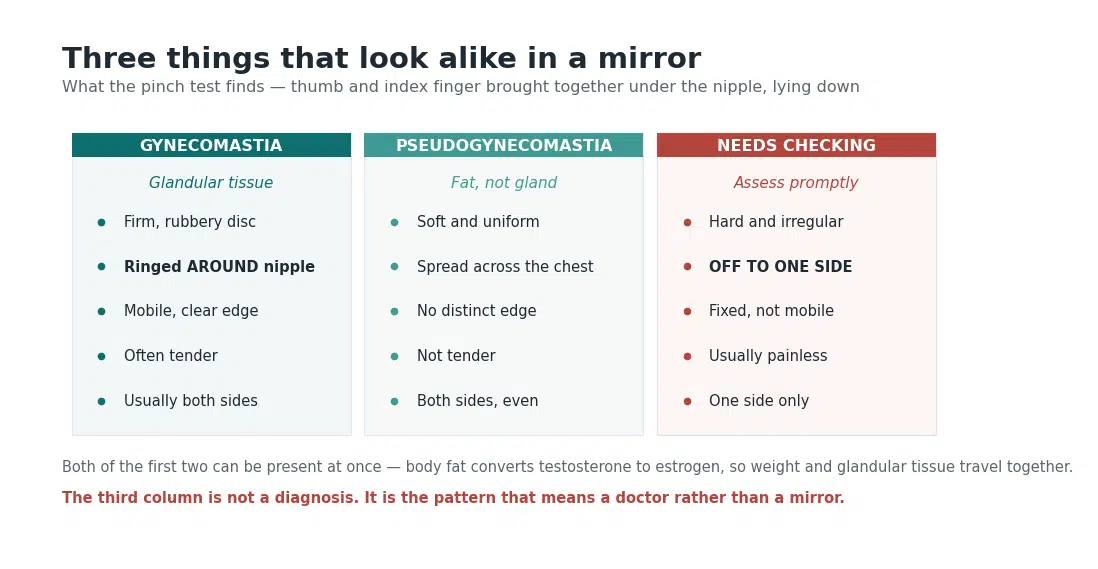
Both can be present at once, which is common with excess weight, because body fat converts testosterone into estrogen. So the honest answer is often “some of each,” and that still matters. The fat part will respond to weight loss; the glandular part will not.
Why glandular tissue grows in the first place
Every man has a small amount of breast tissue. Whether it grows comes down to a ratio rather than a single hormone.
Estrogen stimulates breast tissue to proliferate. Testosterone opposes that. In men the balance normally sits far enough toward testosterone that nothing happens. Tip the ratio, whether by more estrogen or less testosterone, and the glandular tissue starts growing.
Several things tip it. Body fat contains aromatase, the enzyme that converts testosterone into estradiol, so carrying more fat shifts the ratio directly. Liver disease and kidney disease both disturb hormone clearance. So does an overactive or underactive thyroid. Testicular problems reduce testosterone from the other side of the equation.
And in about a quarter of cases, no cause is ever identified. That is a genuinely common outcome rather than a failure of investigation.
The three ages it turns up
Gynecomastia has what clinicians call a trimodal distribution. It clusters at three points in life, and the meaning is different at each.
Newborns. Up to 90% of newborn boys have palpable breast tissue, from estrogen crossing the placenta before birth. It typically settles within about four weeks.
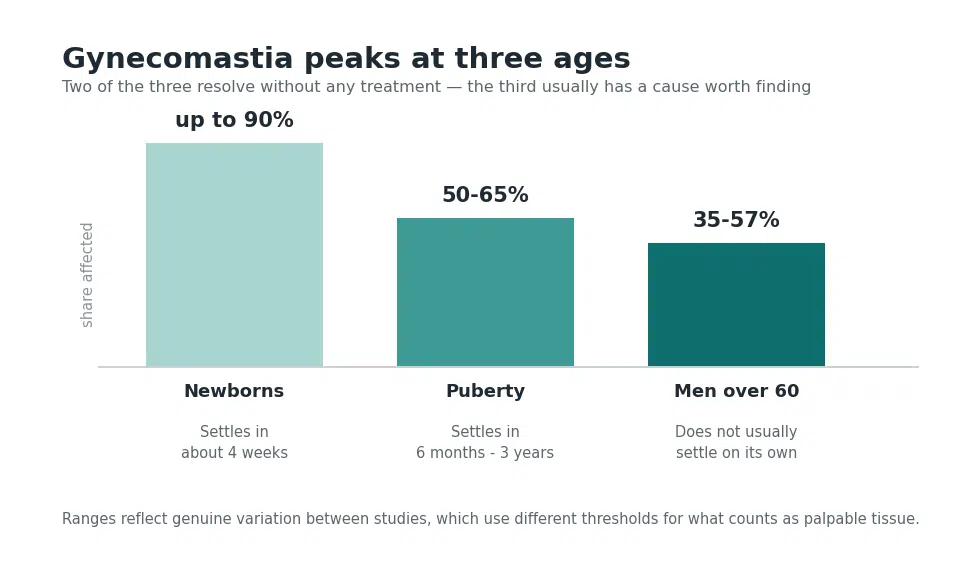
Puberty. Somewhere between half and two thirds of adolescent boys develop it, usually because estradiol rises faster than testosterone early in puberty. Most cases resolve on their own within six months to two or three years. It is common, it is temporary, and it is also genuinely distressing at that age, which is worth taking seriously rather than dismissing.
Men over 50. Estimates run from roughly a third to over half of men past 60. Testosterone declines, body fat and aromatase activity rise, and sex hormone binding globulin increases, and that binds testosterone more tightly than estrogen, leaving relatively more free estrogen. This is also the group taking the most medication, which matters more than anything else on this page.
The cause almost nobody checks
Drugs account for roughly 25% of all cases. In older men, one cohort study put the figure at 80%.
That is an extraordinary number for a cause most men never think to raise, and the giveaway is timing. Breast tissue appears within months of a new prescription or a dose change.
- Spironolactone. Used for blood pressure, heart failure and fluid retention, and one of the most frequently implicated
- Cimetidine. An older acid-reducing drug still available over the counter
- Finasteride and dutasteride. Prescribed for prostate enlargement and hair loss
- Ketoconazole. An antifungal
- Digoxin, thiazide diuretics, calcium channel blockers. Cardiovascular drugs
- Some antipsychotics and older antidepressants
- Anabolic steroids and testosterone used without supervision. The body aromatizes the excess into estrogen, which is why this shows up in gym settings
- Cannabis, and some HIV medications
None of this is a reason to stop a medication on your own. Several of these drugs are doing important work, and spironolactone in particular is often prescribed for reasons that matter a great deal. Our guide to reading your blood pressure numbers covers where it fits. Within most of these classes there are alternatives, which makes this a conversation rather than a decision.
Bring the full list, including anything bought over the counter or online. Supplements marketed for testosterone belong on it too, since some contain undisclosed hormones, a problem we cover in our look at natural testosterone boosters and what the trials actually found.
The pattern that is not gynecomastia
Male breast cancer is uncommon, but it exists, and the reason it gets caught late is that men assume any chest change is cosmetic.
The single most useful distinction is position. Gynecomastia sits concentrically, ringed evenly around the nipple. A cancerous lump typically sits eccentrically, off to one side, rather than centered. That difference is what a doctor is checking for first.
Alongside that: it tends to be hard rather than rubbery, irregular rather than smooth-edged, fixed rather than mobile, one-sided, and usually painless. Gynecomastia, by contrast, is often tender.
Get assessed promptly for any of these:
- A hard lump off to one side of the nipple rather than ringed around it
- A lump that feels fixed to the skin or the chest wall
- Nipple discharge of any kind, particularly if bloody or from one side only
- The nipple turning inward when it did not before
- Skin dimpling, puckering, or an orange-peel texture over the area
- Ulceration, scaling or persistent redness of the nipple
- A swollen lymph node in the armpit on the same side
Imaging is not routinely needed when the examination looks like straightforward gynecomastia. It is needed when any of the above is present, which is precisely the point of knowing the difference.
What actually changes it
The answer depends entirely on which thing you have.
If it is mostly fat, weight loss works, and reducing overall body fat also lowers aromatase activity, so it helps both problems at once. Chest exercises alone will not, since you cannot direct fat loss to one area.
If a medication is responsible, switching it is the highest-value move available, and the tissue often regresses if the change happens early enough.
If it is pubertal, time is usually the treatment. Most cases resolve without intervention.
If an underlying condition is driving it, whether thyroid, liver, kidney or a testicular problem, treating that comes first, and blood tests are how it gets found.
Timing matters more than most people realize. Early on, glandular tissue is still soft and inflammatory, and medical treatment can shrink it. Left long enough it becomes fibrous and scarred, and at that stage drugs stop working and surgery is the only thing that removes it. That is the argument for raising it early rather than waiting to see.
When to see a doctor
- Any of the breast-cancer patterns above, promptly rather than at your next routine appointment
- Breast tissue that appeared within months of starting or changing a medication
- Rapid growth, or tissue that keeps enlarging
- Pain or tenderness that interferes with daily life
- Gynecomastia alongside shrinking testicles, loss of body hair, low libido or erectile problems
- Any new breast tissue in a man who is not going through puberty and is not on a new drug
- Adolescent gynecomastia that has not settled after two to three years
Worth saying plainly: this causes real distress, and that is a legitimate reason to seek help on its own. It does not need to be dangerous to be worth treating.
Frequently asked questions
How do I know if I have gynecomastia or just fat?
Do the pinch test lying down. A firm rubbery disc with a definite edge under the nipple is glandular tissue. Uniform softness with nothing firmer at the center is fat. Tenderness points toward glandular tissue as well.
Will losing weight get rid of gynecomastia?
It will remove the fat component and reduce aromatase activity, which helps. It will not remove established glandular tissue. Many men have both, so weight loss often improves the appearance without resolving it entirely.
Can gynecomastia go away on its own?
Often, in newborns and in adolescents. Most pubertal cases resolve within six months to three years. In adults it is less likely to resolve spontaneously unless the cause, usually a drug, is removed early.
Does low testosterone cause it?
It can, since the ratio between estrogen and testosterone is what matters. But testosterone treatment can also cause it, because the body converts excess testosterone into estrogen. Testing before treating is the sensible order, as we set out in our guide to the early signs of low testosterone.
Is it a sign of cancer?
Usually not. It is overwhelmingly benign. What warrants checking is a hard lump positioned off to one side of the nipple, one-sided changes, nipple discharge or retraction, skin dimpling, or a swollen node in the armpit.
The one thing to take away
Do the pinch test first. It costs nothing and it splits the question into two entirely different problems before you spend money or worry on either.
Then check your medication list, because that is where a quarter of cases live, and a much larger share if you are over 60. And if there is a hard lump sitting off to one side rather than ringed around the nipple, stop reading and book an appointment.
SOURCESOur Editorial Standards
HealthMagHub is built on primary sources: peer-reviewed research, clinical practice guidelines, and health agencies such as the NIH, CDC, and FDA. Read our editorial standards to see how we research, cite, and update our articles.
- Johnson RE, Murad MH. Gynecomastia: pathophysiology, evaluation, and management. Mayo Clinic Proceedings 2009;84(11):1010–1015. mayoclinicproceedings.org
- Gynecomastia: clinical evaluation and management. American Academy of Family Physicians. AAFP clinical review
- Gynecomastia. StatPearls, National Library of Medicine. NCBI Bookshelf
- Gynecomastia: etiology, diagnosis, and treatment. Endotext, National Library of Medicine. NCBI Bookshelf