
Before anything else: soaking sweats that come with a fever, unexplained weight loss, or swollen glands need a doctor’s appointment, not a cooler duvet. That combination is the one doctors take seriously.
Night sweats in men get blamed on low testosterone more often than the evidence supports. The real list is longer, and the most common item on it has nothing to do with hormones.
Here’s what actually causes night sweats, what the research says about each, and the specific combinations that mean you should stop reading and book an appointment.
- Night sweats are far more common than men assume, and almost nobody raises them: 41% of primary care patients reported them in the past month, but only 12% had ever mentioned it to a doctor.
- Untreated sleep apnea is the cause men miss most often, affecting 30.6% of those with it versus 9.3% of the general population — and effective treatment brings the sweating back down.
- Look at your sleep before your hormones. Low testosterone is an oversold explanation, and its symptoms overlap almost exactly with untreated apnea.
What counts as night sweats, and what doesn’t
There’s a real difference between waking up warm and having night sweats.
The clinical version means sweating heavy enough to soak your bedclothes or sheets, happening when the room isn’t hot. If you change your t-shirt at 3am, or your partner notices the sheets are damp, that counts. Feeling a bit clammy under a thick duvet in August does not.
The distinction matters because the first thing worth doing is ruling out the room. Bedroom temperature, a duvet rated for winter, flannel pajamas, a partner who runs hot, alcohol in the evening. Alcohol is worth singling out: in a large primary care study, greater alcohol use was one of the few factors specifically associated with sweating in men.
If the sweats persist after you’ve made the room cool and cut evening drinking for two weeks, then it’s worth working through the list below.
How common are night sweats?
More common than most people assume, which is reassuring on its own.
When researchers asked 2,767 consecutive primary care patients directly, 41% reported night sweats in the previous month. Across studies, the prevalence runs from about 10% in older patients to 41% in middle-aged ones, and it peaks between the ages of 41 and 55.
Two things follow from that. First, night sweats are a common symptom, and most people who report persistent night sweats in primary care do not have a serious underlying disorder. Second, almost nobody mentions them: in one study, only 12% of patients who reported night sweats when asked had brought it up with their doctor themselves.
So if you’re wondering whether this is worth mentioning at your next appointment, the answer is yes, and you’d be in the minority for doing it.
The most common causes of night sweats in men
Working roughly from most to least common:
- Sleep apnea. Covered properly below, because it’s the one men miss.
- Alcohol and the evening wind-down. Alcohol dilates blood vessels and disrupts the second half of the night. The single easiest variable to test.
- Anxiety and low mood. Mood disorders are one of the conditions most consistently associated with night sweats in primary care. The sweating is real, not imagined.
- Reflux. Gastroesophageal reflux is on the same list, and it often goes unrecognized at night because the heartburn is silent.
- An overactive thyroid. Hyperthyroidism raises heat production. It comes with weight loss despite normal eating, a fast or irregular pulse, tremor and heat intolerance — worth separating from the ordinary metabolic changes of getting older.
- Infection. Anything from a viral illness to tuberculosis or a deep-seated bacterial infection. Fever alongside the sweats points here.
- Medicines. A longer list than most people realize, covered below.
- Low blood sugar overnight. Relevant if you take insulin or a sulfonylurea for diabetes, where a nocturnal drop can trigger sweating, tremor and a thumping heart. This one has a specific fix, and it’s worth raising with whoever manages your diabetes.
Sleep apnea: the night sweats cause men miss most
This is the one worth knowing about, because the association is strong and the treatment works.
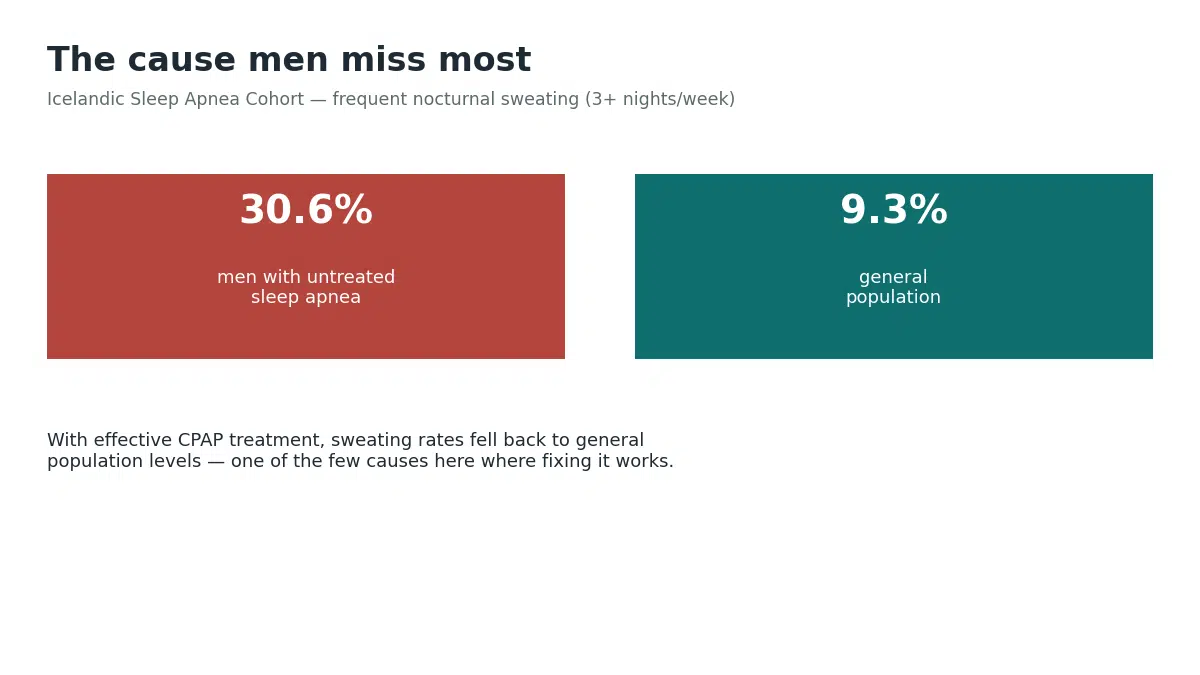
In the Icelandic Sleep Apnea Cohort, frequent nocturnal sweating — three or more nights a week — was reported by 30.6% of men with untreated obstructive sleep apnea, compared with 9.3% of men in the general population. Roughly three times the rate.
The mechanism is straightforward. When breathing stops repeatedly, oxygen dips and the body responds with a surge of adrenaline and cortisol. That’s a stress response, and sweating is part of it.
The part that makes this genuinely useful: with effective positive airway pressure treatment, sweating rates in that cohort fell back to general population levels. It’s one of the few causes on this list where fixing the underlying problem reliably fixes the symptom.
Worth being assessed if the sweats come with snoring, witnessed pauses in breathing, waking with a dry mouth or headache, daytime sleepiness, or needing to pass urine repeatedly at night. Excess weight around the neck raises the risk, which is part of why the two travel together.
Do low testosterone and night sweats really go together?
Sometimes, but it’s oversold.
Genuine hypogonadism can produce vasomotor symptoms much like the hot flashes of menopause, and men on androgen deprivation therapy for prostate cancer get them frequently. That’s a real, well-documented effect.
The problem is the leap from “I have night sweats” to “I need testosterone.” Low testosterone isn’t a common explanation for night sweats in an otherwise well man, and the symptoms attributed to it — fatigue, poor sleep, low mood, low libido — overlap almost perfectly with the symptoms of untreated sleep apnea. Sleep apnea also lowers testosterone directly. We’ve set out what low testosterone actually looks like separately.
So the order matters. Investigating the sleep first is more likely to find the answer than reaching for a hormone panel, and starting testosterone in a man with untreated apnea can make the apnea worse.
Medicines that cause night sweats
If your sweats started within a few weeks of a new prescription, look here first.
Antidepressants, particularly SSRIs and SNRIs, are the most commonly implicated. A primary care study that examined 35 medication classes found SSRIs associated with night sweats independently of age, sex and weight.
Others worth checking: some blood pressure medicines, hormone treatments including androgen deprivation therapy, drugs that lower blood sugar, and regular acetaminophen or anti-inflammatories taken for something else, which can mask a fever and unmask sweating as they wear off.
None of this is a reason to stop a medicine on your own. Bring the timing to your pharmacist, who can see the whole list, and let them work out whether a switch or a dose change makes sense.
Night sweats red flags: when to get checked promptly
Most night sweats aren’t sinister. But a specific cluster of symptoms is, and it’s defined precisely enough to be useful.
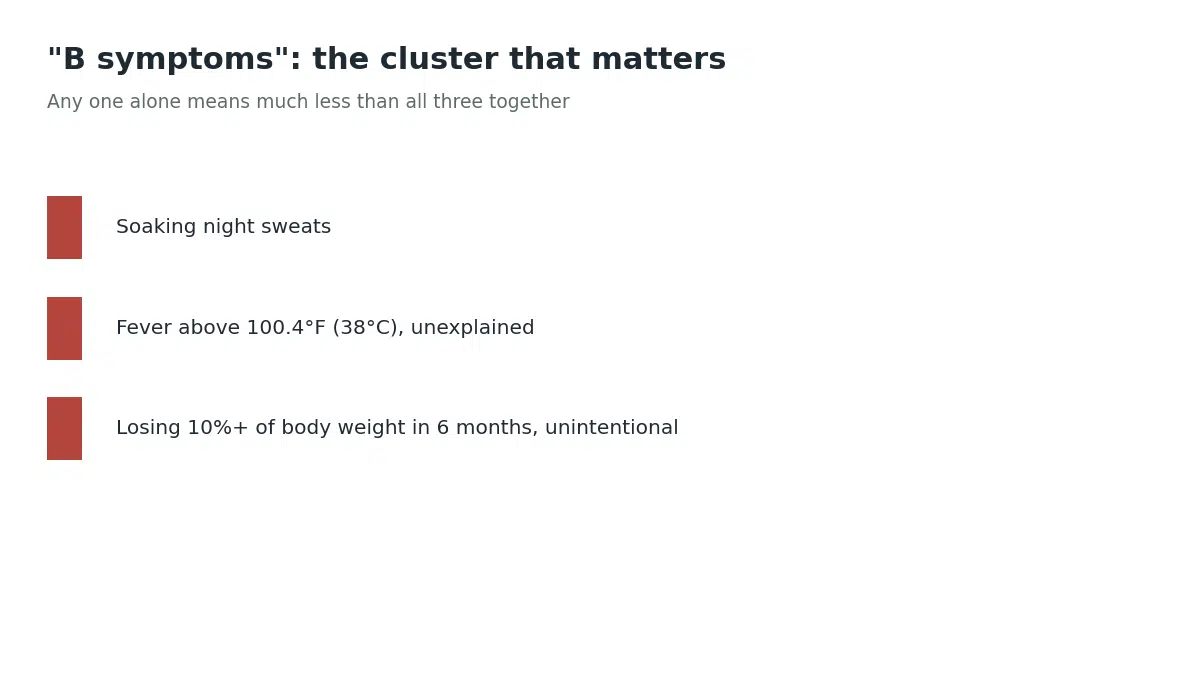
Doctors assessing lymphoma lean on a shorthand for three findings that tend to arrive together, filed under the label B symptoms. What carries the weight is the cluster: any one of those three, standing on its own, means considerably less than all three at once.
Book an appointment promptly if your sweats come with any of these:
- Unexplained weight loss, particularly more than a few pounds without trying
- Fever that keeps returning, or persists more than a couple of weeks
- Lumps or swollen glands in the neck, armpits or groin
- A cough lasting more than three weeks, or coughing up blood
- Persistent tiredness that’s out of character
- Itching all over without a rash
Also worth prompt review if the sweats started suddenly, are getting worse week on week, or are severe enough to disturb your sleep every night.
The point of this section isn’t to frighten you. It’s that “night sweats plus one of the above” is a different conversation from “night sweats alone,” and doctors triage it differently.
What your doctor will actually check
Knowing what to expect takes some of the dread out of booking.
Most of the work is the conversation. A doctor will want to know how long it’s been going on, whether the sweats soak through, whether there’s fever or weight change, what medicines you take, how much you drink, how you sleep and whether anyone has heard you stop breathing. That history does most of the diagnostic work.
The examination usually focuses on lymph nodes in the neck, armpits and groin, the thyroid, the abdomen, and your temperature and weight compared with previous records.
Blood tests, if they’re ordered, are typically a complete blood count, inflammatory markers, thyroid function and blood glucose. A chest x-ray comes in if there’s a cough, fever, or a reason to think about infection. Imaging beyond that isn’t routine and is reserved for cases where something specific points to it.
If nothing turns up and you’re otherwise well, that’s a genuinely common outcome rather than a failure. Guidance for doctors suggests treating a suspected cause for four to eight weeks and reviewing, rather than escalating straight to scans.
What to do about night sweats that aren’t dangerous
Assuming the red flags are absent and your doctor has ruled out the treatable causes, most of what helps is unglamorous.
Drop the bedroom temperature and use lighter, breathable bedding. Cotton or bamboo beats synthetic. Layers you can kick off beat one heavy duvet.
Move alcohol earlier or cut it, at least as a two-week experiment. Same for late heavy meals if reflux is in the picture.
Keep water by the bed. Heavy sweating over months loses meaningful fluid and salt, and rehydrating properly helps more than people expect.
Get the sleep assessed if there’s any hint of apnea, even if you don’t consider yourself overweight and don’t think you snore. Partners are usually the better witness here.
The one thing to take away
Night sweats in men are common, under-reported, and usually not dangerous. The single most useful thing you can do is look at your sleep before you look at your hormones, because sleep apnea is both more likely and more fixable than low testosterone.
And the one combination worth acting on quickly is sweats plus fever, weight loss or swollen glands. Alone, night sweats are a nuisance. Together with those, they’re a reason to be seen.
SOURCESOur Editorial Standards
HealthMagHub is built on primary sources: peer-reviewed research, clinical practice guidelines, and health agencies such as the NIH, CDC, and FDA. Read our editorial standards to see how we research, cite, and update our articles.
- Smetana GW. Persistent Night Sweats: Diagnostic Evaluation. American Family Physician, 2020
- Mold JW, Mathew MK, Belgore S, DeHaven M. Prevalence of night sweats, day sweats, and hot flashes in older primary care patients. Annals of Family Medicine
- Arnardottir ES et al. Is frequent nocturnal sweating a symptom of obstructive sleep apnea? Icelandic Sleep Apnea Cohort. European Respiratory Society
- B-Symptoms, concept definition. MedGen, NCBI
This article is for general information and isn’t a substitute for advice from a doctor who can examine you and see your full medical history.