
- The strongest evidence is a 48-week randomized trial showing better-preserved bone density in postmenopausal women with osteopenia.
- A 60-day trial found improved sexual satisfaction, but the mechanism isn’t established and it hasn’t been replicated.
- The real risk isn’t the compound. It’s heavy metal contamination from the rock shilajit forms in, so only buy with a current, batch-specific Certificate of Analysis.
- Energy, cognitive, skin and fertility claims rest on weaker or indirect evidence than the marketing suggests.
The Real Risk: Heavy Metal Contamination
Shilajit forms in mineral-rich rock, and the same geological process that concentrates fulvic acid and trace minerals also concentrates lead, arsenic, mercury and cadmium from the surrounding rock.
Testing of shilajit products sold in the US has found heavy metal and microbial contamination in a meaningful share of them.[1]
A 2023 toxicology review reached the same conclusion: contamination risk is real and inconsistent across brands, and purification methods vary widely in how effectively they remove it.[2]
Fulvic acid itself binds to metals. It’s a natural chelator, which is part of why it helps mineral absorption.
In a clean product that’s a benefit. In a contaminated one, the same mechanism delivers lead and arsenic into your cells more efficiently.
What this means practically: never buy shilajit without a current, batch-specific Certificate of Analysis (COA) from an independent lab, showing actual measured values for lead, arsenic, mercury and cadmium, not just a “pass” stamp. Avoid raw or unprocessed shilajit sold without testing.
This matters more for women of childbearing age, since heavy metals are a particular concern in pregnancy.
Shilajit Benefits for Females: What’s Actually in It
Processed shilajit typically contains 15-20% fulvic acid, 60-80% humic acid, and upwards of 80 trace minerals including iron, magnesium and zinc. Fulvic acid is the most studied component and plays a role in how efficiently minerals cross into cells.
Magnesium deserves a specific mention. It supports muscle relaxation, sleep and energy production, and many women fall short of it in their diet.
If sleep is the main goal, though, a dedicated magnesium supplement has better-established dosing and evidence behind it than shilajit does for that specific use.
Bone Health: The Best Evidence Shilajit Has
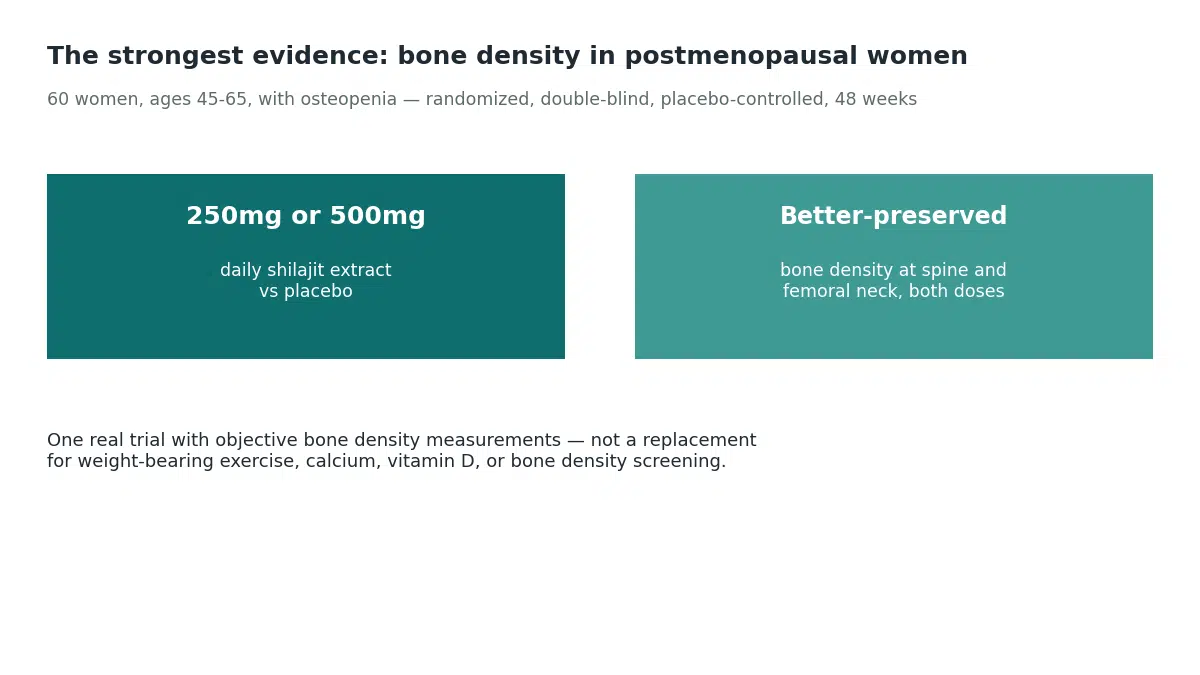
This is the strongest trial in the female-specific literature. Sixty postmenopausal women aged 45-65 with osteopenia were randomized to placebo, 250mg, or 500mg of shilajit extract daily for 48 weeks.
Both supplemented groups showed significantly better-preserved bone mineral density at the spine and femoral neck compared with placebo, alongside reduced markers of bone turnover, oxidative stress and inflammation.[3]
That’s a real, well-designed trial: randomized, double-blind, placebo-controlled, with objective bone density measurements rather than self-report. It’s also one trial.
It supports shilajit as a plausible adjunct for postmenopausal bone health, not a replacement for weight-bearing exercise, adequate calcium and vitamin D, or bone density screening.
Sexual Function: One Real Trial, Modest Claims
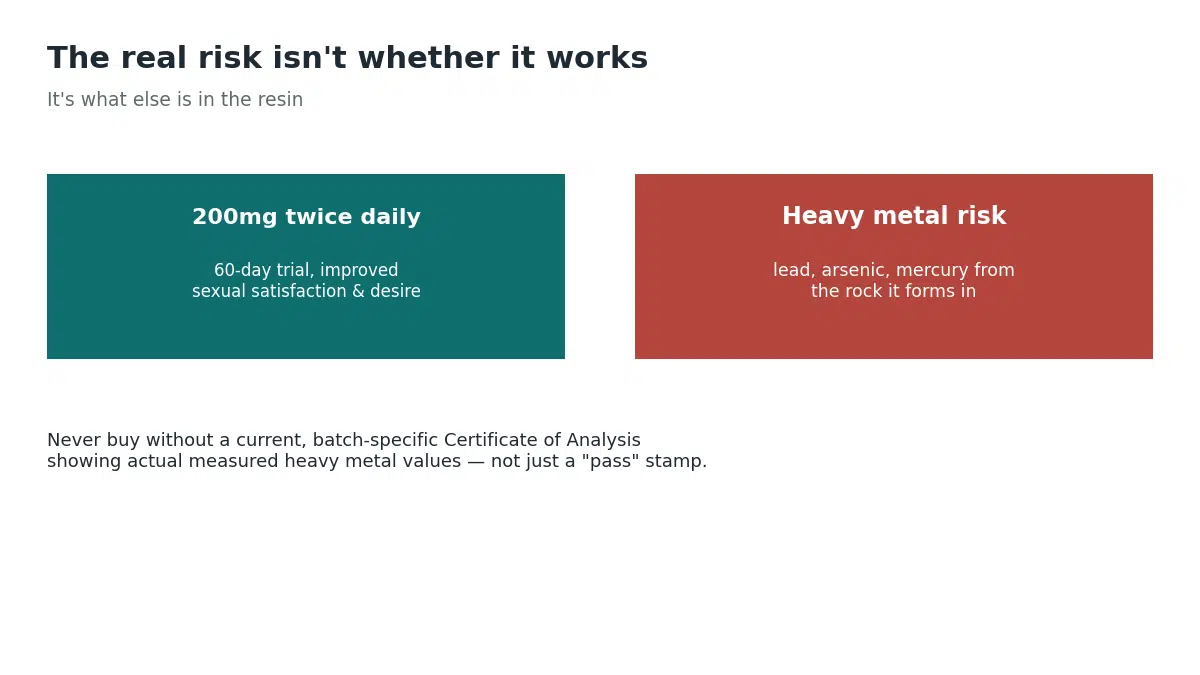
A 2023 triple-blind randomized trial gave women of reproductive age 200mg of purified shilajit twice daily for 60 days and measured sexual function and quality of life against placebo.[4]
The supplemented group reported improved sexual satisfaction, desire and a more positive view of their intimate relationships.
Two things worth knowing before reading too much into it: the study didn’t measure estrogen or progesterone levels, so the mechanism isn’t established, and it hasn’t been replicated at a larger scale.
It’s a real, published trial, and not nothing, but one study is a starting point rather than a settled answer.
Where the Evidence Is Thinner
Energy and fatigue. The mechanism, supporting mitochondrial ATP production, is plausible and backed by lab-level research, but there isn’t a placebo-controlled human trial in women specifically measuring fatigue or energy as an outcome.
Treat this as a reasonable hypothesis rather than a demonstrated effect.
Cognitive function and brain fog. Fulvic acid has antioxidant properties, and low magnesium is genuinely linked to worse cognitive symptoms during stress.
But there’s no clinical trial testing shilajit against brain fog or memory in women. Claims about protecting against dementia or Alzheimer’s specifically go beyond what’s been published in humans.
Skin and anti-aging. One 14-week study found oral shilajit improved skin blood flow and activated genes involved in skin structure.[5]
No study has measured its effect on visible wrinkles or skin appearance in humans. The claim rests on a plausible mechanism, not a demonstrated cosmetic outcome.
Menstrual cycle regulation and fertility. This rests on traditional use and anecdote rather than clinical trials.
Shilajit is not a fertility treatment, and anyone facing fertility challenges deserves evidence-based medical care rather than a supplement.
Who Should Be Careful or Avoid It
- Pregnant or breastfeeding. No safety data exists for either, and the heavy-metal contamination risk alone is reason enough to avoid it during these periods.
- Hormone-sensitive conditions such as endometriosis, breast cancer, or other hormone-sensitive tumors, since effects on hormone-sensitive tissue aren’t well studied. Talk to your doctor first.
- Low blood pressure. Shilajit may lower blood pressure further; monitor and check with a doctor if you already run low.
- Hemochromatosis or iron overload conditions, where shilajit’s iron content could be a problem.
Reported side effects include digestive upset (nausea, diarrhea), headache, and dizziness, usually mild and dose-related. Because shilajit may influence testosterone, some women notice acne or unwanted hair growth. Stop and speak to a doctor if that happens.
Choosing a Product, If You’re Going to Try It
Look for a current, batch-specific Certificate of Analysis from an independent lab showing actual measured heavy metal values, not just a pass/fail claim.
Purified resin, capsules and tablets all work; capsules and tablets are easier for precise, consistent dosing. Skip products that are vague about sourcing or purification. That vagueness is itself a signal.
We don’t recommend specific brands, for the same reason we don’t anywhere else on this site: we can’t independently verify what’s in any given bottle, and formulations change.
The COA is the thing that actually protects you, not the marketing copy.
Trial doses in the research above ran 200-500mg daily, typically split into two doses. That’s a reasonable starting range to discuss with a doctor, not a recommendation to self-prescribe at the upper end.
Common Questions
Does shilajit actually work for women?
Is shilajit safe for women to take daily?
Can shilajit help with menopause symptoms?
Will shilajit raise my testosterone too much?
The Bottom Line
Shilajit has real, published evidence behind two specific uses in women, postmenopausal bone density and, more preliminarily, sexual function, and much weaker evidence for the energy, cognitive and skin claims commonly attached to it.
The bigger practical issue isn’t whether it works; it’s contamination. Buy from a source with a real, batch-specific Certificate of Analysis, or don’t buy it at all.
If you’re managing menopause symptoms, low energy, or hormone-related concerns more broadly, that’s worth raising with a doctor rather than working through supplements alone.
Our guide to ashwagandha safety covers a related adaptogen with a similar buyer-beware pattern around product quality.
SOURCESOur Editorial Standards
HealthMagHub is built on primary sources: peer-reviewed research, clinical practice guidelines, and health agencies such as the NIH, CDC, and FDA. Read our editorial standards to see how we research, cite, and update our articles.
- Khan S, Shah MA, Ali M. Heavy Metals and Microbial Contamination of Shilajit Products Sold in USA: A Safety Concern. J Toxicol Environ Health A. 2014;77(18):1061-7. DOI: 10.1080/15287394.2014.945827
- Jangra A, et al. Safety and Toxicity of Shilajit: A Comprehensive Review. J Ethnopharmacol. 2023;316:116744. DOI: 10.1016/j.jep.2023.116744
- Biswas TK, et al. Shilajit Extract Reduces Oxidative Stress, Inflammation, and Bone Loss to Dose-Dependently Preserve Bone Mineral Density in Postmenopausal Women With Osteopenia: A Randomized, Double-Blind, Placebo-Controlled Trial. Phytomedicine. 2022;105:154334. sciencedirect.com
- Mosavi S, Tabarrai M, Tansaz M, et al. Effects of Oral Shilajit Tablets on Sexual Function and Sexual Quality of Life Among Reproductive-Aged Women: A Triple-Blind Randomized Clinical Trial. Traditional Medicine Research. 2023;8:66. tmrjournals.com
- Das A, El Masry MS, Gnyawali SC, et al. Skin Transcriptome of Middle-Aged Women Supplemented With Natural Herbo-Mineral Shilajit Shows Induction of Microvascular and Extracellular Matrix Mechanisms. J Am Coll Nutr. 2019;38(6):526-536. pubmed.ncbi.nlm.nih.gov
Disclaimer: This article is general information, not medical advice, and we do not test or endorse specific supplement products. Do not take shilajit if you are pregnant or breastfeeding, and speak to a doctor first if you have a hormone-sensitive condition, low blood pressure, or an iron-overload condition.