This guide covers which nutrients matter, the two label details worth checking before you buy anything, and how to find a vitamin that won’t upset your stomach.
- Check the vitamin A form: beta-carotene is safe, but preformed vitamin A (retinol, retinyl palmitate, retinyl acetate) can cause birth defects at high doses.
- Take the standard 27 mg of iron unless a blood test shows you need more. Excess iron drives most of the nausea and constipation blamed on prenatals.
- Iron-containing supplements are a leading cause of fatal accidental poisoning in children under six, so store the bottle out of a toddler’s reach.
- Most prenatals cover folic acid, DHA, and vitamin D, but rarely the full 1,000 mg of daily calcium, which usually needs a separate source.
Two Things to Check Before You Buy
1. What form of vitamin A is in it. Vitamin A comes in two forms, and they behave completely differently in pregnancy. Beta-carotene is fine, because your body converts only what it needs. Preformed vitamin A, listed as retinol, retinyl palmitate, or retinyl acetate, is a different matter: at high doses it can cause birth defects. Look for a prenatal whose vitamin A comes as beta-carotene, and read the section below before taking any separate vitamin A supplement.
2. Where you’re going to store the bottle. Prenatal vitamins contain more iron than almost any other supplement on the shelf, and accidental overdose of iron-containing products is a leading cause of fatal poisoning in children under six. If there’s a toddler in your house, this matters more than any feature on the label.
Essential Nutrients to Look for in a Prenatal Supplement
Your prenatal vitamin should deliver specific nutrients that support your baby’s development.[1] These aren’t optional extras. They’re building blocks your body uses to create a healthy pregnancy.
Folic Acid: The Neural Tube Protector
Folic acid helps prevent neural tube defects in your developing baby’s brain and spine.[2] You need at least 400 micrograms daily, though many healthcare providers recommend up to 600 micrograms during pregnancy. Our deeper guide to folic acid during pregnancy breaks down exactly how much and why.
Your body uses folic acid most effectively during the first few weeks of pregnancy. That’s often before you even know you’re pregnant. This is why health care providers suggest taking prenatal vitamins before you start trying to conceive.
Vitamin A: The Form Matters More Than the Amount
This is the nutrient most worth understanding before you buy, because getting the form wrong carries real risk.
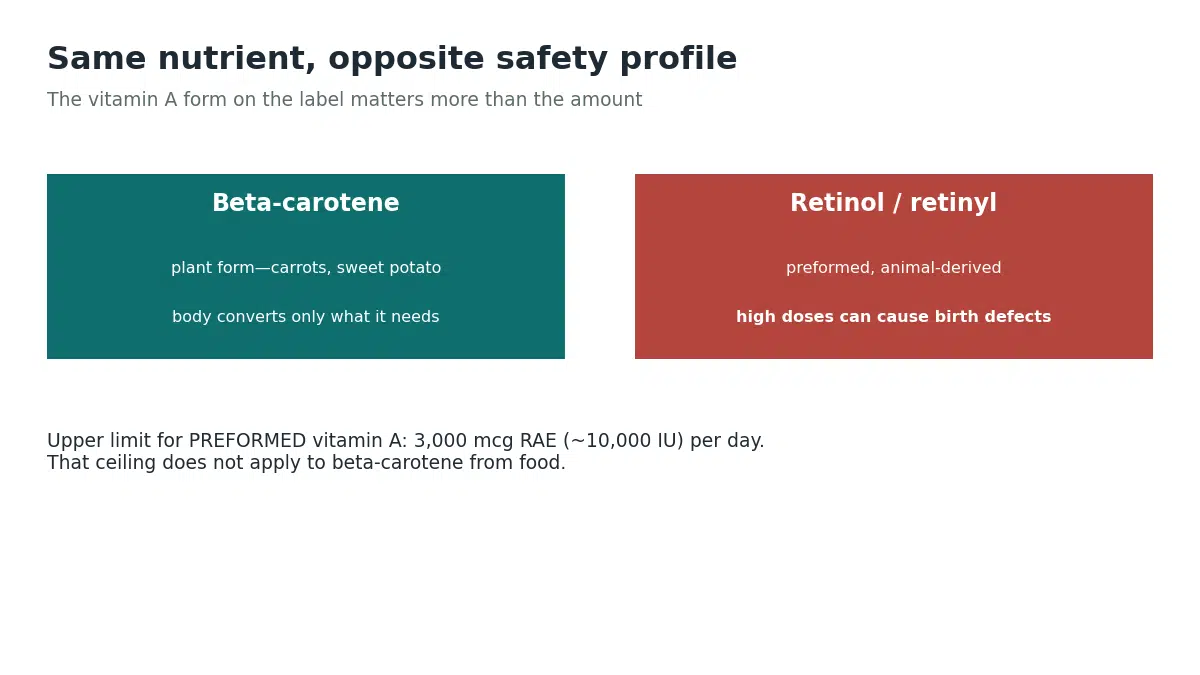
Preformed vitamin A, meaning retinol and its relatives retinyl palmitate and retinyl acetate, is the active form found in animal products and some supplements. Your body absorbs it whether it needs it or not, and it accumulates. At high intakes during pregnancy it’s teratogenic, meaning it can cause birth defects affecting the skull, face, heart, brain, and nervous system.[6]
Beta-carotene works differently. It’s the plant form, found in carrots, sweet potatoes, and pumpkin, and your body converts only as much as it needs into active vitamin A. It doesn’t carry the same risk, which is why the safest prenatal vitamins supply their vitamin A entirely as beta-carotene.
The Numbers
The recommended intake during pregnancy is 770 micrograms RAE per day, roughly 2,565 IU. The tolerable upper limit for preformed vitamin A is 3,000 micrograms RAE, about 10,000 IU per day, and that ceiling exists specifically because of the risk to a developing baby.[7] Some guidance is more conservative still, capping supplemental retinol well below that.
The upper limit applies to preformed vitamin A only. It does not apply to beta-carotene from food.
What to Actually Do
Read the vitamin A line on your prenatal’s label. If it says beta-carotene, you’re in good shape. If it lists retinol, retinyl palmitate, or retinyl acetate, note the amount and mention it to your provider, particularly if you’re taking anything else containing vitamin A.
Don’t stack a separate vitamin A supplement, cod liver oil, or a beef liver supplement on top of a prenatal without talking to your provider first. These can push you past the limit quickly. Liver itself is worth avoiding during pregnancy for the same reason: a single serving can contain several times the daily upper limit.
This also extends beyond what you swallow. Prescription oral retinoids for acne are known to cause serious birth defects, and topical retinoids are generally advised against in pregnancy too. Bring your skincare products to your provider along with your supplement list.
Iron: Fighting Pregnancy Anemia
Iron helps your body make red blood cells. During pregnancy, your blood volume increases by nearly 50%. You need extra iron to support this change and prevent anemia.[1]
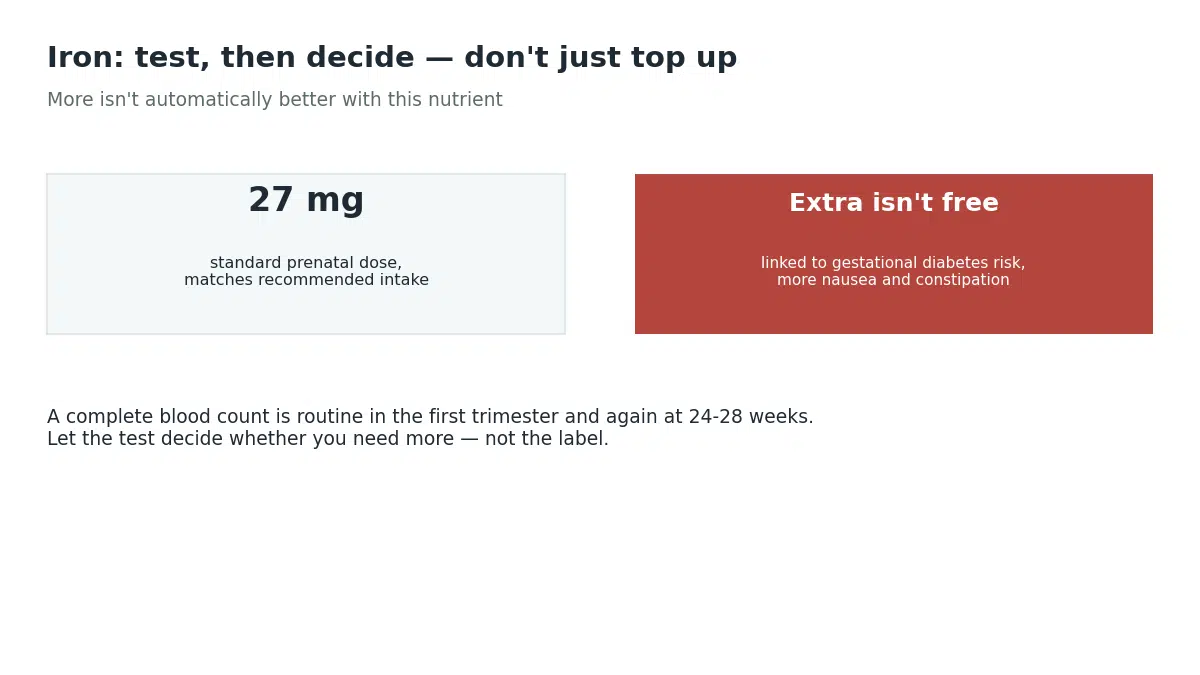
Most prenatal vitamins contain 27 milligrams of iron, which matches the recommended daily intake for pregnancy. Some people need more, and some need considerably more, but that’s a decision to make from a blood test rather than from a label.
Why More Isn’t Automatically Better
Iron is not a nutrient where topping up generously is harmless. If you’re already iron-replete, extra iron can push you toward overload, and several studies have linked higher iron and ferritin levels in pregnancy to an increased risk of gestational diabetes, though the evidence is mixed and the effect size looks small.[8] Excess iron also drives most of the nausea and constipation people blame on prenatals generally.
The practical version: take the standard amount in a normal prenatal, and let a blood test decide whether you need more.
Getting Tested
Anemia screening in pregnancy is routine. A complete blood count is typically done in the first trimester and again between 24 and 28 weeks, and if that shows anemia, your provider may follow up with serum iron and ferritin to work out whether iron deficiency is the cause.
If you’re diagnosed with iron deficiency anemia, treatment is a specific dose for a specific reason, and your provider will usually recheck your levels a couple of weeks in to confirm it’s working. Worth knowing: taking iron every other day is often just as effective as daily dosing and considerably easier on your stomach, so ask about it if side effects are a problem.
Iron and Children: The Warning on Every Bottle
Prenatal vitamins contain the highest iron levels of any common multivitamin, and iron is one of the few supplements that can genuinely kill a small child. The FDA requires this warning on iron-containing products: accidental overdose is a leading cause of fatal poisoning in children under six.[9]
The classic scenario is a toddler in a house with a new baby, getting into a parent’s prenatal bottle. Child-resistant caps slow children down; they don’t stop them.
Store the bottle out of sight and out of reach, not on a nightstand or kitchen counter. Keep the cap fully closed. If a child swallows any amount, call Poison Control right away on 1-800-222-1222 or get emergency care. Don’t wait to see whether symptoms appear, because the dangerous phase of iron poisoning can be delayed by hours.[10]
DHA: Brain and Eye Development
DHA is an omega-3 fatty acid that supports your baby’s brain and eye development. Experts generally recommend at least 200 mg of DHA daily during pregnancy, on top of what you get from food.[1] Look for prenatal vitamins that include DHA in this range.
Not all prenatal vitamins include DHA. Some require a separate supplement. Check the label carefully. If DHA isn’t included, ask your healthcare provider about adding a separate omega-3 supplement.
One caution if you go the separate-supplement route: choose a plain fish oil or algal DHA rather than cod liver oil, which is high in preformed vitamin A for the reasons covered above.
Calcium: Building Strong Bones
Your baby needs calcium to build strong bones and teeth. You need it to maintain your own bone health during pregnancy. Most prenatal vitamins contain some calcium, but rarely the full 1,000 milligrams you need daily.[3]
You’ll likely need to get additional calcium from your diet or a separate supplement. Dairy products, fortified plant milk, and leafy greens are excellent sources.
One timing note: calcium interferes with iron absorption, so if you’re taking a separate calcium supplement, space it a couple of hours apart from your prenatal rather than swallowing them together.
This catches more people than it should, because calcium arrives from an unexpected direction. Chewable antacids are calcium carbonate, so a few Tums taken for pregnancy heartburn count toward your calcium intake and blunt iron absorption exactly the way a calcium tablet would. Given how common heartburn becomes in the third trimester, that’s worth planning around rather than discovering later.
Vitamin D: The Sunshine Vitamin
Vitamin D helps your body absorb calcium. It also supports your immune system and may help prevent pregnancy complications. Look for prenatal vitamins with 600-800 IU of vitamin D.[4]
Are There Any Prenatal Vitamins Specifically for Sensitive Stomachs?
Morning sickness is rough enough without your prenatal vitamin making it worse. Many prenatal vitamins contain enough iron to trigger nausea, constipation, or stomach upset.
Here’s the good news. Several prenatal vitamin formulations are designed for sensitive stomachs, and these gentler options can make the difference between taking your vitamins and dreading them.
What Makes a Prenatal Vitamin Gentle?
Gentle prenatal vitamins typically use different forms of iron that are easier to digest. They might include carbonyl iron or iron bisglycinate instead of ferrous sulfate. These forms cause fewer digestive side effects for many people.
Some gentle formulas also come in smaller pills that are easier to swallow. Others split the daily dose into two or three pills so you’re not taking all the nutrients at once. This can help reduce stomach upset.
If constipation is the main problem rather than nausea, our guide to high-fiber foods for pregnancy covers what helps and why the iron in your prenatal is usually the culprit.
Gummy Prenatal Vitamins
Gummy prenatal vitamins have become popular because they taste good and don’t cause the same stomach problems as pills. They’re easy to take and don’t have that metallic vitamin taste.
But there’s a catch. Gummy vitamins often contain less iron than pill forms, and some contain none at all. If you choose gummies, ask your healthcare provider whether you need iron from another source, and get your levels checked rather than guessing.
A second catch worth naming: gummies taste like candy, which makes them considerably more attractive to a curious toddler than a tablet. If your gummies do contain iron, the storage advice above applies with extra force.
Tips for Taking Prenatal Vitamins Without Nausea
Take your prenatal vitamin with food. An empty stomach makes nausea worse. A small snack or full meal can help your body tolerate the vitamins better.
Try taking your vitamin at night before bed. If the vitamins make you queasy, you’ll sleep through the worst of it. Many people find this simple timing change solves the problem entirely.
If nausea persists despite food and timing changes, tell your provider rather than quietly stopping. There are usually options: a different iron form, a split dose, or every-other-day dosing if iron is the culprit.
Vegan-Friendly Prenatal Vitamin Options
Finding a truly vegan prenatal vitamin takes more effort than you might expect. Many prenatal vitamins contain gelatin capsules, vitamin D from lanolin, or omega-3s from fish oil. None of these work for a plant-based diet.
The good news is that several companies now make completely vegan prenatal vitamins, using plant-based capsules and sourcing every vitamin and mineral from vegan-friendly ingredients.
Key Nutrients for Vegan Pregnancies
If you follow a vegan diet, a few nutrients deserve extra attention.
Vitamin B12 is critical and isn’t found naturally in plant foods. Our guide to vitamin B12 covers why vegetarians and vegans specifically need to stay on top of this one. Your prenatal vitamin must include adequate B12.
DHA typically comes from fish oil, but vegan prenatal vitamins use algae-based DHA instead. Algae is where fish get their omega-3s in the first place, so it’s just as effective and completely plant-based.
Iron needs a more careful answer, which is worth its own section.
Iron on a Plant-Based Diet: Test, Then Decide
Plant-based iron, the non-heme form, is absorbed less efficiently than iron from meat. That’s a real difference, and it’s why vegans and vegetarians are often told to seek out a higher-iron prenatal.
That advice skips a step. Lower absorption raises your risk of running low; it doesn’t establish that you already are. Plenty of long-term vegans have perfectly adequate iron stores, and loading up on extra iron you don’t need brings its own problems: the gastrointestinal side effects, and the possible association with gestational diabetes noted earlier. Some people also carry conditions like hereditary hemochromatosis, where extra iron is actively harmful.
So the right sequence is: get tested, then supplement to the result.
Ask your provider for a complete blood count and a ferritin level, ideally before conception or early in the first trimester. If your stores are low, your provider will prescribe a dose aimed at your actual deficit, which may well be more than a standard prenatal provides. If your stores are fine, a standard prenatal is fine, and you’ve avoided a problem rather than created one.
In the meantime, absorption is something you can improve without changing your dose. Vitamin C taken alongside plant iron increases how much you absorb, so pairing beans or lentils with peppers, tomatoes, or citrus genuinely helps. Tea and coffee do the opposite, since the tannins bind iron, so keep them away from iron-rich meals and away from your prenatal. Calcium supplements and calcium-based antacids compete too, so space those apart.
What to Look for on the Label
Check for “vegan” or “vegetarian” certification on the bottle. Don’t assume a vitamin is vegan just because it looks plant-based. Read the ingredients list carefully.
Make sure the vitamin D is D2 or vegan D3 from lichen, not D3 from sheep’s wool. Check that omega-3s come from algae, not fish. Verify the capsule itself is plant-based, not gelatin.
One convenient overlap: vegan prenatals commonly use beta-carotene rather than retinol for their vitamin A, which is the form you want anyway.
Whole Food vs. Synthetic Vitamins
Some vegan prenatal vitamins emphasize “whole food” sources, extracting nutrients from plants rather than synthesizing them. They’re often gentler on the stomach.
Whole food vitamins can be more expensive and sometimes contain lower amounts of certain nutrients. Check the actual vitamin content against your needs rather than assuming whole food equals better.
Where Can I Buy High-Quality Prenatal Vitamins Online?
Buying prenatal vitamins online gives you access to more brands and better prices than most local stores. But quality matters when you’re choosing supplements for pregnancy, and not all sellers are equal.
You want to buy from sources that store products properly and don’t sell expired or counterfeit stock.
What to Check Before Buying Online
Look for third-party testing certifications like USP, NSF, or ConsumerLab. These independent organizations verify that supplements contain what the label claims and don’t have harmful contaminants, which matters more than marketing might suggest. One recent analysis found undeclared ingredients, contaminants, or dosing inaccuracies in a meaningful share of commercially available prenatal supplements.[5]
Buy from the retailer directly or from the brand’s official store rather than a third-party marketplace seller, where you can’t verify authenticity or storage conditions.
Check the expiration date. Vitamins lose potency over time, and you want at least a year of shelf life when you buy.
And read the supplement facts panel before you order, not after it arrives. The vitamin A form and the iron amount are both easier to check on a product page than on a bottle you’ve already paid for.
How to Choose the Right Prenatal Vitamin for You
The best prenatal vitamin for you depends on your health needs, dietary restrictions, and how your body responds to different formulations.
Consider Your Health History
Talk to your healthcare provider before choosing a prenatal vitamin. They can test your current nutrient levels and recommend specific formulations based on your history.
If you have anemia, you may need more iron than a standard prenatal provides. If you’re vegan, you’ll need reliable B12 and an iron plan based on testing. If there’s a history of neural tube defects in your family, your provider may recommend a higher folic acid dose. If you take any other supplement containing vitamin A, bring it to that conversation.
Think About Your Lifestyle
Do you travel frequently? Single-dose packets might work better than large bottles. Do you struggle to swallow pills? Gummies or liquid vitamins could be easier.
The best prenatal vitamin is the one you’ll actually take consistently.
Watch Your Budget
Prenatal vitamins range from a few dollars per month to over fifty. More expensive doesn’t always mean better, and some pricey vitamins contain the same nutrients as cheaper options with fancier marketing.
That said, the cheapest option isn’t automatically the best value. Compare the actual nutrient amounts and forms.
When Should You Start Taking Prenatal Vitamins?
Start taking prenatal vitamins before you become pregnant. Many healthcare providers recommend beginning at least three months before you start trying to conceive.[2]
Your baby’s neural tube develops during the first few weeks of pregnancy, often before you know you’re pregnant. Having adequate folic acid in your system from the start helps prevent birth defects.
That pre-conception window is also the ideal time to get your iron levels checked, since you can correct a deficiency without the added demands of pregnancy working against you.
If you’re already pregnant and haven’t been taking prenatal vitamins, don’t panic. Start now. Your body and baby will benefit from the nutrients even if you didn’t start before conception.
Continue throughout your pregnancy. If you breastfeed, your healthcare provider will likely recommend continuing prenatal vitamins or switching to postnatal vitamins during lactation.
When to Talk to Your Healthcare Provider
Schedule an appointment before choosing prenatal vitamins. Your provider can evaluate your nutritional needs and recommend appropriate supplements based on your health history.
Bring the actual bottles, or photos of the supplement facts panels, of everything you’re taking. That’s the fastest way to catch a vitamin A total that’s climbing higher than anyone intended.
Call your provider if your prenatal causes persistent nausea, constipation, or other side effects. There are alternatives, and quietly stopping isn’t one of the good ones.
Seek immediate care if you experience difficulty breathing, severe stomach pain, or signs of an allergic reaction after taking prenatal vitamins.
If a child swallows any amount of an iron-containing supplement, call Poison Control on 1-800-222-1222 or get emergency care immediately, even if the child seems completely fine.
If you have a medical condition like diabetes, high blood pressure, hemochromatosis, or a bleeding disorder, discuss prenatal vitamins with your provider. Some vitamins and minerals interact with medications or affect certain conditions.
Making Your Final Decision
Choosing the best prenatal vitamins comes down to a few checks. Confirm the vitamin A is beta-carotene rather than retinol. Take the standard 27 mg of iron unless a blood test says otherwise. Make sure folate, DHA, calcium, and vitamin D are covered, and add separate supplements where your prenatal falls short.
Then match the format to you. Gentle formulas or gummies if your stomach is struggling, verified plant-based ingredients if you’re vegan, and a price point you can sustain for a year or more.
And put the bottle somewhere a small child cannot reach it. That’s the one step on this page with irreversible consequences if it’s skipped.
The best prenatal vitamin is ultimately the one you’ll take consistently. Don’t agonize over finding a perfect option. Any quality prenatal with the right nutrients, in the right forms, supports a healthy pregnancy alongside good food and regular care.
SOURCESOur Editorial Standards
HealthMagHub is built on primary sources: peer-reviewed research, clinical practice guidelines, and health agencies such as the NIH, CDC, and FDA. Read our editorial standards to see how we research, cite, and update our articles.
- National Institutes of Health, Office of Dietary Supplements. Dietary Supplements and Life Stages: Pregnancy. Health Professional Fact Sheet. ods.od.nih.gov
- Centers for Disease Control and Prevention. Folic Acid. cdc.gov
- National Institutes of Health, Office of Dietary Supplements. Calcium: Fact Sheet for Consumers. ods.od.nih.gov
- National Institutes of Health, Office of Dietary Supplements. Vitamin D: Fact Sheet for Consumers. ods.od.nih.gov
- Dietary Supplements in Pregnancy and Postpartum: Evidence, Safety Challenges and a Precision Nutrition Framework. PMC. ncbi.nlm.nih.gov
- MotherToBaby, Organization of Teratology Information Specialists. Vitamin A. mothertobaby.org
- EFSA Panel on Nutrition. Scientific opinion on the tolerable upper intake level for preformed vitamin A and β-carotene. ncbi.nlm.nih.gov
- Petry CJ. Iron Supplementation in Pregnancy and Risk of Gestational Diabetes: A Narrative Review. Nutrients. ncbi.nlm.nih.gov
- U.S. Food and Drug Administration. Label Warning Statements for Iron-Containing Supplements and Drugs. fda.gov
- National Capital Poison Center. Iron Poisoning: A Simple but Serious Mistake. poison.org
Disclaimer: This article provides general information about prenatal vitamins and is not medical advice. Supplement needs during pregnancy vary considerably between individuals, and doses, particularly of iron and vitamin A, should be set by your healthcare provider based on your own test results and history. If a child has swallowed an iron-containing supplement, call Poison Control on 1-800-222-1222 or seek emergency care immediately.