The moisturizer that worked for a decade stops doing anything. Your face feels tight by mid-morning. Or you’re getting breakouts along your jaw that you last saw at seventeen.
None of it is random, and none of it means you’ve been doing your skincare wrong.
- Collagen loss is front-loaded — roughly 30% in the first 5 years after menopause, then about 2% a year afterward.
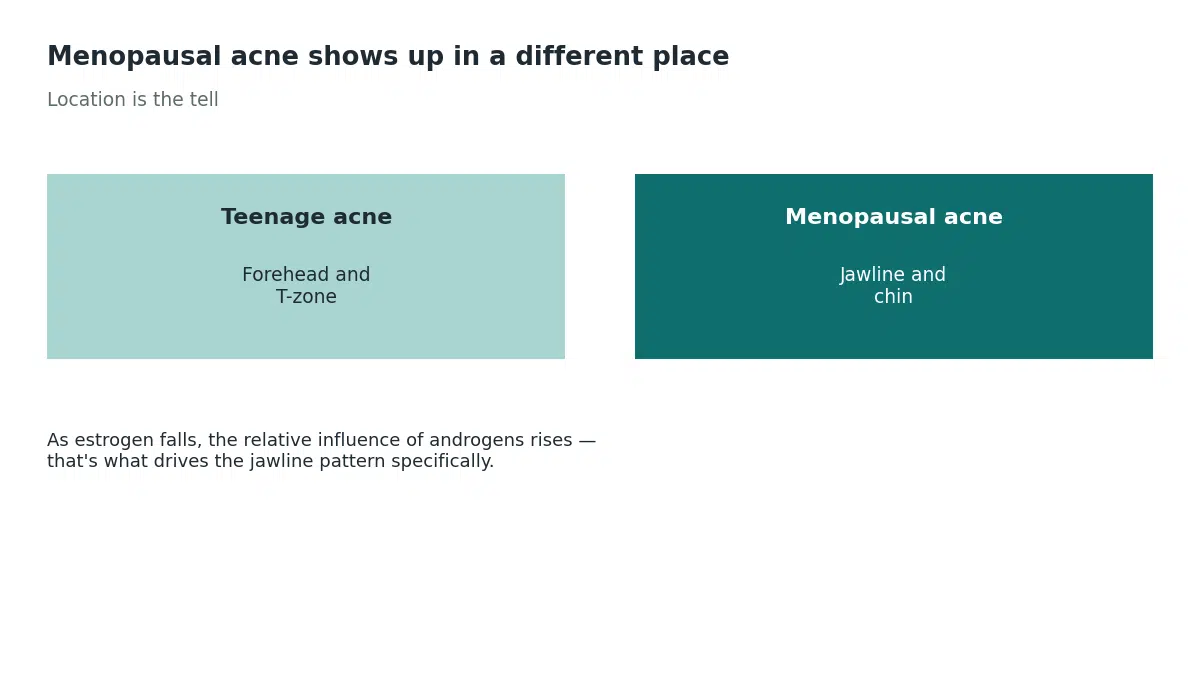
- Menopausal acne appears along the jawline and chin, unlike teenage acne’s forehead pattern — driven by rising relative androgen influence.
- Retinoids and daily sunscreen have the strongest evidence of anything for lines, firmness and pigment.
- Any mole that changes, or a sore that doesn’t heal, needs a dermatologist — not an “it’s just menopause” assumption.
Menopause and Your Skin: What’s Actually Changing
Estrogen supports collagen production, helps skin hold water, regulates oil glands, and maintains the small vessels that feed the skin. When it falls, all four slow at once.
The most-quoted figure comes from research by Brincat and colleagues in 1987: around 30% of skin collagen is lost in the first five years after menopause, followed by roughly 2% per year thereafter.[1]
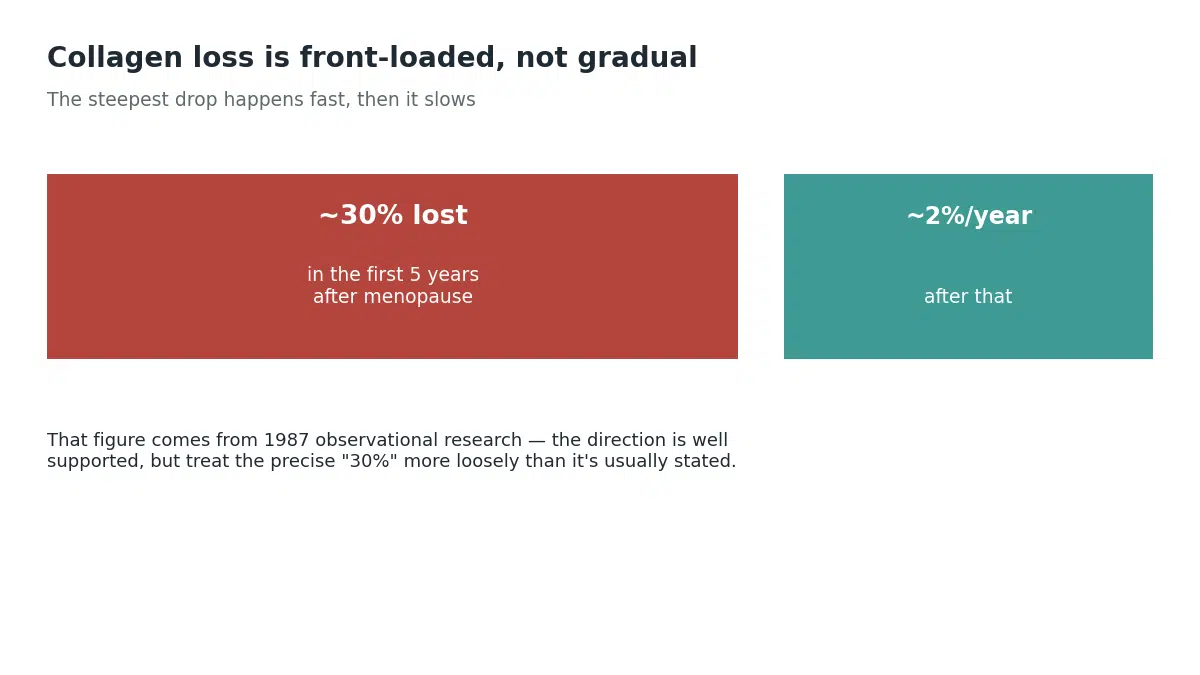
Two honest caveats about that number, because it gets repeated everywhere without them. It comes from older observational work rather than modern imaging studies. And while later research broadly supports the relationship between estrogen and skin collagen, studies of hormone therapy have disagreed about whether treatment reliably increases collagen — at least one found no stimulatory effect at all.
The direction is well established. The precision of “30%” is softer than the confidence with which it’s usually stated.
What that means practically: less collagen means less structural support, so lines deepen and firmness goes. Less oil and less water retention means dryness. And a thinner barrier means more sensitivity to products you tolerated for years.
What Isn’t Just Menopause
Skin cancer risk rises with age and accumulated sun exposure, and these changes are easy to file under “aging”:
- Any mole that changes size, shape or color, or starts to itch, bleed or crust
- A new growth or sore that doesn’t heal within a few weeks — particularly a pearly bump or a rough scaly patch
- A spot that looks different from all your others
- Rapid, one-sided or asymmetric change rather than the gradual, even change of aging
- Sudden hair loss, or hair loss with scalp scarring
Don’t assume a new dark patch is an age spot. Get it looked at.
The Changes You’ll Notice
Dryness is usually first — skin tight after washing, makeup sitting badly, flaking around the nose. Less sebum and less water retention together.
What helps: swap foaming cleansers for cream or oil-based ones. Use a richer moisturizer than you used to, containing ceramides and hyaluronic acid, applied while skin is still damp.
Lines and loss of firmness from the collagen change — a softer jawline, flatter cheeks, deeper lines around eyes and mouth.
What helps: a retinoid, and daily sunscreen. Nothing else comes close on evidence.
Adult acne, which surprises people. As estrogen falls, the relative influence of androgens rises, and that stimulates oil production. The distribution is the tell: jawline and chin, rather than the forehead of teenage acne.[2]
What helps: gentle cleansing rather than aggressive washing, non-comedogenic products, salicylic acid. If eight weeks of over-the-counter treatment does nothing, prescription options including topical retinoids or hormonal treatment work well.
If months of treatment still change nothing, it is worth asking whether the diagnosis is right at all. Fungal acne can look almost identical to hormonal acne and responds to neither antibiotics nor hormonal treatment, and three clues separate the two.
If you’re already left with marks, our guide to treating acne scars covers which are permanent and which fade.
Thinner skin that bruises and tears more easily, with veins more visible on the hands.
Nails that split and peel at the same time, since the same drop in estrogen affects them. Fragility rises sharply after 60, but most of it still comes down to water exposure rather than hormones — our guide to what causes brittle nails goes through the causes worth checking and the one nail change that needs a doctor.
Dark spots and uneven tone, mostly old sun damage becoming more visible as skin thins, plus some hormonal pigment change.
What helps: sunscreen above all, then vitamin C, niacinamide or an AHA. Prescription hydroquinone works for stubborn cases but isn’t for indefinite use — prolonged use can cause ochronosis, a blue-black discoloration that’s hard to reverse.
New sensitivity — products that were fine for years now sting, and the face flushes more easily.
What helps: fewer products, fragrance-free, no alcohol-based toners or scrubs, patch-test anything new. If flushing and redness persist, that may be rosacea rather than sensitivity — it commonly appears or worsens around this time and is treated quite differently.
Menopause and Your Skin: A Routine That Works
You don’t need twelve steps. You need four things done consistently.
Morning: gentle cleanser, vitamin C serum on slightly damp skin, richer moisturizer, then sunscreen — SPF 30 minimum, broad spectrum, every day without exception. Sunscreen is doing more for collagen preservation than everything else combined.
Evening: cleanse properly to remove sunscreen, then your retinoid, then moisturizer.
Start the retinoid slowly. A pea-sized amount for the whole face, two or three nights a week, building as tolerated. Expect some redness and flaking for the first few weeks — that’s adaptation, not damage. If it’s too much, apply moisturizer first and the retinoid on top, which buffers it.
And include your neck and the backs of your hands. Both show these changes and both get consistently forgotten.
The ingredients with real evidence
- Retinoids — the strongest evidence by a distance, with decades of research on collagen stimulation and reversing photoaging.[4] Over-the-counter retinol or prescription tretinoin.
- Sunscreen — prevention rather than repair, and the highest-value habit on this page.
- Vitamin C — supports collagen synthesis and fades pigment.
- Niacinamide — barrier support, less redness, gradual pigment improvement, tolerated by nearly everyone.
- Hyaluronic acid and ceramides — hydration and barrier repair. They don’t build collagen, but comfortable skin is most of what people actually want.
- Peptides — plausible, less evidence than retinoids. Reasonable if retinoids irritate you.
Give any of it eight to twelve weeks before judging. Switching products every couple of weeks is the commonest reason people conclude nothing works.
Hair Changes Too — In Both Directions
The same shift thins scalp hair while sometimes prompting coarser hair on the chin and upper lip. Follicles miniaturize, the growth phase shortens, and the relative androgen influence rises.
Minoxidil has the best evidence for female pattern hair loss, supported by placebo-controlled trials.[3] It takes four to six months, and the effect stops when you stop.
Before assuming it’s hormonal, rule out the treatable causes — iron deficiency and thyroid disease both cause hair loss and both are found with a blood test. That’s worth doing before spending on treatment, and the same two tests apply if your nails have turned fragile alongside your hair.
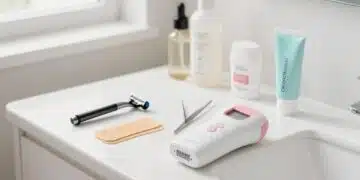
For unwanted facial hair, our guide to hair removal options covers the choices in detail.
Sudden hair loss, patchy loss, or loss with a sore or scarred scalp needs a dermatologist rather than a product.
Four Things That Aren’t True
“You need to keep switching products.” Skin doesn’t build tolerance to a moisturizer. What feels like a product stopping work is usually your skin reaching a new baseline. Constant switching irritates and makes it impossible to know what helped.
“Natural is safer.” Plenty of botanical extracts are potent irritants, and several essential oils are among the commonest causes of contact dermatitis. Judge by the ingredient and the evidence, not the label.
“Drinking more water fixes dry skin.” Adequate hydration matters generally, but dry skin is a barrier problem — water leaving through a compromised barrier faster than it’s replaced. That’s fixed topically, not by the eighth glass.
“Expensive works better.” Price tracks packaging and marketing far more reliably than it tracks active ingredients or concentrations.
What Else Genuinely Helps
Stopping smoking — it constricts the vessels feeding the skin and directly impairs collagen production. Nothing you apply compensates for it.
Sun protection beyond sunscreen — shade and a hat in the middle of the day, since that’s when most cumulative damage happens. Our guide to summer skincare mistakes covers the application errors that undermine it.
Sleep, because repair happens during it. Poor sleep also worsens under-eye shadows, which thinning skin already makes more visible.
Eating well and exercising support skin as they support everything else — real but modest, and no substitute for sunscreen and a retinoid.
On collagen supplements: the trial evidence is mixed, and a 2025 meta-analysis found the skin benefit appears mainly in industry-funded studies. Not a scandal, not a miracle.
Common Questions About Menopause and Your Skin
Why did my skin change so suddenly?
The change genuinely is faster than ordinary aging, so it isn’t your imagination.
Why am I getting acne at 50?
If eight weeks of over-the-counter treatment doesn’t help, prescription options work well. If months of treatment change nothing, it is worth checking whether it is fungal acne rather than hormonal acne.
Does HRT help with menopause and your skin?
It isn’t prescribed for skin alone — that’s a conversation about your wider symptoms with your doctor.
Do collagen supplements work?
Retinoids and sunscreen have far stronger support for the same money.
My skin suddenly reacts to everything. What changed?
Persistent flushing and redness may be rosacea, which needs different treatment.
How long before I see results?
Take a photograph at the start, because gradual change is invisible to the person looking daily.
The Bottom Line on Menopause and Your Skin
The changes are hormonal, they’re front-loaded into the first few years, and they aren’t a failure of your routine.
Sunscreen daily, a retinoid at night, a richer moisturizer, and eight to twelve weeks of patience covers most of what’s achievable at home.
And keep an eye on individual spots rather than only the overall picture — a mole that changes is the one thing here that shouldn’t wait.
SOURCESOur Editorial Standards
HealthMagHub is built on primary sources: peer-reviewed research, clinical practice guidelines, and health agencies such as the NIH, CDC, and FDA. Read our editorial standards to see how we research, cite, and update our articles.
- Brincat M, Kabalan S, Studd JW, Moniz CF, de Trafford J, Montgomery J. A Study of the Decrease of Skin Collagen Content, Skin Thickness, and Bone Mass in the Postmenopausal Woman. Obstetrics & Gynecology, 1987. pubmed.ncbi.nlm.nih.gov
- Khunger N, Mehrotra K. Menopausal Acne — Challenges and Solutions. International Journal of Women’s Health. pmc.ncbi.nlm.nih.gov
- Lucky AW, et al. A Randomized, Placebo-Controlled Trial of 5% and 2% Topical Minoxidil Solutions in the Treatment of Female Pattern Hair Loss. Journal of the American Academy of Dermatology. jaad.org
- Balado-Simó P, et al. An Updated Review of Topical Tretinoin in Dermatology: From Acne and Photoaging to Skin Cancer. Journal of Clinical Medicine, 2025. ncbi.nlm.nih.gov
Disclaimer: This article is general information, not medical advice. See a dermatologist promptly for any mole that changes, a growth that doesn't heal, or sudden hair loss. Discuss hormone therapy with your own doctor — it is not prescribed for skin changes alone.