

Numbness in mouth can catch you off guard. Sometimes it’s harmless — triggered by eating certain foods or sitting in the dentist’s chair. Other times it’s your body flagging something that needs attention today, not next week. The tricky part is telling which is which, and that’s what the rest of this article is for.
Read This First: When Mouth Numbness Is an Emergency
Call 911 right away if numbness in mouth or face came on suddenly and affects one side only — even if that numbness is the only symptom you have, and even if it has already worn off.
Sudden one-sided numbness can be a stroke. Most people picture a drooping face or slurred speech, but a stroke doesn’t have to look like that. Some strokes cause changed sensation and nothing else. Waiting for a “real” stroke symptom to show up is how people miss the treatment window.
Also call 911 if your tongue, lips, or throat are swelling, or you’re struggling to breathe or swallow. If you carry an epinephrine auto-injector, use it first, then call.
Note the time your symptoms started and tell the dispatcher. That timestamp decides which treatments doctors can offer you.
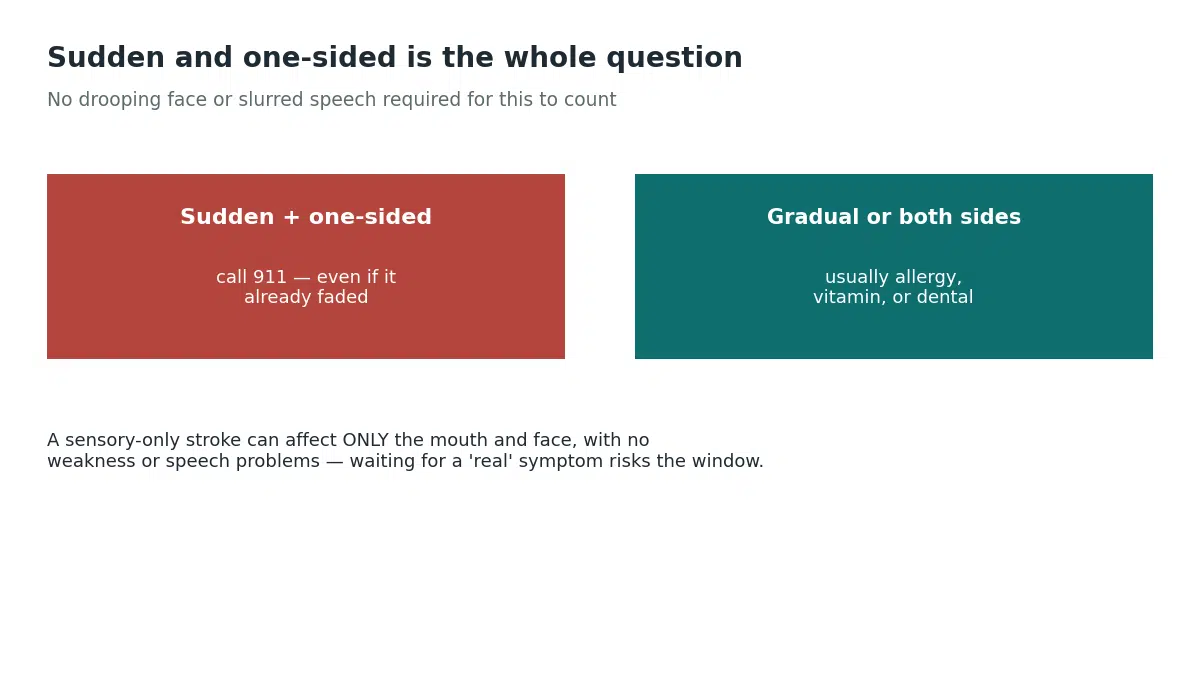
- Sudden numbness affecting one side of your mouth or face is a 911 call on its own — you do not need face drooping or slurred speech alongside it for a stroke to be the cause
- Rapid swelling of the tongue, lips, or throat, or any trouble breathing or swallowing, means anaphylaxis until proven otherwise: use epinephrine if you have it, then call 911
- New numbness limited to the chin and lower lip deserves prompt medical evaluation, because it can point to a problem in the jaw bone or elsewhere in the body
- Common and far less worrying causes include oral allergy syndrome from raw fruits, dental anesthesia, vitamin deficiencies, and medication side effects
- Low vitamin B12, folate, or calcium levels can cause persistent numbness in the tongue and mouth, and blood tests check these easily
- See a doctor if numbness lasts more than a few hours without a clear cause, keeps returning, or arrives with other new symptoms
Serious Causes of Numbness in Mouth: What to Rule Out First
Most mouth numbness turns out to be something minor. But a few causes need action within minutes or hours, so it’s worth checking these against your symptoms before you read anything else.
Stroke: Why One-Sided Numbness Alone Counts
Sudden numbness on one side of your mouth, lips, tongue, or face can be a stroke. A stroke happens when blood flow to part of your brain is cut off, and the brain regions that handle facial sensation can be affected on their own, without touching the areas that control movement or speech.
Doctors call this a pure sensory stroke. It’s not exotic — sensory-only strokes make up a meaningful share of small-vessel (lacunar) strokes, and a small but real percentage of all ischemic strokes show up first as numbness in the face or mouth rather than weakness. There’s even a recognized pattern called cheiro-oral syndrome, where numbness hits the area around the mouth and the hand on the same side, with nothing else wrong.
So the rule is simple. Sudden plus one-sided equals call 911. Face drooping, arm weakness, slurred speech, confusion, sudden vision trouble, severe headache, dizziness, or trouble walking all make it more urgent still — but their absence does not make it safe.
Time is the whole game with stroke. Clot-dissolving treatment and clot removal both work on a clock measured in hours from when symptoms began, which is why the single most useful thing you can tell a dispatcher is what time it started. If you woke up with it, say when you were last known to be normal.
One more trap: symptoms that go away. Numbness that resolves after a few minutes can be a transient ischemic attack, a warning stroke. The American Stroke Association treats a TIA as an emergency, not a false alarm, because the risk of a full stroke in the following days is high. Don’t cancel the ambulance because you feel better.
Anaphylaxis: A Swelling Airway
An allergic reaction causing rapid swelling of your tongue, lips, or throat is anaphylaxis, and it’s a medical emergency.
Unlike oral allergy syndrome, which causes mild tingling and stays put, anaphylaxis makes breathing or swallowing difficult. Your tongue or throat can swell enough to narrow your airway. The numbness here is a side effect of swollen tissue pressing on nerves — the swelling is the dangerous part.
What to do: if you have an epinephrine auto-injector, use it immediately, into the outer thigh, before anything else. Then call 911. Lie down with your legs raised unless breathing is easier sitting up. Go to hospital even if the injector works, because symptoms can return hours later.
Common triggers include peanuts, tree nuts, shellfish, insect stings, and medications. Antihistamines are not a substitute for epinephrine in a reaction involving the airway.
Numbness Limited to Your Chin and Lower Lip
There’s a specific pattern doctors take seriously: numbness confined to the chin and lower lip on one side, with no dental work to explain it. It’s known as numb chin syndrome.
Sometimes the cause is benign — a dental infection, a cyst, or nerve irritation after an extraction. But because the nerve involved runs through the jaw bone, this pattern can also be the first sign of a growth in the jaw or of cancer that has spread from elsewhere in the body. It has also been reported as the presenting sign of a small stroke.
None of that means the worst case is likely. It means this particular pattern shouldn’t be watched and waited on. If your chin and lower lip go numb without an obvious dental explanation, book an appointment promptly rather than giving it a few weeks.
Very Low Blood Calcium
Tingling around the mouth and in the fingertips is a classic sign of low blood calcium, which can follow thyroid or parathyroid surgery, severe vitamin D deficiency, or kidney disease.
Mild cases just need testing and supplements. But severe hypocalcemia can cause muscle spasms, seizures, and heart rhythm problems, so numbness around the mouth paired with muscle cramping, twitching, confusion, or palpitations needs same-day medical care rather than a routine appointment.
Multiple Sclerosis and Nerve Compression
Multiple sclerosis is a condition where the immune system attacks the protective coating around nerves, and it can cause tingling or numbness in the mouth among many other symptoms.
MS numbness typically comes and goes in episodes lasting days or weeks. It rarely shows up as mouth numbness alone — most people also have vision problems, weakness, balance trouble, or numbness elsewhere. Recurring unexplained numbness in different places at different times is worth a neurological evaluation.
Growths, cysts, or swelling in the jaw, sinuses, or base of the skull can press on the nerves supplying your mouth. Diabetes damages nerves throughout the body over years, including in the mouth. If you have diabetes and develop new numbness anywhere, tell your doctor rather than assuming it’s expected.
Migraine With Aura
Some people get numbness and tingling as part of a migraine aura, the warning phase before the headache. It often starts in a hand, creeps up the arm to the face, and affects the mouth and tongue on one side, typically lasting 20 to 60 minutes before fading completely.
Here’s the catch. Migraine aura and stroke can look nearly identical in the moment. If this is your first episode, or if it feels different from your usual pattern, treat it as a possible stroke and get emergency evaluation. Only after a doctor has established the pattern is it reasonable to ride one out at home.
What Is Numbness in Mouth?
Numbness in mouth means you’ve lost normal feeling in your lips, tongue, gums, or the inside of your cheeks. The medical term is oral paresthesia.
Your mouth might feel tingly, like pins and needles pricking your tongue. Or you might have no sensation at all in certain spots. This happens when something interferes with the nerves carrying sensation from your mouth to your brain.
Your mouth holds thousands of nerve endings that normally report temperature, touch, pain, and taste. When those nerves get irritated, compressed, or damaged, the signals get scrambled.
Some people describe fuzziness on the tongue. Others say their lips feel thick and swollen even though they look completely normal. You might struggle to tell whether food is hot or cold.
How Mouth Sensation Normally Works
Your mouth has more nerve endings per square inch than almost anywhere else on your body. The trigeminal nerve does most of the work, with three branches covering your upper jaw, lower jaw, and the area around your eyes and forehead.
These nerves fire constantly. Bite your tongue and they report the pain instantly. Sip cold water and different fibers report the temperature. The system works so well you never think about it, which is exactly why numbness feels so unsettling.
Why Location Matters
Numbness isn’t a sensation in itself. It’s the absence of one. Some people feel tingling because nerves are firing randomly; others feel nothing because signals aren’t getting through at all.
Where you feel it tells doctors a great deal. Numbness in half your tongue points to one nerve branch. Numbness across your whole mouth suggests something affecting multiple nerves or your whole system. Numbness on one side of the face, involving mouth and cheek together, raises the question of the brain rather than the mouth.
Before you call your doctor, map it out with a fingertip. Which exact areas are numb, and is it strictly one side? That answer shapes everything that follows.
Common Causes of Mouth Numbness
With the emergencies ruled out, most oral numbness traces back to a short list of ordinary culprits.
Oral Allergy Syndrome
This tops the list for people who get mouth tingling after eating. Oral allergy syndrome happens when your immune system confuses proteins in raw fruits or vegetables with pollen proteins. If you have hay fever, you’re far more likely to develop it.
The reaction starts within minutes. Your lips tingle or itch. Your tongue might feel swollen even though it looks normal. The roof of your mouth or your throat may feel scratchy. Common triggers are raw apples, cherries, peaches, melons, carrots, and celery.
Here’s the useful part: cooking usually prevents the reaction, because heat breaks down the proteins your immune system objects to. Raw apple causes symptoms; apple pie doesn’t.
Dental Procedures and Anesthesia
Your mouth feels numb after dental work because that’s the point. Local anesthetics like lidocaine block nerve signals temporarily so you don’t feel pain. This numbness is normal and expected.
It usually wears off within two to four hours. Your lips might feel huge and clumsy. You might drool without noticing. Skip hot food until feeling returns, since you can’t sense temperature and could burn yourself.
Occasionally an injection irritates a nerve directly and numbness lasts longer. This usually resolves on its own but can take days or weeks. If numbness persists more than 24 hours after dental work, call your dentist.
Vitamin Deficiencies
Your nerves need specific vitamins to work. Run low and nerve problems follow.
Vitamin B12 deficiency commonly causes numbness and tingling in the mouth, especially the tongue. Your tongue may look smooth and red instead of its normal slightly bumpy texture. Low folate can do something similar. Low calcium causes tingling around the mouth and in the fingertips.
These develop slowly, so the numbness creeps in gradually rather than arriving suddenly. That gradual onset is itself a reassuring sign.
Higher risk groups include vegetarians and vegans, since B12 comes mainly from animal products; older adults, who absorb it less efficiently; and people with digestive conditions affecting absorption. Blood tests settle the question quickly.
Medications That Affect Sensation
Several medications list mouth numbness or tingling as a side effect. The seizure and migraine drug topiramate is a frequent offender, causing tingling in the mouth and hands. Some blood pressure medicines can contribute. Chemotherapy drugs damage nerves throughout the body, mouth included. Certain antibiotics trigger temporary numbness.
If you started a new medication and numbness followed, mention the timing to your doctor. They may adjust the dose or switch you. Never stop a prescribed medication on your own — some cause serious problems when discontinued abruptly.
Burning Mouth Syndrome
Despite the name, burning mouth syndrome doesn’t always burn. Some people experience numbness instead.
The cause isn’t fully understood, but it appears to involve nerve dysfunction in the mouth. It typically affects the tongue tip and roof of the mouth, and it’s more common in women after menopause. There’s usually nothing visible to see, which makes it a diagnosis of exclusion.
Injury to Your Mouth or Jaw
Trauma damages nerves directly. Biting your tongue hard, taking a hit to the jaw, or having a tooth pulled can all injure them.
Wisdom tooth removal sometimes affects the nerve running through the lower jaw, causing numbness in the lower lip, chin, or tongue on that side. Most injury-related numbness improves as nerves heal, though recovery can take weeks to months. If it isn’t improving within a few weeks, see an oral surgeon who handles nerve problems.
When to See a Doctor About Numbness in Your Mouth
Here’s how to sort your own symptoms into the right level of urgency.
See a Doctor Within a Day or Two If
- Numbness has lasted more than a few hours with no obvious cause
- Numbness is limited to your chin and lower lip and you’ve had no recent dental work
- Symptoms began after starting a new medication
- Numbness keeps returning over days or weeks
- You also have extreme tiredness, weakness, or vision changes
- Numbness started after dental work and has lasted more than 24 hours
- You have diabetes and have developed new numbness anywhere
Make a Routine Appointment If
- You get mild tingling every time you eat certain raw fruits or vegetables
- Your tongue looks unusually smooth or feels different
- Mouth numbness happens occasionally with no identifiable trigger
- You want to discuss whether symptoms might relate to a vitamin deficiency
What Your Doctor Will Check
Expect detailed questions first. When did it start? Sudden or gradual? Exactly where? Constant or intermittent? Any recent dental work, injuries, new medications, or diet changes?
The physical exam includes testing sensation in different parts of your mouth, checking how your tongue moves, and inspecting your gums and cheeks.
A neurological exam covers balance, coordination, eye movements, and facial muscle strength. Blood tests typically check vitamin B12, folate, calcium, vitamin D, blood sugar, and thyroid function.
Depending on what turns up, you might need an MRI to look for nerve damage, a growth, or signs of MS, or a CT scan if stroke is suspected. Nerve conduction studies measure how well signals travel through specific nerves.
Understanding Oral Allergy Syndrome
Since oral allergy syndrome causes so much of the mouth tingling people worry about, it’s worth understanding properly.
Why Your Immune System Gets Confused
If you have hay fever, your immune system has learned to treat pollen as a threat and built antibodies against specific pollen proteins.
Some proteins in raw fruits and vegetables happen to be shaped similarly. When those foods touch your mouth, your immune system thinks it’s found pollen and fires off the same reaction you get in allergy season.
That’s why birch pollen allergy so often pairs with reactions to apples, cherries, and hazelnuts, and ragweed allergy with melons and bananas. The cross-reactions follow predictable patterns, which the American College of Allergy, Asthma & Immunology maps out in detail.
Common Food Triggers
| Pollen Allergy | Common Food Triggers | Typical Symptoms |
| Birch | Apples, cherries, peaches, pears, plums, kiwi, carrots, celery, hazelnuts, almonds | Tingling lips and tongue, itchy mouth, mild throat irritation |
| Ragweed | Melons, bananas, cucumbers, zucchini, sunflower seeds | Itchy palate, tongue numbness, scratchy throat |
| Grass | Tomatoes, melons, oranges, peaches | Mouth tingling, sensation of lip swelling |
| Mugwort | Carrots, celery, parsley, peppers, sunflower | Burning tongue, numb gums |
Managing Oral Allergy Syndrome
Most people don’t need to avoid trigger foods entirely.
Cooking destroys the proteins responsible, so baked apples, cooked carrots, and canned fruit are usually fine. Even microwaving fruit for 30 seconds often does the job. Peeling helps too, since the proteins concentrate near the skin.
Varieties differ. One type of apple might bother you while another doesn’t. A food diary is genuinely useful here — it turns guesswork into a short, specific avoid list.
Some people find antihistamines before eating trigger foods reduce the reaction. Ask your doctor whether that fits your situation, and don’t use it as a way to push through a reaction that’s escalating.
When oral allergy syndrome stops being minor: Oral allergy syndrome normally stays mild and confined to the mouth. If you develop throat tightness, trouble swallowing or breathing, hives on your body, vomiting, or lightheadedness, that’s a systemic allergic reaction, not oral allergy syndrome. Use epinephrine if you have it and call 911. See an allergist for proper testing. You may need an epinephrine auto-injector to carry.
Vitamin Deficiencies and Mouth Numbness
Your nerves depend on specific vitamins to maintain their insulation and transmit signals. When those run low, nerve symptoms follow.
Vitamin B12 Deficiency
B12 is essential for nerve health. Low levels damage the myelin sheath insulating your nerves, and that damage often shows up in the mouth and tongue first.
Your tongue might feel numb, tingly, or sore, and can look unusually smooth and red because B12 deficiency also affects the cells creating its normal texture. Other signs include fatigue, weakness, memory trouble, and numbness or tingling in the hands and feet.
B12 deficiency takes months or years to develop because your body stores it. Once stores run down, symptoms appear. Since this vitamin does far more than nerve maintenance, it’s worth understanding what B12 actually does in the body before deciding whether supplements make sense.
Who’s at risk? Vegetarians and vegans, since B12 comes mainly from animal foods. Older adults, who absorb it less efficiently. People who’ve had stomach surgery or have Crohn’s or celiac disease. And people taking metformin or long-term proton pump inhibitors, both of which interfere with absorption. The NIH Office of Dietary Supplements keeps a detailed breakdown of requirements and interactions.
One important caution: if you’re low in both B12 and folate, taking folate alone can mask the blood changes of B12 deficiency while nerve damage quietly continues. That’s a good reason to get tested rather than self-prescribing a B-complex.
Folate Deficiency
Folate works alongside B12 for nerve health. Low levels can cause mouth numbness, tongue soreness, and mouth ulcers.
It’s less common than B12 deficiency in countries that fortify grain products. Risk goes up during pregnancy, with heavy alcohol use, and with certain cancer treatment drugs.
Calcium and Vitamin D
Calcium does more than build bone — it’s central to nerve signaling. Very low levels cause numbness and tingling, classically around the mouth and in the fingertips, often with leg cramps.
Vitamin D helps you absorb calcium, so low vitamin D can produce the same picture. Insufficiency is common in people living at northern latitudes, spending little time outdoors, or with darker skin, which produces vitamin D more slowly in response to sunlight.
Getting Tested
Simple blood tests measure all of these. Treatment depends on cause and severity: supplements, dietary changes, or in some cases injections. B12 deficiency with nerve symptoms often starts with injections, because they bypass absorption problems and refill stores faster.
Managing Mild Oral Numbness at Home
Once a doctor has ruled out serious causes and you’re dealing with mild, occasional numbness, a few things genuinely help.
For Oral Allergy Syndrome
Keep a food diary noting which foods set you off, and test different varieties of the same fruit. Cook, microwave, or buy canned versions of triggers. Peel fruit before eating. Rinse your mouth with cool water straight after eating a trigger food.
Managing your seasonal allergies well often reduces oral symptoms as a side benefit.
Protecting Your Mouth After Dental Work
While the anesthetic wears off, take care not to bite your tongue, cheek, or lip. Avoid hot food and drink, since you can’t judge temperature. Don’t chew on the numb side, skip hard or crunchy foods, and use a straw if your lips aren’t cooperating.
General Mouth Care
Brush twice daily and floss to prevent infections that could affect nerves. See your dentist regularly and deal with dental problems before they reach bone or nerve. If gum health is on your mind, it’s worth knowing which nutrients actually support healthy gums.
If you have diabetes, tight blood sugar control protects nerves throughout your body, mouth included. When diabetic nerve damage extends to the hands and feet, some people ask about supplements studied for neuropathy pain — a conversation worth having with your doctor rather than acting on alone, since several interact with common medications.
Treatment Depends Entirely on the Cause
There’s no single treatment for mouth numbness, which is why the diagnosis matters more than the symptom.
Vitamin deficiencies respond to supplements or injections, with retesting after several weeks to confirm levels are climbing. Oral allergy syndrome is managed by cooking or avoiding triggers, sometimes with antihistamines, and occasionally improves as a side benefit of allergy immunotherapy.
Nerve damage from diabetes calls for better blood sugar control first, with medications for nerve pain if needed. Compression from a growth or cyst may need surgery. Some nerve damage recovers slowly over months; some is permanent, though the brain often adapts so it bothers you less over time.
If medication is the culprit, your doctor may lower the dose, switch you within the same class, or stop the drug if it isn’t essential. Multiple sclerosis needs disease-modifying treatment. Migraine-related numbness responds to migraine prevention. Burning mouth syndrome is stubborn but sometimes improves with certain antidepressants, anti-seizure medications, or cognitive behavioral therapy.
Reducing Your Risk
You can’t prevent every cause, but several are genuinely modifiable.
Eat well enough to cover B12, folate, calcium, and vitamin D, and supplement deliberately if you’re vegetarian or vegan. Keep blood sugar controlled if you have diabetes, since this protects nerves body-wide. Control blood pressure, which is the single biggest lever on stroke risk. Take chronic medications as prescribed and keep monitoring appointments.
Brush and floss daily, see your dentist regularly, and tell them immediately if numbness develops after a procedure. Wear a mouthguard for contact sports and a seatbelt in the car.
If you have oral allergy syndrome, learn your specific triggers and decide which you’ll cook and which you’ll skip.
Living With Ongoing Numbness
Some people manage persistent numbness from conditions that can’t be fully cured.
The practical risks are burns and bites. Test food temperature with a finger or utensil before eating. Let hot food cool longer than feels necessary, and be careful with things that stay molten inside while cooling outside, like pizza and pot pies. Chew slowly, cut food smaller, and avoid talking while eating.
Keep track of your symptoms and note when they shift. A change from your baseline can signal a new problem or a treatment that needs adjusting, and that record is far more useful to your doctor than trying to remember at the appointment.
Chronic symptoms wear on people. Your mouth is central to eating, speaking, and expressing yourself, and abnormal sensation there is hard to ignore. If it’s affecting your mood or daily life, that’s worth raising with your doctor too, not just the numbness itself.
Oral Numbness in Specific Groups
During Pregnancy
Pregnancy raises your need for folate and B12, so deficiency develops more easily. Prenatal vitamins help prevent this.
Pregnancy also shifts immune function, so oral allergy syndrome symptoms may improve or worsen. New or severe numbness during pregnancy needs evaluation — stroke risk is elevated in pregnancy and the weeks after delivery, so the one-sided rule applies with extra force here.
In Children
Kids struggle to describe numbness. They’ll say their mouth feels “funny” or “weird.”
Oral allergy syndrome often starts in childhood or adolescence in kids who already have pollen allergies, and teaching them their triggers helps them choose safely.
Sudden mouth numbness in a child always needs medical attention. Children have different stroke risk factors than adults, but strokes do happen in children, and the causes of sudden numbness need evaluation regardless of age.
In Older Adults
Aging stacks the risk factors: B12 absorption declines, stroke risk rises, medication lists grow, and dental work becomes more frequent.
Don’t write numbness off as part of getting older. Many causes have effective treatments, and the one cause you can’t afford to miss becomes more likely with every decade.
Frequently Asked Questions About Mouth Numbness
When is mouth numbness a sign of stroke?
This matters because some strokes affect only the brain areas handling sensation, producing numbness with no weakness and no speech problems at all. And if sudden one-sided numbness resolves on its own, still seek emergency care — a warning stroke carries a high risk of a full stroke in the days that follow.
Why does my mouth tingle when I eat raw apples?
It usually stays mild and confined to the mouth. Cooking breaks down those proteins, which is why baked apples cause no trouble.
Can stress cause numbness in your mouth?
But stress should never be your own conclusion before a doctor has looked — physical causes can trigger anxiety about the symptom, creating a loop that’s easy to misread.
How long does numbness last after dental work?
If numbness persists beyond six hours, call your dentist. If it lasts into the next day, call regardless.
Should I worry about numbness in just my chin and lower lip?
Not a reason to panic — a reason to be seen within a few days rather than a few months.
Can vitamin deficiency cause a numb tongue?
The timing is the giveaway: deficiency-related numbness builds gradually over months, not suddenly over minutes.
What medications cause mouth numbness?
Talk to your doctor about adjusting the dose rather than stopping a prescribed medication on your own.
The One Thing to Remember
Most mouth numbness turns out to be minor. Oral allergy syndrome, dental anesthetic, vitamin deficiencies, and medication side effects account for the large majority, and all of them are manageable.
But the sorting question isn’t “how bad does it feel.” It’s “how fast did it come on, and is it one-sided?”
Sudden and one-sided means call 911, full stop — no drooping face required, no slurred speech required, and it still counts if the numbness has already faded. Swelling of the tongue or throat with any breathing difficulty means epinephrine if you have it, then 911.
Everything outside those two situations can wait for a normal appointment. Know which bucket you’re in — that single distinction is worth more than any other information on this page.
SOURCESOur Editorial Standards
HealthMagHub is built on primary sources: peer-reviewed research, clinical practice guidelines, and health agencies such as the NIH, CDC, and FDA. Read our editorial standards to see how we research, cite, and update our articles.
- American Stroke Association. Stroke Symptoms. stroke.org
- National Institute of Neurological Disorders and Stroke. Stroke. ninds.nih.gov
- Isolated Facial Sensory Loss Due to Thalamic Lacunar Infarction. pubmed.ncbi.nlm.nih.gov
- Numb Chin Syndrome Due to Thalamic Infarction. BMC Neurology. link.springer.com
- American College of Allergy, Asthma & Immunology. Pollen Food Allergy Syndrome. acaai.org
- NIH Office of Dietary Supplements. Vitamin B12 Fact Sheet for Health Professionals. ods.od.nih.gov
Disclaimer: This article provides general information about numbness in the mouth and should not replace professional medical advice, diagnosis, or treatment. Always consult a qualified healthcare provider with questions about a medical condition. If you think you may be having a stroke or a severe allergic reaction, call 911 immediately rather than reading further.