


Before anything else: bad breath that persists despite good brushing, flossing and tongue cleaning isn’t a hygiene problem. It’s a signal to see a dentist, because gum disease is the most common reason a mouth stays smelly no matter what you scrape.
- A Cochrane review found sulfur compound reduction of 42% with a tongue cleaner, 40% with a scraper, and 33% with a toothbrush — a small gap, and the effect wears off within hours.
- The main reason a scraper wins over a toothbrush is tolerance: 60% felt nauseated using a toothbrush on the tongue versus everyone tolerating the scraper.
- Roughly 9 in 10 cases of bad breath originate in the mouth, sinuses or tonsils, mostly from sulfur-producing bacteria on the back of the tongue.
- A scraper never reaches gum disease, dry mouth, tonsil stones, sinus drainage or reflux — persistent bad breath despite a clean tongue needs a dentist, not a different tool.
A tongue scraper helps bad breath, but less than the marketing suggests and not for as long as you’d hope.
That’s the honest version, and it’s worth understanding why — because the reason a scraper works also tells you which kinds of bad breath it will never touch.
Where bad breath actually comes from
Roughly nine out of ten cases of bad breath originate in the head — the mouth, sinuses or tonsils. Only about one in ten comes from a systemic cause elsewhere in the body.
Within the mouth, the back of the tongue is the main site. Its surface isn’t smooth. It’s covered in tiny projections with grooves between them, and that texture traps food debris, dead cells and saliva proteins. Bacteria living in those grooves break the proteins down.
The by-products are volatile sulfur compounds: hydrogen sulfide, methyl mercaptan and dimethyl sulfide. These are the same family of molecules that make rotten eggs and drains smell the way they do. Hydrogen sulfide is detectable by the human nose at extraordinarily low concentrations, which is why a small amount of bacterial activity produces a disproportionate smell.
That’s the whole mechanism. Protein plus bacteria plus a surface that holds both equals sulfur gas. Which explains why a tongue scraper does anything at all: it removes the coating the bacteria live in.
How common is bad breath?
Commoner than the embarrassment around it suggests. Estimates put persistent bad breath at somewhere between a quarter and half of people worldwide, depending on how it’s measured and who’s doing the measuring.
That range is wide for a reason. Self-reported bad breath and bad breath confirmed by an assessor or a sulfide monitor give very different numbers, in both directions. Plenty of people who worry about it don’t have it, and plenty who have it have never been told.
Worth holding onto before you spend money on the problem. Step one is establishing whether it’s real, step two is finding the source. The scraper is step three at best.
Does a tongue scraper help bad breath? What the trials found
Here’s where most articles stop being useful, because the honest answer involves a small evidence base.
A Cochrane review examined randomized trials comparing tongue cleaning methods in adults with halitosis. It found only two eligible trials, with 40 participants between them. In one, sulfur compound levels fell by 42% with a tongue cleaner, 40% with a tongue scraper, and 33% with a toothbrush.
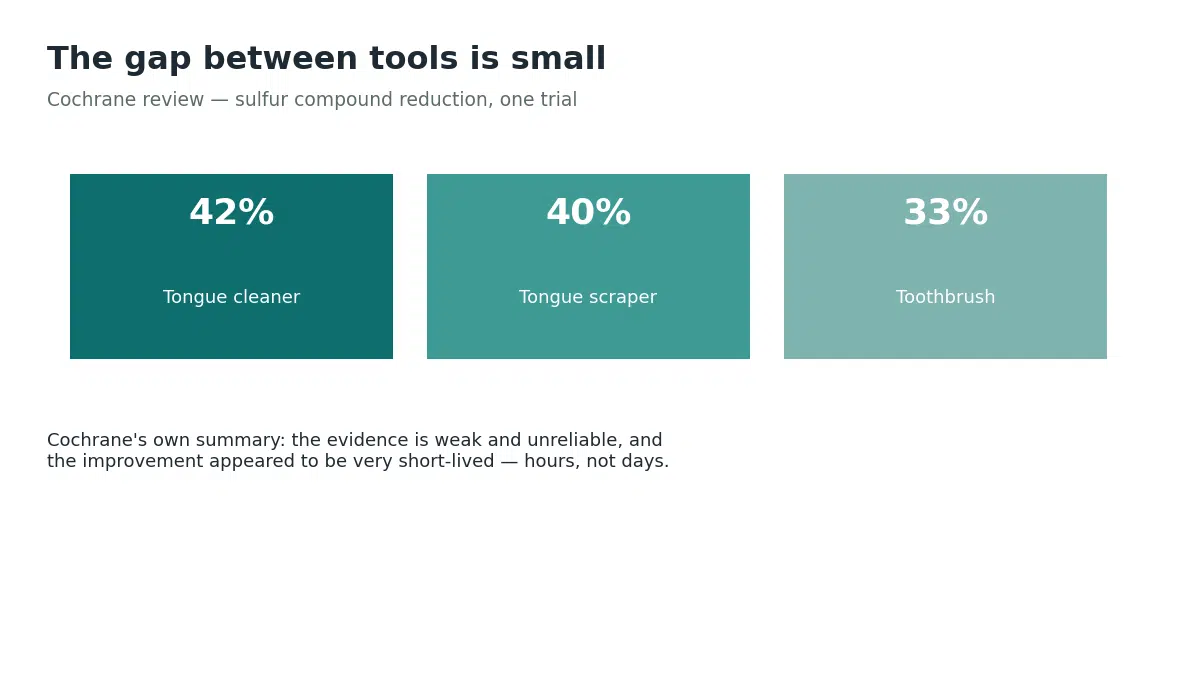
So a scraper beat a toothbrush. But look at the size of that gap. The difference between a dedicated scraper and simply brushing your tongue was a handful of percentage points.
The reviewers’ own summary is worth stating plainly: the evidence is weak and unreliable, and the improvement appeared to be very short-lived.
A separate meta-analysis pooling five randomized trials came out more favorably, finding that brushing plus tongue cleaning reduced sulfur compounds and tongue coating substantially more than brushing alone. A later systematic review concluded that data on chronic, long-standing halitosis specifically remain insufficient.
Put those together and a fair reading emerges. Cleaning your tongue reduces the gases that cause mouth odor. Whether the tool is a scraper or your toothbrush matters less than whether you do it at all. And the effect wears off within hours, because the bacteria are still there and start rebuilding the coating immediately.
Scraper or toothbrush?
Given the trials found so little between them, the practical difference comes down to tolerance.
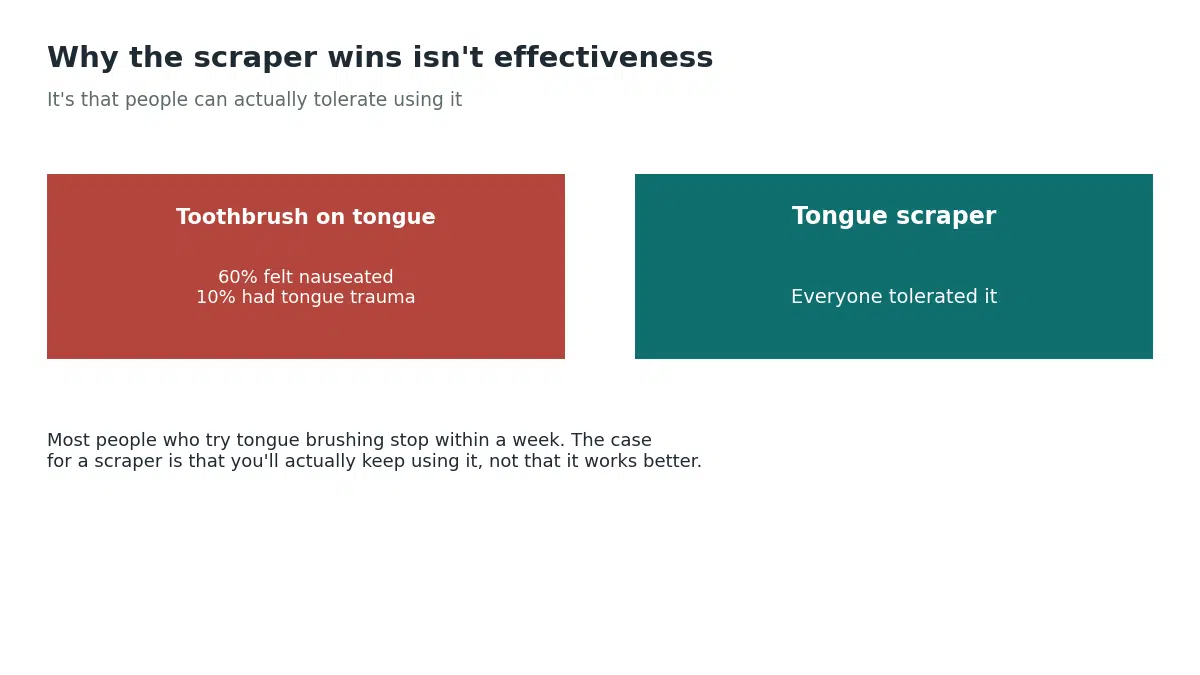
In one of the Cochrane trials, 60% of participants felt nauseated using a toothbrush on the tongue and 10% experienced trauma to the tongue surface. Everyone tolerated the scraper.
That gag reflex isn’t trivial. It’s the reason most people who try tongue brushing stop within a week. A scraper is flatter, needs less depth of insertion to reach the back of the tongue, and comes away cleaner.
So the case for a scraper isn’t that it’s dramatically more effective. It’s that you’re more likely to keep using it.
How to use a tongue scraper without gagging
Technique matters more than the device.
- Do it before brushing, not after, so you aren’t spreading the coating around a freshly cleaned mouth.
- Start further forward than you think and work backwards over several passes. Going straight for the very back on the first stroke is what triggers the reflex.
- Use light pressure. You’re lifting a film, not sanding a surface. Scraping until the tongue is sore or bleeding damages the taste buds and achieves nothing extra.
- Rinse the scraper between strokes. Four or five passes covering the middle and both sides is enough.
- Exhale slowly through your mouth as you reach the back. It sounds like folklore but it genuinely dampens the gag reflex.
Once a day is sufficient. Morning is the logical time, because the coating builds overnight when saliva flow drops.
What the coating on your tongue actually is
A pale film across the tongue is normal. Everyone has one, and its thickness varies through the day.
It gets heavier when saliva flow is low, which is why it’s thickest on waking. Smoking thickens it. So does a soft diet, because coarse food physically abrades the tongue surface as you eat and soft food doesn’t. Dehydration thickens it. Mouth breathing at night thickens it.
Thickness matters because the amount of coating tracks the amount of sulfur gas produced. That’s the finding underneath the meta-analysis above: cleaning reduced both the coating and the gases together.
A few coatings aren’t ordinary debris and shouldn’t simply be scraped. A thick white coating that wipes off leaving a raw, red or bleeding surface can be oral thrush, which needs antifungal treatment rather than mechanical removal. A patch that won’t come off at all — particularly a white or red one persisting more than a couple of weeks — should be looked at by a dentist. Neither of those is a bad breath problem.
What tongue scraping will not fix
This is the part that matters most, and the part a product page will never tell you.
- Gum disease. Bacteria in periodontal pockets below the gumline produce the same sulfur compounds, and no amount of tongue cleaning reaches them. If your gums bleed when you brush, that’s where the smell is coming from — receding gums are worth taking seriously for the same reason.
- Dry mouth. Saliva is the mouth’s natural rinse. When it drops, odor rises. This is why morning breath exists, and why medications that dry the mouth — antihistamines, antidepressants, many blood pressure drugs — so often produce bad breath as a side effect.
- Tonsil stones. Small calcified deposits in the tonsil crypts, intensely smelly, entirely out of reach of a scraper.
- Sinus and post-nasal drip. Mucus draining down the back of the throat feeds the same bacteria continuously.
- Reflux. Stomach contents reaching the throat carry their own odor and irritate the tissue.
- Systemic causes. Uncontrolled diabetes produces a sweet, acetone-like breath. Advanced liver or kidney disease produce their own characteristic smells. Uncommon — but the reason persistent unexplained bad breath deserves a medical opinion rather than a stronger mouthwash.
What about mouthwash?
Most mouthwash masks. Some genuinely reduces the gases.
The ones with evidence behind them contain zinc, chlorhexidine or cetylpyridinium chloride, which either bind sulfur compounds or reduce the bacteria producing them. A crossover trial found a zinc lactate rinse combined with tongue scraping outperformed brushing alone on both measured sulfur levels and how the breath actually smelled to an assessor.
Alcohol-based rinses are worth avoiding if dryness is part of your picture. They give a strong clean sensation and then leave the mouth drier than before, which is counterproductive.
Mints and chewing gum do nothing to the bacteria. Sugar-free gum has one real benefit: chewing stimulates saliva. If you’re also chasing a brighter smile, whitening is a separate question with its own evidence problems.
How to tell whether you actually have bad breath
Cupping your hand and breathing into it doesn’t work. You can’t smell your own breath, because you’ve adapted to it.
Two better methods: lick the inside of your wrist, let it dry for ten seconds and smell it. Or draw a clean plastic spoon along the back of your tongue and smell the residue after a moment.
If both come back fine but you remain convinced otherwise, that’s worth mentioning to a dentist too. Persistent belief in bad breath that others can’t detect is a recognized condition, and it’s treated very differently from the real thing.
The one thing to take away
A tongue scraper is cheap, safe, takes ten seconds and modestly reduces the compounds that cause mouth odor. That makes it worth owning.
It isn’t a treatment for bad breath. It’s maintenance. If the smell keeps coming back despite a clean tongue, the answer is almost certainly in your gums, your saliva, your sinuses or your medication list — and the useful next step is an appointment rather than a different scraper.
SOURCESOur Editorial Standards
HealthMagHub is built on primary sources: peer-reviewed research, clinical practice guidelines, and health agencies such as the NIH, CDC, and FDA. Read our editorial standards to see how we research, cite, and update our articles.
- Outhouse TL, Al-Alawi R, Fedorowicz Z, Keenan JV. Tongue scraping for treating halitosis. Cochrane Database of Systematic Reviews
- Van der Sluijs E et al. Effectiveness of mechanical tongue cleaning on breath odour and tongue coating: a systematic review. PubMed
- Efficacy of a Zinc Lactate Mouthwash and Tongue Scraping in the Reduction of Intra-Oral Halitosis: a single-blind, controlled, crossover clinical trial. PMC