
Most articles listing natural ways to whiten teeth include at least two things the American Dental Association specifically warns against — and one of them can make your teeth look yellower over time.
So this page splits them properly: what has evidence behind it, what’s harmless but overstated, and what to avoid outright.
The general rule worth carrying into all of it: home methods remove surface stains. They don’t change the underlying color of your teeth, and anything promising otherwise is either exaggerating or damaging enamel to create the illusion.
- Home whitening only removes surface stains — it never changes the underlying color of your teeth, which is set by the dentin beneath the enamel.
- Lemon, vinegar and other acidic remedies are classified as fiction by the ADA: they etch and demineralize enamel, which does not grow back.
- No charcoal product has earned the ADA Seal of Acceptance; one study found charcoal-and-salt abrasive, ineffective, and a cause of a yellow cast and abrasion cavities.
- A single tooth darkening, grey or brown tones, or translucent edges on front teeth need a dentist rather than a home remedy.
Natural Ways to Whiten Teeth: What Actually Has Evidence
Baking soda
This is the one with genuine support. Sodium bicarbonate is a low-abrasion agent that lifts surface stains, and it’s low enough on the abrasivity scale that plenty of ADA-accepted toothpastes contain it. It also raises oral pH, which works against the bacteria that contribute to discoloration.
The straightforward way to use it is simply to buy a toothpaste containing baking soda and fluoride, which gives you the stain removal plus cavity protection in one step.
If you’d rather mix your own: a paste of baking soda and water, brushed gently with a soft brush for two minutes, two or three times a week rather than daily. Use light pressure — the abrasive does the work, and scrubbing hard is what causes wear.
Dilute hydrogen peroxide, carefully
Peroxide is the active ingredient in professional whitening, so the chemistry is real. At home the margin for error is narrower.
Standard 3% drugstore hydrogen peroxide, diluted half-and-half with water, used briefly as a rinse and then spat out, is the version most dentists consider reasonable. Don’t swallow it, don’t hold it against your gums, and stop if anything stings or whitens the gum tissue.
One thing to be clear about: so-called food-grade hydrogen peroxide is typically 35% — roughly twelve times the strength of the drugstore bottle — and is caustic. It causes chemical burns to mouth and throat tissue and has caused serious injury when ingested. It should never go anywhere near your mouth, diluted or otherwise. If you want peroxide whitening at a meaningful strength, that belongs in a dental setting with your gums protected.
Whitening toothpaste with the ADA Seal
Not glamorous, but it’s the same mechanism as the baking soda paste with better-controlled abrasivity and added fluoride. For most people it’s the sensible default.
What to Avoid — and Why
Acidic remedies: lemon, vinegar, fruit rubs
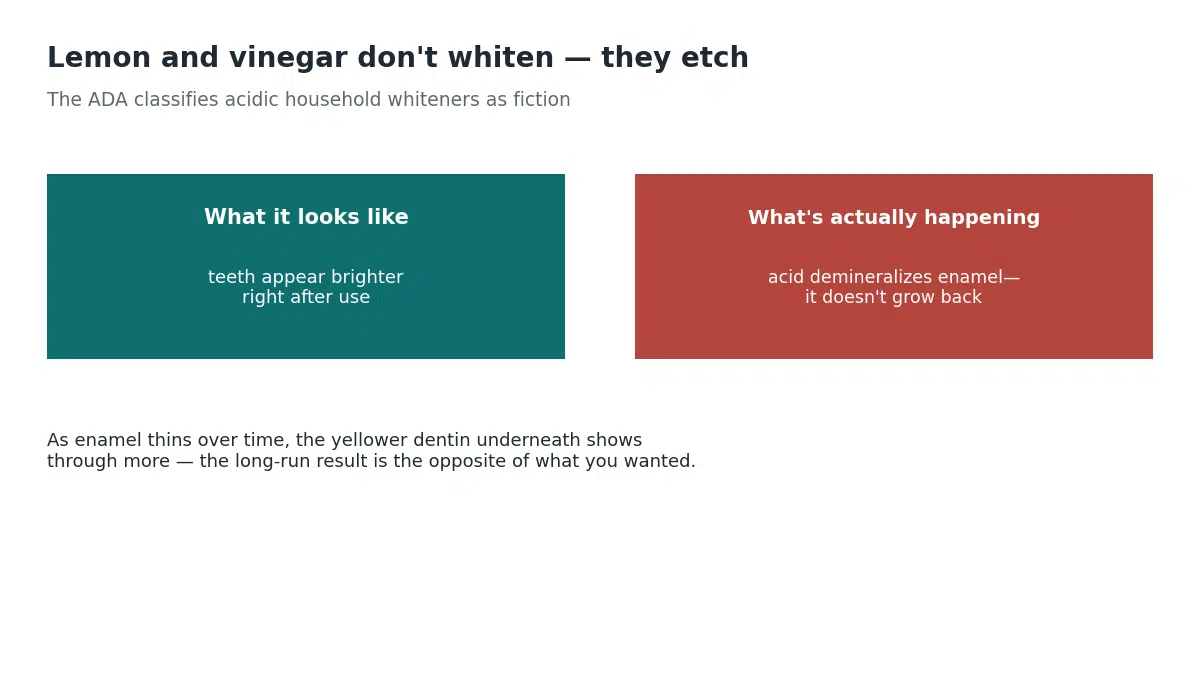
The ADA classifies the whole category of acidic household whiteners — lemon, orange, apple cider vinegar — as fiction. Their point is direct: acid wears away enamel, and prolonging its contact with teeth or using it to scrub them puts your enamel at risk.
Here’s the trap. Acid etching does make teeth look temporarily brighter, because it roughens and demineralizes the surface. What you’re seeing isn’t stain removal — it’s enamel being dissolved. And enamel doesn’t grow back. As it thins, the yellower dentin underneath shows through more, so the long-run result is the opposite of what you wanted.
Eat the fruit. Don’t rub it on your teeth.
Activated charcoal
No charcoal product has earned the ADA Seal of Acceptance, and the ADA’s own review describes the evidence for these products as insufficient.
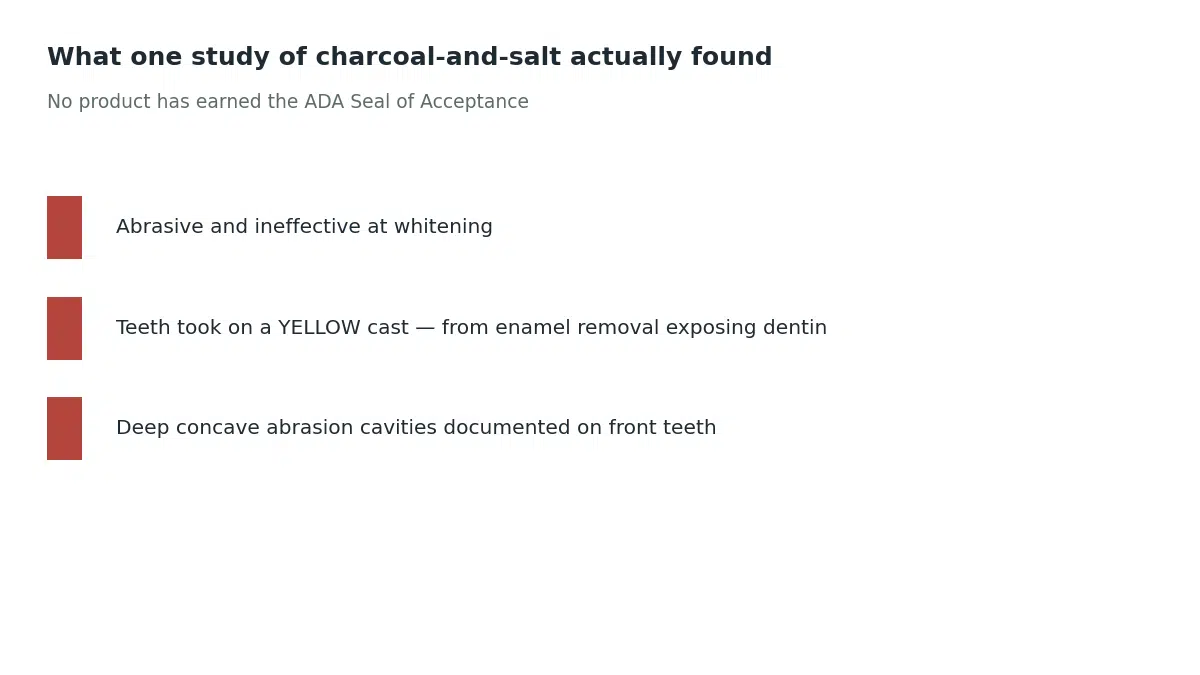
The specific finding worth knowing: one study of a charcoal-and-salt mixture found it abrasive and ineffective, with teeth taking on a yellow cast — which the authors attributed to enamel being removed during brushing, exposing the dentin beneath. The report also documented deep concave abrasion cavities on the front surfaces of the front teeth.
A systematic review of in-vitro studies reached a similar conclusion: less whitening than the alternatives, and less safe because of high abrasive potential.
Charcoal particles also lodge in micro-cracks and along the gumline, which can leave a grey tinge. And most charcoal toothpastes omit fluoride, trading cavity protection for a cosmetic claim that doesn’t hold up.
Strawberry and baking soda paste
A popular one, and it’s been tested directly. Researchers examined whether a strawberry and baking soda mixture whitened teeth and were unable to find measurable improvement. The malic acid in strawberries isn’t strong enough to whiten but is acidic enough to be worth not applying deliberately.
Oil Pulling: Harmless, Oversold
Swishing coconut oil for 15 to 20 minutes won’t hurt you, and some people find their mouth feels cleaner. Coconut oil does contain lauric acid, which has antimicrobial properties.
But there’s no good evidence that it whitens teeth, and the idea that it pulls toxins from the body has nothing behind it. Whatever benefit exists is about reducing plaque bacteria — which is what brushing and flossing already do, in a fraction of the time.
If you enjoy it, carry on. It should sit alongside brushing and flossing, never replace them. And spit it into the bin rather than the sink, since coconut oil solidifies in drains.
The Part That Actually Keeps Teeth White
Preventing stains beats removing them, and this is where most of the achievable improvement lives.
Rinse with water straight after coffee, tea, red wine or anything dark. Pigments set as they sit.
Use a straw for iced coffee and dark drinks so less of it washes across your front teeth.
Wait before brushing after anything acidic. Acid softens enamel temporarily, and brushing during that window accelerates wear. Thirty to sixty minutes, or rinse with water and brush later.
Brush properly. Two minutes, twice daily, soft bristles, fluoride toothpaste, gentle circular motion at the gumline. Floss daily — the stains between teeth are ones no whitening method reaches.
Get a professional cleaning. This is the most underrated item on the page. Hardened tartar can’t be removed by any home method, and a scale and polish often achieves what people were hoping whitening would. It’s also cheaper than most whitening products.
Stop smoking if you do. Nothing else on this list comes close for staining.
Crunchy fruit and vegetables, cheese and plenty of water all help modestly. If gum health is also a concern, our guide to vitamins for receding gums covers what’s supported there.
What’s Realistic
Home methods remove surface staining. They will not lighten the underlying color of your teeth, which is set by the dentin beneath the enamel and by genetics.
If your teeth are stained from coffee and tobacco, expect a real if modest improvement over several weeks. If they’re naturally darker, or yellowing with age as enamel thins, home methods won’t change that — and pushing harder just wears enamel, which makes it worse.
Restorations don’t whiten either. Crowns, veneers and fillings keep their color permanently, so whitening natural teeth around visible dental work creates a mismatch.
For intrinsic discoloration, professional options exist and our guide to in-office whitening covers what they do and don’t achieve.
When Discoloration Needs a Dentist
Book an appointment rather than reaching for a remedy if you notice:
- A single tooth darkening — this can mean a dying nerve, often after an old injury, and needs treating rather than covering
- Grey or brown tones rather than yellow, which are usually intrinsic and won’t respond to surface treatments
- Discoloration with pain, swelling or sensitivity
- White chalky patches or dark spots, which can indicate early decay or enamel defects
- Translucent or see-through edges on your front teeth — a sign of enamel erosion, and a reason to stop any acidic or abrasive routine immediately
- Ongoing sensitivity to hot and cold that’s new
Children and teenagers shouldn’t use whitening methods on developing teeth. If a young person’s tooth color is a concern, that’s a conversation with a dentist about the cause.
Frequently Asked Questions
Do natural ways to whiten teeth actually work?
Some do, within limits. Baking soda removes surface stains and has real support; dilute hydrogen peroxide has the right chemistry but needs care. Both work on surface staining only.
Nothing at home changes the underlying color of your teeth. Expect modest brightening over weeks, not a shade transformation.
Is activated charcoal safe for teeth?
No charcoal product has the ADA Seal, and the ADA describes the evidence as insufficient. One study of a charcoal mixture found it abrasive and ineffective, leaving teeth with a yellow cast from enamel removal, plus deep abrasion cavities on the front teeth.
Particles also lodge near the gumline and can leave a grey tinge, and most charcoal pastes skip fluoride.
Can I whiten my teeth with apple cider vinegar or lemon?
Don’t. The ADA classes acidic household whiteners as fiction, because acid wears away enamel — and enamel doesn’t grow back.
Any brightening you notice is etched, demineralized surface, not clean enamel. As it thins, the yellower dentin underneath shows through more.
How often can I use baking soda on my teeth?
Two or three times a week, not daily, if you’re mixing your own paste. Brush gently with a soft brush — light pressure, since scrubbing hard is what causes wear.
A baking soda toothpaste with fluoride is the easier route and gives you cavity protection alongside.
Is hydrogen peroxide from the drugstore safe to use?
Standard 3% peroxide diluted half-and-half with water, used briefly as a rinse and spat out, is what most dentists consider reasonable. Don’t swallow it or hold it against your gums.
Never use food-grade hydrogen peroxide — it’s typically 35%, caustic, and causes chemical burns to mouth and throat tissue.
Does oil pulling whiten teeth?
There’s no good evidence that it does, and the idea that it pulls toxins from the body has nothing behind it. It’s harmless and may reduce plaque bacteria a little.
If you enjoy it, keep it alongside brushing and flossing rather than instead of them. Spit into the bin, not the sink.
Why do my teeth look yellower than they used to?
Enamel thins with age, letting the naturally yellower dentin beneath show through. That’s intrinsic and doesn’t respond to surface whitening.
Abrasive or acidic remedies accelerate exactly this process, which is why aggressive home whitening often backfires over time.
When should tooth discoloration be checked?
When a single tooth darkens — often a dying nerve after an old injury — or when tones are grey or brown rather than yellow, or when there’s pain, swelling or new sensitivity.
Also get see-through edges on your front teeth looked at; that’s enamel erosion, and a reason to stop any acidic or abrasive routine straight away.
SOURCESOur Editorial Standards
HealthMagHub is built on primary sources: peer-reviewed research, clinical practice guidelines, and health agencies such as the NIH, CDC, and FDA. Read our editorial standards to see how we research, cite, and update our articles.
- American Dental Association. Whitening — Oral Health Topics. ada.org
- American Dental Association, MouthHealthy. Natural Teeth Whitening: Fact vs. Fiction. mouthhealthy.org
- Pecci-Lloret MP, et al. Effectiveness and abrasiveness of activated charcoal as a whitening agent: A systematic review of in vitro studies. pubmed.ncbi.nlm.nih.gov
Disclaimer: This article is general information, not dental advice. Speak to a dentist before starting any whitening routine, particularly if you have sensitive teeth, gum disease, visible dental work, or worn enamel. Stop immediately and seek dental advice if you develop sharp or lasting sensitivity, bleeding or irritated gums, white patches or burns on gum tissue, or translucent edges on your front teeth. Never use concentrated or food-grade hydrogen peroxide in the mouth — it is caustic and causes chemical burns. Whitening methods are not appropriate for children or for teenagers with developing teeth.