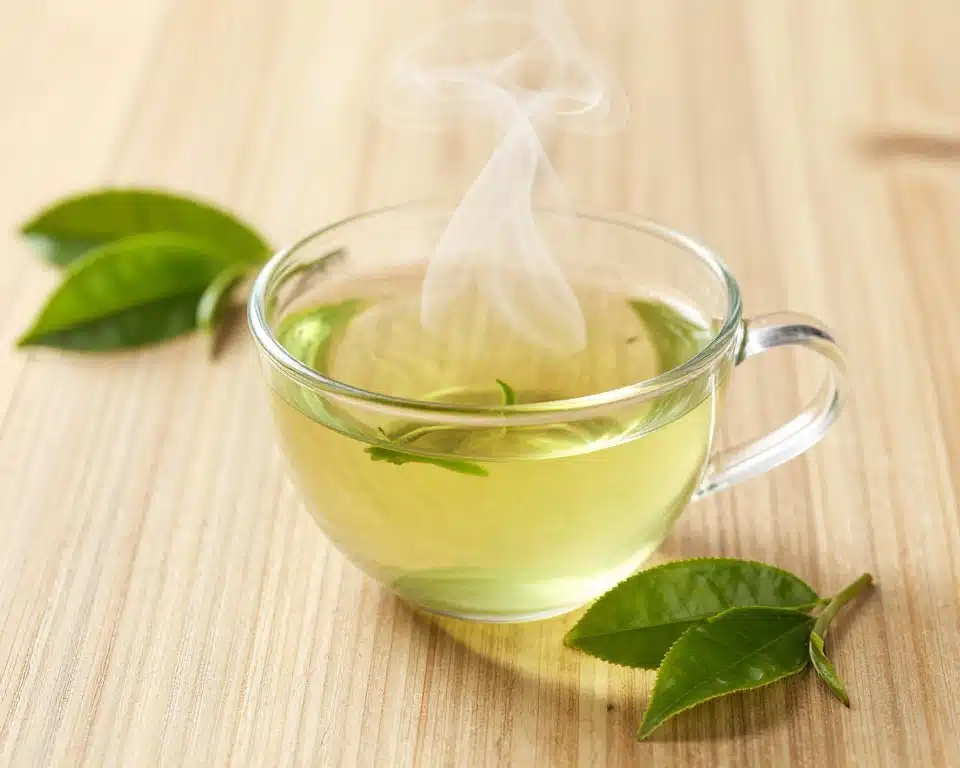
Does green tea have caffeine? Yes. Roughly 25 to 50 mg in an 8-ounce cup, against about 95 mg for the same amount of brewed coffee, so a third to a half.
That’s the short answer. The more useful part is why published figures vary so widely, and why one popular trick for cutting caffeine at home doesn’t actually work.
- Green tea has roughly 25-50 mg of caffeine per 8-ounce cup, about a third to a half of brewed coffee.
- The popular “30-second rinse” trick doesn’t remove caffeine. Only about 9% comes out that fast, leaving 91% in the leaf.
- Shorter steeping, cooler water, and fewer leaves genuinely reduce caffeine, but won’t get you to decaf.
- Tannins in green tea bind non-heme iron, so drink it between meals rather than with them if you’re iron-deficient or vegetarian.
Does Green Tea Have Caffeine? How Much Is Actually in Your Cup
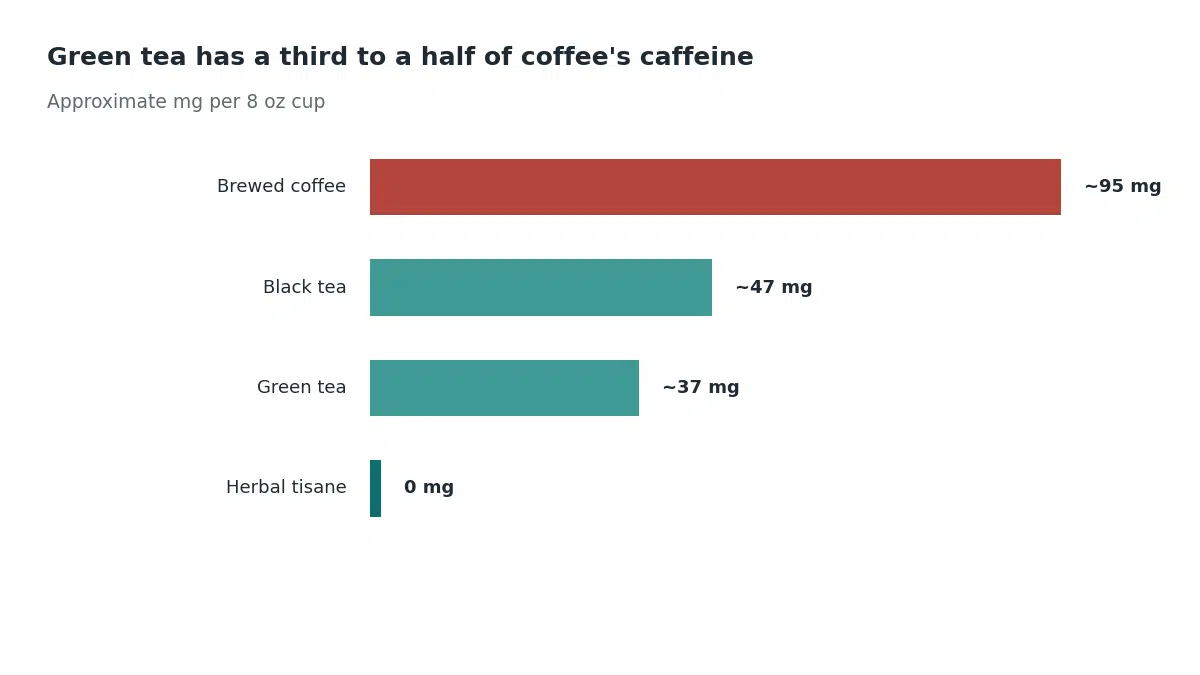
Approximate ranges, which is the most honest way to give them.
Green tea: around 25-50 mg per 8 oz
That range is wide on purpose. The low end is a light, briefly steeped cup of a mature-leaf tea; the high end is a generous measure of young-leaf tea steeped four or five minutes. Both are legitimately “a cup of green tea.”
For most people drinking two or three cups spread across a day, total intake lands somewhere around 75 to 150 mg, which is roughly one mug of coffee.
Matcha: noticeably higher
Matcha is the exception to everything else on this list, because you aren’t drinking an infusion. The leaf is stone-ground into powder and whisked into suspension, so you consume the whole thing rather than what water managed to pull out of it. Everything in the leaf comes with it, caffeine included.
Two other factors push it up further. Matcha is made from shade-grown leaves, and shading increases caffeine in the plant. And a typical serving uses one to two teaspoons of powder, which represents more leaf than a standard infusion.
The practical result is a cup that can sit closer to coffee than to brewed green tea. If you switched to matcha expecting something gentler, that’s worth knowing.
Black tea: somewhat more than green, though the overlap is large
Black and green tea come from the same plant. The difference is oxidation, and oxidation does not meaningfully create or destroy caffeine.
Black tea does average slightly higher, but the ranges overlap so heavily that the category tells you little. A robust sencha can easily out-caffeinate a mild black tea. Leaf age, cultivar and how you brew it matter more than the color on the box.
Brewed coffee: around 95 mg, sometimes far more
The 95 mg figure is for 8 ounces, and that’s where comparisons quietly break down. A coffee shop “small” is usually 12 ounces, and larger sizes run to 20. At that point you’re looking at 200 to 300 mg in a single cup, which is several times any green tea.
Espresso is the reverse case. A single shot carries roughly 60 to 65 mg, less than a mug of drip coffee, but it arrives in an ounce or two rather than sipped over twenty minutes.
Decaf green tea: small residual amounts, not zero
Decaffeination removes most of the caffeine but never all of it. A few milligrams per cup typically remain, which is irrelevant for most people and not irrelevant for a few: anyone unusually sensitive, and anyone told to avoid caffeine entirely for a medical reason.
Worth knowing too that the process removes some catechins along with the caffeine, so decaf green tea isn’t nutritionally identical to the regular version. That’s a fair trade if caffeine is the problem you’re solving.
Herbal tisanes: genuinely caffeine-free
Chamomile, rooibos, peppermint and the rest contain no caffeine at all, for the simple reason that they aren’t tea. They’re infusions of other plants entirely, and the tea plant is where the caffeine comes from.
One caveat that catches people out: not everything sold in the herbal aisle is caffeine-free. Yerba mate and guayusa both contain caffeine, sometimes at levels comparable to tea or higher, despite sitting alongside chamomile on the shelf. If you’re avoiding caffeine, read the box rather than trusting the section it came from.
Deliberately not offered here: a table assigning precise milligram values to sencha, gyokuro, bancha and so on. Those tables circulate widely and look authoritative, but the underlying variation makes them close to meaningless.
Why the numbers move around so much
Caffeine in the dry leaf depends on the cultivar, the age of the leaves picked (young tips carry more than mature leaves), growing conditions, shading, harvest season, and even nitrogen fertilizer use.[3]
Then your brewing changes how much of it ends up in the cup. Hotter water and longer steeping both extract more. Leaf quantity matters. Broken leaf and tea bags release faster than whole leaf.
The practical upshot: two cups of “green tea” can differ by a factor of two or more. If you need a precise number for medical reasons, the label on a commercial product is more reliable than any generic chart.
One myth worth retiring while we’re here: black tea does not automatically contain more caffeine than green. Variety, leaf age and brewing matter more than the color category.
Does Green Tea Have Caffeine Left After a 30-Second Rinse? Almost All of It
You’ll find this advice everywhere: steep your leaves for 30 seconds, throw that water away, then brew properly, supposedly removing most of the caffeine.
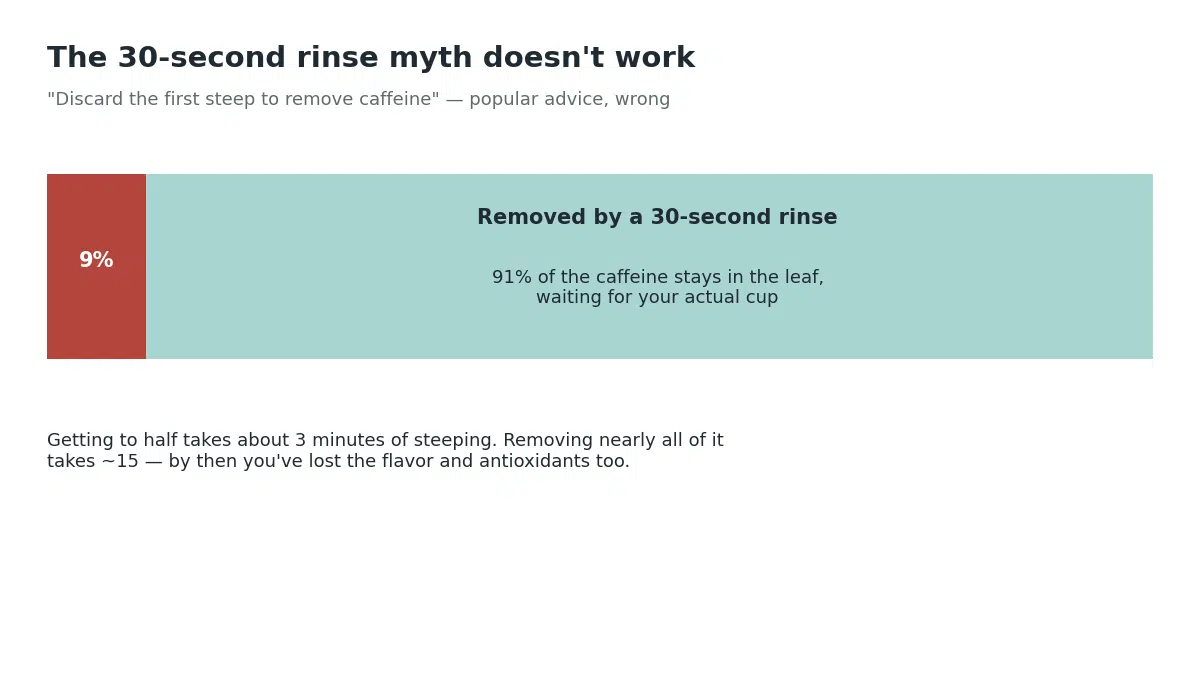
It doesn’t work. Research on caffeine extraction found that roughly 9% of the caffeine comes out in the first 30 seconds.[3] Around 91% stays in the leaf, waiting for your actual cup.
Caffeine is only moderately water-soluble and comes out gradually. Getting to about half takes something like three minutes of steeping; removing nearly all of it would need a quarter of an hour, at which point you’ve discarded the flavor and much of the antioxidant content too, and are left with hot water.
If you genuinely need to avoid caffeine, use commercially decaffeinated tea or a herbal tisane. The rinse trick gives false reassurance, which is worse than no trick at all.
What Actually Reduces Caffeine
Brewing adjustments do help, just less dramatically than the rinse myth promises, and they work by extracting less overall rather than by removing caffeine selectively.
Steep for less time. The single most effective lever. One to two minutes rather than four or five.
Use cooler water. Around 160-170°F (71-77°C) instead of near-boiling slows extraction, and green tea tastes better this way regardless, with less bitterness.
Use fewer leaves. Straightforwardly proportional.
Cold brew. Steeping in cold water for several hours in the fridge extracts less caffeine and produces a sweeter, smoother result.
Choose roasted or lower-grade teas. Hojicha is roasted and comes out noticeably milder. Genmaicha is cut with roasted rice, so each cup contains less actual leaf. Bancha uses later-harvest mature leaves.
Drink it earlier. Caffeine has a half-life of roughly five hours, so an afternoon cup is still working on you at bedtime. Six hours before sleep is a reasonable cutoff.
Combining these gets you a meaningfully lighter cup. It does not get you decaf.
Why It Feels Different From Coffee
The caffeine molecule in tea is identical to the one in coffee. What differs is the dose and the company it keeps.
Green tea contains L-theanine, an amino acid associated with a relaxed but alert state. The combination of caffeine and L-theanine is often described as smoother than caffeine alone, and there’s reasonable research interest in the pairing for attention and reaction time.
Be a little skeptical of how far this gets stretched in marketing, though. A large part of why tea feels gentler is simply that you’re consuming less caffeine per cup, more slowly.
Limits, Interactions and Who Should Be Careful
Most healthy adults tolerate up to about 400 mg of caffeine daily, comfortably more green tea than most people drink.[1] But total intake counts everything: coffee, cola, energy drinks, chocolate, some painkillers and pre-workout supplements.
Lower limits apply if you’re: pregnant or breastfeeding (usually 200 mg daily or less, from all sources combined); prone to anxiety or panic attacks (caffeine can amplify exactly the symptoms you’re trying to manage); living with a heart rhythm problem, or on medication for blood pressure; dealing with reflux or ulcers (tea is acidic and caffeine relaxes the esophageal sphincter); a child or teenager (limits are much lower and weight-based); or sleeping badly, particularly if you drink tea after mid-afternoon.
Iron. This is the interaction most worth knowing. Tannins in green tea bind non-heme iron, the kind in plants, and reduce how much you absorb. If you’re iron-deficient, vegetarian, or take an iron supplement, drink tea between meals rather than with them, ideally leaving an hour. Vitamin C alongside the meal helps counteract it.
Warfarin. Green tea contains vitamin K, which works against warfarin. Consistency matters more than avoidance, since sudden changes in how much you drink are the problem. Tell your anticoagulation clinic if your habits change.
Caffeine also interacts with stimulant medications, some antibiotics, certain antidepressants and asthma drugs. Worth a word with a pharmacist if you’re on regular medication.
Brewed tea and green tea extract are not the same thing. This distinction matters more than the caffeine question. Drinking green tea is regarded as generally safe.[2] Concentrated green tea extract supplements are a different proposition: the European Food Safety Authority concluded that products delivering 800 mg or more of EGCG per day are associated with signs of liver damage, and could not identify a dose it considered safe. Case reports include acute hepatitis and, rarely, liver failure. Health Canada and USP both require cautionary labeling. If you’re taking a green tea supplement rather than drinking the tea, that’s worth discussing with a doctor, and stopping immediately for yellowing skin or eyes, dark urine, unusual fatigue or right-sided abdominal pain.
If you’re using green tea as part of a weight or energy strategy, our guide to the best tea for weight loss covers what the trials actually found, and our piece on what actually affects metabolism covers where the realistic gains are. And if acidity or reflux is your concern, our guide to whether green tea is acidic covers that separately.
Signs You’re Having Too Much
Trouble falling asleep despite being tired. Feeling wired or on edge through the day. A racing or fluttering heartbeat. Hand tremor. Stomach upset or reflux. Headaches on days you skip it, which is a withdrawal sign rather than a reason to keep going.
If you decide to cut down, taper over a week or two. Stopping abruptly tends to produce a few days of headache and fatigue.
Seek medical advice for chest pain, a persistently irregular heartbeat, fainting, or severe anxiety following caffeine, particularly if you have an existing heart condition.
Frequently Asked Questions
Does green tea have caffeine?
Yes. Roughly 25 to 50 mg per 8-ounce cup, about a third to a half of brewed coffee. All true teas from the Camellia sinensis plant contain it naturally.
Only herbal tisanes like chamomile, rooibos and peppermint are genuinely caffeine-free, since they aren’t tea.
Does rinsing tea for 30 seconds remove the caffeine?
No. Research found only about 9% of the caffeine comes out in the first 30 seconds, and roughly 91% stays in the leaf for your actual cup.
Getting to about half takes around three minutes of steeping, and removing nearly all of it would take about fifteen, by which point you’ve discarded the flavor and antioxidants too.
Why do caffeine figures for green tea vary so much?
Because cultivar, leaf age, shading, harvest season and fertilizer all change the caffeine in the dry leaf, and then water temperature, steeping time and leaf quantity change how much reaches your cup.
Two cups of green tea can differ twofold. For a precise figure, a commercial product’s label beats any generic chart.
Does matcha have more caffeine than brewed green tea?
Yes, generally. With matcha you consume the whole ground leaf rather than an infusion of it, so you get more of everything in the leaf, caffeine included. Shade-growing raises it further.
The exact amount depends on grade and how much powder you use per serving.
Are all herbal teas caffeine-free?
Most are, since they aren’t made from the tea plant. Chamomile, rooibos and peppermint contain none at all.
But yerba mate and guayusa do contain caffeine, sometimes at levels comparable to tea, despite being sold as herbal. Read the box rather than trusting the aisle.
What actually lowers the caffeine in my cup?
Shorter steeping is the biggest lever, then cooler water, fewer leaves, and cold brewing. Roasted teas like hojicha, and genmaicha which is cut with roasted rice, are naturally milder.
These give a meaningfully lighter cup, not a decaf one. For genuine avoidance use commercially decaffeinated tea or a herbal tisane.
Can I drink green tea if I’m iron-deficient?
Yes, but not with meals. Tannins bind non-heme iron and reduce absorption, which matters most for vegetarians, people who are iron-deficient, and anyone taking an iron supplement.
Leave about an hour between eating and drinking tea, and pair vitamin C with iron-containing meals.
Is green tea safe during pregnancy?
In moderation. Guidance is usually 200 mg of caffeine daily or less from all sources combined, which a few cups can approach once coffee and chocolate are counted.
Discuss your total intake with your midwife or doctor rather than counting cups alone.
Are green tea supplements the same as drinking it?
No, and this matters. Brewed green tea is regarded as generally safe, but concentrated extract supplements are different. EFSA linked doses of 800 mg EGCG or more daily to signs of liver damage and couldn’t identify a safe dose.
Case reports include acute hepatitis and rarely liver failure. Stop and seek advice for yellowing skin or eyes, dark urine, unusual fatigue or right-sided abdominal pain.
SOURCESOur Editorial Standards
HealthMagHub is built on primary sources: peer-reviewed research, clinical practice guidelines, and health agencies such as the NIH, CDC, and FDA. Read our editorial standards to see how we research, cite, and update our articles.
- Mayo Clinic. Caffeine: How much is too much? mayoclinic.org
- National Center for Complementary and Integrative Health. Green Tea. nccih.nih.gov
- Suteerapataranon S, et al. Caffeine in Chiang Rai tea infusions: effects of tea variety, type, leaf form, and infusion conditions. Food Chemistry, 2009.
Disclaimer: This article is general information, not medical advice. Speak to a doctor if you're pregnant, take warfarin, or have a heart rhythm problem, and use caution with concentrated green tea extract supplements, which carry a liver injury risk that brewed tea does not.