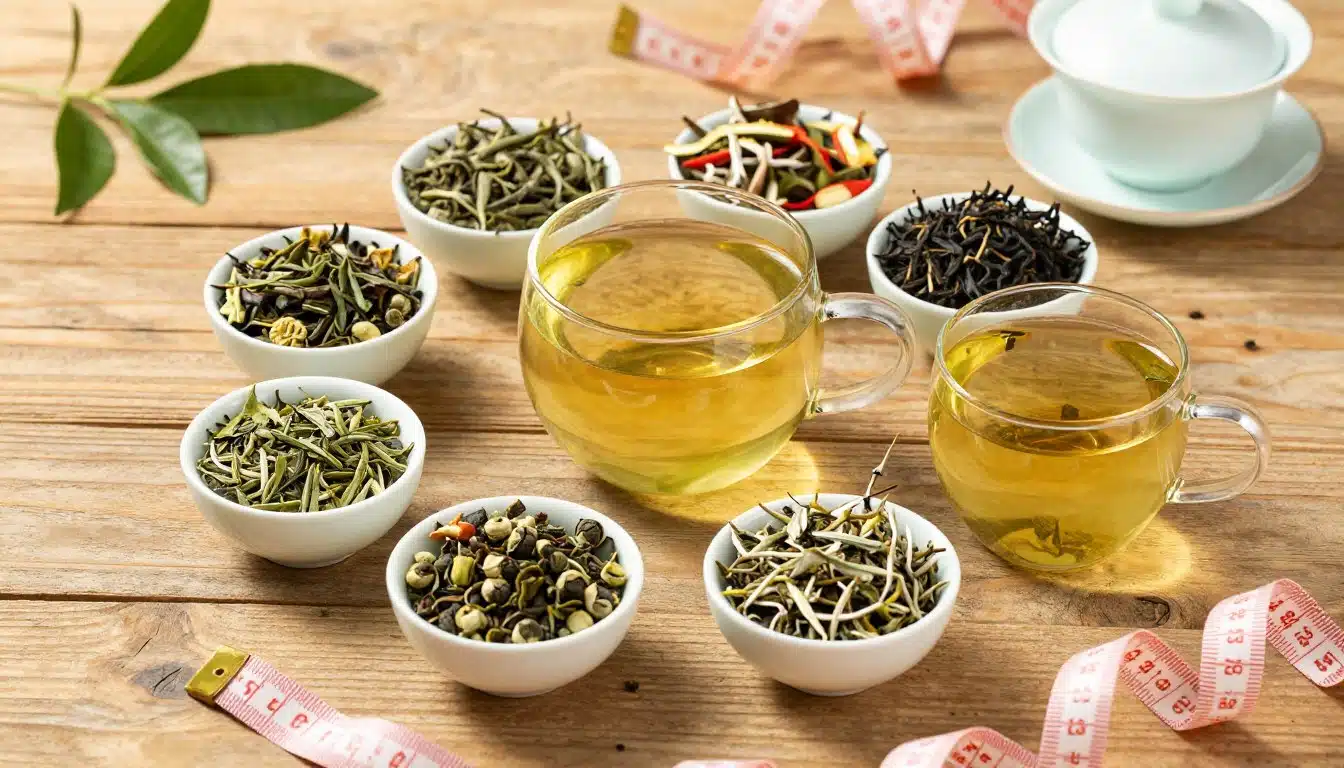
That’s worth knowing before you buy anything. Tea is a genuinely good drink with real compounds behind it. But the gap between what the research shows and what tea marketing implies is wide.
Here’s what the trials actually found, how the types compare, the one form of green tea that carries a real safety warning, and where tea does help with weight in a way that isn’t in dispute.
- Cochrane found green tea’s weight-loss effect too small to be clinically important — roughly 1.3 kg vs. placebo over 12 weeks, from extract-based trials.
- Green tea has the most research of any tea type; matcha, oolong, black and white teas have far thinner evidence.
- Green tea extract supplements at 800mg+ EGCG daily carry a documented liver-injury risk — brewed tea does not.
- The real, reliable benefit is substitution: unsweetened tea replacing sugary drinks.
What the Research on the Best Tea for Weight Loss Actually Found
The Cochrane review is the most rigorous look at this. Jurgens and colleagues pooled randomized trials of at least 12 weeks in overweight and obese adults. They concluded that green tea preparations produce a small, statistically non-significant weight loss. Because the amount is small, it isn’t likely to be clinically important. Green tea also had no significant effect on keeping weight off.
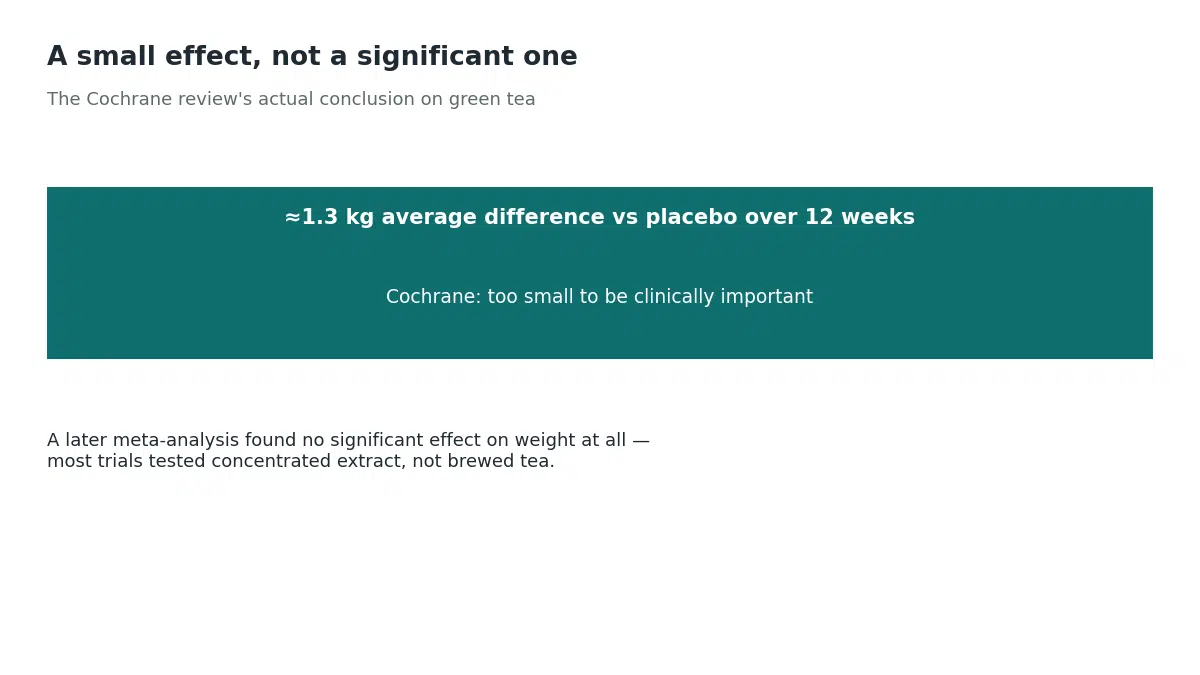
A later meta-analysis reached much the same place. No statistically significant effect on body weight. A small effect on fat mass percentage that the authors judged not clinically relevant.
More recent work is slightly more positive but no less modest. A 2024 meta-analysis of ten randomized trials found green tea catechins combined with exercise produced small but consistent reductions in weight, BMI and body fat compared with exercise alone.
The detail most articles skip: the majority of these trials used concentrated extracts, not brewed tea. Drinking three cups a day is not the same intervention. The results don’t transfer cleanly.
So the widely quoted “1.3 kg more than controls over 12 weeks” figure is real. But it describes a small average difference, in supplement trials, that later and more rigorous reviews couldn’t confirm as significant.
How the Tea Types Compare
All true tea comes from the same plant, Camellia sinensis. What differs is oxidation, and that changes the compound mix.
Green tea is minimally oxidized and retains the most catechins, chiefly EGCG. It has by far the most research behind it, which is why it heads every list — including this one. Roughly 25 to 50 mg of caffeine per cup; our guide to how much caffeine green tea contains covers the variation.
Matcha is powdered whole leaf. You consume the leaf rather than an infusion, and the catechin dose per cup is genuinely higher. The often-repeated “137 times more catechins” claim is a misquote. It comes from a single 2003 study comparing one matcha against one specific bagged tea. It isn’t a general figure.
Oolong is partly oxidized, sitting between green and black, with a mix of catechins and theaflavins. Small studies suggest a modest effect on energy expenditure. The evidence base is much thinner than green tea’s.
Black tea is fully oxidized, so its catechins have converted to theaflavins and thearubigins. Most of its weight-related research is in animals and concerns gut bacteria rather than fat burning. Highest caffeine of the four, roughly 40 to 70 mg per cup.
White tea is the least processed and lowest in caffeine. The fat-cell findings you’ll see quoted come from laboratory cell studies, not people.
Pu-erh is microbially fermented. Traditionally drunk after rich meals, with some small human studies on cholesterol. Interesting, under-researched.
Herbal infusions — hibiscus, rooibos, ginger, peppermint — aren’t tea at all and contain no catechins. Some have small studies attached. All of them are pleasant, caffeine-free, and calorie-free, which turns out to be the part that matters most.
The Extract Warning Worth Taking Seriously
Green tea extract is not the same as green tea
Because the trials used extracts, the obvious conclusion looks like “take the supplement instead.” That’s the one move to avoid.
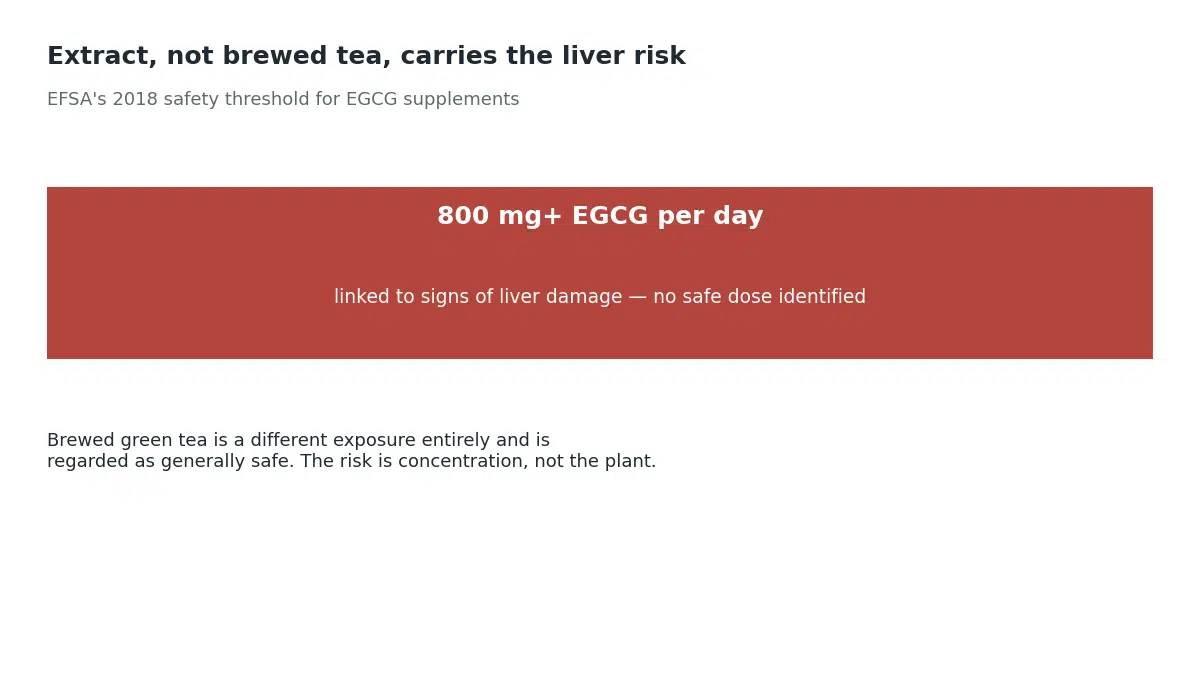
EFSA’s 2018 assessment found that supplements delivering 800 mg or more of EGCG per day are associated with signs of liver damage. It could not identify a safe dose from supplement sources. Case reports describe acute hepatitis and, rarely, liver failure. Health Canada and USP require cautionary labeling.
Brewed green tea is a different matter and is generally regarded as safe. The distinction is dose and concentration — and it’s precisely the distinction that supplement marketing blurs.
If you’re drinking tea, drink tea. The evidence for extracts isn’t strong enough to justify the liver risk.
Where Tea Genuinely Helps
The honest mechanism isn’t thermogenesis. It’s substitution.
A mug of unsweetened tea has essentially no calories. If it replaces a sweetened drink, that’s a real and repeatable difference. Far larger than the metabolic effect the trials struggled to detect. It doesn’t depend on which type you choose.
Tea also provides warmth, volume and a pause, which some people find useful around meals. And it’s hydrating, despite the persistent myth that caffeinated drinks don’t count.
What it won’t do is create a calorie deficit on its own, target fat in a specific area, or compensate for the rest of the diet. If the tea gets sweetened with sugar or honey, the arithmetic reverses immediately. That applies just as much to a tea marketed specifically as a weight-loss blend, since added ingredients can’t change basic calorie math.
For a broader view of what does move the needle after middle age, our guide to metabolism after 50 corrects a few assumptions that get in the way.
Drinking It Sensibly
Brewing. Green and white tea suit water around 160-185°F for two to three minutes; boiling water scorches the leaf and turns it bitter. Black, oolong and pu-erh handle hotter water and longer steeps.
Caffeine. Up to about 400 mg a day is the usual general guidance for healthy adults — roughly eight cups of green tea. In pregnancy the limit is 200 mg.
Iron. Tannins reduce absorption of iron from plant foods. If you have iron deficiency or eat a plant-based diet, drink tea between meals rather than with them.
Warfarin. Green tea contains some vitamin K. The issue is consistency rather than avoidance. A sudden change in how much you drink is what matters, so mention it to whoever manages your INR.
Acid reflux and stomach upset. If tea on an empty stomach doesn’t agree with you, that’s common; our piece on whether green tea is acidic explains what’s actually going on, and it’s usually caffeine rather than acidity.
Who Should Be Careful
- Pregnancy and breastfeeding — caffeine limit of 200 mg daily, and weight loss isn’t the goal during pregnancy
- Anxiety disorders or heart rhythm problems — caffeine can worsen both
- Anyone taking stimulants, beta-blockers or blood thinners — worth a conversation with a pharmacist
- Existing liver disease — avoid green tea extract entirely
If thinking about food, weight or your body has started taking up a lot of your day, that’s worth talking to someone about — a doctor, or the National Alliance for Eating Disorders helpline. Weight-loss content of any kind, including this article, isn’t the right tool for that.
Common Questions About the Best Tea for Weight Loss
Which is the best tea for weight loss?
Treat it as a pleasant zero-calorie drink that may help slightly, not as a weight-loss method.
How much weight can you lose drinking tea?
More rigorous reviews couldn’t confirm that as statistically significant, so treat it as an upper bound rather than an expectation.
Should I take green tea extract instead?
Brewed tea doesn’t carry that concern. The modest possible benefit doesn’t justify the risk.
Does matcha have 137 times more antioxidants?
Matcha does deliver more catechins per cup, because you consume the whole leaf. The multiplier is marketing.
Does tea reduce belly fat specifically?
Some studies report abdominal changes, but they sit inside the same small overall effect.
How many cups a day?
Drink what you enjoy at a level that doesn’t disturb your sleep — there’s no dose that unlocks a different result.
The Bottom Line
Green tea has the most evidence of any tea for weight loss. That evidence describes a small effect that the most rigorous review could not call statistically significant.
The reliable benefit is simpler: unsweetened tea replacing sweetened drinks, every day, without effort. That’s worth more than the catechins.
Drink the tea you actually like, keep the sugar out, skip the extracts, and don’t expect the mug to do the work.
SOURCESOur Editorial Standards
HealthMagHub is built on primary sources: peer-reviewed research, clinical practice guidelines, and health agencies such as the NIH, CDC, and FDA. Read our editorial standards to see how we research, cite, and update our articles.
- Jurgens TM, Whelan AM, Killian L, et al. Green tea for weight loss and weight maintenance in overweight or obese adults. Cochrane Database Syst Rev. 2012;12:CD008650. pubmed.ncbi.nlm.nih.gov
- Green tea catechins with exercise: a 2024 meta-analysis of randomized trials. ncbi.nlm.nih.gov
- European Food Safety Authority. Scientific opinion on the safety of green tea catechins. EFSA Journal, 2018. efsa.europa.eu
- National Center for Complementary and Integrative Health (NCCIH), National Institutes of Health. Green Tea: Usefulness and Safety. nccih.nih.gov
Disclaimer: This article is general information, not medical advice, and isn't intended to diagnose or treat anything. Speak to a doctor or pharmacist before substantially increasing tea intake if you are pregnant or breastfeeding, take blood thinners, stimulants or beta-blockers, have a heart rhythm problem, an anxiety disorder, or liver disease. Green tea extract supplements carry a documented risk of liver injury and should not be taken without medical advice.