


High protein meal replacement shakes for weight loss do work, but by less than the marketing suggests. Pooled across 23 randomized trials in nearly 8,000 adults, people using meal replacements were about 1.4 kg lighter at one year than people on comparison diets. That rose to roughly 2.2 kg when both groups got dietary support.
That’s a real effect. It is also a modest one, and it’s worth knowing before you commit to a monthly subscription.
What follows is how they actually work, how many meals to replace, who shouldn’t use them without medical input, and the point where a weight-loss tool stops being helpful.
- Meal replacements produce a modest, real effect — about 1.4 kg more weight loss than control diets at one year, or 2.2 kg with added dietary support.
- Replace one or two meals only; total diet replacement of all meals needs medical supervision.
- A meal replacement needs a full micronutrient panel, not just protein — otherwise it’s a protein shake sold as a meal.
- Insulin, sulfonylureas, and several other medications need dose review before you start.
Read This Before You Start
Meal replacements are designed to replace one or two meals a day, not all of them. In the research, a meal replacement program replaces at least one meal and keeps at least one meal of ordinary food. Total diet replacement, where shakes stand in for everything, is a different intervention. It’s studied separately, and it needs clinical supervision.
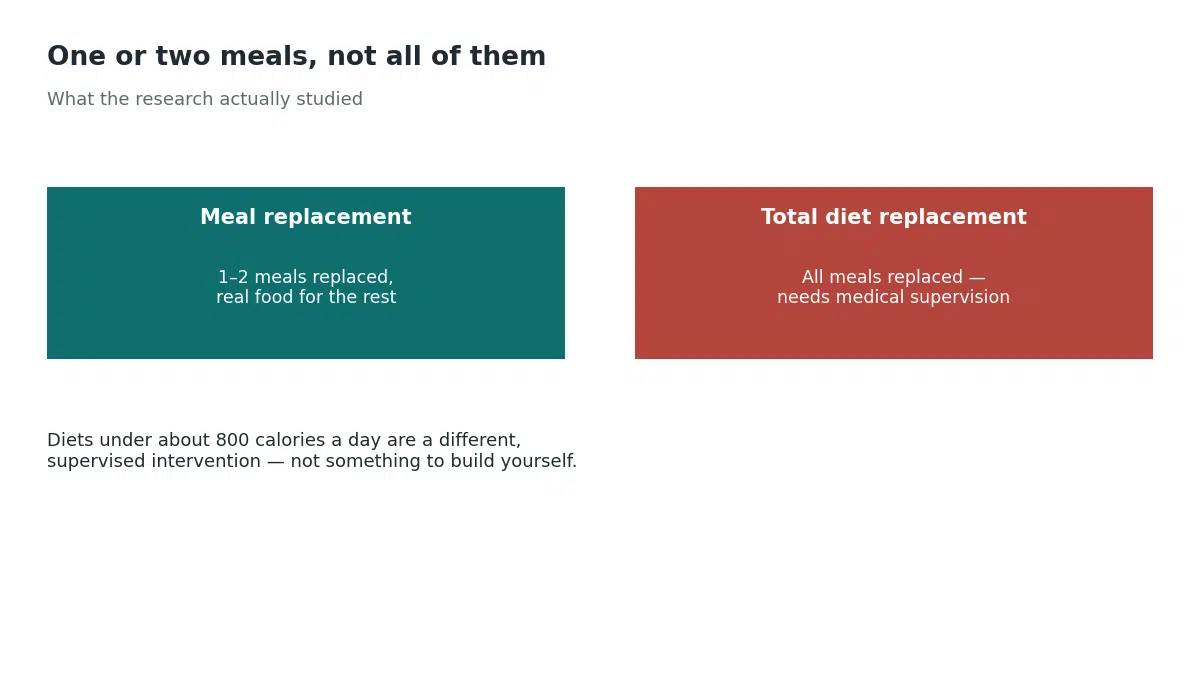
Very low energy diets, under about 800 calories a day, require medical supervision. Research reviews exclude them from ordinary meal-replacement studies for exactly that reason. This isn’t a thing to build yourself from products bought online.
Talk to your doctor or a dietitian first if you: take insulin or other diabetes medication, have kidney or liver disease, are pregnant or breastfeeding, have had bariatric surgery, take a GLP-1 medication, are under 18 or over 65, or have any history of an eating disorder.
If you’re losing weight without trying to, rather than choosing to, see a doctor rather than starting a diet. Unintentional weight loss needs a cause found.
What the Trials Actually Show
The best available synthesis is a 2019 systematic review in Obesity Reviews covering 23 randomized trials and 7,884 adults with overweight or obesity, measuring weight at one year.
Meal replacements came out ahead in every comparison.
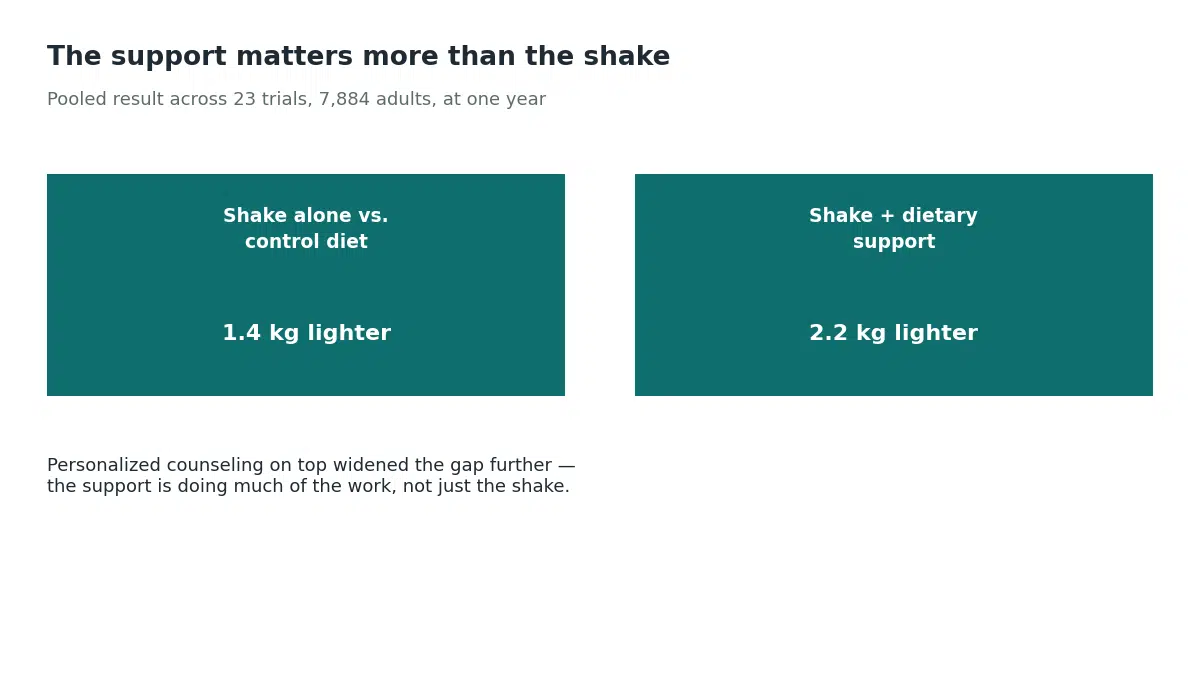
The pooled difference was about 1.4 kg against control diets, and around 2.2 kg when both arms received dietary support. Where people got intensive, personalized counseling on top, the gap was considerably larger. That’s the most informative finding in the whole review.
Read that last point carefully, because it’s the one the product pages leave out. The support did more work than the shake. A shake bought alone, without any change in how you eat the rest of the time, is operating at the low end of that range.
Why they help at all
Mostly it’s structure, not metabolism. A pre-portioned shake removes a decision and fixes the calorie content of one meal, which is a genuine advantage over estimating a plate of food.
Protein contributes too. It has a higher thermic effect than carbohydrate or fat. Your body spends roughly 20–30% of protein’s energy digesting it, against 5–10% for carbohydrate and very little for fat. It also blunts hunger more effectively and helps preserve lean mass during weight loss, which matters because muscle lost during dieting is hard to get back.
The thermic effect is real but small in absolute terms. It’s a nudge, not a mechanism that overrides overall intake.
Choosing High Protein Meal Replacement Shakes for Weight Loss
The distinction that matters is between a meal replacement and a protein powder. A protein powder is protein. A meal replacement is supposed to stand in for a meal, which means it needs the micronutrients that meal would have supplied.
Turn the tub around and check:
- Protein, roughly 20 g or more per serving. Below that it won’t hold you.
- Fiber. Often the difference between feeling fed and feeling cheated an hour later.
- A proper vitamin and mineral panel. If it’s only protein and flavoring, it’s a protein shake being sold as a meal.
- Added sugars. Some are closer to a milkshake than a meal.
- Third-party testing — USP, NSF, or Informed Choice. Protein powders have a poor record for heavy metal contamination, and verification is the only practical check.
Plant-based blends usually combine sources — pea with rice, for instance — to cover the amino acid profile that a single plant protein lacks. Whey does this on its own but doesn’t suit everyone.
Beyond that, the specific brand matters less than whether you’ll still be drinking it in three months. Taste and cost predict adherence, and adherence predicts results.
Medication and Health Considerations
Swapping a meal for a shake changes what reaches your bloodstream, and several medications are calibrated to what you normally eat.
- Diabetes medication. This is the important one. If you take insulin or a sulfonylurea, replacing a meal with a lower-carbohydrate shake can cause hypoglycemia at your usual dose. Doses often need adjusting, and that’s a conversation to have before you start rather than after a hypo.
- Kidney disease. High protein loads are usually restricted in reduced kidney function. Check with whoever manages it.
- Levothyroxine. Calcium and iron in fortified shakes bind it in the gut and reduce absorption. Space them several hours apart.
- Warfarin. Shakes containing greens or added vitamin K can shift your INR. Consistency matters more than avoidance — tell your anticoagulation clinic if your routine changes.
- GLP-1 medications. Appetite is already suppressed, so protein and micronutrient intake needs planning rather than further reduction. Your prescriber should know.
- Blood pressure medication. Weight loss lowers blood pressure, which can mean doses need reviewing as you go.
Take the actual tub to your pharmacist if you’re on regular medication. It’s free and it takes five minutes.
Using Them Sensibly
Replace one meal, or at most two, and eat real food for the rest. That’s how they were studied and it’s the pattern with evidence behind it.
Pick the meal you handle worst. For most people that’s breakfast, or a lunch that otherwise becomes whatever’s nearest. Replacing the meal you actually enjoy is how people quit in week three.
Don’t stack a shake on top of everything else you were eating. And count what you add. Blending it with juice, nut butter, and a banana can double the calories, which is fine if you meant to and counterproductive if you didn’t.
Chewing matters more than people expect. Liquid calories register less strongly than solid food, so pairing a shake with something you actually chew — fruit, nuts, vegetables — tends to satisfy better than the shake alone. Our guide to high protein snacks covers options that work alongside one.
Have an exit plan from the start. A shake habit that ends abruptly, with no idea what replaces it, is how weight comes back. Work out what that meal looks like as ordinary food before you need it — our high protein weight loss diet guide covers the food-based version of the same approach.
If your metabolism feels slower than it used to, that’s largely muscle mass and activity rather than anything a shake fixes — natural ways to support metabolism after 50 covers what actually moves it. And treat detox teas and similar products with skepticism; our look at whether slimming tea is safe daily explains why.
When a Weight-Loss Tool Stops Being One
Meal replacements can slide from convenient into something less healthy, and the transition is easy to miss from the inside.
Worth pausing and talking to someone if you notice: replacing more meals over time without deciding to; feeling anxious about eating ordinary food; using shakes to avoid meals with other people; thinking about food or weight for much of the day; or feeling that the number on the scale determines whether the day went well.
Those patterns are common and treatable, and they respond much better to early help than to willpower. In the US, the National Alliance for Eating Disorders runs a helpline staffed by licensed clinicians. A GP is also a perfectly good place to start.
Also worth noting: no shake fixes weight gain that has a medical cause. Thyroid problems, PCOS, and several common medications all affect weight, and they need identifying rather than dieting around.
The Short Version
Meal replacement shakes produce a modest, real advantage — in the region of 1.4 to 2.2 kg over a year in trials. They work by removing a decision and fixing a portion, not by doing anything clever to your metabolism.
Replace one meal, keep real food for the others, check the label carries actual micronutrients rather than just protein, and pick one you’ll tolerate long enough to matter.
And if you take diabetes medication, have kidney disease, are pregnant, or have any history of disordered eating, have the conversation with a clinician first. That’s the step that actually protects you.
FAQ
Do high protein meal replacement shakes for weight loss actually work?
Modestly, yes. Pooling 23 randomized trials in 7,884 adults, people using meal replacements were about 1.4 kg lighter at one year than comparison groups, rising to around 2.2 kg when both groups received dietary support.
The larger effects came when people also got personalized counseling, which suggests the support is doing much of the work. A shake bought on its own sits at the lower end.
How many meals can I replace with shakes?
One or two, with real food for the rest. That’s the pattern that was studied: meal replacement programs replace at least one meal and keep at least one meal of conventional food.
Replacing everything is a different intervention called total diet replacement, and diets below roughly 800 calories a day require medical supervision. That isn’t something to assemble yourself from products bought online.
I take insulin. Is it safe to skip a meal for a shake?
Speak to your diabetes team before you start. Replacing a meal with a lower-carbohydrate shake while keeping your usual insulin or sulfonylurea dose can cause hypoglycemia.
This is manageable — doses get adjusted routinely for dietary changes — but it needs planning rather than discovering mid-afternoon.
What’s the difference between a meal replacement and a protein powder?
A protein powder supplies protein. A meal replacement is meant to substitute for a meal, so it should also carry the vitamins, minerals, fiber, and fat that meal would have provided.
Plenty of products marketed as meal replacements are protein powders with a longer ingredient list. If there’s no proper micronutrient panel on the label, treat it as a protein shake.
Will I regain the weight when I stop?
Likely, if nothing else changed. The shake controlled one meal without teaching you what that meal looks like as food, so stopping returns you to the pattern you started with.
The people who hold onto losses generally used the shake period to build habits that outlast it. Decide what replaces the shake before you stop using it.
Are protein shakes bad for your kidneys?
In healthy kidneys, higher protein intakes have not been shown to cause damage. If you already have reduced kidney function, that’s different — protein is usually restricted, and a high-protein shake could work against your treatment.
If you don’t know your kidney function and have diabetes, high blood pressure, or a family history of kidney disease, it’s worth asking for a check.
When should I stop and talk to someone?
If you find yourself replacing more meals than you intended, feeling anxious about eating ordinary food, using shakes to avoid eating around other people, or thinking about food and weight for much of the day.
Those patterns respond well to early support. The National Alliance for Eating Disorders runs a helpline staffed by licensed clinicians, and your GP is a good starting point too.
SOURCESOur Editorial Standards
HealthMagHub is built on primary sources: peer-reviewed research, clinical practice guidelines, and health agencies such as the NIH, CDC, and FDA. Read our editorial standards to see how we research, cite, and update our articles.
- Astbury NM, Piernas C, Hartmann-Boyce J, et al. A systematic review and meta-analysis of the effectiveness of meal replacements for weight loss. Obesity Reviews. ncbi.nlm.nih.gov
- National Institute of Diabetes and Digestive and Kidney Diseases. Weight Management. niddk.nih.gov
- Effectiveness of a protein-supplemented very-low-calorie diet program for weight loss: a randomized controlled trial. ncbi.nlm.nih.gov
- National Alliance for Eating Disorders. Helpline and treatment referrals. allianceforeatingdisorders.com