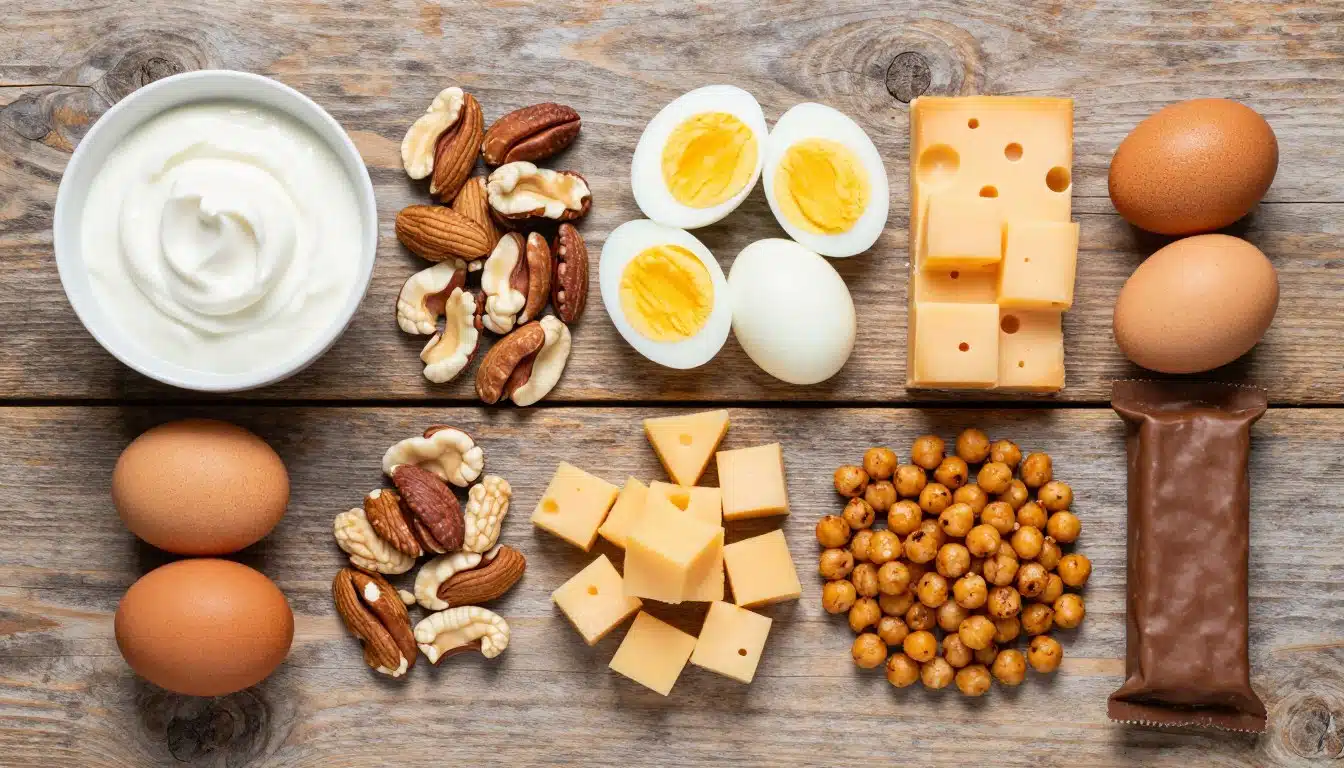
Snacks with high protein are the easiest fix for the two things that derail most eating plans: getting hungry an hour after eating, and arriving at dinner ravenous.
Protein is more filling per calorie than carbohydrate or fat, and spreading it across the day works better than loading it all onto dinner. Below: how much you actually need, the options worth keeping in the house, and one piece of gym folklore worth letting go of.
- Aim for 10–20 g of protein per snack, with the muscle-building response plateauing around 20–30 g in one sitting.
- The 30-minute post-workout window is a myth — a 23-trial meta-analysis found no timing effect once total daily protein was controlled for; the real window is 4–6 hours.
- Cottage cheese, plain Greek yogurt, tuna pouches and egg whites give the most protein per calorie.
- If you have chronic kidney disease, don’t raise protein intake on general advice — your renal team sets the right amount.
How Much Protein Do Snacks With High Protein Need to Deliver?
Start with your daily total, then divide it up.
Roughly 0.8 g per kg of body weight is the baseline for adults who aren’t training. Recreational exercisers do better around 1.0–1.2 g/kg. For people doing serious resistance training, the evidence points to a benefit up to about 1.6 g/kg, with little gained above roughly 2.2 g/kg.
Older adults sit higher than the baseline — around 1.0–1.2 g/kg — because aging muscle responds less readily to protein.
For a 70 kg person exercising regularly, that’s roughly 84–112 g a day. Split across three meals at 25–30 g each, a snack or two carrying 10–20 g closes the gap comfortably.
Around 20–30 g in one sitting appears to be the point where the muscle-building response plateaus for most people. Snacks below that still count — they just aren’t doing anything special beyond keeping you full.
If you have chronic kidney disease, this advice doesn’t apply to you. Reduced kidney function often means limiting protein rather than increasing it, and the right amount is set by your renal team. Don’t raise your intake on general nutrition advice.
The Best Snacks With High Protein, by Category
Approximate figures — brands vary, so the label beats any chart.
Dairy
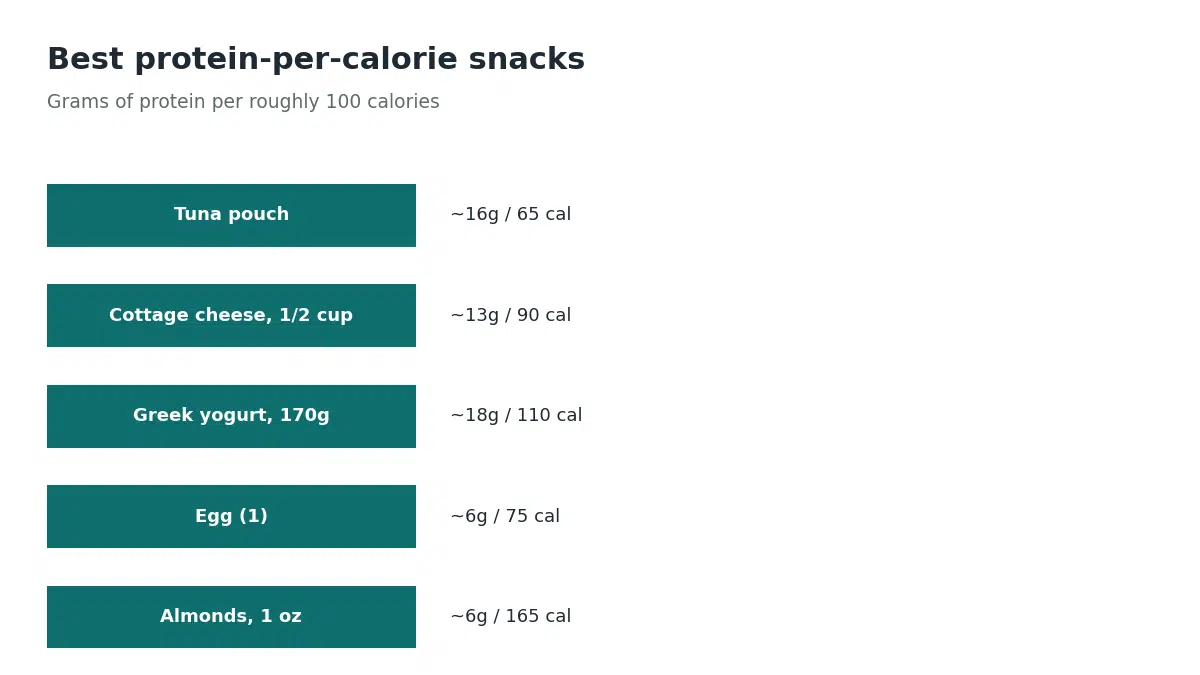
Greek yogurt is the strongest all-rounder: around 17–20 g of protein in a 170 g pot for about 100–120 calories. Buy plain — flavored versions often carry more sugar than the protein is worth. Our guide to reading a yogurt label covers the ten-second check.
Cottage cheese gives roughly 12–14 g per half cup for under 100 calories — the best protein-per-calorie ratio on this page. It’s also mostly casein, which digests slowly.
String cheese is 6–8 g per stick and needs no preparation, which is often what matters most.
Eggs
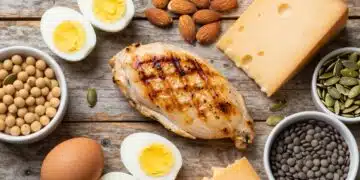
About 6 g each, roughly 70–80 calories, and complete in all essential amino acids. Boil a batch at the start of the week. Everything bagel seasoning stops them becoming boring by Wednesday.
Nuts and seeds
An ounce of almonds or peanuts gives 6–7 g; pumpkin seeds are higher at around 9 g. All are calorie-dense at 160–180 calories per ounce, so portion them out rather than eating from the bag.
Legumes
Edamame is the standout — around 17 g of complete protein per cup of shelled beans, unusual for a plant source. Roasted chickpeas give about 7 g per half cup plus 6 g of fiber. Hummus with vegetables works, though it’s lower in protein than people assume.
Meat and fish
A tuna pouch is excellent value — around 16 g for 60–70 calories.
Turkey slices roll up around vegetables in seconds. Jerky travels anywhere and needs no fridge, at 9–12 g per ounce, though it’s usually high in sodium; worth checking if you’re watching blood pressure.
The 30-Minute Post-Workout Window Is a Myth
If you’ve ever rushed home from the gym worried your session was wasted, you can stop.
A meta-analysis by Schoenfeld, Aragon and Krieger pooled 23 randomized controlled trials and found no significant timing effect on either muscle growth or strength once total daily protein was accounted for.
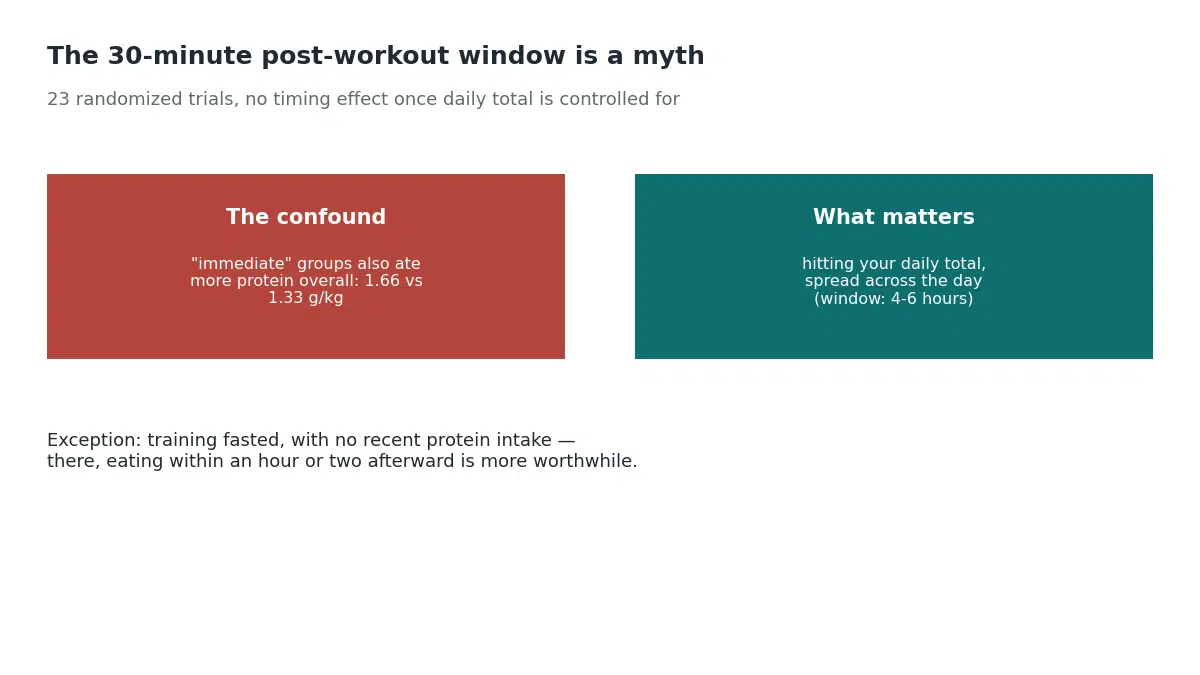
The reason earlier studies seemed to show a timing benefit was a dosing confound: the groups eating immediately after training were also eating more protein overall — around 1.66 g/kg versus 1.33 g/kg. Control for that, and the timing effect disappears.
Aragon and Schoenfeld’s related work suggests the practical window runs to four to six hours, not thirty minutes — and if you ate a protein-containing meal a couple of hours before training, those amino acids are still circulating while you lift.
The one exception: training fasted. With no recent protein intake, getting some within an hour or two afterwards is more worthwhile.
What actually predicts results is hitting your daily total, spread reasonably across the day. That’s a much easier target than a stopwatch.
Choosing Snacks With High Protein for Your Situation
Managing weight? Prioritize protein per calorie. Cottage cheese, Greek yogurt, tuna pouches and egg whites deliver a lot of protein for very little. Nuts are nutritious but calorie-dense — easy to overshoot.
Training hard? Add carbohydrate alongside the protein, and don’t stress the clock.
Watching blood sugar? Protein and fat with minimal refined carbohydrate: eggs, cheese, nuts, meat roll-ups. Pairing protein with carbohydrate also blunts the glucose rise — our guide to fruit and blood sugar covers how to test your own response.
Vegetarian or vegan? Edamame, hemp seeds and soy products are complete proteins. Others aren’t individually, but eating varied sources across the day handles that — you don’t need to combine them at each snack.
Older? Softer options are easier: yogurt, cottage cheese, eggs, smooth nut butters.
Feeding children? Whole nuts and whole grapes are choking hazards under about five — our guide to cutting grapes safely explains why lengthwise matters.
Protein Bars and Powders: Read the Label
Both are convenient and neither is necessary. If you use them:
Aim for protein at least double the added sugar. A bar with 15 g protein and 6 g sugar is doing its job; one with 10 g protein and 15 g sugar is a chocolate bar with a health claim.
Front-of-pack claims mean little — some “protein” bars contain 5–7 g. Check the panel.
Worth knowing about powders. Clean Label Project testing of 160 top-selling protein powders in 2025 found 47% exceeded at least one federal or state contaminant threshold, with 21% over twice the California Prop 65 lead limit. Plant-based powders averaged around three times more lead than whey, organic around three times more than non-organic, and chocolate roughly four times more than vanilla. The lowest-contaminant category was non-chocolate whey or collagen. The industry body disputed the methodology, so treat it as contested — but if you use powder daily, non-chocolate whey is the lower-risk pick. Our guide to protein powder side effects covers this in more detail.
Whole foods bring fiber, vitamins and minerals that neither bars nor powders reliably match. Use the convenient options when convenience is the constraint, not as the default.
Making It Actually Happen
Preparation is the whole game. Snacks with high protein mostly fail because nothing is ready when you’re hungry.
Boil a dozen eggs at the weekend.
Portion nuts into small bags straight after shopping, while you’re not hungry.
Keep shelf-stable options — tuna pouches, jerky, a bar — in your bag, car and desk. These exist to stop you buying something worse at 4pm.
Buy plain and add your own. Large tubs of plain yogurt and blocks of cheese cost far less per serving than individually packaged versions, and you control the sugar.
Put the good stuff at eye level. Genuinely effective, slightly embarrassing, works anyway.
Timing-wise: mid-morning and mid-afternoon, roughly two to three hours after a meal, is when most people need it. A small portion of something slow-digesting like cottage cheese before bed suits people training hard.
Frequently Asked Questions
How much protein should snacks with high protein contain?
Around 10–20 g works for most people between meals. Roughly 20–30 g in one sitting is where the muscle-building response plateaus.
Snacks below that still help with fullness — they’re just not doing anything extra for muscle.
Do I need protein within 30 minutes of a workout?
No. A meta-analysis of 23 randomized trials found no timing effect on muscle or strength once total daily protein was controlled for — earlier studies suggesting otherwise had groups eating more protein overall.
The practical window is more like four to six hours. Training fasted is the one case where sooner is better.
Which snack gives the most protein per calorie?
Cottage cheese, plain Greek yogurt, tuna pouches and egg whites lead on protein per calorie. A tuna pouch delivers around 16 g for 60–70 calories.
Nuts are nutritious but calorie-dense at 160–180 per ounce, so they’re a poor choice if calories are the constraint.
What are the best portable options?
Tuna pouches, jerky, pre-portioned nuts, string cheese and a decent bar all survive a bag or glovebox without refrigeration.
With a cool bag you can add Greek yogurt, cottage cheese, hard-boiled eggs and turkey roll-ups.
Can you eat too much protein?
For healthy adults, intakes up to around 2 g/kg appear safe, and there’s little benefit above roughly 1.6 g/kg for muscle. Beyond that it’s just expensive calories.
If you have chronic kidney disease this is different — protein is often restricted, and your renal team sets the amount.
Are protein powders safe?
Clean Label Project’s 2025 testing of 160 powders found 47% exceeded at least one contaminant threshold, with plant-based averaging about three times more lead than whey and chocolate about four times more than vanilla.
The industry disputed the methodology, so it’s contested — but non-chocolate whey looks like the lower-risk option for daily use.
What are good vegetarian and vegan options?
Edamame at around 17 g per cup is the standout, and hemp seeds and soy are also complete proteins. Roasted chickpeas, nut butters and seeds fill in.
Individual plant proteins may be incomplete, but eating varied sources across the day covers it — no need to combine at every snack.
Is a bedtime protein snack worth it?
For people training seriously, a small slow-digesting portion — cottage cheese is the classic, being mostly casein — gives a steady amino acid release overnight.
Keep it small, 100–200 calories. For anyone not training hard, it makes little difference.
SOURCESOur Editorial Standards
HealthMagHub is built on primary sources: peer-reviewed research, clinical practice guidelines, and health agencies such as the NIH, CDC, and FDA. Read our editorial standards to see how we research, cite, and update our articles.
- Schoenfeld BJ, Aragon AA, Krieger JW. The effect of protein timing on muscle strength and hypertrophy: a meta-analysis. JISSN, 2013. jissn.biomedcentral.com
- Morton RW, et al. A systematic review, meta-analysis and meta-regression of protein supplementation on resistance training-induced gains in muscle mass and strength. British Journal of Sports Medicine, 2018.
- Mayo Clinic Health System. Are You Getting Too Much Protein? mayoclinichealthsystem.org
- Clean Label Project. Protein Powder Study, 2025. cleanlabelproject.org
Disclaimer: This article is general information, not dietetic advice. If you have chronic kidney disease or liver disease, do not increase protein intake on general advice; your care team sets the appropriate amount. Whole nuts and whole grapes are choking hazards for children under five.