
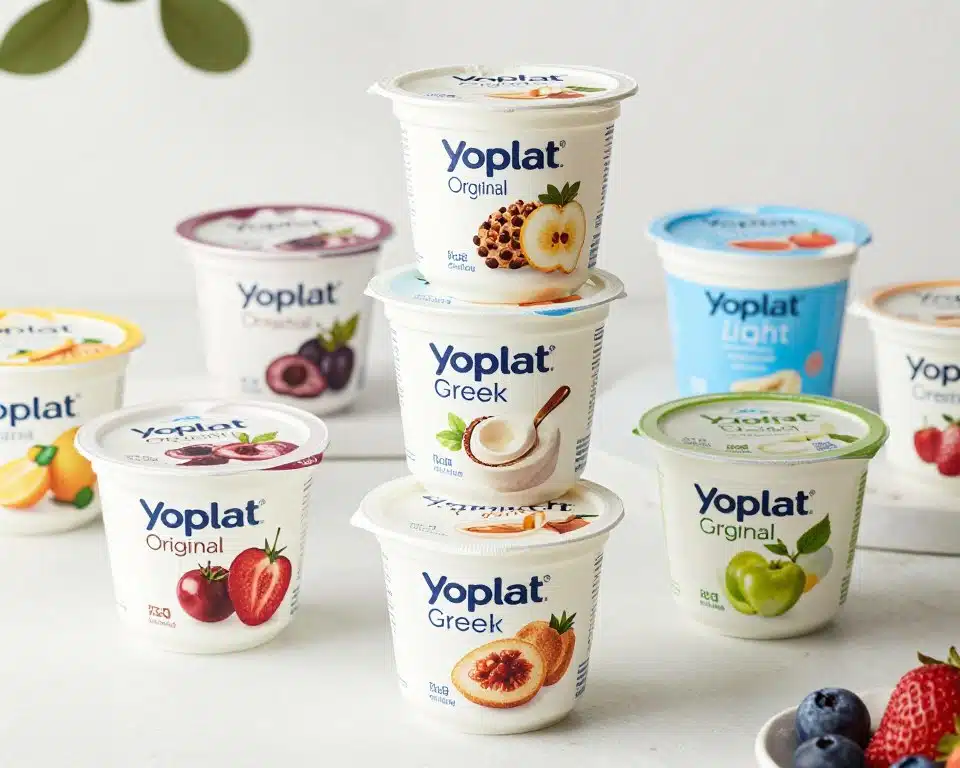
Rather than trust a number printed in an article, since formulations change and this one has changed repeatedly, the useful skill is reading the cup in front of you. It takes about ten seconds once you know where to look.
- Check the “Added Sugars” line, not total sugars. Plain yogurt naturally contains 7-12g of milk lactose that isn’t the problem.
- Rule of thumb: look for at least as many grams of protein as added sugar. Plain Greek passes easily; flavored and children’s cups often fail.
- Yoplait removed high fructose corn syrup in 2009 and dropped aspartame from Light, so older articles listing these are out of date.
- All yogurt has live cultures by definition, but mainstream yogurt isn’t a defined-strain probiotic, though it’s still useful for lactose digestion.
The Ten-Second Label Check
Find the “Includes Xg Added Sugars” line. This is the one that matters, and US labels have been required to carry it since 2020, which is exactly what makes older yogurt advice obsolete.[2]
Total sugars are misleading here. Plain yogurt contains around 7-12 grams of lactose naturally, and that’s simply milk. What you’re looking at is the added figure underneath.
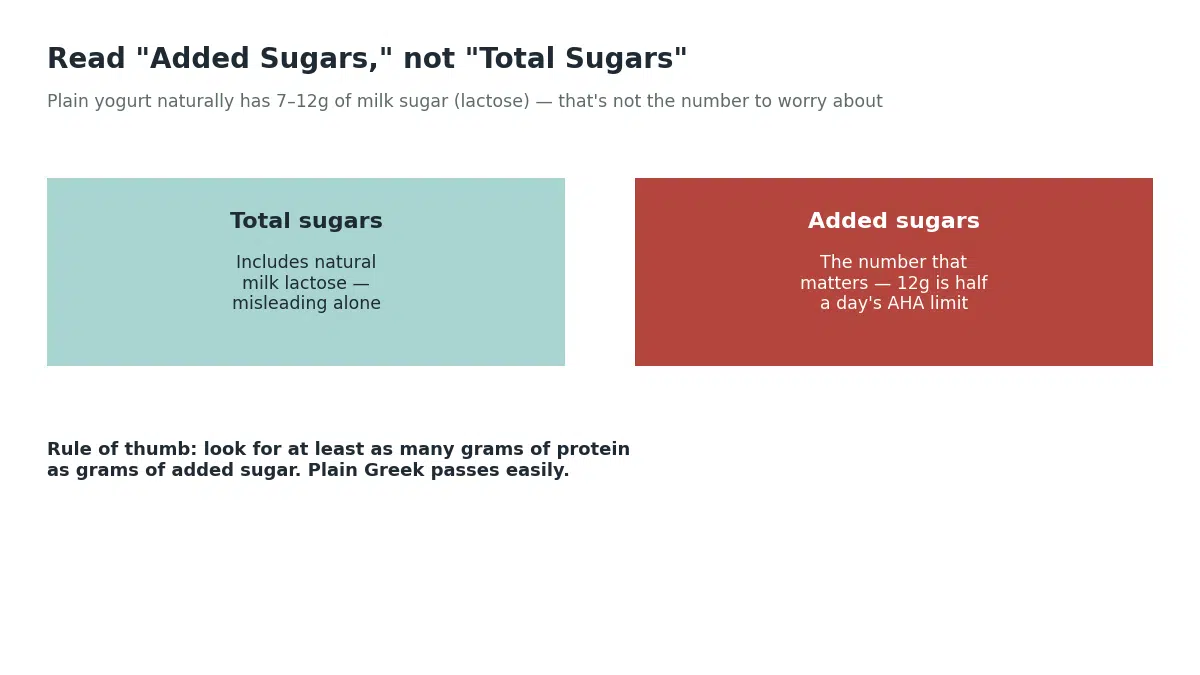
For context, the American Heart Association suggests limiting added sugar to about 25 grams a day for women and 36 for men.[1] A cup carrying 12 grams of added sugar has used roughly half a day’s allowance.
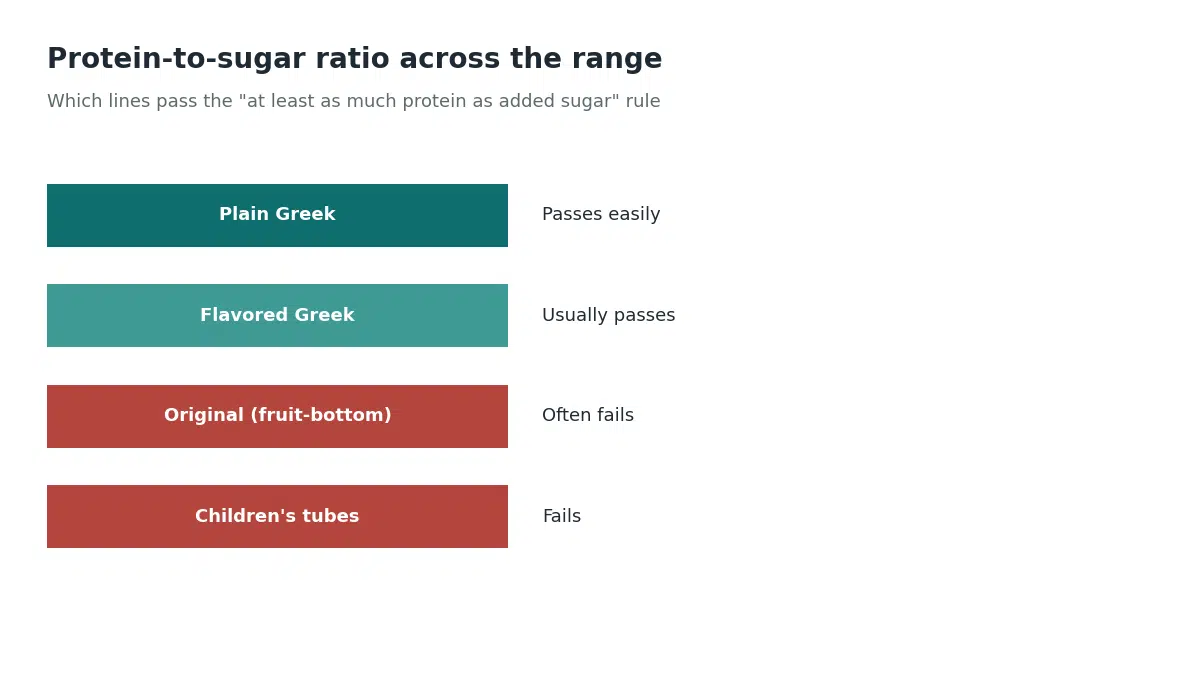
Then check protein against it. A rough rule: aim for at least as many grams of protein as added sugar. Plain Greek passes easily. Dessert-flavored cups usually don’t.
Then glance at the ingredient list length. Plain Greek yogurt is typically milk and cultures. The further a product travels from that, the more it’s a sweetened dairy snack rather than yogurt in the useful sense.
That’s the whole method, and it works on any brand in the aisle.
How the Yoplait Lines Differ
Approximate shapes rather than exact figures, since these get reformulated:
Plain Greek is the strongest option in the range. Straining concentrates protein and removes some lactose, and with no flavoring there’s nothing added. This is the one to buy if you want yogurt to do nutritional work.
Flavored Greek keeps most of the protein advantage and adds sweetener. Still a reasonable protein-to-sugar ratio in most cases.
Original is the classic fruit-on-the-bottom style: modest protein, noticeably more sugar. General Mills reformulated this line in 2015, cutting sugar by about a quarter, dropping calories and adding a gram of protein by using more milk.[3]
Light reduces calories using non-nutritive sweeteners rather than sugar. Whether that’s an improvement depends on what you’re optimizing for; it doesn’t add protein.
Children’s products, meaning tubes and character-branded cups, are formulated for taste acceptance. They deliver calcium and vitamin D, but sugar is doing much of the work.
Two things frequently repeated online that are out of date: Yoplait removed high fructose corn syrup from its yogurts in 2009, and stopped using milk from cows treated with rBGH/rBST the same year. Articles still listing HFCS as a Yoplait ingredient are working from pre-2009 information. The Light line no longer uses aspartame. General Mills switched away from it. If you’re avoiding a specific sweetener, read the current cup rather than an old list.
Is Yogurt Yoplait Healthy For You?
Calcium and vitamin D in a form people reliably eat. For anyone who doesn’t drink milk, yogurt is one of the easier routes to both.
Protein, substantially more in Greek varieties, which is what makes the difference between a snack that holds you and one that doesn’t.
Live cultures. All yogurt contains them by definition. That’s what fermentation is. Worth being precise about what that means: mainstream yogurts don’t specify strains or colony counts, so they aren’t equivalent to a probiotic taken for a defined purpose. What they do reliably do is partially break down lactose, which is why many people who struggle with milk manage yogurt comfortably. Our guide to fermented foods and gut health covers where the evidence is stronger.
Yogurt is also genuinely convenient, and a portable food someone actually eats beats an optimal food they don’t.
Choosing Well for Your Situation
Managing diabetes: plain Greek, with fruit added yourself. The added sugars line is the number to check, and pairing with nuts or seeds slows absorption. Our guide to fruit and blood sugar covers how to test your own response rather than relying on published figures.
Feeding children: plain or lightly sweetened with fruit stirred in is better than character-branded tubes, though anything they’ll actually eat has some value. Sweetness is a learned preference, and starting lower makes lower easier later.
Training or trying to stay full: Greek, for the protein. Note that some competitors reach higher protein per cup than Yoplait’s Greek line, so if that’s your main criterion it’s worth comparing across brands.
Lactose intolerance: Greek tends to be better tolerated than regular, since straining removes some lactose and the cultures break down more. Lactose-free options exist if that isn’t enough.
Watching your budget: a large plain tub costs considerably less per serving than single cups, and adding your own fruit removes the sugar problem entirely. That single swap fixes most of what’s wrong with the category.
Making a Plain Tub Interesting
The recurring objection to plain yogurt is that it’s dull. That’s a solvable problem.
Sweet: berries, sliced green grapes, banana with cinnamon, cocoa powder, a small drizzle of honey. Fruit brings fiber and antioxidants that a fruit preparation at the bottom of a cup mostly doesn’t.
Crunch and staying power: almonds, walnuts, pumpkin seeds, chia, ground flaxseed, nut butter.
Savory, and underused: cucumber and dill, garlic and lemon as a dip, olive oil and za’atar, everything bagel seasoning. Plain Greek works as a sour cream substitute in most applications.
Honey shouldn’t be given to infants under 12 months.
Keeping It in Proportion
A sweetened yogurt is not a health disaster. It still carries calcium, vitamin D, protein and live cultures, which is more than most snacks of comparable sweetness manage.
The honest framing is that flavored cups sit somewhere between a snack and a dessert, and are better thought of that way than as a health food. Plain yogurt with fruit you added is straightforwardly a good food.
Nothing about one cup of yogurt determines the quality of a diet in either direction.
Frequently Asked Questions
Is yogurt Yoplait healthy overall?
Check the “Includes Added Sugars” line rather than total sugars, since plain yogurt naturally contains milk sugar.
Which Yoplait is the healthiest?
Buy it in a large tub and add your own fruit. That’s cheaper per serving than single cups and it removes the added sugar entirely.
Does Yoplait contain high fructose corn syrup?
Articles still listing HFCS as a Yoplait ingredient are working from pre-2009 information.
How much sugar should I look for?
A useful rule of thumb is at least as many grams of protein as added sugar.
Does Yoplait have probiotics?
What they do reliably do is partially break down lactose, which is why many people tolerate yogurt better than milk.
Is Yoplait suitable if I have diabetes?
Flavored varieties need checking against the added sugars line, and your own glucose readings tell you more than any label does.
Is Greek yogurt better than regular?
Regular yogurt isn’t bad; it’s just a lighter option nutritionally.
Can I eat yogurt past the date on the cup?
Discard it if there’s mold, an off smell, or anything unusual. Once opened, use within about a week, and don’t leave it out more than two hours.
SOURCESOur Editorial Standards
HealthMagHub is built on primary sources: peer-reviewed research, clinical practice guidelines, and health agencies such as the NIH, CDC, and FDA. Read our editorial standards to see how we research, cite, and update our articles.
- American Heart Association. Added Sugars. heart.org
- U.S. Food and Drug Administration. Added Sugars on the Nutrition Facts Label. fda.gov
- Food Business News. General Mills reduces sugar in Yoplait (2015). foodbusinessnews.net
Disclaimer: This article is general information, not medical or dietetic advice, and is not affiliated with or endorsed by General Mills. Product formulations change, so always read the current label. Speak to a doctor or dietitian if you are managing diabetes, kidney disease, or a dairy allergy.