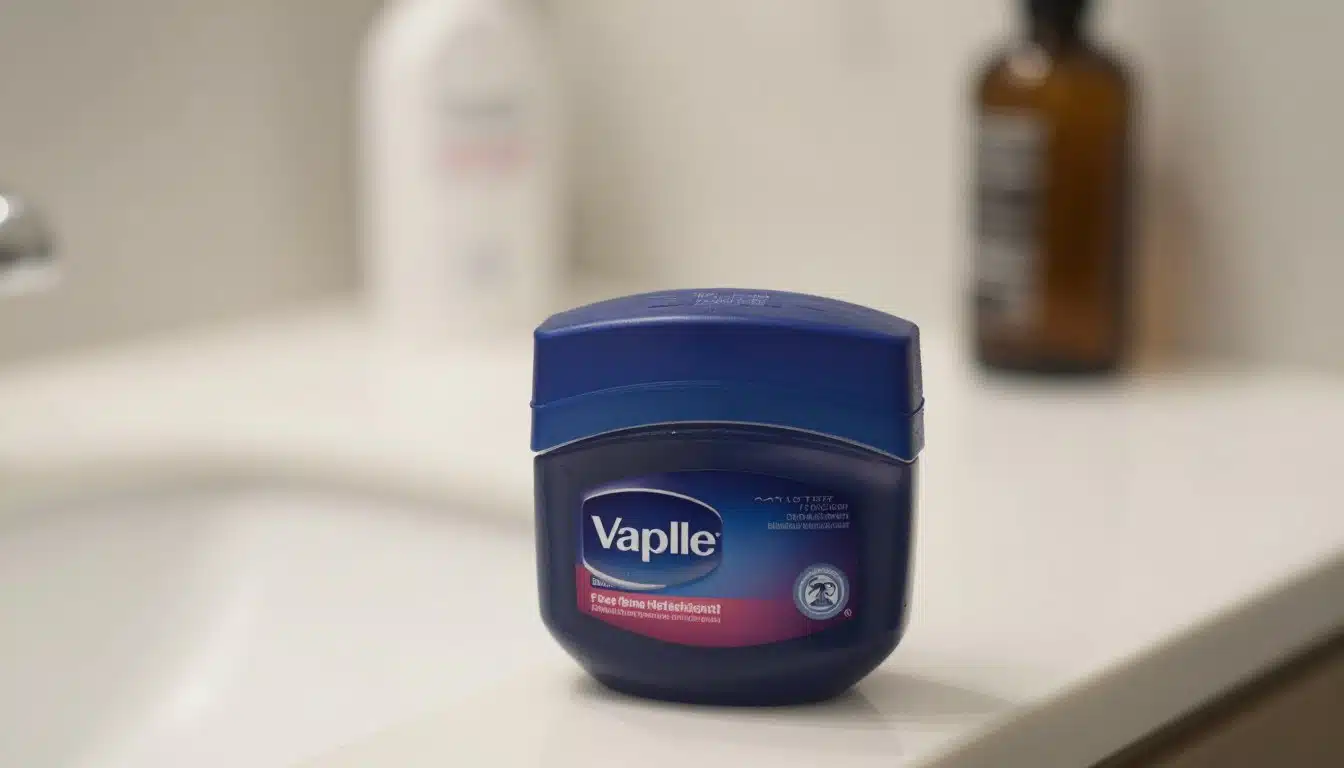
Does Vaseline expire? Technically yes, but it’s one of the most stable products in your bathroom — a jar found at the back of a cupboard is usually fine.
The more useful questions are how to tell when it has actually gone off, and where you shouldn’t be putting it regardless of how fresh it is. Two common uses carry real risks, and neither has anything to do with the expiry date.
- Petroleum jelly has no water content, so nothing shortens its shelf life more than contamination from fingers or moisture in the jar.
- Nasal use can cause exogenous lipoid pneumonia; as a sex lubricant it degrades latex and roughly doubles bacterial vaginosis risk.
- Fresh petroleum jelly has no smell at all — any odor is the clearest sign something’s changed.
- Use fresh product on broken skin, wounds, babies, faces, and any condition you’re actively treating.
Does Vaseline Expire, and Why Is It So Stable?
Petroleum jelly is a mixture of mineral oils and waxes with no water in it. That single fact explains most of its longevity.
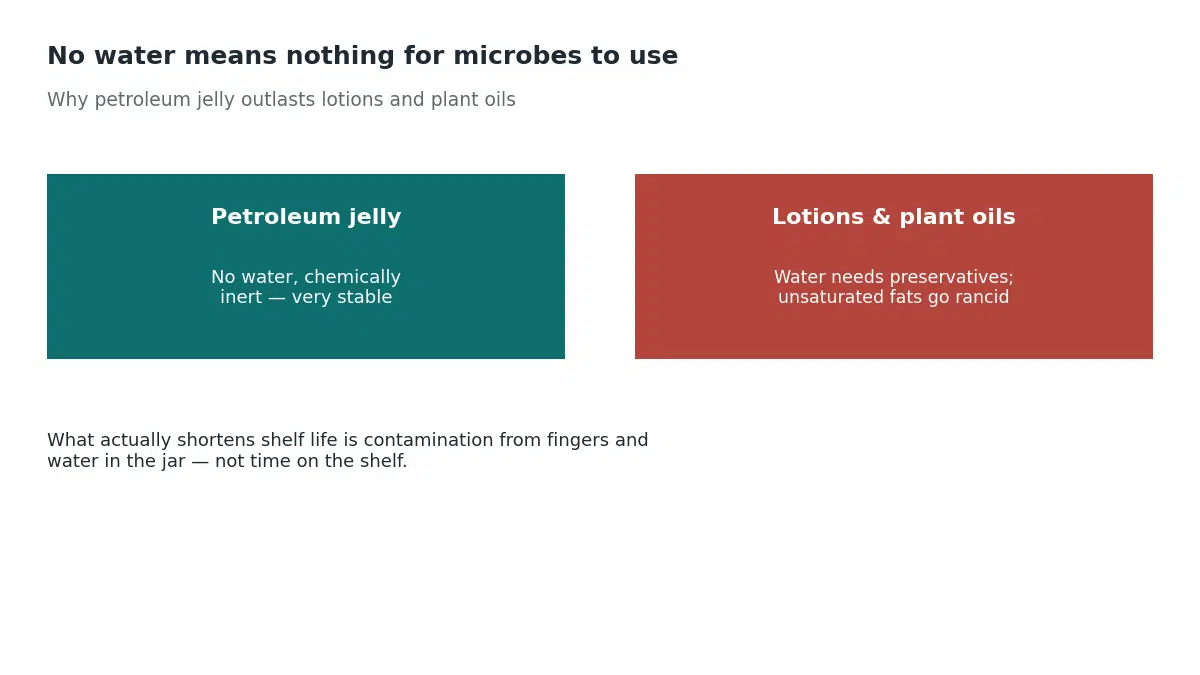
Bacteria and mold need moisture to grow. Lotions and creams contain water, which is why they need preservatives and expire within a couple of years. Petroleum jelly gives microbes nothing to work with.
It’s also chemically inert. Plant oils — coconut, shea, argan — contain unsaturated fats that oxidize and go rancid within months. Refined petrolatum has no such bonds to break.
Manufacturers typically print a date around three years out. That’s a quality guarantee, not a cliff edge. Stored sealed in a cool cupboard, pure petroleum jelly stays usable well beyond it.
What does shorten its life is contamination, not time. Fingers introduce bacteria and skin cells. Water getting into the jar creates somewhere for microbes to live. A three-year-old sealed jar is in better shape than a one-year-old jar that’s been dipped into daily with wet hands.
How to Tell If It Has Gone Off
Fresh petroleum jelly is clear to faintly translucent, completely odorless, and smooth throughout.
Throw it out if you see:
- Any smell at all — rancid, chemical, or just “off”
- Yellowing, darkening or patchy discoloration
- Visible mold, or anything fuzzy
- Liquid separating out and pooling on the surface
- A gritty or crystalline texture
- Debris, hairs or foreign particles in the jar
Smell is the most reliable early signal. Petrolatum has no scent of its own, so anything you can detect came from somewhere else.
Consistency changes with temperature and don’t necessarily mean spoilage — a jar left in a hot car may go runny and firm up again when it cools. Repeated heating and cooling does eventually affect texture, though.
Two Uses to Avoid, Whatever the Date Says
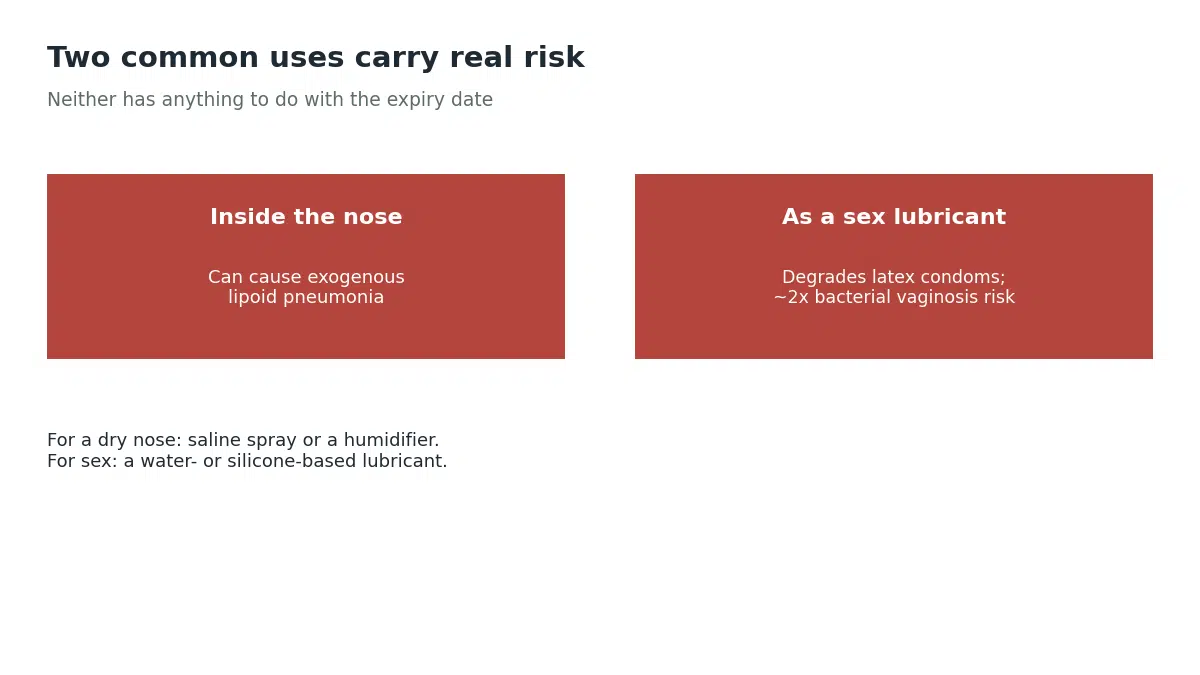
Don’t put it inside your nose. This is common advice for winter dryness and nosebleeds, and it carries a real risk. Small amounts inhaled over time can accumulate in the lungs and cause exogenous lipoid pneumonia — inflammation caused by oil in lung tissue.
Mayo Clinic notes that prolonged inhalation can cause this lung inflammation, and there are published case reports of it following regular nightly application inside the nostrils.
It’s hard to spot, because it develops slowly and looks like other lung conditions on imaging. Treatment is usually just stopping the product, though recovery can take a long time.
Use instead: saline nasal spray or gel, or a humidifier — our guide to clearing a blocked nose covers what works and how to rinse safely. If you must use a lubricant, choose a water-soluble one, use it sparingly, and not in the hours before lying down. Take particular care with children and anyone with swallowing difficulties.
Don’t use it as a sexual lubricant. Two separate problems here.
It destroys latex. Oil-based products degrade latex condoms and diaphragms, which can cause them to fail — removing the protection you’re relying on for contraception and infection prevention.
It’s associated with bacterial vaginosis. Research published in Obstetrics & Gynecology found women using petroleum jelly intravaginally were around twice as likely to have bacterial vaginosis. Petrolatum is slightly alkaline, and the vagina depends on an acidic environment to keep its bacterial balance.
Use instead: a water-based or silicone-based lubricant. Both are condom-safe and designed for the purpose.
Both of these matter more than the expiry date on the tub, and neither appears on the label.
Is Slightly Expired Vaseline Safe to Use?
On intact skin, usually yes. Dry hands, rough heels, chapped lips, a bit of chafe protection — an old jar that looks and smells normal will do the job.
Use fresh product for:
- Broken skin, cuts, or anywhere the barrier is compromised
- Post-surgical sites or wound care
- Babies and diaper rash
- Faces, particularly if you’re acne-prone
- Eczema or any condition you’re actively managing
The logic is straightforward: anywhere skin is broken, contamination matters far more, and a jar that’s been open for years has been exposed to more of it.
Petroleum jelly is genuinely excellent at its main job — it reduces water loss through the skin by around 98%, which is why dermatologists recommend it so consistently. Apply to slightly damp skin after washing to trap moisture underneath. It works from the outside in, which is worth bearing in mind when comparing it to ingestible skin products: our look at collagen supplements and skin covers how much weaker that evidence is.
When a Dry Patch Needs More Than Petroleum Jelly
Petroleum jelly is a barrier, not a treatment. It protects skin while skin heals itself — so if something isn’t healing, the jelly isn’t the answer.
Worth getting looked at:
- A patch of skin, sore or lip lesion that hasn’t healed in two weeks. Persistent changes on the lips in particular deserve attention — our guide to white patches on the lips explains why the two-week rule matters
- Widespread itching with no visible rash, which can point to something systemic rather than dry skin — covered in our piece on what causes itching without a rash
- Skin that’s cracked, weeping, crusted or spreading, which suggests infection rather than dryness
- Sudden severe dryness alongside other symptoms like fatigue or weight change
Barrier creams are excellent for what they do. They just don’t diagnose anything.
Storage That Actually Extends Its Life
Since contamination shortens shelf life more than time does, hygiene is the thing worth getting right.
Use a clean tool — a cotton bud or small spatula — rather than fingers. This is the single biggest factor.
Never put unused product back in the jar.
Close the lid properly and keep water out.
Store somewhere cool and dark. A bedroom drawer beats a bathroom cabinet, which gets steam and temperature swings every day.
Buy a size you’ll actually use. A small tub finished in a year is better than a large one opened weekly for five.
Tubes are more hygienic than tubs, since nothing goes into them.
Refrigeration isn’t necessary and makes it unpleasantly hard to spread.
Not All Vaseline Products Last the Same
Pure petroleum jelly is the most stable thing in the range. Everything else in the line-up contains more ingredients, and more ingredients means more that can degrade.
Lotions contain water, so they need preservatives and expire meaningfully sooner. Lip products with flavors and colors, and jellies with added vitamins or aloe, sit somewhere in between.
The general rule: the shorter the ingredient list, the longer it lasts. Check the individual label rather than assuming the whole brand behaves like the original jelly.
What to Do With an Old Jar
If it looks and smells wrong, don’t put it on your skin — but it doesn’t have to go straight in the bin.
Petroleum jelly is a genuinely good lubricant and rust preventer. Squeaky hinges, sticking drawer runners, garden tools going into winter storage, battery terminals, the threads of a light bulb. It also conditions leather.
When you do dispose of it, it goes in general waste — it doesn’t biodegrade and shouldn’t go down the drain or into compost. Scrape the container out before recycling it.
Frequently Asked Questions
Does Vaseline expire?
Very slowly. With no water content and chemically inert ingredients, it resists both microbial growth and oxidation. Manufacturers typically print a date around three years out, but sealed and stored well it lasts beyond that.
Contamination shortens its life far more than time does.
Can I put Vaseline in my nose for dryness?
Better not to. Inhaling small amounts over time can cause exogenous lipoid pneumonia — lung inflammation from accumulated oil — and Mayo Clinic advises against prolonged nasal use.
Use saline spray or gel, or a humidifier. If you need a lubricant, choose a water-soluble one and avoid it before lying down.
Can I use Vaseline as a lubricant during sex?
No. Oil-based products degrade latex, so condoms and diaphragms can fail. Research in Obstetrics & Gynecology also found intravaginal petroleum jelly use associated with roughly double the rate of bacterial vaginosis.
Water-based or silicone-based lubricants are condom-safe and made for the job.
How can I tell if Vaseline has gone bad?
Smell it first — fresh petroleum jelly has no odor at all, so any smell means something’s changed. Then look for yellowing, mold, liquid separating out, grittiness, or debris in the jar.
Texture changes from heat alone often reverse when it cools and don’t necessarily mean spoilage.
Is it safe to use expired Vaseline on my skin?
On intact skin, generally yes, if it looks and smells normal. Dry hands, heels and chapped lips are fine.
Use fresh product on broken skin, wounds, surgical sites, babies, faces, or any condition you’re actively treating — contamination matters much more where the skin barrier is compromised.
Can I use ten-year-old Vaseline?
If it’s been sealed and stored cool, it’s probably chemically fine — but a jar that old has usually been opened and dipped into repeatedly.
Reserve it for household jobs like lubricating hinges or protecting tools from rust, and buy a fresh tub for skin.
Should I keep it in the fridge?
No need, and it makes it hard to spread. A cool, dark cupboard is ideal.
A bedroom drawer is better than a bathroom cabinet, which gets steam and daily temperature swings.
Does Vaseline clog pores?
Pure petrolatum is considered non-comedogenic, but it’s strongly occlusive — so applying it over unclean skin seals in whatever’s already there.
If you’re acne-prone, apply sparingly to clean skin, and use a fresh jar rather than an old one for facial use.
SOURCESOur Editorial Standards
HealthMagHub is built on primary sources: peer-reviewed research, clinical practice guidelines, and health agencies such as the NIH, CDC, and FDA. Read our editorial standards to see how we research, cite, and update our articles.
- Mayo Clinic. Petroleum jelly: Safe for a dry nose? mayoclinic.org
- Kilaru H, et al. Nasal application of petrolatum ointment — a silent cause of exogenous lipoid pneumonia. Respiratory Medicine Case Reports, 2017.
- Exogenous Lipoid Pneumonia after Long-Term Nasal Petroleum Jelly Application. pubmed.ncbi.nlm.nih.gov
Disclaimer: This article is general information, not medical advice. Do not apply petroleum jelly inside the nose or use it as a sexual lubricant. See a doctor for any skin or lip lesion that hasn't healed within two weeks, or before using it on wounds, burns, infants, or diagnosed skin conditions.