
Before you buy anything, the uncomfortable part about vitamins for receding gums: no supplement makes receded gum tissue grow back. Gum tissue doesn’t regenerate the way skin does. Once it has pulled away from a tooth, it’s gone unless a periodontist rebuilds it surgically.
- No vitamin regrows receded gum tissue. Only a surgical graft restores coverage once tissue has migrated down the tooth.
- Vitamin C has the strongest evidence: correcting a deficiency reduces gingival bleeding, but it doesn’t reverse established periodontitis.
- In a trial after surgical root coverage, CoQ10 achieved complete coverage 60% of the time versus 13.3% with placebo, but only as an adjunct to surgery rather than on its own.
- Vitamin K2 and CoQ10 can both interact with warfarin, and this matters more than anything else in the article for anyone on that medication.
That doesn’t make nutrition irrelevant. Deficiency genuinely accelerates gum disease, correcting one genuinely helps, and a few nutrients have decent evidence for reducing inflammation and improving healing after treatment.
But the distinction matters, because the most expensive mistake here is spending a year on capsules while the underlying cause keeps eating away at bone.
See a Dentist First, Not a Supplement Aisle
Recession is a symptom. The common causes (periodontitis, brushing too hard, grinding, thin gum tissue, orthodontic movement) need different responses, and only one of them has anything to do with nutrition.
Book a dental appointment promptly if you have:
- Gums that bleed regularly when you brush or floss
- Teeth that feel loose, or new gaps appearing between teeth
- Persistent bad breath or a bad taste that brushing doesn’t fix
- Recession that’s visibly progressing over months
- Pain when biting, or gum tenderness that doesn’t settle
Get emergency care the same day for facial or jaw swelling with fever, difficulty swallowing or opening your mouth, or a rapidly worsening dental abscess. Infections in the floor of the mouth can compromise the airway.
Get any mouth ulcer, red or white patch, or lump that hasn’t healed in three weeks checked. That’s an oral cancer screening question, and dentists are the people who catch it.
What Recession Actually Is, and What Won’t Fix It
Gum recession means the gum margin has migrated down the tooth, exposing more of the crown and sometimes the root. You notice teeth looking longer, a notch at the gumline, and cold sensitivity where root surface is now exposed.
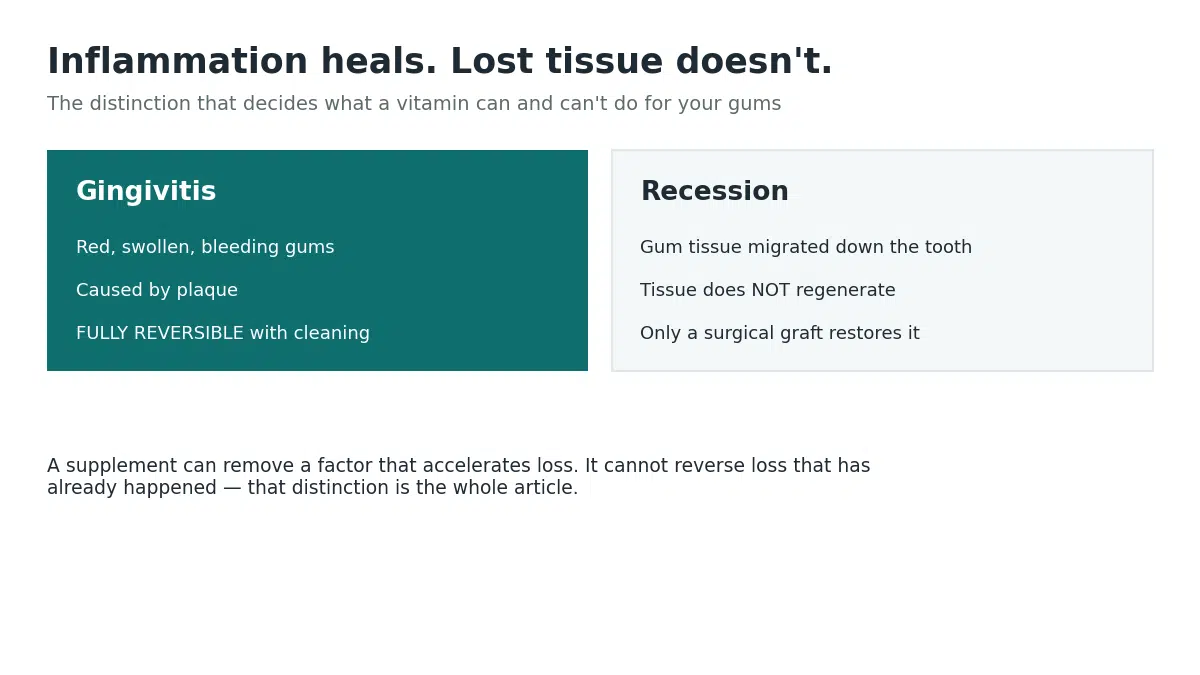
Two things get conflated constantly, and the difference decides what’s possible.
Gingivitis, meaning red, puffy, bleeding gums from plaque, is inflammation, and it’s fully reversible with proper cleaning. Recession is tissue that has been lost. Unlike skin, gum tissue doesn’t regenerate to fill the gap. When periodontitis is the cause, the bone underneath is being lost too, and that doesn’t come back either.[1]
So the realistic goals are: stop it progressing, treat any active disease, and reduce sensitivity. Coverage of an exposed root requires a graft: connective tissue taken from the palate, a repositioned flap of adjacent gum, or a donor matrix. That’s a periodontist’s procedure, not a nutritional one.
The causes worth checking before you blame your diet
- Brushing too hard. People using hard-bristled brushes have roughly twice as much recession. This is the single most modifiable cause and it costs nothing to change.
- Periodontitis. Bacterial infection destroying the attachment and bone. Needs professional cleaning below the gumline.[1]
- Grinding and clenching. Often nocturnal, often unnoticed, and a night guard helps.
- Naturally thin gum tissue, crowded teeth, or orthodontic movement.
- Tobacco and vaping, which restrict blood flow to gum tissue.
- Lip or tongue piercings rubbing against the gumline.
Which Vitamins for Receding Gums Have Real Evidence
Vitamin C: the strongest case, with limits
Vitamin C is required to build collagen, and gum tissue is largely collagen. Severe deficiency causes scurvy, whose classic sign is swollen, bleeding gums.[2]
Beyond deficiency, the evidence is real but bounded. Across multiple observational studies, lower vitamin C intake and blood levels track with more periodontal disease, and people with the lowest intake show the fastest progression. Supplementing improved gingival bleeding in people with gingivitis.
What it did not do was reverse established periodontitis, and it doesn’t regrow tissue. Being deficient accelerates loss; correcting a deficiency removes that accelerator. Taking more than you need doesn’t add benefit.
Food covers this easily: peppers, citrus, broccoli, strawberries. The upper limit for supplements is 2,000 mg a day, above which you mostly get diarrhea and, in susceptible people, a higher kidney stone risk.[2]
CoQ10: suggestive, as an adjunct
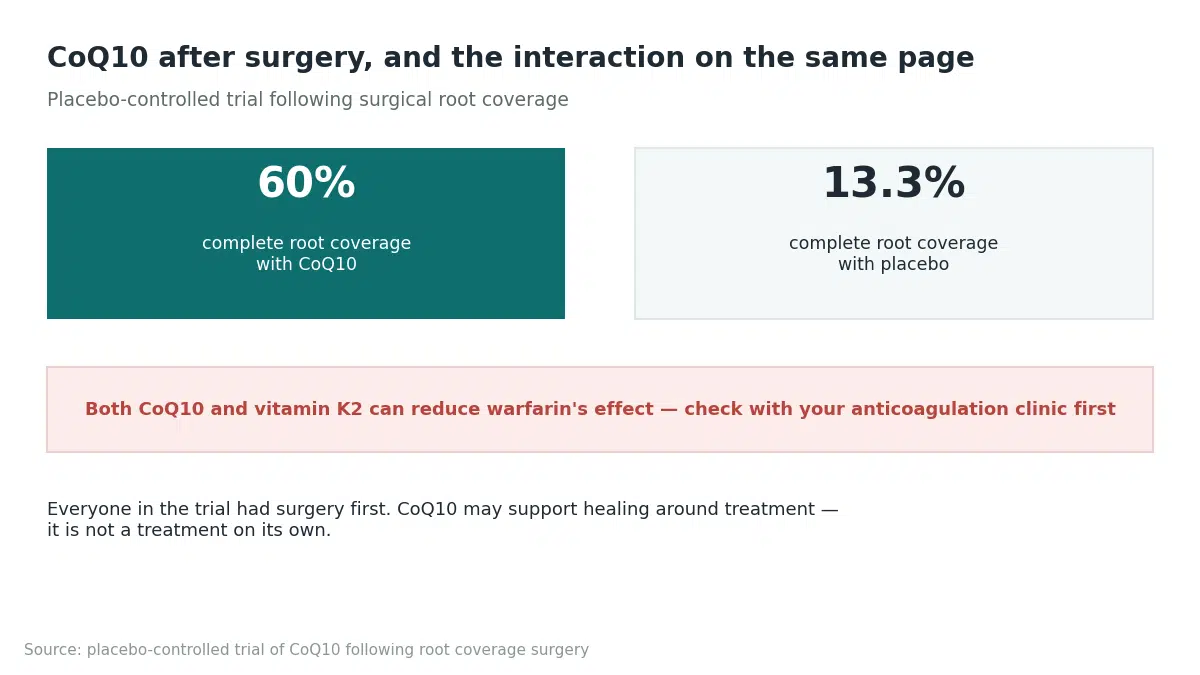
CoQ10 is the one with the most interesting finding. In a placebo-controlled trial of patients who had surgical root coverage, those taking CoQ10 achieved complete root coverage 60% of the time against 13.3% on placebo. Small trials of topical CoQ10 gel alongside scaling and root planing have also reported reduced inflammation and bleeding.
Read the same study carefully, though: the difference in mean root coverage (about 85% versus 72%) didn’t reach statistical significance. Suggestive, not settled.
The honest positioning is that CoQ10 may help healing around professional treatment. It is not a treatment on its own, and nothing in that trial happened without surgery first.
Vitamin D: plausible, mostly observational
Vitamin D matters for calcium absorption and for immune function, and gum tissue carries vitamin D receptors. Studies show an association between low vitamin D and gingival inflammation, and adequate levels appear to improve outcomes after periodontal surgery.
Most of that is observational, so the direction of cause isn’t settled. Worth testing your level and correcting a genuine deficiency, which is common and worth knowing anyway.[3] Not worth taking high doses on the theory that more protects your gums.
Vitamin K2: mechanistically plausible, thin evidence
K2 activates proteins that direct calcium into bone rather than soft tissue. That’s a real mechanism and it’s often paired with vitamin D for that reason.
For gum recession specifically, human evidence is thin. The mechanism is reasonable; the clinical case isn’t made. And K2 carries the most important interaction on this page, covered below.
What doesn’t have support
Oil pulling, charcoal, and most herbal rinses lack evidence for recession or gum disease. Oil pulling isn’t harmful and some people like how it feels, but it isn’t a treatment. Charcoal is abrasive, which is the opposite of what receding gums need.
Interactions and Safety
These are ordinary vitamins, which makes it easy to assume they’re inert. Several aren’t.
- Vitamin K2 and warfarin: the big one. Vitamin K directly opposes how warfarin works. A K2 supplement can reduce warfarin’s effect and destabilize your INR. If you take warfarin, do not start a K2 or D3+K2 product without your anticoagulation clinic’s input. This matters more than anything else in this article.
- CoQ10 and warfarin. CoQ10 is structurally similar to vitamin K and has been reported to reduce warfarin’s effect. Same conversation applies.[4]
- CoQ10, blood pressure, and blood glucose. It can lower both modestly, which is relevant if you’re already on medication for either.[4]
- Vitamin D at high doses can raise blood calcium. That risk increases with thiazide diuretics, and high calcium is dangerous alongside digoxin. Get a level tested rather than guessing at a dose.[3]
- Calcium supplements bind several medicines in the gut: levothyroxine, tetracycline and quinolone antibiotics, and iron. Space them several hours apart.
- Vitamin C above 2,000 mg daily causes GI upset and raises kidney stone risk in people prone to them.[2]
Take the actual bottles to your pharmacist if you’re on regular medication. It’s a free check and it catches the warfarin problem in about a minute.
What Actually Stops Recession Progressing
In rough order of how much difference they make:
Change how you brush. Soft bristles only, light pressure, angled at the gumline rather than scrubbed across it. An electric brush with a pressure sensor removes the guesswork. This is free and it addresses the commonest mechanical cause.
Get any periodontitis treated. Scaling and root planing removes the bacterial deposits below the gumline that no amount of brushing reaches. Nothing you eat substitutes for this.
Clean between your teeth daily, with floss or interdental brushes sized to your gaps, and a hygienist can tell you which.
Stop smoking or vaping. Tobacco restricts blood supply to gum tissue and is one of the strongest risk factors for periodontal disease.
Deal with grinding if you wake with jaw ache or your dentist has noticed wear facets. A night guard is straightforward.
Then correct any nutritional deficiency. It belongs on the list, just not at the top of it.
For sensitivity from exposed roots, a desensitizing toothpaste used consistently helps, and your dentist can apply fluoride varnish or bond the exposed area. If whitening is also on your mind, note that peroxide products aggravate exposed roots. Our guide to gentler whitening options covers that, and dental laser whitening is worth discussing with your dentist rather than attempting around receding gums.
Choosing a Supplement, If You Need One
Test before you treat where you can. Vitamin D is a simple blood test, and knowing your level beats guessing at a dose. Vitamin C deficiency is uncommon on a reasonable diet.
Look for USP or NSF verification, which confirms the contents match the label. Avoid proprietary blends that hide doses. Match the dose to a documented need rather than the largest number on the shelf. With fat-soluble vitamins like D and K, more is not safer. If you’re evaluating something you found through an online ad, our guide to checking whether a supplement is legitimate is worth a read first.
Oral probiotics are heavily marketed in this space as well, on the argument that reseeding the mouth’s bacteria protects the gums. Look for a product naming specific, published strains rather than a proprietary blend, and check whether those strains actually have oral-health trial data behind them before paying a premium.
The Bottom Line
No vitamin regrows gum tissue. Anything promising that is selling you something.
Correcting a real vitamin C or vitamin D deficiency helps, and CoQ10 may support healing around professional treatment. Those are worthwhile but modest, and they sit underneath the things that actually change the trajectory: a soft brush used gently, treatment for any active gum disease, daily cleaning between teeth, and not smoking.
If your gums bleed regularly, teeth feel loose, or recession is visibly progressing, book the appointment. Recession you prevent this year is worth more than any tissue a supplement was never going to give back.
FAQ
Can vitamins for receding gums make the tissue grow back?
No. Gum tissue doesn’t regenerate the way skin does, so once it has receded it’s permanently lost. Only a surgical graft restores coverage: connective tissue from the palate, a repositioned flap, or a donor matrix.
What nutrition can do is remove a factor that accelerates loss. Correcting a genuine deficiency helps; taking extra on top of adequate levels doesn’t.
Which vitamin has the best evidence for gum health?
Vitamin C. Deficiency causes bleeding gums, low intake tracks with more periodontal disease across several observational studies, and supplementing improved gingival bleeding in people with gingivitis.
It did not reverse established periodontitis, and it doesn’t regrow tissue. Food usually covers it: peppers, citrus, broccoli, strawberries.
Does CoQ10 help receding gums?
As an adjunct, possibly. In a placebo-controlled trial after surgical root coverage, 60% of the CoQ10 group achieved complete root coverage versus 13.3% on placebo, though the difference in mean coverage didn’t reach statistical significance.
Note that everyone in that trial had surgery first. CoQ10 may support healing around treatment; it isn’t a treatment by itself.
I take warfarin. Are these supplements safe?
Check with your anticoagulation clinic before starting any of them, and vitamin K2 in particular. Vitamin K directly opposes how warfarin works and can destabilize your INR. Many D3 products now include K2, so read the label.
CoQ10 has also been reported to reduce warfarin’s effect. Neither is off-limits necessarily, but both need monitoring rather than a quiet start.
Is gum recession reversible at all?
Inflammation is; lost tissue isn’t. Gingivitis, meaning red, swollen, bleeding gums, resolves completely with proper cleaning, and gums that looked receded because they were swollen can appear better once inflammation settles.
True recession, where tissue has migrated down the tooth, doesn’t reverse on its own. Grafting is the option that restores coverage.
What causes gum recession most often?
Brushing too hard is the commonest modifiable cause, since hard-bristle users have around twice the recession of others. Periodontitis is the other major driver, and that one takes bone with it.
Grinding, naturally thin gum tissue, orthodontic movement, tobacco and vaping, and lip or tongue piercings all contribute. Which one applies changes what you should do.
When is a gum problem an emergency?
Facial or jaw swelling with fever, difficulty swallowing or opening your mouth, or a rapidly worsening abscess needs same-day care, because infections in the floor of the mouth can affect the airway.
Separately, any mouth ulcer, red or white patch, or lump that hasn’t healed within three weeks should be examined, since that’s how oral cancer is caught early.
SOURCESOur Editorial Standards
HealthMagHub is built on primary sources: peer-reviewed research, clinical practice guidelines, and health agencies such as the NIH, CDC, and FDA. Read our editorial standards to see how we research, cite, and update our articles.
- National Institute of Dental and Craniofacial Research. Periodontal (Gum) Disease. nidcr.nih.gov
- NIH Office of Dietary Supplements. Vitamin C: Fact Sheet for Health Professionals. ods.od.nih.gov
- NIH Office of Dietary Supplements. Vitamin D: Fact Sheet for Health Professionals. ods.od.nih.gov
- Memorial Sloan Kettering Cancer Center. Coenzyme Q10: herb monograph and interactions. mskcc.org