

The red yeast rice side effects worth knowing about start with one fact: it works because it contains a compound chemically identical to a prescription statin. Everything else follows from that.
If your doctor mentioned your cholesterol at your last checkup, there’s a decent chance you’ve since looked it up. It’s marketed as a gentler, more “natural” way to bring your numbers down, with no prescription needed. But many of the same side effects a statin carries come along for the ride, and unlike a prescription, nobody’s checking the dose or watching your labs unless you ask them to.
This guide walks through what red yeast rice actually is, the side effects people report most, the rarer but more serious risks, who should stay away from it, and when a symptom is worth an urgent call to your doctor.
- Red yeast rice works because it contains monacolin K, a compound identical to the statin lovastatin.
- Most side effects are mild (stomach upset, headache, muscle soreness), but rare, serious reactions are documented in medical literature.
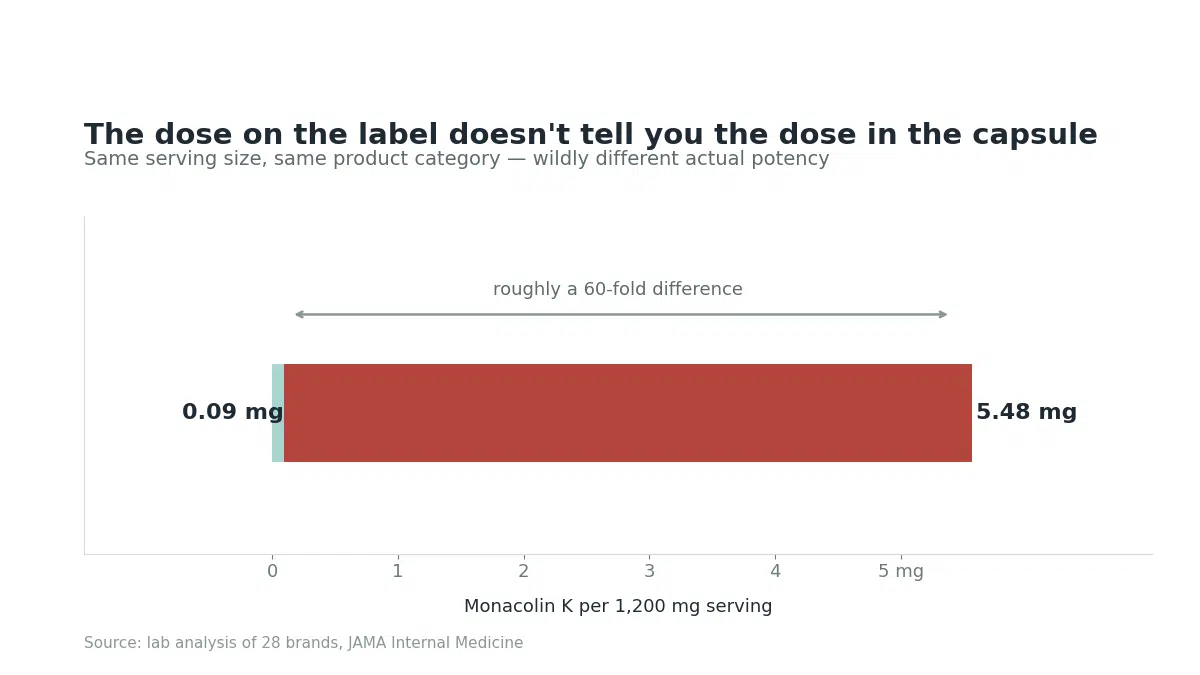
- Because it’s a supplement, the actual dose inside a bottle can vary enormously from one brand to the next. One analysis found a roughly 60-fold difference across 28 brands.
- Certain people, including pregnant women and anyone with liver disease, should avoid it or check with a doctor first.
What’s Actually in Red Yeast Rice
Red yeast rice starts as ordinary white rice, fermented with a mold called Monascus purpureus. That fermentation is what turns the rice a deep red and, along the way, produces a group of compounds called monacolins.
The Fermentation Process and Monacolin K
The most important of those compounds is monacolin K. As Mayo Clinic explains, it works by blocking an enzyme in your liver called HMG-CoA reductase, which your body needs to manufacture cholesterol. Block the enzyme, and your liver makes less cholesterol. That’s the whole mechanism, and it’s the same one prescription statins use.[4]
Chemical Similarities to Statin Medications
Here’s the part that surprises most people: monacolin K doesn’t just work like a statin. It has the exact same chemical structure as lovastatin, a cholesterol drug that’s been prescribed since the 1980s. Your body can’t tell the difference between the two.[3]
That’s why “natural” doesn’t mean “mild” here. The image below lays out just how closely the two overlap.
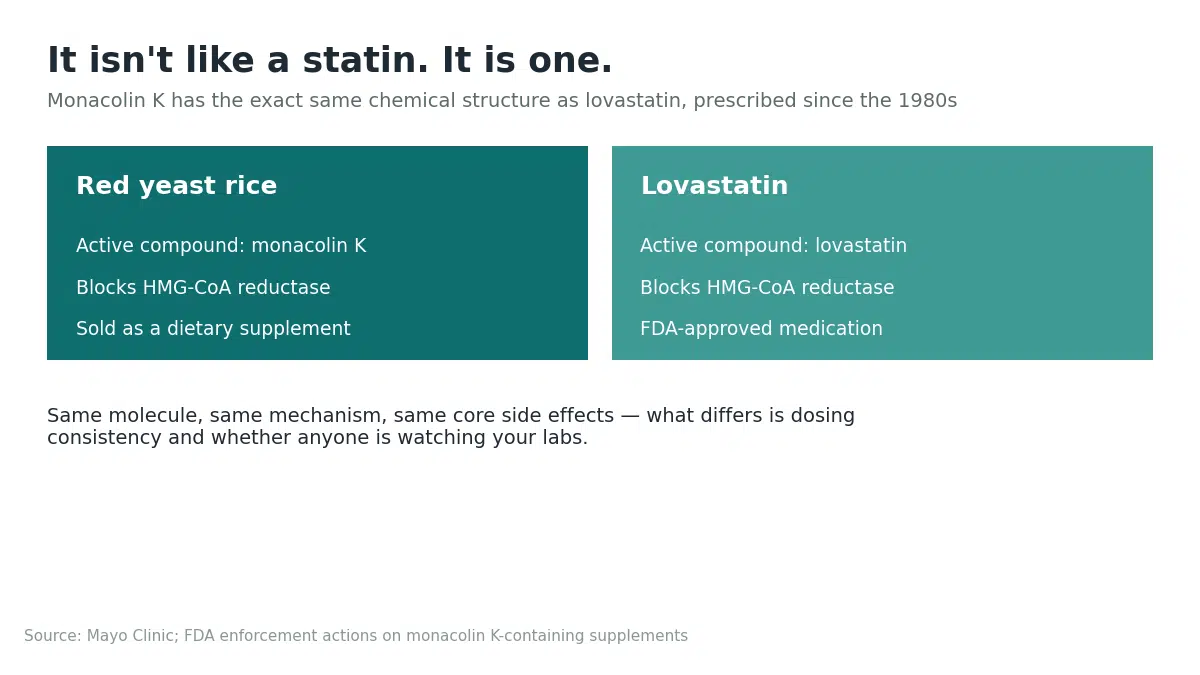
| Feature | Red Yeast Rice | Lovastatin |
|---|---|---|
| Active compound | Monacolin K | Lovastatin |
| How it works | Blocks HMG-CoA reductase | Blocks HMG-CoA reductase |
| Regulatory status | Dietary supplement | FDA-approved medication |
| Source | Fermented rice | Synthetic/semi-synthetic |
Commonly Reported Red Yeast Rice Side Effects
Most people who try red yeast rice tolerate it fine. But a meaningful share notice something as their body adjusts, and it’s worth knowing what’s typical versus what’s a red flag.
Digestive Discomfort
The most common complaints are digestive: bloating, gas, and general stomach discomfort, usually within the first few days. Taking it with food tends to help.
If it doesn’t settle down after a week or two, or it gets worse instead of better, that’s worth mentioning to a doctor rather than pushing through it.
Muscle Aches and Myalgia
Muscle pain, medically called myalgia, is the side effect that tracks most closely with red yeast rice’s statin-like activity. It usually shows up as mild stiffness or soreness, often in the thighs, calves, or lower back.
Occasional soreness after a hard workout is normal. Muscle pain that shows up without exertion, or that doesn’t fade after a few days, deserves attention. It’s the same symptom that, in rare cases, precedes something more serious (more on that below).
Headaches and Dizziness
Some people also get mild headaches or feel a bit dizzy, especially early on. These usually pass on their own. Keeping a quick note of when they happen, and what dose you took, can help you and your doctor figure out if the supplement is the cause.
| Symptom category | Common presentation | Typical severity | What to do |
|---|---|---|---|
| Digestive | Bloating, gas | Mild | Take with food |
| Muscular | Soreness, myalgia | Mild to moderate | Monitor; call your doctor if it persists or worsens |
| Neurological | Headache, dizziness | Mild | Stay hydrated; rest |
Serious Red Yeast Rice Side Effects Worth Knowing About
The reactions above are the common ones. A smaller set of risks are rarer but more serious, and they’re the reason doctors recommend treating red yeast rice with the same respect you’d give a prescription statin.
Liver Enzyme Elevation
Red yeast rice can raise liver enzymes, a sign your liver is working harder than usual to process what you’re giving it. This usually causes no symptoms on its own; it typically shows up on a routine blood test, which is exactly why doctors recommend one before you start and periodically afterward.[3]
In rare cases, elevated enzymes can progress to actual liver injury. Watch for fatigue, yellowing of the skin or eyes, or pain in the upper right side of your belly, and call a doctor if any of those show up.
Rhabdomyolysis
Rhabdomyolysis is rare, but it’s the reaction that shows up most often in case reports and medical journals. It happens when muscle tissue breaks down quickly and releases its contents into your bloodstream, including proteins that can overwhelm your kidneys.
The warning signs are severe muscle pain, pronounced weakness, and dark or “cola-colored” urine. This isn’t a symptom to wait out. Doctors have documented cases of people hospitalized with this reaction after only a few weeks of use, and in at least one case, after just two days.
Kidney Stress
Kidney stress from red yeast rice is usually a downstream effect of rhabdomyolysis, since your kidneys have to filter out the debris from muscle breakdown, and a large amount can overwhelm them. Higher doses and longer use raise this risk. Periodic kidney function tests (creatinine, specifically) can catch trouble early.
| Organ system | Potential risk | How it’s monitored |
|---|---|---|
| Liver | Enzyme elevation, rarely liver injury | Blood chemistry panel |
| Muscle | Myalgia, rarely rhabdomyolysis | Symptom tracking, creatine kinase test |
| Kidneys | Filtration stress, usually secondary | Creatinine testing |
How Common Are These Serious Problems, Really?
It’s worth putting this in perspective, because case reports can make a rare event feel more likely than it is. An analysis of the FDA’s adverse event database over a ten-year period found that muscle-related reports tied to red yeast rice made up less than a tenth of one percent of all muscle-related reports the agency received in that window. Liver-related reports were a similarly small share of the total.
Some meta-analyses of clinical trials have gone further, finding no statistically significant link between red yeast rice and either muscle symptoms or liver problems compared with a placebo. So why do serious case reports keep appearing? Partly because supplement reactions are widely underreported compared to prescription drugs, and partly because, as the next section explains, the actual dose inside a bottle of red yeast rice is far less predictable than a prescription statin’s.
The Role of Citrinin in Red Yeast Rice Safety
There’s a second risk that has nothing to do with monacolin K itself: citrinin, a toxic byproduct that the same fermentation process can produce if conditions aren’t tightly controlled.
What Citrinin Is and Why It Matters
Citrinin is a mycotoxin, a poison produced by certain molds, and it’s specifically harmful to the kidneys. Manufacturers don’t add it on purpose; it’s a contaminant that can form during fermentation. According to NCCIH’s fact sheet on red yeast rice, a 2021 analysis of 37 red yeast rice products found only one had citrinin levels below the European Union’s maximum threshold.[3]
What’s Being Done About It
Some markets have set limits on how much citrinin a red yeast rice product is allowed to contain, and responsible manufacturers test for it. But enforcement varies, and in the U.S., there’s no requirement that a supplement maker test for citrinin before selling a product. Practically speaking, the burden of checking falls on you as the buyer, which is why third-party-tested products (more on this below) are worth the extra look.
Drug Interactions to Watch For
Because monacolin K behaves like a statin, it can interact with other medications the same way a statin would.
Combining It With Prescription Statins
Taking red yeast rice alongside a prescription statin is one of the riskier combinations, because you’re effectively doubling your statin dose without anyone accounting for it. That raises the risk of both muscle and liver side effects. If you’re already on a statin, this is a conversation for your doctor, not a decision to make solo.
Blood Thinners
If you take a blood thinner such as warfarin, aspirin, or clopidogrel, red yeast rice may amplify your bleeding risk. That’s not a reason to panic, but it is a reason to loop in whoever manages your anticoagulation before adding this supplement.
The Grapefruit and Enzyme Connection
Your liver clears monacolin K using an enzyme system called cytochrome P450, mainly a version called CYP3A4. Think of that enzyme as a drain your body uses to flush the drug out. Grapefruit and grapefruit juice clog that drain, so instead of clearing normally, monacolin K builds up to higher, riskier levels, the same interaction grapefruit has with prescription statins.
Certain antibiotics and antifungal medications (erythromycin and itraconazole, for example) use that same pathway and can cause a similar buildup. So can some blood pressure medications. If you’re on any of these regularly, ask your doctor or pharmacist whether red yeast rice is safe to add.
Who Should Avoid Red Yeast Rice
A “natural” label doesn’t mean risk-free for everyone. A few groups face meaningfully higher stakes and should either avoid red yeast rice or only use it under close medical supervision.
Pregnancy and Breastfeeding
Red yeast rice should not be used during pregnancy or while breastfeeding. Statins, including the compound in red yeast rice, have been linked to developmental problems in babies exposed in the womb, which is why doctors advise against it during these periods. Cholesterol treatment is generally paused for the duration rather than swapped for something gentler. There isn’t a supplement version of this that becomes safe in pregnancy.
Existing Liver Disease
If your liver is already under strain from another condition, adding a compound that raises liver enzymes is asking a lot of an organ that’s already working hard. People with liver disease face a higher risk of the hepatic side effects described above.
A History of Muscle Problems
If you’ve had rhabdomyolysis or unexplained muscle pain in the past, especially in reaction to a statin, your body may be more prone to a repeat reaction with red yeast rice, since it acts on the same pathway.
Other groups worth flagging to your doctor before starting:
- Anyone with kidney disease, since it may reduce your ability to clear both monacolin K and citrinin.
- Anyone already taking a prescription statin, gemfibrozil, or high-dose niacin.
- Anyone on blood thinners.
- Anyone with a procedure or surgery scheduled soon. Statin-like compounds are often paused beforehand, and it’s easy to forget to mention a supplement.
Quality Control: Why One Bottle Isn’t Like Another
This is arguably the single biggest practical risk with red yeast rice, and it has nothing to do with side effects directly. It’s about not knowing your actual dose.
The Unregulated Manufacturing Problem
Because red yeast rice is sold as a supplement rather than a regulated drug, it doesn’t go through the same pre-market testing a prescription medication does. That means the amount of monacolin K inside can vary enormously between brands, and sometimes between batches of the same product.
One lab analysis of 28 brands bought from mainstream US retailers, published in the European Journal of Preventive Cardiology, found monacolin K content ranging from 0.09 to 5.48 milligrams per 1,200-milligram serving, roughly a 60-fold difference. Two of those brands contained no detectable monacolin K at all.[1] An earlier analysis in Archives of Internal Medicine found an even wider spread across the products it tested.[2] Picture two bottles that look identical on the shelf: one might be roughly as potent as a light beer, the other closer to moonshine, and you can’t tell which is which just by looking.
| Feature | Standard supplement | Third-party tested |
|---|---|---|
| Ingredient accuracy | Often inconsistent | Verified potency |
| Contaminant screening | Minimal or none | Tested for citrinin and heavy metals |
| Transparency | Low | High, with a Certificate of Analysis available |
How to Spot a Tested Product
Look for a certification seal from an independent body like USP, NSF International, or ConsumerLab. These organizations verify that what’s on the label matches what’s in the capsule, and that contaminants like citrinin and heavy metals stay within safe limits. If a company won’t share its Certificate of Analysis on request, treat that as a warning sign rather than an oversight.
Red Yeast Rice vs. Prescription Statins
Both aim to do the same thing, lowering LDL cholesterol, using the same mechanism. But the similarities mostly stop at the chemistry.
| Feature | Red yeast rice | Prescription statins |
|---|---|---|
| Regulatory oversight | Limited (dietary supplement) | Strict (FDA approved) |
| Dosing consistency | Variable, often unpredictable | Standardized |
| Clinical monitoring | Left to the patient | Physician-directed |
| Cost and access | Over the counter | Requires prescription; often insurance-covered |
The honest way to frame the choice isn’t “natural versus pharmaceutical.” It’s “unregulated statin versus regulated statin,” and the regulation is what buys you predictable dosing and someone watching your labs.
Using It More Safely, If You Decide To
Start Low and Go Slow
If you and your doctor decide it’s worth trying, start with the lowest available dose rather than jumping in at a higher one. That gives you a chance to see how your body reacts before increasing anything, and any increase should happen gradually and with your doctor’s input.
Get Your Blood Work Checked
Ask about a baseline liver panel before you start, then periodic re-checks of liver enzymes and creatine kinase (a marker of muscle breakdown) while you’re taking it. If either climbs significantly, that’s a signal to stop and follow up with your doctor, not to wait and see.
Warning Signs That Mean Stop and Call a Doctor
Most side effects here are mild: some stomach upset, an occasional headache, muscle soreness that comes and goes. A shorter list of symptoms means something more urgent.
Stop taking red yeast rice and call your doctor if you notice muscle pain, tenderness, or weakness that isn’t tied to exercise, especially if it’s severe or comes on quickly. The same goes for dark, tea-colored, or “cola-colored” urine, which can signal muscle breakdown affecting your kidneys.
Yellowing of the skin or eyes, unusual fatigue, or pain in the upper right side of your belly can point to liver trouble. If you develop severe muscle pain alongside a high fever or confusion, or you have trouble breathing or severe abdominal pain, treat that as an emergency rather than something to monitor at home.
| Symptom category | Mild warning sign | Emergency indicator |
|---|---|---|
| Muscle | Mild soreness or stiffness | Severe pain and weakness |
| Liver | Fatigue or nausea | Jaundice, abdominal pain |
| Kidneys | Minor changes in urination | Dark urine, reduced output |
| General | Headache or dizziness | Confusion, high fever |
Lifestyle Habits That Affect Tolerance
Support Your Liver With What You Eat
Since your liver is doing the work of processing monacolin K, diet matters. Antioxidant-rich foods like berries, leafy greens, and walnuts support liver function, while cutting back on processed sugar and alcohol reduces the load your liver is already carrying.
Stay Hydrated and Support Muscle Recovery
Adequate water intake helps your body clear metabolic waste and keeps electrolytes in balance, both relevant if you’re dealing with muscle soreness. A few other habits that help: light movement to keep blood flow up, consistent sleep for muscle repair, and enough potassium- and magnesium-rich food to help prevent cramping. None of this cancels out a serious reaction if one occurs, but it can make the routine, mild side effects easier to live with.
What the Research Actually Shows
Clinical trials of red yeast rice have generally focused on monacolin K’s cholesterol-lowering effect, and the results are consistent: meaningful LDL reduction, in some studies comparable to a moderate-dose statin, according to the National Center for Complementary and Integrative Health’s review of the evidence.[3] Side effect data is messier, partly because products tested in different studies aren’t standardized, which is the same labeling inconsistency problem discussed above playing out in the research itself.
| Observation | Frequency in studies | Clinical significance |
|---|---|---|
| Digestive discomfort | Low to moderate | Usually temporary |
| Muscle-related symptoms | Moderate, but similar to placebo in some meta-analyses | Warrants monitoring |
| Liver enzyme changes | Uncommon | Needs medical follow-up if it occurs |
Most trials run for a matter of months, so long-term data on what happens after years of daily use is thinner than anyone would like. That’s a real gap, not a reason to panic, but it means “we don’t fully know yet” is an honest answer to “is this safe long-term.”
Where the FDA Stands
In the U.S., the FDA doesn’t regulate red yeast rice as a drug by default. But if a product contains meaningful amounts of monacolin K, the agency treats it as containing an unapproved drug, since that compound is chemically identical to a prescription medication. FDA lab testing found products such as Cholestene contained undeclared lovastatin.[5] The FDA has taken enforcement action against supplement makers more than once on exactly this basis, going back to its 1998 action against the supplement Cholestin.
That creates a real catch-22: a product with too little monacolin K probably won’t do much for your cholesterol, and one with enough to work is, by the FDA’s own logic, an unregulated statin. If part of the draw of red yeast rice is avoiding “pharmaceutical” oversight, that oversight gap is the actual trade-off, not a loophole you’re getting around.
A few practical habits help here: look for third-party testing seals, favor products with a clearly disclosed monacolin K amount per serving, and be skeptical of anything promising to “replace” a prescription medication outright.
Talking to Your Doctor First
Before starting red yeast rice, a conversation with your doctor is worth having, not as a formality, but because they can flag interactions with your current medications and order the baseline blood work that makes the whole thing safer.
Questions Worth Asking
- Does this make sense given my cholesterol numbers and overall heart health?
- Does it interact with anything I’m currently taking?
- What blood tests should we run before I start, and how often afterward?
- What dose makes sense, and for how long?
- What symptoms should make me stop and call you?
It’s a Piece of the Plan, Not the Whole Plan
Whether you end up on red yeast rice, a prescription statin, or neither, supplements work best alongside the basics rather than instead of them: a reasonable diet, regular movement, and follow-up with your doctor. None of this is an argument against trying red yeast rice. It’s an argument for doing it with your eyes open.
The Bottom Line
Red yeast rice can genuinely lower cholesterol, and for some people that trade-off will make sense. But it isn’t a gentler alternative to statins so much as an unregulated version of one: same mechanism, same core side effects, far less consistency in dose, and no built-in monitoring unless you set it up yourself.
That pattern isn’t unique to this supplement. Our look at whether ashwagandha can cause weight loss works through the same question from the other direction, with a “natural” product whose real effect is smaller than the marketing rather than larger than it looks.
If you’re drawn to it specifically to avoid a prescription statin’s side effects, that’s worth raising directly with your doctor: why you want to avoid statins, what your actual cardiovascular risk looks like, and whether a different approach fits your health and your comfort level better.
FAQ
What are the most common red yeast rice side effects?
Why does red yeast rice act so much like a prescription statin?
What are the most serious red yeast rice side effects with long-term use?
What is citrinin, and why does it matter for red yeast rice safety?
Can red yeast rice interact with other medications?
Who should avoid red yeast rice?
How does red yeast rice compare to prescription statins?
How can I choose a safer red yeast rice product?
What symptoms mean I should stop taking it right away?
What is the FDA’s position on red yeast rice?
SOURCESOur Editorial Standards
HealthMagHub is built on primary sources: peer-reviewed research, clinical practice guidelines, and health agencies such as the NIH, CDC, and FDA. Read our editorial standards to see how we research, cite, and update our articles.
- Cohen PA, Avula B, Khan IA. Variability in strength of red yeast rice supplements purchased from mainstream retailers. European Journal of Preventive Cardiology. 2017;24(13):1431-1434. pubmed.ncbi.nlm.nih.gov
- Gordon RY, Cooperman T, Obermeyer W, Becker DJ. Marked variability of monacolin levels in commercial red yeast rice products: buyer beware! Archives of Internal Medicine. 2010;170(19):1722-1727. pubmed.ncbi.nlm.nih.gov
- National Center for Complementary and Integrative Health. Red Yeast Rice: What You Need To Know. nccih.nih.gov
- Mayo Clinic. Red Yeast Rice. mayoclinic.org
- U.S. Food and Drug Administration. Public Notification: Cholestene Contains Hidden Drug Ingredient. fda.gov