
That’s not the answer most articles give. Search avocado seed for pain and you’ll find tea recipes, dosing charts, and confident claims about arthritis. What you won’t find is a single human trial.
Here’s what the research actually says, where the confusion comes from, and who should stay away from this entirely.
- No published human trial has tested avocado seed for pain. The research is limited to cell culture and animal studies on purified extracts.
- The real arthritis evidence is for avocado-soybean unsaponifiables (ASU), a standardized oil extract, not for home-dried seed, and the two get conflated online.
- The California Avocado Commission itself recommends against eating the seed, citing insufficient research on its risks and benefits.
- Avocado in any form is harmful to dogs, cats, and especially birds, so keep ground seed out of reach of pets.
The Real Evidence Behind Avocado Seed for Pain
The most-cited study on avocado seed anti-inflammatory activity comes from Penn State. Researchers had spent about a decade developing an orange extract from crushed avocado seeds as a natural food colorant. When they tested it, it inhibited pro-inflammatory mediators in cell culture.[1]
Read that again: macrophages in petri dishes. The lead researcher said plainly that the next step, before drawing further conclusions, would be to design animal studies. Not human studies. Animal studies. That’s how early this is.
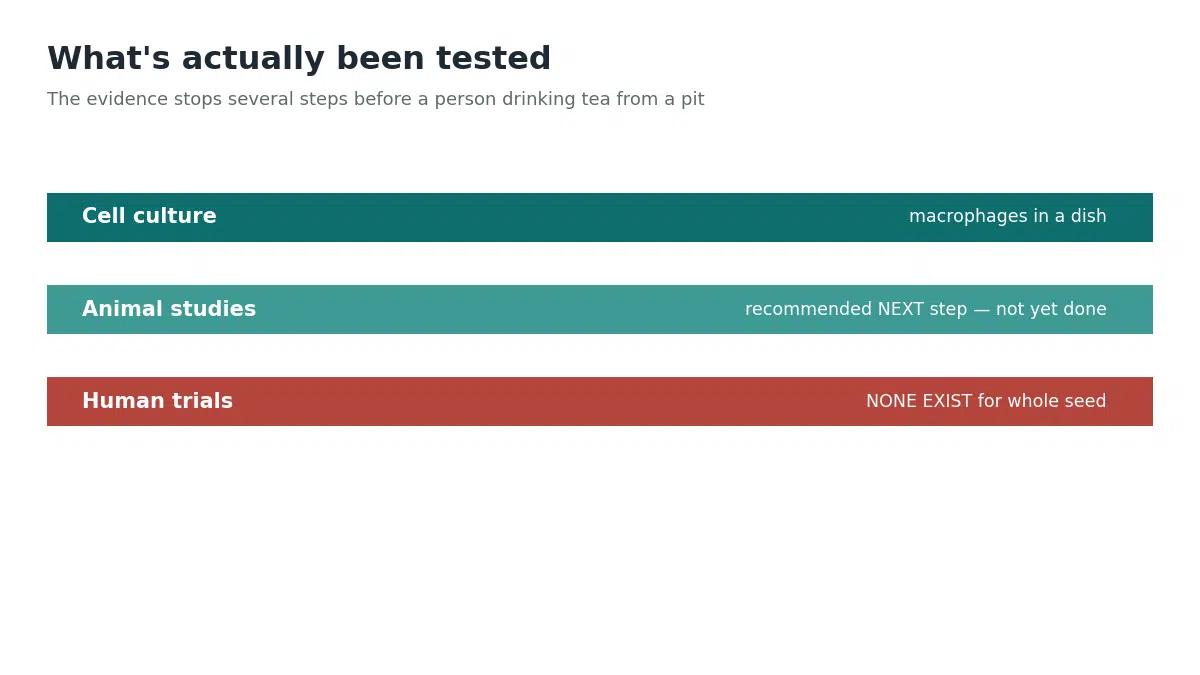
Two more things worth knowing about that study. The researchers had filed a patent on the extract and founded a company to sell it as a food additive, which doesn’t make the finding wrong but is worth knowing when a single lab result gets quoted everywhere. And the extract they tested was a purified, concentrated compound produced in a lab, not seed you dried on a windowsill and ground in a coffee grinder.
That gap between extract and kitchen is the whole problem with avocado seed for pain. The chemistry of what you’d make at home is unknown. Nobody has measured it, and nobody has tested it in a person.
Where the Arthritis Claims Actually Come From
There is real clinical research on avocado and joint pain. It just isn’t about the seed.
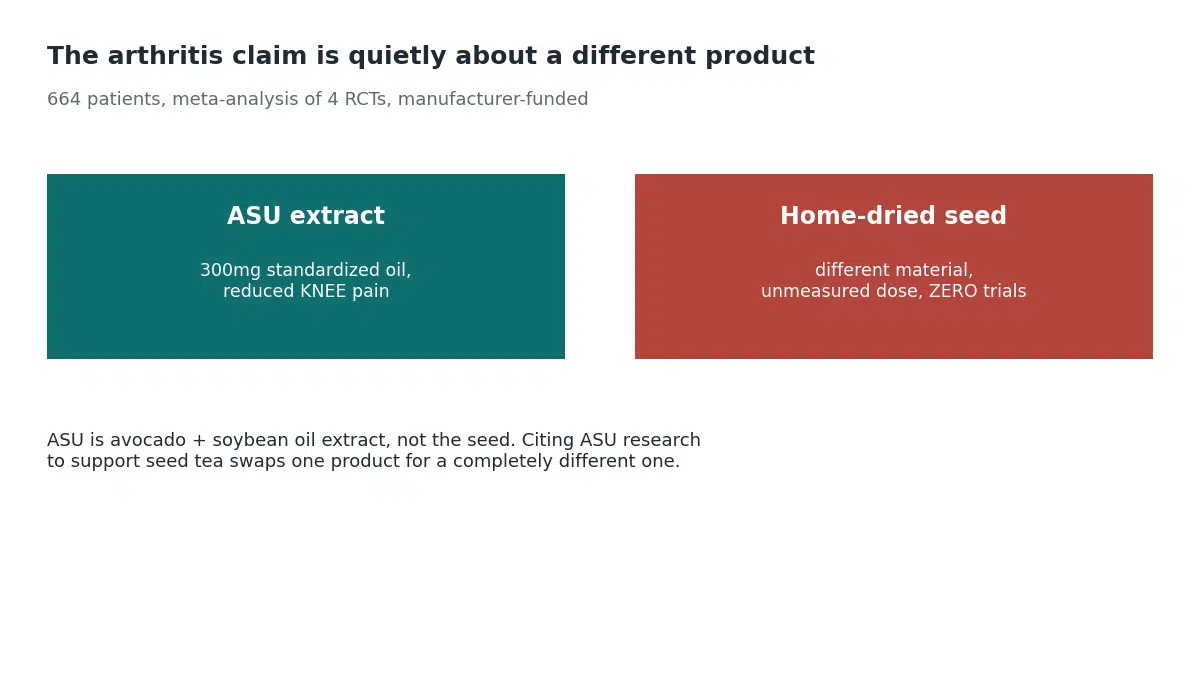
Avocado-soybean unsaponifiables, or ASU, is a prescription-grade preparation made from avocado oil and soybean oil in a one-to-two ratio. A meta-analysis of four randomized controlled trials covering 664 patients found that 300 mg a day reduced pain in knee osteoarthritis, though not in hip osteoarthritis. All four trials were funded by the manufacturer, which the reviewers flagged.[3]
So the honest position is: a standardized oil extract, at a measured dose, has modest manufacturer-funded evidence for knee pain. That tells you nothing about drinking tea made from a pit. The starting material is different, the dose is unknown, and the preparation is different.
When an article cites ASU research to support avocado seed for pain, it is quietly swapping one thing for another. If joint pain is what brought you here, our comparison of collagen vs. glucosamine for joint pain covers supplements with more direct evidence behind them.
Is Avocado Seed Safe to Eat?
The clearest answer available. Asked directly whether it is safe to eat the avocado seed, the California Avocado Commission’s answer, published by UC Agriculture and Natural Resources, was: we don’t recommend it. There is a body of evidence on seed extracts, but not enough research to support consuming the seed itself, and the benefits and risks are poorly characterized.[2]
That’s an industry body with every commercial reason to encourage avocado consumption, declining to endorse the pit. It’s the most direct statement anyone has made on this.
The specific unknowns are worth naming. Avocado seeds contain persin, a natural fungicide found throughout the plant and concentrated far more in the seed, skin and leaves than in the flesh. Persin is seriously toxic to birds, horses, cattle and other animals. In humans it appears not to cause the same problems at dietary levels, but “appears not to” is doing real work in that sentence, because there are no long-term human safety studies.
Seeds are also high in tannins, which is why the tea is bitter and why stomach upset is the commonly reported effect. Rodent work on ethanol-based seed extract found an acute toxicity threshold; the water-based extract looked safer.[4] Neither tells you much about a person drinking it daily for months.
How People Prepare Avocado Seed for Pain
This section describes what people do, not what we recommend. Given the safety position above, we’re not publishing a dosing protocol, and you should be skeptical of any site that does, because there is no established safe amount, so any number you see was invented.
The seed is rinsed, dried for several days until the papery skin lifts off, then chopped and ground. It is genuinely hard, and people have injured themselves and their blenders trying to shortcut this. You cannot bite into it.
The two common preparations are a tea, made by simmering thin slices until the water turns reddish-brown, and a powder stirred into something strongly flavored to cover the bitterness. Some people apply a paste externally instead, which at least avoids the digestive questions, though there’s no evidence for it either.
If you try it anyway, the sensible approach is a very small amount, once, and paying attention to how you feel over the following day.
Who Should Not Try Avocado Seed for Pain
Some of these are firmer than others, but all of them are reasons to leave this alone:
- Pregnant or breastfeeding. No safety data at all. This is the easiest call on the list.
- Children. Same reasoning, plus a smaller body.
- Latex allergy. Avocado is part of the well-documented latex-fruit cross-reactivity group, alongside banana, kiwi and chestnut.
- Taking prescription medication. The composition of home-prepared seed is unmeasured, so interactions can’t be predicted. Ask a pharmacist rather than guessing.
- Kidney or liver disease. Both organs handle unfamiliar plant compounds, and you have less margin.
- Anyone with a pet in the house. Avocado in any form, including the ground seed, causes serious harm to dogs, cats and especially birds. Don’t leave powder where an animal can reach it.
One more: if you’re managing blood sugar, ignore the claim that avocado seed helps. That comes from extract studies in animals. Our piece on fruit and blood sugar is a better use of your attention.
When Pain Means See a Doctor
None of the following should be managed with a home remedy while you wait and see:
- Pain that began suddenly after a fall or injury
- Numbness, tingling, or weakness alongside the pain
- Fever, redness, or a hot swollen joint, since a joint infection is an emergency
- Pain that keeps getting worse despite rest
- Unexplained weight loss with back pain
- Loss of bladder or bowel control with back pain, which means going to an emergency department
Nerve pain in particular has causes worth identifying rather than covering up; our guide to supplements for neuropathy pain in feet and hands goes through what’s known there.
What Has Better Evidence Than Avocado Seed for Pain
If the appeal is doing something at home without a prescription, several things have more behind them than the pit does.
Movement is the strongest. For knee osteoarthritis, exercise therapy is strongly recommended by rheumatology guidelines, and it outperforms most things people try instead. Topical NSAIDs are recommended ahead of oral ones for knee pain, with fewer stomach and kidney risks.
Weight, sleep and stress all measurably change how much pain you feel, which is unglamorous but real. And the avocado flesh itself is a genuinely useful food, so you don’t need the seed to get something out of the fruit.
Common Questions About Avocado Seed for Pain
Does avocado seed for pain have any human evidence?
Is avocado seed poisonous to humans?
Why do so many sites recommend it then?
Can I give avocado seed to my dog for arthritis?
Is the tea safer than the powder?
The Bottom Line
Avocado seed for pain sits in an awkward place: interesting enough that real scientists are studying the extract, unproven enough that the avocado industry itself won’t recommend eating the pit.
If you try it, you’re running an experiment on yourself with an unmeasured substance. Some people are fine with that. Just don’t let it delay finding out why you’re in pain, and don’t let a remedy replace treatment that’s actually been tested.
SOURCESOur Editorial Standards
HealthMagHub is built on primary sources: peer-reviewed research, clinical practice guidelines, and health agencies such as the NIH, CDC, and FDA. Read our editorial standards to see how we research, cite, and update our articles.
- Dabas D, Ziegler GR, Lambert JD. Anti-inflammatory properties of a colored avocado seed extract. Penn State research summary. psu.edu
- UC Agriculture and Natural Resources, Topics in Subtropics: “Eat THAT Seed?” including the California Avocado Commission response. ucanr.edu
- Christensen R, Bartels EM, Astrup A, Bliddal H. Symptomatic efficacy of avocado-soybean unsaponifiables in osteoarthritis patients: a meta-analysis of randomized controlled trials. PubMed 18042410
- Padilla-Camberos E et al. Acute toxicity and genotoxic activity of avocado seed extract. The Scientific World Journal, 2013.
Disclaimer: This article is general information, not medical advice. Avocado seed has not been tested in humans for pain, and there is no established safe dose. See a doctor rather than trying a home remedy for pain that began suddenly after an injury, comes with numbness or weakness, involves a fever or hot swollen joint, keeps worsening despite rest, or comes with unexplained weight loss. Loss of bladder or bowel control with back pain needs emergency care.