
That matters more than a brand list, because formulations change, availability varies, and your own glucose response to a given cereal is something only your meter can tell you.
Here’s what to check on the label, which categories reliably pass, what to avoid, and the one situation where changing your breakfast carbs needs a conversation with your prescriber first.
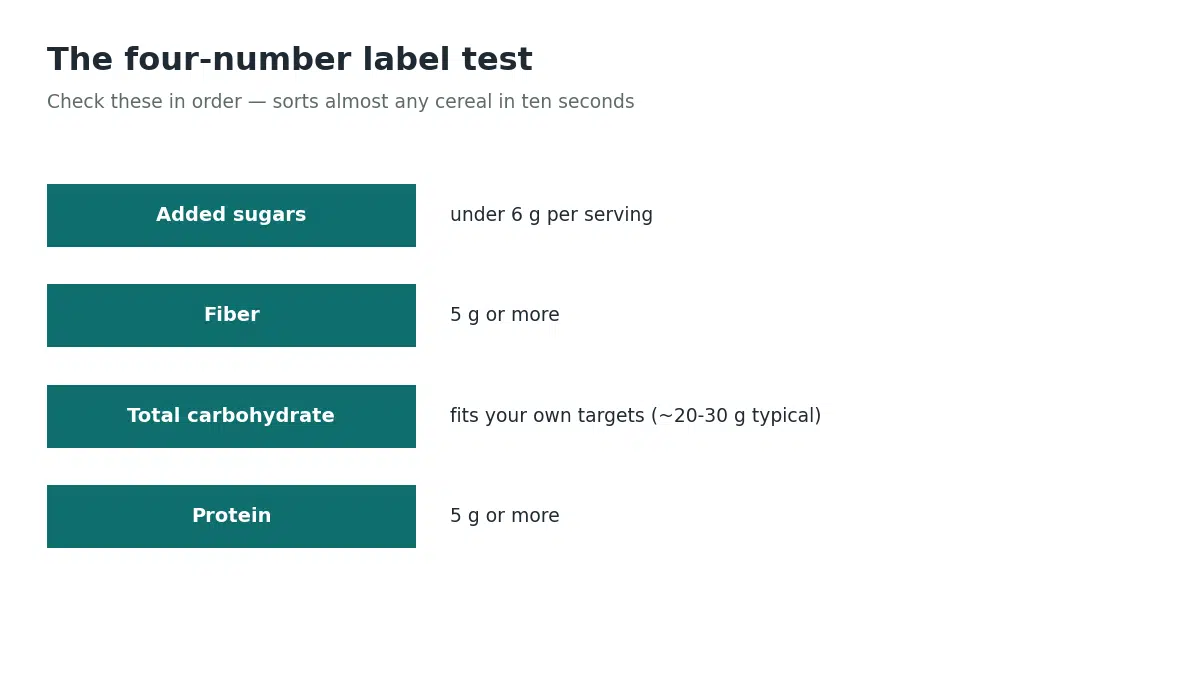
- Check four numbers in order: added sugar under 6 g, fiber 5 g or more, total carbohydrate that fits your own targets, and protein 5 g or more.
- Plain oats and high-bran cereals are the most reliable categories: high fiber, no added sugar.
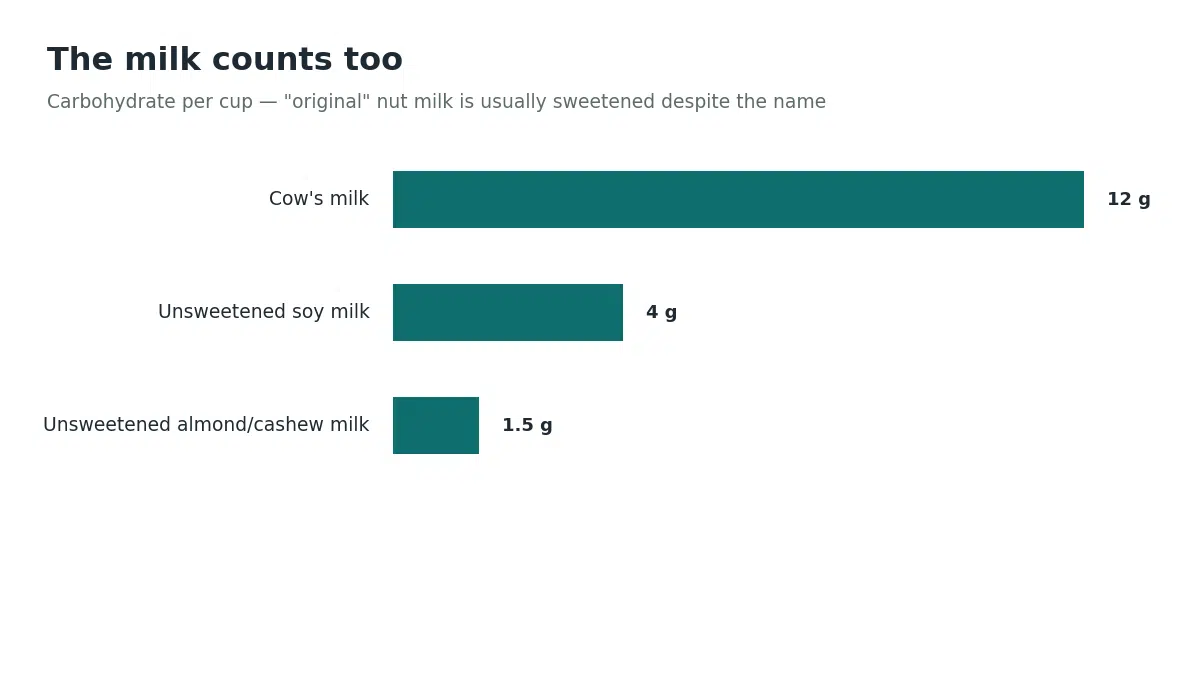
- The milk you pour matters too: cow’s milk carries about 12 g of carbohydrate per cup versus 1 to 2 g for unsweetened almond milk.
- If you take insulin or a sulfonylurea, talk to your prescriber before making a standing change to your breakfast carbohydrate, because the risk is hypoglycemia.
The Label Test for Breakfast Cereals for Diabetics
Four numbers, in this order. Check the serving size first, because everything below is per serving and cereal servings are often much smaller than what people actually pour.
1. Added sugars: under 6 g per serving
This is its own line on US Nutrition Facts labels, separate from total sugars, and it has only been mandatory since 2020.[4] That separation is what makes it useful. Total sugars lumps in the sugar naturally present in the grain and any milk solids, which tells you very little. Added sugars is what the manufacturer put in.
Under 6 g per serving is a reasonable ceiling for a daily breakfast. Above that you are usually looking at a cereal where sugar is doing the work that fiber and whole grain should be doing.
The label also gives you a %DV figure for added sugars, benchmarked against 50 g a day. A cereal at 12 g is spending nearly a quarter of that budget before you have eaten anything else, and it is worth remembering the rest of the day still has to fit.
One trap: sugar appears on ingredient lists under many names. Honey, molasses, cane juice, brown rice syrup, malt syrup, fruit juice concentrate and anything ending in -ose all count as added sugar, and splitting them across several entries keeps any one of them from appearing high on the list. The added sugars line catches all of it at once, which is why it beats reading ingredients for this purpose.
2. Fiber: 5 g or more
Fiber is the number that most changes how a cereal behaves in your body, and it is the main reason two whole-grain cereals with identical carbohydrate counts can produce different readings.[2]
Soluble fiber is doing most of that work. It absorbs water and forms a viscous gel in the gut, which slows how quickly stomach contents empty and how quickly glucose crosses into the blood. The result is a flatter curve rather than a spike. Oats are the standout here because their soluble fiber, beta-glucan, is particularly good at forming that gel.
Insoluble fiber, the kind that dominates in wheat bran, works differently. It adds bulk and speeds transit rather than slowing absorption, and its benefits are more about regularity and long-term gut health than about your two-hour reading.
Most cereals contain both, and 5 g per serving is a practical threshold that filters out the heavily processed options without ruling out much else. Be aware that “made with whole grain” on the front of the box says nothing about how much, and plenty of cereals carrying that phrase come in under 2 g.
3. Total carbohydrate: the number your own targets govern
This is the figure with the largest single effect on your glucose, and it is also the one this article can be least prescriptive about.
Total carbohydrate on a US label already includes starch, sugars and fiber added together. It is not an additional amount on top of the sugar line, which confuses people who assume the two stack.
Roughly 20 to 30 g per serving suits most breakfasts, but that is a starting point rather than a rule. Carbohydrate targets are individualized, and they depend on your medication, your activity, your weight goals and what the rest of your day looks like. The American Diabetes Association is explicit that there is no single ideal macronutrient distribution for people with diabetes.[1]
The practical problem is rarely the number on the label. It is that the labeled serving is often three quarters of a cup or less, and most people pour closer to two cups. At that point a well-behaved cereal is delivering 60 g or more of carbohydrate before the milk. Measure once and the number on the box becomes meaningful.
4. Protein: 5 g or more
Protein does not lower the carbohydrate content of a bowl of cereal, and it will not rescue a sugary one. What it does is slow the meal down and keep you full longer, which matters for two reasons.
First, protein slows gastric emptying, so the carbohydrate alongside it arrives in the bloodstream more gradually. Second, and probably more important day to day, a breakfast with protein in it tends to hold until lunch. A bowl of low-protein cereal often does not, and the mid-morning snack that follows is where a lot of unplanned carbohydrate enters the day.
Most boxed cereals sit between 2 and 4 g of protein per serving, so 5 g is a genuinely selective threshold. Legume-based and grain-free cereals clear it comfortably. For everything else, the easier route is adding protein rather than hunting for a cereal that already has it: a spoonful of plain Greek yogurt, a handful of nuts or seeds, or an egg alongside.
Then glance at the first ingredient. If it isn’t a whole grain, the rest of the label is usually already telling you no. The same ten-second approach works on other packaged breakfast foods, and our look at reading a yogurt label applies it to the tub next to the cereal.
A caution about “net carbs”: Subtracting all the fiber from total carbohydrate is a rough shortcut, not a rule. A common clinical approach is to subtract only half the fiber, and only when a serving carries more than 5 g of it.
Sugar alcohols in low-carb and grain-free cereals complicate this further. They aren’t carbohydrate-free, and they cause digestive trouble for a lot of people. If you count carbs to dose insulin, use the method your diabetes team gave you rather than a number off a website.
Why We Don’t Rank Brands
We don’t test cereals, we have no way to verify one box against another, and manufacturers reformulate regularly, so a ranking written today can be wrong within a year without anything on the page changing.
More importantly, a ranked list answers the wrong question. Two people with diabetes can eat the identical bowl and see meaningfully different glucose readings two hours later, depending on medication, activity, sleep and what else is on the plate.
The American Diabetes Association takes the same approach: it publishes criteria rather than endorsing products, and it states plainly that there is no single ideal macronutrient distribution for people with diabetes.[1] Use the label test above, then let your own readings decide.
The Categories That Usually Pass
Plain oats, rolled or steel-cut rather than instant flavored. The soluble fiber beta-glucan genuinely moderates glucose response, and you control every addition. Instant flavored packets are a different product entirely and usually carry added sugar.
Wheat bran and high-bran cereals. These are where the highest fiber figures live, often well above the 5 g threshold, typically with no added sugar. Introduce them gradually and with fluid, because going from a low-fiber breakfast to a very high-fiber one overnight is uncomfortable.
Plain shredded wheat. Often a single ingredient, no added sugar. Total carbohydrate can still be high per serving, so portion matters.
Unsweetened whole-grain flakes and O-shaped cereals. Middling fiber, low sugar. Fine, and often the realistic step down from a sweetened cereal.
Legume and grain-free cereals. Lower carbohydrate, higher protein, usually more expensive. Check for sugar alcohols.
The honest summary: oats and bran do most of the work, and everything else is a matter of taste and budget.
What to Leave on the Shelf
- Frosted, honey-coated or chocolate cereals, often 12 g or more of added sugar per serving
- Most granola. Clusters are held together with syrup, portions are small and dense, and dried fruit adds more sugar
- Puffed rice and corn flakes, which are heavily processed, minimal in fiber, and among the fastest-digesting cereals on the shelf
- Instant flavored oatmeal packets
- Anything with dried fruit high in the ingredient list
And ignore the front of the box. “Natural”, “wholesome”, “heart-healthy” and “made with whole grains” are marketing, not nutrition. A cereal can carry all four and still fail every number on the back.
Portion, Milk and What You Add
Measure it once. Most people pour two to three times the labeled serving without noticing. Measure into your usual bowl for a week and mark the level. After that you can eyeball it.
The milk counts. Cow’s milk carries about 12 g of carbohydrate per cup from lactose. Unsweetened almond or cashew milk is 1 to 2 g; unsweetened soy is around 4 g with considerably more protein. “Original” nut milks are usually sweetened despite the name. The word to look for is unsweetened.
Add protein and fat. Nuts, seeds, plain Greek yogurt or an egg alongside all slow the meal down. This does more for your glucose curve than switching between two similar cereals, and our guide to high-protein snacks covers portions for the same additions.
Berries over dried fruit. A quarter cup of fresh berries adds sweetness at a fraction of the sugar in raisins or dried cranberries. Whole fruit isn’t off-limits either, and our piece on whether people with diabetes can eat bananas works through how portion and ripeness change the answer.
Then test. Check your glucose two hours after eating. That single reading tells you more about a specific cereal than any article can, including this one.
If You Take Insulin or a Sulfonylurea
Changing the carbohydrate content of a meal you eat every day is a medication question, not just a food question.
If you take mealtime insulin, your dose is matched to the carbs you’re eating. Switching to a much lower-carb cereal without adjusting it risks hypoglycemia. The same applies to sulfonylureas such as gliclazide or glipizide, which push insulin regardless of what you’ve eaten.
Talk to your prescriber or diabetes educator before making a standing change, and know the low blood sugar rule: at 70 mg/dL (3.9 mmol/L) or below, take about 15 g of fast-acting carbohydrate (glucose tablets are preferred) and recheck after 15 minutes.[1]
Common Questions About Breakfast Cereals for Diabetics
What are the best breakfast cereals for diabetics?
Beyond that, use the label test rather than a brand: under 6 g added sugar, 5 g or more fiber, and a whole grain first on the ingredient list.
Can I eat cereal every day with diabetes?
Check your glucose two hours afterwards for a few days to see how your usual breakfast actually behaves.
Is oatmeal better than boxed cereal?
Some high-bran cereals actually carry more fiber than oats. Both can work.
Does almond milk raise blood sugar?
Sweetened and flavored versions are a different matter, and “original” often means sweetened. Check for the word unsweetened.
Should I count net carbs?
If you dose insulin by carb counting, follow the method your diabetes team taught you rather than a formula from an article.
Can people with diabetes eat granola?
Low-sugar versions exist, and homemade lets you control it, but treat granola as occasional rather than a daily breakfast.
The Bottom Line
Check four numbers on the back of the box: added sugar under 6 g, fiber 5 g or more, carbohydrate that fits your targets, and protein where you can get it. A whole grain should be first on the ingredient list.
Measure the portion once, use unsweetened milk, add nuts or yogurt, and check your glucose two hours later. That last step is the one that actually personalizes this. If you’re building out the rest of the day too, our guide to fermented foods for gut health covers another fiber-friendly habit worth adding.
And if you take insulin or a sulfonylurea, talk to your prescriber before making a permanent change to your breakfast carbs.
SOURCESOur Editorial Standards
HealthMagHub is built on primary sources: peer-reviewed research, clinical practice guidelines, and health agencies such as the NIH, CDC, and FDA. Read our editorial standards to see how we research, cite, and update our articles.
- American Diabetes Association. Standards of Care in Diabetes: Facilitating Positive Health Behaviors, including medical nutrition therapy and hypoglycemia management. diabetesjournals.org
- American Diabetes Association, Diabetes Food Hub. Choosing a Cereal. diabetesfoodhub.org
- Mayo Clinic. Diabetes Diet: Create Your Healthy-Eating Plan. mayoclinic.org
- U.S. Food and Drug Administration. Added Sugars on the Nutrition Facts Label. fda.gov
Disclaimer: This article is general information, not medical advice, and doesn't replace guidance from your diabetes care team. Blood sugar responses vary substantially between individuals depending on medication, activity, sleep and the rest of the meal. If you take insulin or a sulfonylurea, speak to your prescriber before making a standing change to your breakfast carbohydrate, because of the risk of hypoglycemia. Product formulations change. Always check the current label rather than relying on figures published anywhere online, including here.