

- A Cochrane review of roughly 30 trials in more than 5,000 men found saw palmetto no better than placebo for urinary symptoms, flow, or prostate size.
- Beta sitosterol improved IPSS symptom scores by about 4.9 points and peak flow by roughly 3.9 mL/s across four trials in 519 men, but does not shrink the prostate.
- The CAMUS trial found saw palmetto does not lower PSA, unlike finasteride, so it does not need to be stopped before a PSA test.
- Saw palmetto carries a documented, if weak, bleeding-risk signal with warfarin and other blood thinners; beta sitosterol does not share that signal.
If you’re weighing saw palmetto vs beta sitosterol for an enlarged prostate, you’re really asking one question: which of these is actually likely to help you sleep through the night? The honest answer is that one of them has a reasonable evidence base and the other has largely failed its biggest tests, and neither is a substitute for finding out why your symptoms started.
Waking up three times a night to urinate wears you down. Plenty of men reach for a supplement before they see a doctor, which is understandable but backwards, because the symptoms of a benign enlarged prostate overlap almost exactly with several conditions that need actual treatment.
Here’s what the research shows, what it doesn’t, and what to check before you start either one.
Before You Buy Either One: Get Checked
Benign prostatic hyperplasia (BPH) is common and not dangerous in itself. But a weak stream, urgency, and night-time urination are also how prostate cancer, bladder stones, urinary infection, and neurological conditions present. A supplement can quietly relieve enough symptoms to delay a diagnosis by months.
Get emergency care the same day if you:
- Cannot urinate at all despite a full, painful bladder. This is acute urinary retention and needs immediate treatment
- See blood in your urine
- Have fever, chills, or severe pain in the lower back, groin, or perineum alongside urinary symptoms
Book an appointment before starting a supplement if you have: symptoms that appeared suddenly rather than gradually, unexplained weight loss, bone pain, difficulty starting a stream that’s getting rapidly worse, or a family history of prostate cancer.
One practical warning: over-the-counter decongestants and older antihistamines can tip a man with an enlarged prostate into full retention. If you take a cold remedy and then can’t pass urine, that’s an emergency room trip, not a wait-and-see.
What BPH Actually Is
The prostate sits just below the bladder and wraps around the urethra, the tube urine passes through. Its job is producing seminal fluid. As men age, the gland commonly enlarges, and because of where it sits, growth squeezes the tube running through it.
That produces the familiar cluster: a weak or stop-start stream, difficulty starting, urgency, frequency, waking at night, and the sense that the bladder never quite empties.
Worth knowing: prostate size correlates poorly with how bad symptoms feel. Some men with substantially enlarged glands barely notice; others with modest enlargement are miserable. That’s part of why supplements that shrink the prostate on paper don’t reliably translate into feeling better, and why symptom scores matter more than gland measurements.
Saw Palmetto vs Beta Sitosterol: What the Trials Show
This is where the two part company, and it’s worth being direct about it.
Saw Palmetto: The Evidence Got Worse, Not Better
Saw palmetto comes from the berries of Serenoa repens, a palm native to the southeastern United States. It’s the most popular prostate supplement on the market, and for years the early research looked promising.
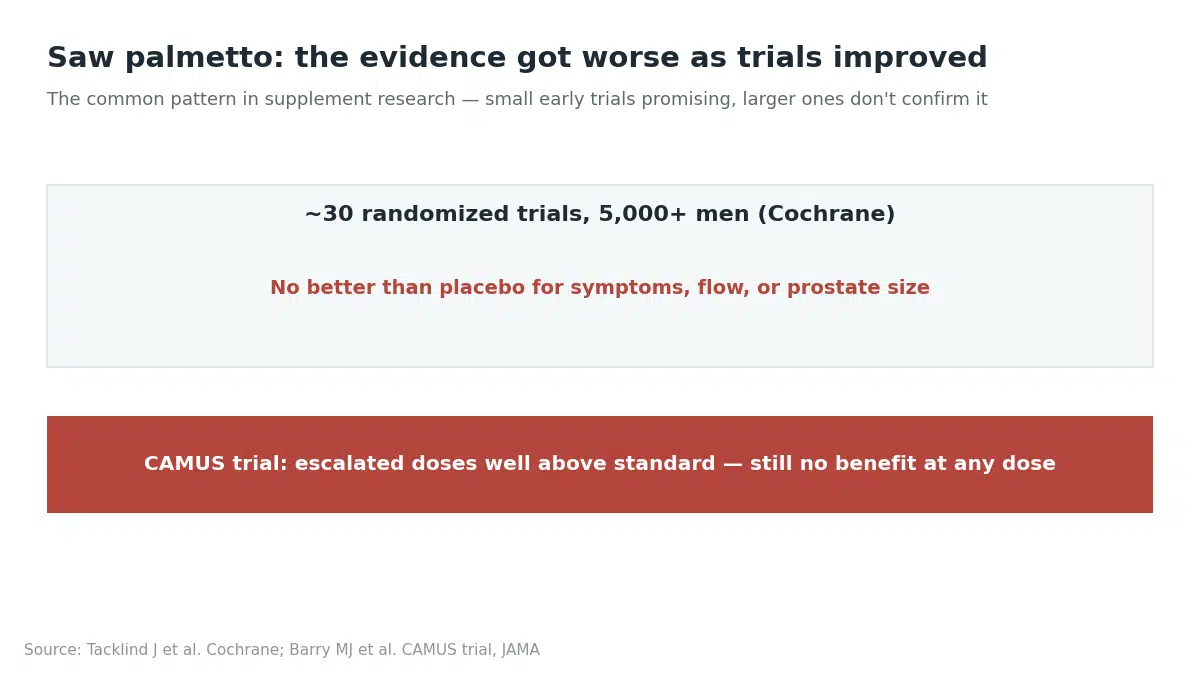
Then the trials got bigger and better designed, and the effect disappeared. A Cochrane review pooling roughly 30 randomized trials in more than 5,000 men concluded that saw palmetto was well tolerated but no better than placebo for urinary symptoms, peak urine flow, or prostate size.[2] The CAMUS trial, which escalated doses well above the standard 320 mg daily, found no benefit at any dose.[3]
This is a common pattern in supplement research: small early trials show promise, larger and more rigorous ones don’t reproduce it. It doesn’t prove saw palmetto does nothing for anyone. It does mean that if it works for you, you’re probably an exception rather than the rule, and you should judge that by whether your symptoms actually change.
Beta Sitosterol: Better Evidence, Narrower Than It Sounds
Beta sitosterol is a plant sterol, a compound structurally similar to cholesterol, found in wheat germ, soybean oil, pumpkin seeds, nuts, and most vegetables.
Its evidence base is genuinely more favorable. A Cochrane review of four randomized, double-blind, placebo-controlled trials covering 519 men found that non-glucosidic beta sitosterol improved urinary symptom scores by about 4.9 points on the International Prostate Symptom Score, increased peak urine flow by roughly 3.9 mL per second, and reduced residual bladder volume by about 29 mL compared with placebo. Withdrawal rates were essentially identical to placebo, at around 8% in both groups.[1]
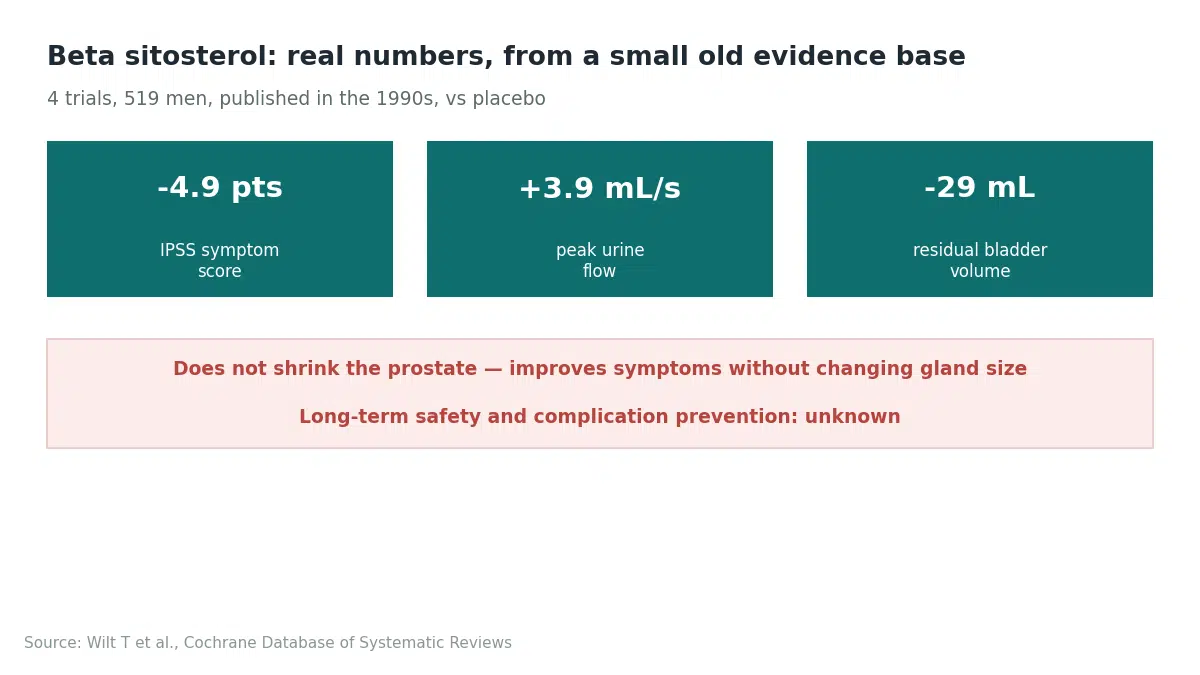
A 4.9-point IPSS improvement is clinically meaningful, so that’s a real result. But read the fine print, because it constrains what you can conclude:
- The trials were short. They ran between 4 and 26 weeks. Nobody has established what happens over years.
- The evidence base is small and old. Four trials, 519 men, published in the 1990s.
- It doesn’t shrink the prostate. Beta sitosterol improved symptoms without reducing gland size, so it isn’t altering the underlying process.
- Long-term safety and complication prevention are unknown. The reviewers said so explicitly. It has not been shown to prevent retention, infections, or the need for surgery.
- Not all forms performed equally. The one trial using pure beta-sitosteryl-beta-D-glucoside showed no improvement in urinary flow.
So the fair summary of saw palmetto vs beta sitosterol is this: beta sitosterol has short-term evidence for symptom relief that saw palmetto has largely lost. Neither has been shown to change the course of the disease.
How They’re Thought to Work
Saw palmetto is proposed to inhibit 5-alpha reductase, the enzyme converting testosterone to dihydrotestosterone, which drives prostate growth. That’s the same pathway prescription finasteride uses. The mechanism is plausible; the clinical results just haven’t followed.
Beta sitosterol’s mechanism is less clearly established. Proposed explanations involve effects on inflammation and on how the bladder and prostate handle pressure. Notably, it improves flow without shrinking the gland, which suggests it’s doing something other than reversing the enlargement.
Safety, Side Effects, and Drug Interactions
Both are generally well tolerated. That’s not the same as risk-free, and a few interactions genuinely matter.
Saw Palmetto
Common effects are mild: nausea, diarrhea, abdominal discomfort, headache, occasionally reduced libido. Taking it with food helps.
- Blood thinners and antiplatelet drugs. Case reports describe a rise in INR and excess surgical bleeding in men taking saw palmetto with warfarin, possibly through inhibition of the CYP2C9 enzyme. The overall evidence is thin (two randomized trials found no increase in surgical bleeding), but Memorial Sloan Kettering and the European Medicines Agency both advise caution.[4] If you take warfarin, apixaban, rivaroxaban, clopidogrel, or regular NSAIDs, clear it with your prescriber first.
- Surgery. Tell your surgeon, and expect to stop it in advance.
- Finasteride or dutasteride. Both act on the same pathway. Don’t stack them without your doctor’s input.
- Hormonal medications. Its anti-androgenic activity may interfere with hormone therapies and estrogen-based contraceptives.
- Rare but serious. Isolated case reports describe cholestatic hepatitis and acute pancreatitis.[5] Stop and seek care if you develop yellowing of the eyes or skin, dark urine, or severe upper abdominal pain radiating to the back.
- Not for women who are pregnant or breastfeeding, given the hormonal activity and absence of safety data.
One Thing Saw Palmetto Does Not Do
A frequent worry is that saw palmetto might suppress PSA and hide early prostate cancer, the way finasteride does. The CAMUS trial tested exactly this and found PSA changes were essentially identical between the saw palmetto and placebo groups, even at elevated doses.[3]
So you don’t need to stop it before a PSA test, and your doctor doesn’t need to adjust the reading. Still tell them you’re taking it, but this particular fear is unfounded.
Beta Sitosterol
Side effects in trials were mild and no more frequent than placebo, mostly bloating, gas, or loose stools when starting.
- Cholesterol medications. Plant sterols reduce cholesterol absorption in the gut. If you take a statin or especially ezetimibe, which also works on absorption, mention it so your lipid results are interpreted correctly.
- Fat-soluble nutrients. Plant sterols can modestly reduce absorption of carotenoids and fat-soluble vitamins with sustained use.
- Sitosterolemia. People with this rare inherited disorder absorb plant sterols excessively and should avoid supplemental doses entirely.
Taking Both Together
Many combination products pair them, often with pygeum, stinging nettle, or pumpkin seed. There’s no specific safety signal against the combination, but no trial has shown the pair outperforms beta sitosterol alone, and given saw palmetto’s record, you may be paying for the ingredient with the weaker case and inheriting its bleeding-risk caveat. If you’re on a blood thinner, that trade is worth questioning.
Practical Points If You Decide to Try One
Both are fat-soluble, so take them with a meal containing some fat. Absorption is poor otherwise, and stomach upset is more likely.
Give it a defined trial and measure it. Take the free International Prostate Symptom Score questionnaire before you start and again after eight to twelve weeks. Guessing whether something helped is unreliable; a score isn’t. If nothing has changed by twelve weeks, stop rather than drifting on indefinitely.
Supplements aren’t regulated like medicines, so look for USP, NSF, or ConsumerLab verification, avoid proprietary blends that hide doses, and check the label states the actual amount of the active compound rather than just total extract weight.
Most prostate products on the shelf aren’t a single ingredient at all but multi-ingredient blends, and the extras bring their own evidence and their own cautions. Look for a product that discloses the exact amount of each active ingredient rather than a proprietary blend total, and check each one against the evidence individually rather than trusting a combined marketing claim.
And keep proven measures in view. Limiting fluids in the evening, cutting late caffeine and alcohol, double voiding, and treating constipation all help. Prescription options such as alpha blockers, 5-alpha reductase inhibitors and combinations have far stronger evidence than either supplement here, so don’t rule them out on principle. Diet plays a part too; our guide to foods to avoid for better prostate health covers what’s worth limiting.
The Bottom Line
On the evidence as it stands, beta sitosterol is the better-supported of the two for short-term symptom relief, and saw palmetto is the one whose case has weakened as the trials improved.
But hold that conclusion loosely. Beta sitosterol’s evidence rests on four short trials in 519 men from the 1990s, it doesn’t shrink the prostate, and nobody knows what years of use does. It’s a reasonable thing to try for mild to moderate symptoms after you’ve been evaluated, not a reason to skip the evaluation.
If your symptoms are moderate or severe, worsening, or came with any of the red flags at the top of this page, the supplement aisle is the wrong place to start. For a wider view of the category, see our roundup of natural supplements for enlarged prostate symptoms, and if fatigue and low mood are part of your picture, early signs of low testosterone in men over 50 may be relevant too.
FAQ
Saw palmetto vs beta sitosterol: which works better for BPH?
Beta sitosterol has the stronger evidence. Pooled trial data show meaningful improvement in symptom scores, peak flow, and residual bladder volume compared with placebo. Saw palmetto performed no better than placebo across roughly 30 randomized trials in more than 5,000 men.
The caveat is that beta sitosterol’s evidence comes from four short trials in 519 men, so “better supported” is a comparison between a modest evidence base and a largely negative one.
Does saw palmetto lower PSA and hide prostate cancer?
No. The CAMUS trial specifically examined this and found PSA changes were essentially identical between saw palmetto and placebo groups, even at higher doses. You don’t need to stop it before a PSA test.
That’s genuinely different from finasteride and dutasteride, which do roughly halve PSA and require your doctor to adjust how the result is read.
How long before I know whether it’s working?
Allow eight to twelve weeks of consistent daily use. Score your symptoms with the IPSS questionnaire before you start and again at the end, rather than relying on impressions.
If the score hasn’t moved by twelve weeks, it isn’t working for you. Stop and talk to your doctor about options with stronger evidence.
Can I take these with a blood thinner?
Ask your prescriber before starting saw palmetto. Case reports describe raised INR and surgical bleeding alongside warfarin, and while the overall evidence is weak, Memorial Sloan Kettering and the European Medicines Agency both advise caution with anticoagulants, antiplatelets, and NSAIDs.
Beta sitosterol doesn’t carry the same signal, which is one reason it may suit men on anticoagulants better. Tell your surgeon about any supplement before a planned operation.
Can I get enough beta sitosterol from food?
Not at trial doses. It’s present in wheat germ, soybean oil, pumpkin seeds, nuts, and vegetables, but the amounts used in studies are far above ordinary dietary intake.
Eating those foods is still worthwhile for other reasons, but don’t expect it to replicate the trial results.
When should I see a doctor rather than try a supplement?
Immediately if you can’t urinate at all, see blood in your urine, or have fever or chills with urinary symptoms.
Promptly if symptoms began suddenly, are worsening quickly, or come with weight loss or bone pain, and before starting anything if you have a family history of prostate cancer. Everyone with new urinary symptoms should be evaluated once before self-treating, because BPH and prostate cancer feel the same from the inside.
SOURCESOur Editorial Standards
HealthMagHub is built on primary sources: peer-reviewed research, clinical practice guidelines, and health agencies such as the NIH, CDC, and FDA. Read our editorial standards to see how we research, cite, and update our articles.
- Wilt T, Ishani A, MacDonald R, et al. Beta-sitosterols for benign prostatic hyperplasia. Cochrane Database of Systematic Reviews. cochranelibrary.com
- Tacklind J, MacDonald R, Rutks I, et al. Serenoa repens for benign prostatic hyperplasia. Cochrane Database of Systematic Reviews, 2012. cochranelibrary.com
- Barry MJ, Meleth S, Lee JY, et al. Effect of increasing doses of saw palmetto extract on lower urinary tract symptoms (CAMUS). JAMA. Summarized in the Merck Manual Professional Edition
- Memorial Sloan Kettering Cancer Center. Saw Palmetto: herb monograph and interactions. mskcc.org
- Bruminhent J, Carrera P, et al. Acute pancreatitis with saw palmetto use: a case report. Journal of Medical Case Reports, 2011;5:414. ncbi.nlm.nih.gov