


Search for natural supplements to improve focus and concentration in adults and you’ll find dozens of confident recommendations. The honest picture is narrower: one combination has decent evidence, a few have modest or mixed support, one popular option has largely failed its biggest trial, and several carry drug interactions that rarely get mentioned.
Here’s what the research supports among supplements to improve focus, what it doesn’t, and what to check before you take any of it.
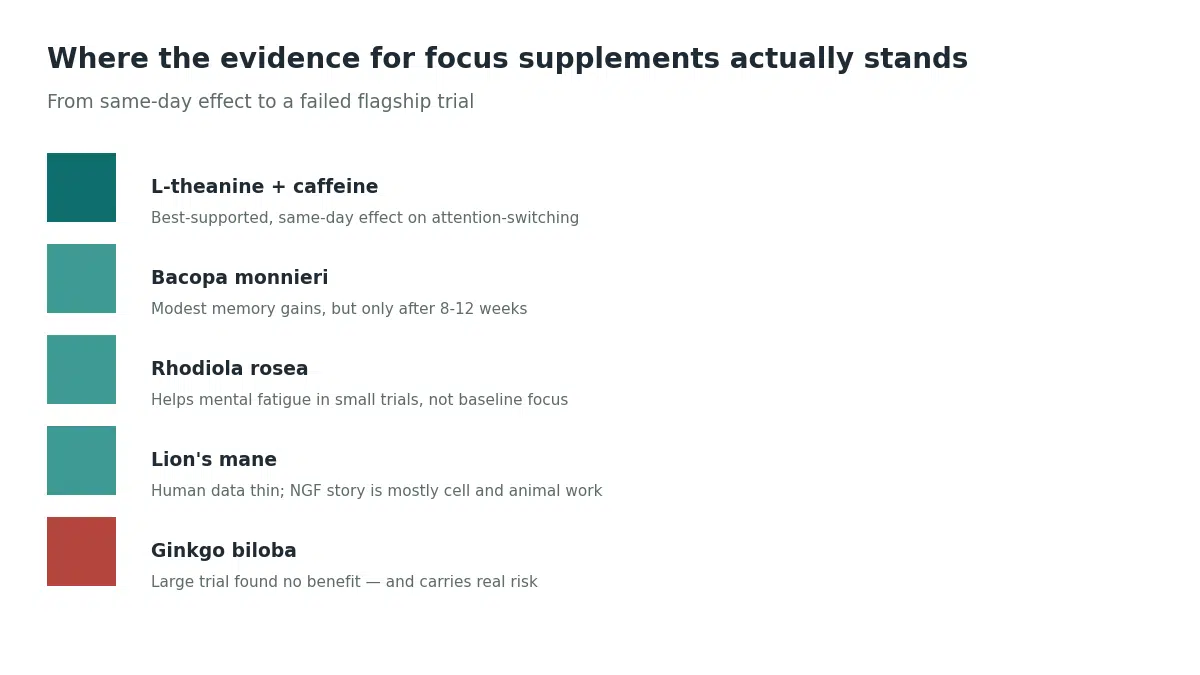
- L-theanine with caffeine has the strongest evidence for short-term attention, and it’s the only option here with a same-day effect.
- Ginkgo biloba failed its largest trial and carries the most significant safety profile, including bleeding and seizure risk.
- Rhodiola can cause serotonin syndrome combined with antidepressants, so check with your prescriber first.
- None of these supplements treats adult ADHD. Lifelong attention difficulties need proper assessment, not herbs.
First: Is This a Supplement Problem?
Poor concentration is a symptom, not a diagnosis. Several common causes are treatable, and some are serious. A supplement can take the edge off enough that you stop investigating.
See a doctor before reaching for a supplement if:
- Your focus or memory has declined noticeably over weeks or months, rather than fluctuating with sleep and stress[5]
- You’re getting lost in familiar places, struggling to find words, or others have noticed the change
- It arrived alongside low mood, loss of interest, or hopelessness, since depression impairs concentration substantially and treating it works
- You snore heavily and wake unrefreshed, since untreated sleep apnea is a common and very treatable cause
- You have numbness or tingling in hands and feet, which alongside fog can point to B12 deficiency
- You started a new medication recently
Blood tests for thyroid function, B12, iron, and blood glucose are cheap and rule out several fixable causes. That’s a better first step than a supplement stack.
Seek urgent care for sudden confusion, disorientation, or difficulty speaking. That’s a different problem entirely and needs emergency assessment.
Supplements to Improve Focus That Actually Have Evidence
L-Theanine With Caffeine
This is the best-supported option for short-term attention, and it’s the one thing on this page you’d notice the same day.
Caffeine blocks adenosine receptors, producing alertness along with the familiar jitteriness. L-theanine, an amino acid from tea leaves, appears to smooth that edge. Trials of the pair have reported improvements in attention-switching and accuracy on demanding tasks beyond what caffeine alone delivers.
Typical study doses pair roughly 100 mg of caffeine with 100–200 mg of L-theanine. Start at the lower end. Caffeine’s half-life is around five hours, so an afternoon dose meaningfully degrades sleep, which then costs you more concentration than the supplement bought.
The real limitation is that this is a stimulant strategy. Unlike supplements to improve focus that claim to build something over time, it doesn’t repair anything, tolerance develops, and it works best as an occasional tool rather than a daily dependency.
Omega-3 Fatty Acids
DHA and EPA are structural components of neuronal membranes, and the case for adequate intake is solid. The case for supplementing on top of a reasonable diet to sharpen focus in healthy adults is much weaker. Trials in cognitively normal people have been largely unimpressive.
Worth taking if you rarely eat oily fish. Not worth expecting a noticeable change in concentration next week.
Supplements to Improve Focus With Mixed Evidence
Bacopa Monnieri
Bacopa has repeatedly shown small improvements in memory acquisition and recall in trials, though effects on attention specifically are less consistent. It is not fast: studies typically run 8–12 weeks before anything shows.
Clinical doses sit around 300–450 mg daily of standardized extract, taken with food. Gastrointestinal upset, nausea, cramping, loose stools, is the most common reason people stop.
Rhodiola Rosea
Rhodiola has some trial support for mental fatigue specifically, shift workers, students in exam periods, rather than for baseline concentration in rested people. The trials are small and several were funded by extract manufacturers.
It has a stimulating effect within about half an hour, which means late dosing disrupts sleep. Morning only. The interaction section below matters particularly here.
Lion’s Mane
Lion’s mane is widely marketed on its effect on nerve growth factor. That work is largely in cell cultures and animals; whether the relevant compounds reach the human brain in meaningful amounts after a capsule is not established.
Human trials exist but are few and small. It’s reasonable to try, but treat the NGF story as a hypothesis rather than a demonstrated mechanism. If you do buy it, fruiting-body extracts contain more of the compounds of interest than mycelium grown on grain.
What the Evidence Doesn’t Support
Ginkgo Biloba
Ginkgo is the most-sold cognitive supplement and it’s the one with the clearest negative result. The Ginkgo Evaluation of Memory study, a large long-running trial, found it did not improve cognitive performance or prevent dementia. Memorial Sloan Kettering’s review notes that earlier positive findings were not confirmed in more recent trials.[1]
It also carries the most substantial safety profile of anything here: bleeding risk and a seizure signal, both covered below. Weak benefit alongside real risk is an unattractive trade.
A Note on Adult ADHD
None of the supplements to improve focus on this page treats ADHD, and none should be positioned as an alternative to assessment or prescribed treatment.
This matters because untreated adult ADHD carries real consequences for work, driving safety, relationships, and mental health, and effective treatment exists. Framing herbal options as the gentler choice with fewer side effects gets the comparison backwards: prescription stimulants have decades of trial data behind them, while the supplements here have never been shown to manage ADHD symptoms at all.
If lifelong difficulty with attention, organization, or impulsivity is affecting your life, seek a proper assessment. Supplements can sit alongside treatment if your clinician agrees. They are not a substitute for it, and delaying a diagnosis to trial herbs for six months is a poor bargain.
Drug Interactions Worth Checking
This is the section most articles about supplements to improve focus skip. Several of these compounds interact with common medications, and “natural” carries no protective meaning here.
Ginkgo Biloba
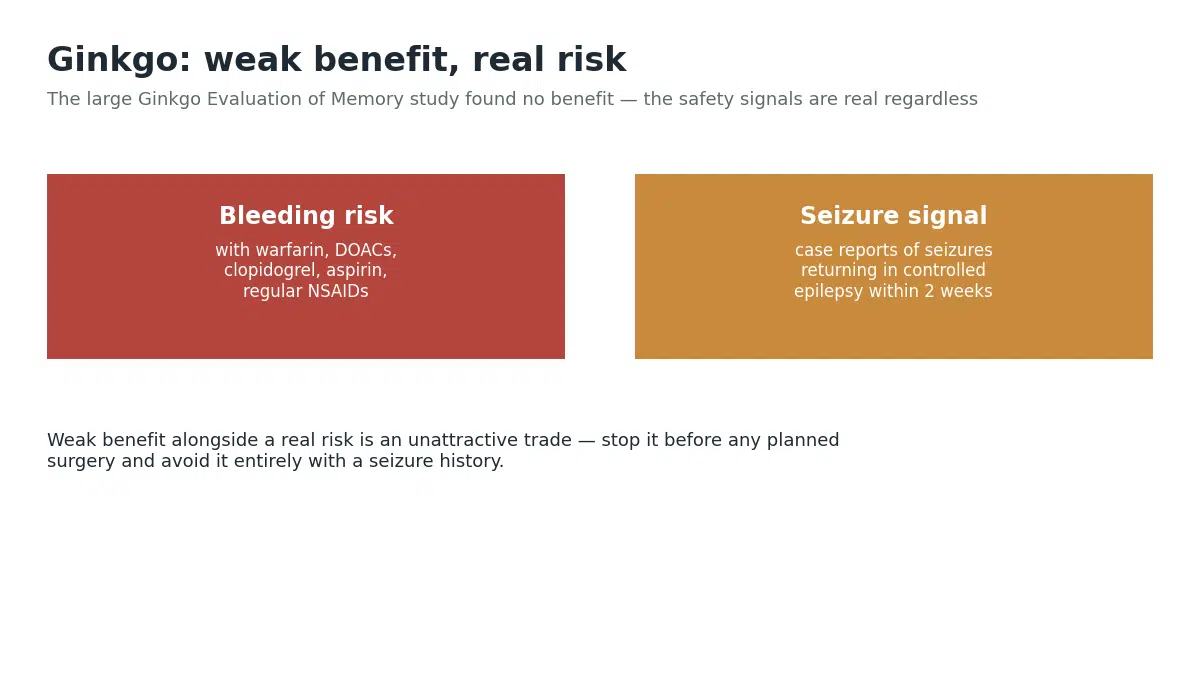
- Bleeding. Ginkgo is associated with increased bleeding risk alongside warfarin, DOACs, clopidogrel, aspirin, and regular NSAIDs. Stop it well before any planned surgery and tell your surgeon.[1]
- Seizures. Ginkgo preparations can contain ginkgotoxin, and case reports describe recurrent seizures in two previously well-controlled epilepsy patients within two weeks of starting an extract, resolving on discontinuation.[2] Avoid it if you have a seizure history, take anti-seizure medication, or take other drugs that lower the seizure threshold, which includes SSRIs, tricyclics, bupropion, antipsychotics, tramadol, and some antibiotics.
- It may also reduce the effectiveness of omeprazole and esomeprazole, and interact with some diabetes medications.
Rhodiola Rosea
- Antidepressants. A published case report describes a serotonin syndrome picture in a patient combining Rhodiola with paroxetine.[3] If you take an SSRI, SNRI, MAOI, or any other serotonergic medication, clear it with your prescriber first.
- CYP2C9. A commercial Rhodiola product has demonstrated inhibition of this liver enzyme, which handles warfarin among other drugs.[4] That’s a route to unpredictable blood levels.
- Its stimulant effect can also compound with caffeine and other stimulants.
Bacopa Monnieri
- Bacopa has cholinergic activity, so it may interact with anticholinergic medications and with cholinesterase inhibitors such as donepezil.
- It has been reported to affect thyroid hormone levels, which matters if you take levothyroxine. Mention it so your levels can be monitored.
- It may slow heart rate, relevant if you take rate-controlling medication or have bradycardia.
Caffeine and L-Theanine
L-theanine itself is well tolerated, though it can lower blood pressure slightly. Caffeine is the component with the interactions: it compounds with other stimulants, can worsen anxiety and palpitations, interacts with theophylline and some antibiotics, and is worth limiting if you have an arrhythmia or uncontrolled high blood pressure.
Omega-3 and Lion’s Mane
High-dose fish oil has a mild antiplatelet effect worth mentioning if you’re on anticoagulants or facing surgery. Lion’s mane has occasional reports of allergic and respiratory reactions, particularly in people with existing allergies or asthma.
Stacks and Pre-Formulated Blends
Combination products multiply the problem. Proprietary blends hide the dose of each ingredient, so neither you nor your pharmacist can assess the risk. Many also contain undisclosed stimulants. Choose products that state every ingredient amount, and take the label to your pharmacist if you’re on any regular medication. That’s a free, five-minute check.
Stop and seek advice if you notice a rapid or irregular heartbeat, unusual bruising or bleeding, a seizure, yellowing of the skin or eyes, severe or persistent headache, marked agitation or confusion, or a rash with swelling or breathing difficulty. Bring the bottle with you.
What Works Better Than Any Supplement
The unglamorous answer outperforms every one of the supplements to improve focus above, and it’s worth stating plainly because supplement articles tend to bury it.
Sleep is the single largest lever. Consistent short sleep degrades attention and working memory more than any supplement improves them, and the effect compounds across a week. Regular aerobic exercise has good evidence for cognitive function. Correcting an actual deficiency, iron, B12, vitamin D, thyroid hormone, produces changes no botanical will match; our guide to what B12 does in the body covers one of the commonest.
Beyond that: fewer simultaneous tasks, phone out of reach during deep work, and honest limits on alcohol, which degrades sleep quality even at modest intake.
Choosing Supplements to Improve Focus
Supplements aren’t approved for safety and efficacy before sale, so verification falls to you. Look for USP, NSF, or Informed Choice marks, which confirm the contents match the label and check for contaminants. Avoid proprietary blends. Check the extract is standardized and the dose matches what trials used, not a token amount.
Try one thing at a time for a defined period, eight weeks for the slower botanicals, and decide honestly whether anything changed. Stacking four supplements to improve focus at once makes it impossible to know what helped or what caused a side effect. If you’re weighing options for an older relative instead, our roundup of nootropic supplements for memory loss in seniors covers age-related decline, and our guide to supplements for brain fog and memory goes deeper on fog specifically.
FAQ
What are the best supplements to improve focus and concentration in adults?
L-theanine combined with caffeine has the strongest evidence for short-term attention, and it’s the only option here you’d notice the same day. Around 100 mg caffeine with 100–200 mg L-theanine matches typical study doses.
Bacopa monnieri has modest support for memory over 8–12 weeks. Everything else is preliminary, and ginkgo has largely failed its biggest trial.
Do any supplements treat adult ADHD?
No. None of these has been shown to manage ADHD symptoms, and they shouldn’t replace assessment or prescribed treatment.
Untreated adult ADHD affects work, driving safety, and mental health, and effective treatment exists. If attention difficulties have been lifelong and are affecting your life, get assessed rather than trialing herbs for months.
Which supplements to improve focus interact with antidepressants?
Rhodiola is the main concern. A case report describes serotonin syndrome when it was combined with paroxetine, so check with your prescriber before taking it with any SSRI, SNRI, or MAOI.
Ginkgo is also worth raising, since SSRIs and tricyclics lower the seizure threshold and ginkgo has its own seizure signal. Some antidepressants additionally increase bleeding risk, which ginkgo compounds.
Is ginkgo biloba safe?
It has the most significant safety profile of the options here. It increases bleeding risk with anticoagulants, antiplatelets, and NSAIDs, and should be stopped before surgery.
There’s also a seizure signal: preparations can contain ginkgotoxin, and case reports describe seizures returning in well-controlled epilepsy patients within two weeks of starting an extract. Avoid it with a seizure history or seizure-threshold-lowering medication. Given the negative efficacy results, the risk-benefit case is poor for most people.
How long until I notice anything?
L-theanine with caffeine works within an hour. Rhodiola’s stimulating effect appears within about 30 minutes.
Bacopa needs 8–12 weeks, and omega-3 and lion’s mane are cumulative rather than acute. Trial one thing at a time for a defined period, then decide.
When should poor concentration be checked by a doctor?
When it’s a clear decline over weeks or months rather than a fluctuation, when others have noticed, when you’re losing words or getting lost in familiar places, or when it comes with low mood, heavy snoring and unrefreshing sleep, or tingling in the hands and feet.
Thyroid problems, B12 deficiency, iron deficiency, depression, sleep apnea, and medication side effects all impair concentration and all respond to treatment. Blood tests are cheap. Sudden confusion or difficulty speaking needs emergency care.
The Short Version
If you want one of these supplements to improve focus to try first, L-theanine with caffeine is the best-supported and the only one with a same-day effect. Bacopa is worth an eight-week trial for memory. Ginkgo is worth skipping.
Before any of it, rule out the treatable causes, and take your medication list to a pharmacist if you take anything regularly. Then fix your sleep, because nothing on this page competes with it.
SOURCESOur Editorial Standards
HealthMagHub is built on primary sources: peer-reviewed research, clinical practice guidelines, and health agencies such as the NIH, CDC, and FDA. Read our editorial standards to see how we research, cite, and update our articles.
- Memorial Sloan Kettering Cancer Center. Ginkgo: herb monograph, including the Ginkgo Evaluation of Memory study. mskcc.org
- Granger AS. Ginkgo biloba precipitating epileptic seizures. Age and Ageing. pubmed.ncbi.nlm.nih.gov
- The interaction of Rhodiola rosea and antidepressants: a case report. pubmed.ncbi.nlm.nih.gov
- Thu OKF, Spigset O, Hellum B. Noncompetitive inhibition of human CYP2C9 in vitro by a commercial Rhodiola rosea product. ncbi.nlm.nih.gov
- National Institute on Aging. Memory, Forgetfulness, and Aging. nia.nih.gov