


The alpha lipoic acid dosage for nerve pain used in almost every serious trial is 600 mg a day. That figure is real. What usually goes unmentioned is that the largest and longest trial of oral ALA in diabetic neuropathy did not meet its primary endpoint.
That doesn’t make ALA useless. It does mean the honest version of this topic is more qualified than supplement marketing suggests, and that a few safety details deserve more attention than they usually get.
Here’s what the trials found, where the 600 mg figure comes from, how the forms differ, and the question that matters more than any of it: what’s causing the nerve damage in the first place.
- 600 mg daily is the dose used in the major trials, not a threshold that unlocks a stronger effect at higher amounts.
- The largest, longest trial (NATHAN 1, 4 years, 460 people) missed its primary endpoint, though some secondary measures improved.
- Serious adverse events were more common on ALA than placebo in that trial, at 38.1% versus 28.0% over 4 years.
- Finding the underlying cause of nerve damage, whether diabetes, B12 deficiency or alcohol, matters more than the supplement itself.
First: Neuropathy Is a Symptom, Not a Diagnosis
Before any supplement, the cause needs identifying. Peripheral neuropathy has a long differential, and several causes are treatable in ways that actually reverse the damage:
- Diabetes and prediabetes: by far the commonest cause, and glucose control is the intervention with the strongest evidence behind it
- B12 deficiency: genuinely reversible if caught early, and permanent if not. Our guide to what B12 does covers why metformin and acid-suppressing drugs make this more likely
- Alcohol, thyroid disease, kidney disease, and several medications including chemotherapy agents and some antibiotics. Our guide to what causes tingling hands and arms maps which symptom pattern points to which cause
See a doctor rather than self-treating if symptoms came on suddenly, affect one side only, involve muscle weakness rather than just sensation, are spreading upward from the feet, or if you have a foot ulcer or wound that isn’t healing. Those patterns point away from ordinary diabetic neuropathy and need assessment.
What the Alpha Lipoic Acid Trials Actually Found
Short-term symptom relief is where the evidence is strongest. Trials of intravenous ALA over about three weeks, and shorter oral trials of a few weeks, have reported improvements in burning, tingling and numbness compared with placebo.[2] That’s a genuine and repeated finding.
The long-term picture is weaker. NATHAN 1 randomized 460 people with mild-to-moderate diabetic polyneuropathy to 600 mg of oral ALA daily or placebo for four years. It’s the longest and largest trial of its kind.[1]
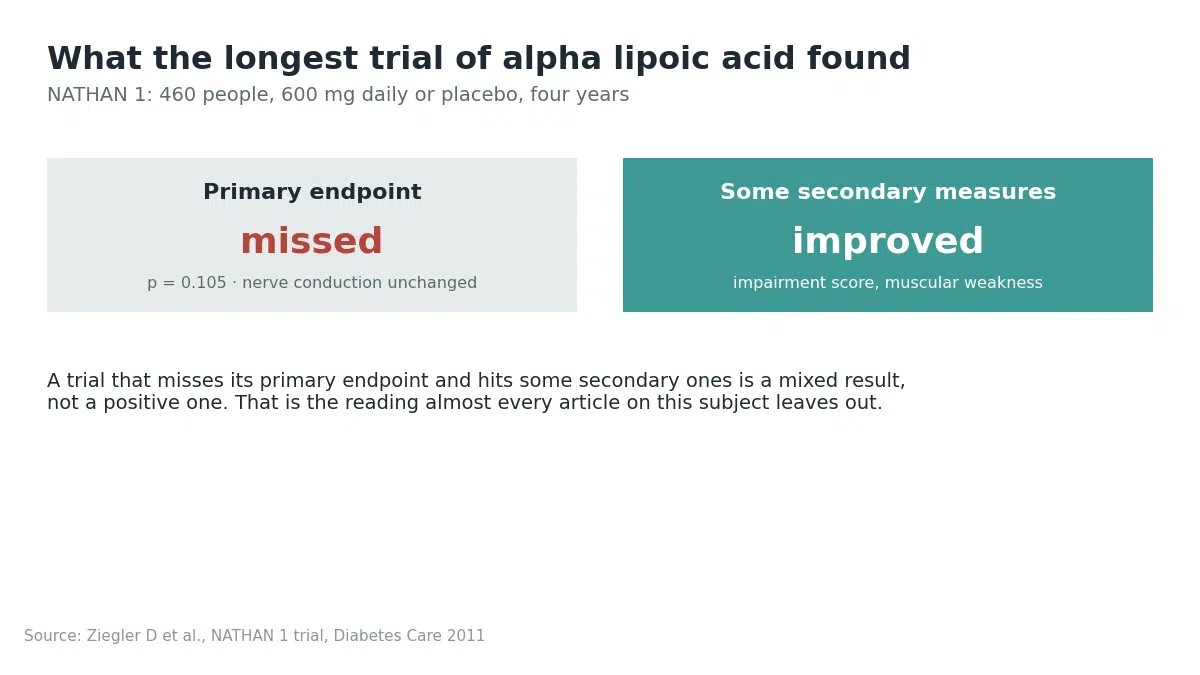
The change in the primary composite endpoint showed no significant difference between groups (p = 0.105). Nerve conduction and quantitative sensory testing did not differ either.
Some secondary measures did favor ALA. The Neuropathy Impairment Score improved significantly, as did the muscular weakness subscore, and more people on ALA were classified as responders while more on placebo progressed.[3] The authors described this as a clinically meaningful improvement in neuropathic impairments.
But a trial that misses its primary endpoint and hits some secondary ones is a mixed result, not a positive one. That’s the honest reading, and it’s the reading almost every article on this subject leaves out.
Alpha Lipoic Acid Dosage for Nerve Pain: Where 600 mg Comes From
600 mg daily is the dose used across the major trials, including NATHAN 1. It isn’t a threshold that unlocks an effect. It’s simply the amount researchers standardized on, and there’s no good evidence that going higher does more.
Doses above 600 mg have been used in obesity research at 1,200 to 1,800 mg, with more side effects and no clear extra benefit for nerves. Taking more is not a shortcut.
On timing: absorption is meaningfully higher on an empty stomach, roughly 30 minutes before eating or two hours after. Food genuinely reduces how much reaches your bloodstream. But if an empty stomach causes nausea, taking it with a small snack and actually continuing beats taking it perfectly and stopping.
R-ALA and Standard ALA: What’s Actually Established
Alpha lipoic acid exists as two mirror-image forms. The R-form occurs naturally in the body; the S-form is a by-product of manufacturing. Most supplements are a racemic 50/50 mixture of both.
R-ALA does show higher bioavailability in absorption studies. What doesn’t exist is a body of clinical trials showing R-ALA produces better outcomes for neuropathy. The trials that found symptom benefit, including NATHAN 1, used the standard racemic form.
So the honest position: R-ALA is absorbed better and costs more, and nobody has demonstrated that this translates into more relief. If you buy it, buy it knowing that.
Safety, Including the Part Usually Left Out
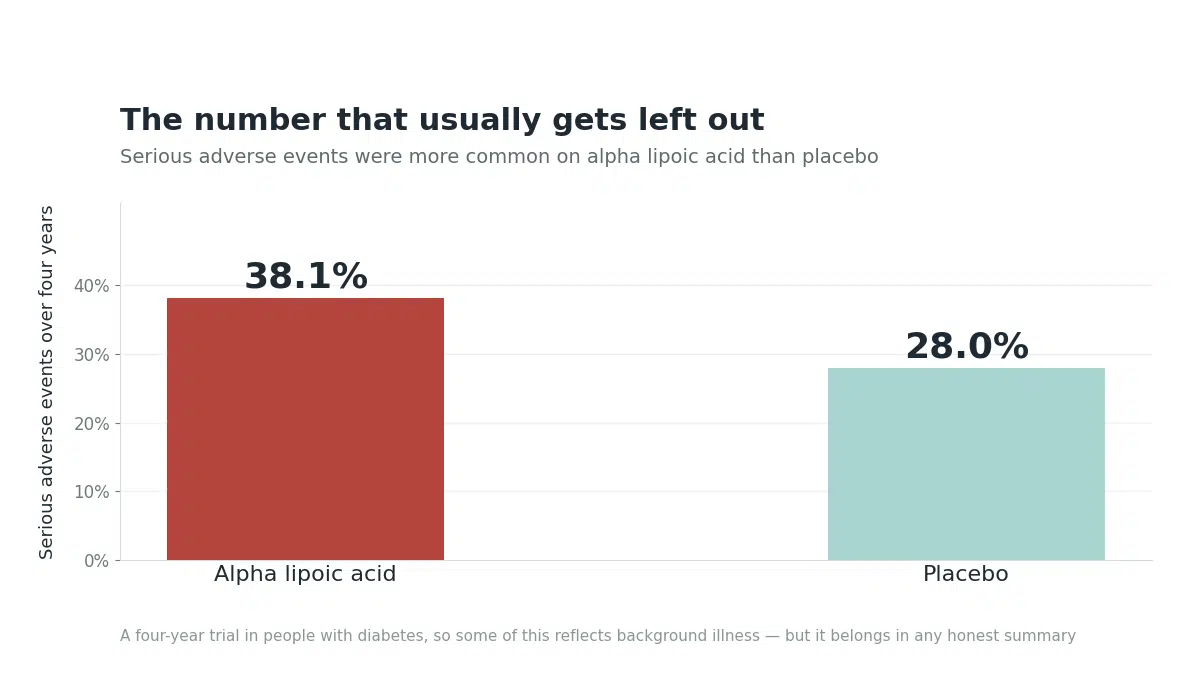
Serious adverse events were more common on ALA than placebo in NATHAN 1, at 38.1% versus 28.0% over four years.[1] The authors still judged it well tolerated overall, and this was a four-year trial in people with diabetes, so some of that reflects background illness. But it belongs in any honest summary, and it’s routinely omitted.
Low blood sugar is the interaction that matters most. ALA improves glucose uptake, so combined with insulin or sulfonylureas it can push blood sugar too low.[2] If you take either, discuss this before starting and monitor more closely at first. Watch for shakiness, sweating, confusion and sudden fatigue.
Other interactions worth flagging: thyroid hormone replacement, chemotherapy agents (clear any antioxidant with your oncologist, since the theoretical concern is interference with treatment), and anticoagulants.
Common side effects are digestive: nausea, cramping, indigestion. Usually early on and often improved by splitting the dose or taking it with a small snack. Skin rash is less common but documented; stop if it appears.
One further caution: ALA is a supplement, so nobody checks what’s in the bottle before it’s sold. Look for USP, NSF or ConsumerLab certification. Our look at red yeast rice covers the same regulatory gap in more detail.
What Helps More Than the Supplement
Blood glucose control. For diabetic neuropathy this is the intervention with the strongest evidence for slowing progression, stronger than any supplement. Our guide to reading a cereal label with diabetes covers one practical corner of that.
Foot care. Reduced sensation means injuries go unnoticed. Daily foot checks and properly fitted shoes prevent ulcers, which are the complication that actually costs people limbs.
Movement. Regular walking or other low-impact activity supports circulation and glucose control at once.
Alcohol. It’s directly neurotoxic and a cause of neuropathy in its own right. Cutting back matters more than most supplement decisions.
And there are prescription options with better evidence for neuropathic pain specifically: duloxetine, pregabalin and others. Worth discussing rather than enduring symptoms. Our guide to supplements for nerve pain in the feet and hands covers the other supplement options alongside these.
Common Questions About Alpha Lipoic Acid Dosage for Nerve Pain
What is the usual alpha lipoic acid dosage for nerve pain?
600 mg daily is what the major trials used, including the four-year NATHAN 1 study. Higher doses haven’t shown extra benefit for nerves and cause more side effects.
Does it actually work?
Short-term trials show symptom improvement. The longest oral trial missed its primary endpoint while improving some secondary measures, a mixed result rather than a clear positive.
When should I take it?
On an empty stomach, about 30 minutes before eating, since food reduces absorption. If that causes nausea, a small snack is a reasonable trade; consistency matters more than perfect timing.
Is R-ALA better?
It’s absorbed better. No trial has shown it produces better neuropathy outcomes, and the studies that found benefit used the standard racemic form.
Can I take it with diabetes medication?
Only with your prescriber’s knowledge. ALA lowers blood sugar, so alongside insulin or sulfonylureas it can cause hypoglycemia. Monitor more closely when starting.
How long before I’d know if it’s helping?
Short trials measured symptom change over three to five weeks. If nothing has changed after about three months at 600 mg, it probably isn’t going to, and that’s worth raising with your doctor rather than escalating the dose.
The Bottom Line
The alpha lipoic acid dosage for nerve pain worth trying is 600 mg daily, taken on an empty stomach. Reasonable if your doctor agrees and you know what you’re getting: possible short-term symptom relief, unproven long-term benefit, and a real interaction with diabetes medication.
What matters more is finding out why the nerves are damaged. Glucose control, a B12 check, an honest look at alcohol, and daily foot care all do more than any capsule.
And if the symptoms are new, one-sided, spreading, or involve weakness, that’s an appointment, not a supplement.
SOURCESOur Editorial Standards
HealthMagHub is built on primary sources: peer-reviewed research, clinical practice guidelines, and health agencies such as the NIH, CDC, and FDA. Read our editorial standards to see how we research, cite, and update our articles.
- Ziegler D, Low PA, Litchy WJ, et al. Efficacy and Safety of Antioxidant Treatment With α-Lipoic Acid Over 4 Years in Diabetic Polyneuropathy: The NATHAN 1 Trial. Diabetes Care. 2011;34(9):2054-2060. pubmed.ncbi.nlm.nih.gov
- National Center for Complementary and Integrative Health. Diabetes and Dietary Supplements. nccih.nih.gov
- Ziegler D, et al. Predictors of improvement and progression of diabetic polyneuropathy following treatment with α-lipoic acid for 4 years in the NATHAN 1 trial. Journal of Diabetes and Its Complications. pubmed.ncbi.nlm.nih.gov